- Messages
- 1,103
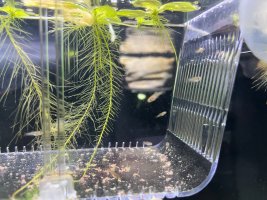
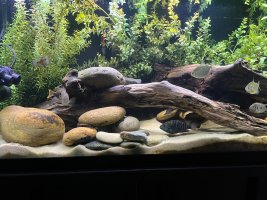
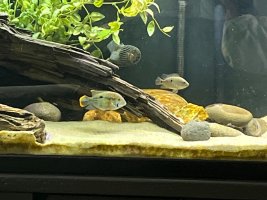
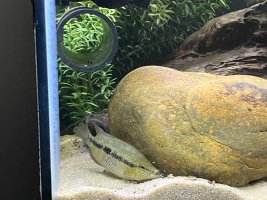
In the fish department my grand acomplishment was checking on my gold rams eggs (last time they were eaten after 1 day today they are wriggling so hopefully they won't eat them tonight) and to take these two pictures:


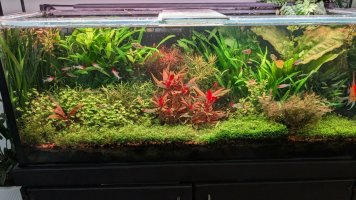
What is the red plant in the centerUsual weekly water change on this tank along with the usual weekly trimming. I started a few months ago with a bit of pearl weed i had designs to grow a carpet along the front. Then a couple months ago I bought one pot of Monte carlo. Now thats starting to run along the left, I'm gradually ripping up the pearl weed to make way for the MC lol. Although I actually don't mind the pearl weed as a carpet when trimmed but up close the MC does look better.
The rotala wallichii always looks the worst after a haircut, although I admit I still haven't got close to working out what makes that plant tick.
Also started my DIY ferts a few weeks ago with the various chemical salts. So I think the tank is still adjusting/balancing to that change too.


Alternanthera Reineckii mini, otherwise known as AR MiniWhat is the red plant in the center


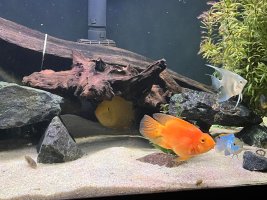


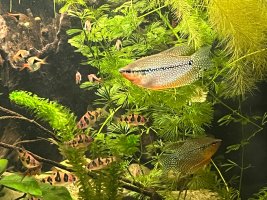
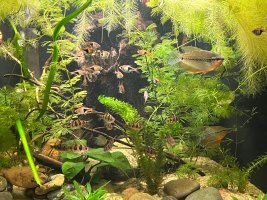
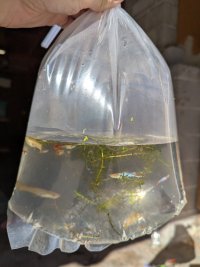
What type of Killifish do you have?Moving some killifish around.
a. Funge...What type of Killifish do you have?
Those have good coloring. Have often concidered getting Killi, have yet to have a success breeding with a regular egg layers let along the requirements for the Killi. Have you been successfull in breeding them? Can you breed without the parents passing?a. Funge...
That is great you are trying to breed them. Very interested in how it goes. If you could post a few updates on your progress would much apprecate.Thanks! I am new to killifish and these are my first pair. They are known to be good breeders and live for several years. I am attempting to breed them and have learned much from this site as well as others on the internet. Check out these sources and good luck
Will do...JimThat is great you are trying to breed them. Very interested in how it goes. If you could post a few updates on your progress would much apprecate.


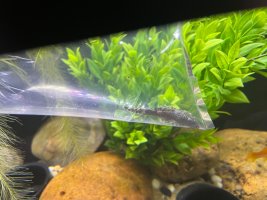

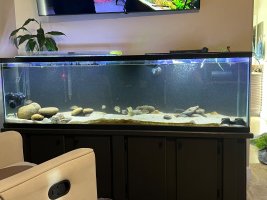

Kribensis are not from Lake Victoria, they are from West Africa with completely different water parameters.a breeding pair of Kribensis cichlids…. While they are lake Victorian, I’ve previously read and he told me they should be fine in a Tanganyikan tank.
Well crud…. Wonder what I got it mixed up with, I asked if it was from lake Victoria and could go in my Tanganyikan tank and named all the fish I have in it…. I can’t get my water below 7.2 in any of my tanks. Need to figure out if I’m taking them back or setting up yet another tank and seeing how they do in 7.2 phKribensis are not from Lake Victoria, they are from West Africa with completely different water parameters.

There is a victorian cichlid called a rock kribensis. Completely different fish to the west african kribensis most of us think of...the rock kribensis is a polygamous, maternal mouthbrooder like most rift lake cichlids.Well crud…. Wonder what I got it mixed up with, I asked if it was from lake Victoria and could go in my Tanganyikan tank and named all the fish I have in it…. I can’t get my water below 7.2 in any of my tanks. Need to figure out if I’m taking them back or setting up yet another tank and seeing how they do in 7.2 ph
Thank you! I might have came across that species when searching the internet for Tanganyikan and Victorian fish that could go in my setup and not realizing the Rock Kribensis was a different species than the regular Kribensis... Or I could have just completely screwed up and misremembered what was what. Either way, I appreciate the info!There is a victorian cichlid called a rock kribensis. Completely different fish to the west african kribensis most of us think of...the rock kribensis is a polygamous, maternal mouthbrooder like most rift lake cichlids.
EDIT; Here is the aforementioned rock kribensis...very different fish to the real kribensis for sure; Yellow Rock Kribensis (Paralabidochromis sauvagei) - shop Imperial Tropicals
My experience with kribs is that they are flexible but a very hard gh is really pushing the limits. Not sure they can breed in such hard water but if they can then even if they only last a few months you will still end up with too many. My personal experience was to keep them in tap which is gh 6 (tds 120 or so); which is still on the soft side of the scale.Thank you! I might have came across that species when searching the internet for Tanganyikan and Victorian fish that could go in my setup and not realizing the Rock Kribensis was a different species than the regular Kribensis... Or I could have just completely screwed up and misremembered what was what. Either way, I appreciate the info!
I'm stopping at the LFS on my way home today to see if they know or can find out where these fish originated from. I'm reading that Kribensis Cichlids in the hobby are rarely wild caught and almost always tank bred. My LFS receives shipments almost exclusively from the Los Angeles area, where most municipalities have hard water (7.5-8.5 PH, Hard-Very Hard GH, Moderately Hard-Very Hard KH, 150-300 TDS). If they were bred at his distributor in LA or a local farm, I'll feel much better about keeping them and seeing how they do. If not, I'll take them back and hopefully someone who is willing to use RO water will purchase them next.
On a positive note, the Central American cichlids I moved to the 40-gallon are working out their hierarchy, but not interested in the swordtails in the slightest so far. They seem to be enjoying this tank more than the 125, where the Green Terror kept them on high alert constantly. Moving around the hiding caves in the 125 also reset the hierarchy in that tank slightly. The GT is still the most boisterous cichlid in the tank, but the larger salvini isn't hiding as much and the pictus catfish are out and about more.
My tap is 7.4, 5 degrees GH, 3 degrees KH, around 120 TDS. I have aragonite in this tank and I occasionally treat with fritz cichlid salt. This paticular tank is at 8.0 ph, 10-12 degrees hardness GH and KH on average, and 300-400 TDS between right after a water change and right before the next. My hope is if they were tank bred in LA, they may have came from harder water than what I actually have in this tank now.My experience with kribs is that they are flexible but a very hard gh is really pushing the limits. Not sure they can breed in such hard water but if they can then even if they only last a few months you will still end up with too many. My personal experience was to keep them in tap which is gh 6 (tds 120 or so); which is still on the soft side of the scale.
Well this is a perfect reason to buy another 20 long and use tap water for the kribsMy tap is 7.4, 5 degrees GH, 3 degrees KH, around 120 TDS. I have aragonite in this tank and I occasionally treat with fritz cichlid salt. This paticular tank is at 8.0 ph, 10-12 degrees hardness GH and KH on average, and 300-400 TDS between right after a water change and right before the next. My hope is if they were tank bred in LA, they may have came from harder water than what I actually have in this tank now.
If not they'll be going back to the store, or I could get them another tank too... Lots of used tanks in my area for cheap and I have extra substrate/ decor/ filters etc. It'd be a good excuse to add another tank when I told myself I'd wait until next year before planning any more tanks lol. (I'm up to 8 now) Just running out of places to put them where I'd actually get to enjoy watching them. Already have them in the living room, dining room, bedroom and next to the bathtub. Anywhere else and it'd be the type of tank I occasionally stand in front of for a few minutes to check them out and then sit somewhere else.


3 days...Oh no! How long have you had them in QT?
Is the qt tank newly setup - i.e, could there be ammonia creeping in - i found kuhli to be very sensitive to bad conditions - on the other hand once settled in they live forever - i have some 7 and 8 year old ones in my blackwater aquarium.3 days...
Qt is cycled. Has been running with fish for quite a while. It's only a temp qt.Is the qt tank newly setup - i.e, could there be ammonia creeping in - i found kuhli to be very sensitive to bad conditions - on the other hand once settled in they live forever - i have some 7 and 8 year old ones in my blackwater aquarium.
 Moving cross country from Seattle to the middle of nowhere Michigan. Literally pretty much the middle of flatsville My goldfish and Betta genetics research is all gone. Technically can't even have an aquarium in the house we're renting for the next year But, I'm sneaking in a ten and 8 bowfront I can easily have in bedrooms. I'll have the male Betta I gave to the kiddo. He's a mess of genetics, but at least unique. Then I have my blonde colony along with males from the other strains. But I have the 20 long and the nice 20 std in storage for the day I can redo those tanks how I always wanted them in a permanent setting. Pond is going to be a lot larger and multiple. Breeding will be moving towards pond fish, ancestral food plants and smaller domesticated food animals.