I would guess, I might be one of the ones you've read that advocates running no ferts. I have very specifically never used nitrogen or
phosphate supplements. My water from the tap however does not contain enough
calcium,
magnesium, or
potassium to grow at the rate I do, or enough bicarbonate to maintain
pH for more than a few days once the tank is in growth stages and has enough stocking to provide the nitrogen and phosphates. I do supplement iron at a very low dose every other
water change now too. I haven't had any serious micro nutrient deficiencies otherwise, though my plants are definitely never "perfect".
If one has very soft water like me, the no ferts approach still requires
buffers(additive of minerals). Conversely having just "hard water" doesn't always mean the minerals are balanced, and not all plants do great at every pH so it may need to be softened. Nitrogen and phosphate can fairly easily be achieved with stocking and food selection, but that can limit your choices too. If you are in the lucky situation where your
tap water is actually ideal for minerals with an average pH in the mid 7 range, you could achieve my results with very low effort, if it's too hard or too soft, you would need to figure out what it lacks and how to adjust the chemistry. As ruud said, you need to be able to embrace the decay stages, and the imperfections that come along with the method, this is definitely truth, I leave a lot of dead plant matter in the tank, removing plants is removing the minerals and naturally occurring fertilizers that made them. When I have to trim, I recognize that I'm removing those things and have over time figured out what that amounts to.
On the same topic, average fertilizer packages are made for average, ideal water. If I were to go to common practices, changing water more frequently and dosing those packages, I would still need a buffer package. Fertilizers and buffers need to be looked at in many cases as separate macro fertilizers, micro fertilizers,
KH buffers and gh buffers. A minimum of 4 different product packages to achieve a balance as required. An example, the
seachem flourish line embraces that, with 8 different expensive products meant to work together, though many are only familiar with one or two that are usually stocked at the store. The reason some fertilizers work so well is that they over dose many of the micros and macros, expecting the aquarium to be purged by water changes, and growth of plants vs algae to be balanced by limiting light input. That method works too.
An aquarium is not natural, and will need to be "limited" to balance plant vs algae in either light, nitrogen, or phosphate. You can bump the minimum in any of those three areas and have minimal damage to the plants, while not growing too much algae. You will often see the planted tank people talk about limiting light as the first most common option, followed by nitrogen, and the least common is phosphate limitation. Light is the easiest to balance and is the primary energy source for plant growth, it gets turned on and off every day and can be easily set with a timer so it's an easy fix. But, maybe you like to see the fish, or maybe certain plants prefer an equatorial (12 hour) light cycle, using a dim light output over longer time can sometimes work, but plant coloration may change too. Nitrogen is easy to limit if the primary input of nitrogen is daily or up to weekly dosing of fertilizers in a low stocked tank. The nitrogen added by fertilizer can be easily overwhelmed in moderate to heavy stockings so more frequent water changes and frequent dosing become necessary to limit nitrogen as natural production increases. Phosphate can be limited just as nitrogen (fertilizers are designed with more of one or the other), or in the case of a "no ferts" tank, nitrogen will likely be produced significantly faster than phosphate so this becomes the limiting factor.
My system has turned out to be phosphate limited. I use 10-11 hours of light at moderately high intensity plus twilight, sunset and sunrise effects modes. In this section I will be using testing numbers based on testable phosphates and nitrogen (as
nitrate) as indicated by the inaccurate but consistent API
test kits. By feeding the variety of food I usually stock, I know through allot of water testing and tracking over the years that I generate about 80 parts nitrate to one part phosphate(after plant growth). With .25
ppm phosphate available, the plants I grow will do ok. At .25 ppm phosphate I have about 20 ppm nitrate. My best growth occurs at 40 ppm nitrogen and .5 ppm phosphate. Now here's the problem, that I don't let be my problem: I have to consistently run my tanks up to 60-80 ppm nitrate before changing water, sensitive fish are said to dislike these levels, but I have not personally had issues with fish life or longevity with the species I stock. Some would say this means my method limits stocking and I completely agree. I'm not going to do trial and error to see if I can get a
discus to survive this, that's not me. I keep a variety of
tetra, catfish and endler as well as various shrimp and snails and those fish keep me pretty content. I run a planted Tanganyikan tank pretty similarly and the multis and calvus are also thriving, but I do not stock the "sensitive" species for the biotopes, I stock what I think is attractive for the application. Cost wise, I think I use a pound of two potassium bicarbonate each year, and similar amounts of calcium chloride and magnesium sulfate as my buffers, in my Tanganyikan tanks I use some sodium bicarbonate. Annually for a few hundred gallons of tanks, close to $50. But I don't do it for the cost, I started out trying to do it the normal way and it didn't work, as I figured out my deficiencies one by one my method came to be and once I solved it, I ran with it. In the off season (I'm very busy during the school year and especially baseball season)I get around on the forum using the aquarium water specific knowledge I gained and my chemistry and problem solving background helping others solve those problems.
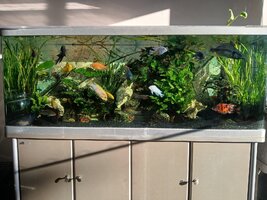
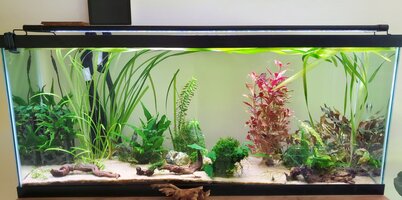
One of the most satisfying parts of the hobby to me is the slowest, made slower by limiting nutrients. I love watching a tank go from sparse and new, to lush and dirty. Right now I have my 125 as an example of that as it's still finding itself. Here a years growth.


I'm certain better results could be achieved faster with a light limiting, fertilized method, but this method works for me. A whole lot of this question you originally posed comes down to what will work for you?