Challenges and limitations of "no fertilizer" planted tanks?

saintabyssal

New Member
Member
Messages
5
I've heard a lot about people setting up aquaria to function as miniature ecosystems that can function with few artificial inputs like fertilizer. This naturalistic approach to fishkeeping appeals to me a lot more than relying on expensive products, frequent maintenance, and "artificial life support" more generally. That being said, I think most aquarists with planted tanks use some kind of chemical fertilizer rather than relying solely on their water chemistry and fish waste. That makes me concerned about whether or not the "natural" approach is sustainable or so limiting as to suck the fun out of the hobby.

So, in your opinion or experience what are the challenges and limitations of trying to run a planted aquarium without using chemical fertilizers?
 

Advertisement
Hardest part is keeping it going after several years. It's easy enough to set up a planted tank with just dirt as the fertilizer. It's harder to set it up in a way where the mulm can accumulate and become new fertilizer.

Funny enough, an enclosed box of water that's only in the double digits of gallons, full of chronically immersed plant growth, and has little algae is actually pretty unnatural and needs some amount of "unnatural" intervention to keep it going.
 

Advertisement
You can have fun with such an approach, provided you run the tank in low energy modus, keep the fish density very low, and embrace the decaying part of life.

All of this is actually in line with minimal intervention.

I do advocate 2, 3 or 4 interventions with large water changes a year to avoid water parameters drifting away from the original state.
 
20240513_155824.jpg
No soil, no ferts ever.
 
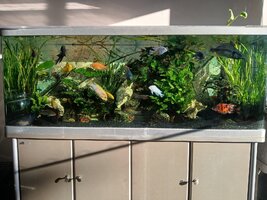
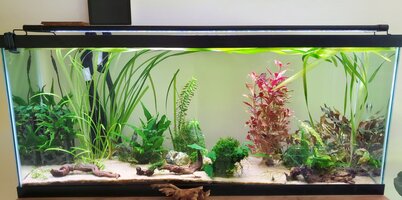
I don't use ferts or Co2, and have a sand substrate. This 55g has various grasses, crypts, Süsswassertang, java ferns, anubias, etc. Plants that have few requirements and are generally easy to grow. It looks quite empty in this picture, but it is quite heavily stocked with cory, otto and whiptail catfish, along with a school of ember tetras and a couple hundred cherry shrimp. I have high nitrates because of it, but I do 15 gallon water changes twice a week, which seems to keep things balanced.
 

Attachments

  • planted55g.jpg
    planted55g.jpg
    659.1 KB · Views: 44
I would guess, I might be one of the ones you've read that advocates running no ferts. I have very specifically never used nitrogen or phosphate supplements. My water from the tap however does not contain enough calcium, magnesium, or potassium to grow at the rate I do, or enough bicarbonate to maintain pH for more than a few days once the tank is in growth stages and has enough stocking to provide the nitrogen and phosphates. I do supplement iron at a very low dose every other water change now too. I haven't had any serious micro nutrient deficiencies otherwise, though my plants are definitely never "perfect".

If one has very soft water like me, the no ferts approach still requires buffers(additive of minerals). Conversely having just "hard water" doesn't always mean the minerals are balanced, and not all plants do great at every pH so it may need to be softened. Nitrogen and phosphate can fairly easily be achieved with stocking and food selection, but that can limit your choices too. If you are in the lucky situation where your tap water is actually ideal for minerals with an average pH in the mid 7 range, you could achieve my results with very low effort, if it's too hard or too soft, you would need to figure out what it lacks and how to adjust the chemistry. As ruud said, you need to be able to embrace the decay stages, and the imperfections that come along with the method, this is definitely truth, I leave a lot of dead plant matter in the tank, removing plants is removing the minerals and naturally occurring fertilizers that made them. When I have to trim, I recognize that I'm removing those things and have over time figured out what that amounts to.

On the same topic, average fertilizer packages are made for average, ideal water. If I were to go to common practices, changing water more frequently and dosing those packages, I would still need a buffer package. Fertilizers and buffers need to be looked at in many cases as separate macro fertilizers, micro fertilizers, KH buffers and gh buffers. A minimum of 4 different product packages to achieve a balance as required. An example, the seachem flourish line embraces that, with 8 different expensive products meant to work together, though many are only familiar with one or two that are usually stocked at the store. The reason some fertilizers work so well is that they over dose many of the micros and macros, expecting the aquarium to be purged by water changes, and growth of plants vs algae to be balanced by limiting light input. That method works too.

An aquarium is not natural, and will need to be "limited" to balance plant vs algae in either light, nitrogen, or phosphate. You can bump the minimum in any of those three areas and have minimal damage to the plants, while not growing too much algae. You will often see the planted tank people talk about limiting light as the first most common option, followed by nitrogen, and the least common is phosphate limitation. Light is the easiest to balance and is the primary energy source for plant growth, it gets turned on and off every day and can be easily set with a timer so it's an easy fix. But, maybe you like to see the fish, or maybe certain plants prefer an equatorial (12 hour) light cycle, using a dim light output over longer time can sometimes work, but plant coloration may change too. Nitrogen is easy to limit if the primary input of nitrogen is daily or up to weekly dosing of fertilizers in a low stocked tank. The nitrogen added by fertilizer can be easily overwhelmed in moderate to heavy stockings so more frequent water changes and frequent dosing become necessary to limit nitrogen as natural production increases. Phosphate can be limited just as nitrogen (fertilizers are designed with more of one or the other), or in the case of a "no ferts" tank, nitrogen will likely be produced significantly faster than phosphate so this becomes the limiting factor.

My system has turned out to be phosphate limited. I use 10-11 hours of light at moderately high intensity plus twilight, sunset and sunrise effects modes. In this section I will be using testing numbers based on testable phosphates and nitrogen (as nitrate) as indicated by the inaccurate but consistent API test kits. By feeding the variety of food I usually stock, I know through allot of water testing and tracking over the years that I generate about 80 parts nitrate to one part phosphate(after plant growth). With .25 ppm phosphate available, the plants I grow will do ok. At .25 ppm phosphate I have about 20 ppm nitrate. My best growth occurs at 40 ppm nitrogen and .5 ppm phosphate. Now here's the problem, that I don't let be my problem: I have to consistently run my tanks up to 60-80 ppm nitrate before changing water, sensitive fish are said to dislike these levels, but I have not personally had issues with fish life or longevity with the species I stock. Some would say this means my method limits stocking and I completely agree. I'm not going to do trial and error to see if I can get a discus to survive this, that's not me. I keep a variety of tetra, catfish and endler as well as various shrimp and snails and those fish keep me pretty content. I run a planted Tanganyikan tank pretty similarly and the multis and calvus are also thriving, but I do not stock the "sensitive" species for the biotopes, I stock what I think is attractive for the application. Cost wise, I think I use a pound of two potassium bicarbonate each year, and similar amounts of calcium chloride and magnesium sulfate as my buffers, in my Tanganyikan tanks I use some sodium bicarbonate. Annually for a few hundred gallons of tanks, close to $50. But I don't do it for the cost, I started out trying to do it the normal way and it didn't work, as I figured out my deficiencies one by one my method came to be and once I solved it, I ran with it. In the off season (I'm very busy during the school year and especially baseball season)I get around on the forum using the aquarium water specific knowledge I gained and my chemistry and problem solving background helping others solve those problems.

One of the most satisfying parts of the hobby to me is the slowest, made slower by limiting nutrients. I love watching a tank go from sparse and new, to lush and dirty. Right now I have my 125 as an example of that as it's still finding itself. Here a years growth.
PXL_20230529_235030686~2.jpg
PXL_20240402_020548664.MP.jpg
I'm certain better results could be achieved faster with a light limiting, fertilized method, but this method works for me. A whole lot of this question you originally posed comes down to what will work for you?
 

Advertisement
Hi Saintabyssal, this part:
"What makes me concerned about whether or not the "natural" approach is sustainable or so limiting as to suck the fun out of the hobby."

The hobby is as fun as you make it,

Depends really on what you consider to be fun or not fun. my brother likes math, went to college for a degree in mathematics. it's "fun" for him. I dislike it beyond necessity. I certainly wouldn't solve equations for "fun" but he does.

The natural approach could be fun if you like the challenge, if you want a perfect tank that looks pristine at all times, unnatural and high tech is the way to go and even that isn't a guarantee. but the best looking tanks I've seen are high tech and well planned and organized and extremely cared for. also a lot of work but rewarding for the person doing it in it's own right.

Natural may not be what you want to do as you'll find it vexing at points in time and not find it "fun". Too much one way, too much another way, a bloom of this here, a bloom of that there, Also it requires some reading and learning and trial and error. on what species to have and what requires too much of something, But if you want a challenge and learn something and try to accomplish it, trying to go natural and as low tech as possible could be quite rewarding.

Or somewhere between natural, no tech and high tech less than natural can be a decent compromise also.
 
Oh yeah, don't get too caught up in rules or dogmas over "naturalism" or whatever. I see it all the time with folks like the followers of Dr. Fish, and they kinda lose the plot on what we're doing here. None of this is "natural." We're isolating some natural processes down to an extremely small scale and eliminating or limiting a lot of factors in nature like parasites, unwanted predators, and diseases. Even a stinky drainage ditch completely blows my 10g out of the water in volume. There are certainly things you can do to take advantage of the way aquatic biology works to create less work for yourself, but don't mistake that as proof that "natural" is inherently superior.

This also falls into the general trap of assuming that "natural" = necessarily good and superior. As noted above, there's a loooooot of nasty that is also very natural. Some aquarists will allow these things to play out, because their goal really is to best simulate a slice of wild ecosystem, parasites and all. But that isn't most of us, because most aquarists just want their pets to live as long and healthily as possible.

Whatever works, works. Life is surprisingly adaptable most of the time. The fish ultimately doesn't care all that much whether you keep the ammonia down via weekly water changes and a huge canister filter, a massive sump system, or plants alone. Sometimes the "artificial" solutions of mechanical filtration and what have you are just the most practical fit for a particular setup's needs.

There is, of course, great value in understanding the biology and chemistry behind everything. People cite the Walstad method all the time as their main inspiration for filterless planted tanks, but that book contains a LOT of dense info on aquatic biology and chemistry that helped the writer develop that Method. Most of us aren't that scientific and are mostly going off of others' experiences and our own untested observations. It works well enough (usually) but having a solid understanding of the Whys of everything can't hurt, and the best way to figure it out is to get into the natural sciences!
 
  • Thread Starter
  • #9
It's harder to set it up in a way where the mulm can accumulate and become new fertilizer.
What is required to do so?
keep the fish density very low, and embrace the decaying part of life.
What fish density would be appropriate for such a tank? Would you be willing to hazard a ballpark in terms of the old inch per gallon rule (eg half an inch per gallon, quarter inch, etc)?

No soil, no ferts ever.
Why didn't you use soil like in a Walstad tank?

It looks quite empty in this picture, but it is quite heavily stocked with cory, otto and whiptail catfish, along with a school of ember tetras and a couple hundred cherry shrimp. I have high nitrates because of it, but I do 15 gallon water changes twice a week, which seems to keep things balanced.
How much do you think you would have to cut back on your stocking levels before you only had to change water a couple of times a year?
 
What is required to do so?

What fish density would be appropriate for such a tank? Would you be willing to hazard a ballpark in terms of the old inch per gallon rule (eg half an inch per gallon, quarter inch, etc)?

I've personally never attempted this, nor have I researched extensively on others' methods. There are some methods out there that are pretty easy to find on Youtube. Father Fish (not Dr. Fish, oops) is one of the bigger ones out there, if you want a starting place. But you should definitely try to look into as many methods as you can and assess which seem to actually work and what risks they might entail.

Imma get this out of the way: fish-per-gallon rule is total crabapples.
There's no hard equation. You err on the side of much less, even if the tank could reasonably hold more. For example, a 10 gallon with a single betta fish is very low-density and would be perfectly suited for a filterless planted tank. A 10 gallon with 2-4 small fish like sparkling gouramis, scarlet badis, or endlers would also be low-density. There's a lot of combinations that could work.

If you want specific answers, you should post your tank size, how it's set up (substrate type, plant amount, filtration if any), your goals in regards to maintenance, and a stocking list of the kind and amount of animals you want to keep in there. Plenty of people on here could tell you if your plan would work, or how to adjust your stock or setup to meet your goal.
 
If you want specific answers, you should post your tank size, how it's set up (substrate type, plant amount, filtration if any), your goals in regards to maintenance
Exactly this, I answered regarding specifically trying to run a planted tank with no "fertilizer" and what that limits. I definitely do not run a once or twice a year tank, I change 50% water in the 125 every 3 weeks as I lose mineralization and accumulate excess nitrogen. It's allot less maintenance than weekly plus ferts daily but nowhere near a walstad type tank. Again though even in a walstad set up, you really need to know what the water/soil etc you are putting in is capable of providing before depletion, and will be even more limited in stocking choice and plant types. If you want to do a once or twice a year set up, you would need to put a bunch of details in to get any real help, and sadly I probably can't give too much more input on how to set it up.
 

Advertisement


What fish density would be appropriate for such a tank? Would you be willing to hazard a ballpark in terms of the old inch per gallon rule (eg half an inch per gallon, quarter inch, etc)?

Research the species. It is species dependent.

For instance, Medaka fish, I have no problem keeping them at 'half an inch per gallon'.

With territorial fish, like Dario and Gourami's, I probably stick to an inch of male fish per 10-15 gallon.

For fast swimmers like Tiger barbs I would focus less on gallons and more on tank footprint. I would probably not keep tiger barbs in anything less than a 60 inch long tank.

Regarding low maintenance / self-regulating. Only plants? Or fish too?

I can stretch interventions big time for both, but options are very limited, although 'limited' is not how I experience this approach.

What I apply: Tiny fish from subtropical regions, in understocked numbers, dead leaf litter, and a high density of rooted plants. Swapping floating plants every now and then between outdoor ponds and these tanks in order to introduce new microbiota and protozoa.

No filter, no heater, no light, no chemicals, no fabricated fish food, no ferts, no nothing.

If a single plant specimen dies, I allow it to decompose. If a single fish specimen dies.... i allow it to decompose as well, but only for my 40 gallon tank. All sorts of toxic gasses are released from the decomposing body, while shrimp and snails pay visits...

This is probably not what you are looking for and probably not beginner stuff either.
 
So, in your opinion or experience what are the challenges and limitations of trying to run a planted aquarium without using chemical fertilizers?
In my opinion, setting up a tank that doesn't need fertilizers is a bit challenging in that it requires a bit of luck. That is, you need to be lucky enough to live in a place where your water source can supply your plants' needs. For example, potassium may be in short supply without adding fertilizer or soil or whatever.

To make sure such a tank can work, one has to make sure plant growth is super slow. If the plants grow too fast, they suck up too many nutrients and become deficient. I find this challenging, because I get impatient. Therefore, I like to have at least one "high-tech" tank running to fulfil my need to tinker and see change.

These low-energy, "low-tech" tanks that don't need much/any fertilization are limiting in that not as many species of plants do well in such tanks. One typically tries to grow several species and winds up keeping those that survive.

Expectations should be a bit limited with tanks that don't need much/any fertilizer as well. While such tanks can certainly be healthy and beautiful, they're not going to look like those tanks one sees in the ADA Aquascaping Competition.

On a side note, I think it's a bit of a misnomer calling such low-energy, low-tech tanks "natural." They have less equipment than a "high-tech" tank, but that equipment is used to more closely mimic natural conditions. Therefore, at least the way I see it, no planted tank is really "natural." Furthermore, calling one style "natural" implies others are "unnatural", and that's a bit too tribal for me. As far as I'm concerned, all styles that create healthy homes for plants and fish have merit. It's just a matter of what you wish to achieve.
 
How much do you think you would have to cut back on your stocking levels before you only had to change water a couple of times a year?
I'm not an expert in that area, but I don't think it is really healthy to do that long term. The plants use a lot of the nitrates, so lower stock would create fewer of those, but still, your water chemistry will change quite a bit over time. Your PH will change, hardness changes, minerals accumulate, etc. A 55 or 75 or 120 gallon 'mud puddle' is just that. None of these are large enough to replicate a natural body of water that can sustain itself long term as a closed ecosystem, so removing 'old' water and replacing it with fresh is an important part of fish keeping. Topping off (like rain added to a puddle) is simply not enough. imho of course.
 
I think topping off, like rain added to a puddle, could be sufficient to enjoy certain tanks for many years in succession. But the characteristics of the tank will change. For instance, you start off with 7 plant species and probably end up with 1 plant species 5 years later. Perhaps some day the system collapses and other (micro)organisms take over. Call it natural, call it perhaps unwanted.

The previous occupants of our house dug a hole in the garden, covered it with plastic sheeting, and placed some lava stones on top. After filling the hole one time with water, they pretty much left the rest to its natural mercy. This pond now has various plants and amphibians. But I would not expect an Oscar fish to survive in this pond, at least not without a few human interventions.

Definitions and expectations.
 
Ohhhh yeah, another thing that does tend to happen with very low tech setups is that your plant diversity often tapers off after several years. Almost all my tanks now have nothing but loads of subwassertang, floaters, a random assortment of anubias and crypts, and a single tiger lotus.

I'll also say that heavy root feeders like amazon swords or lotus plants reeeeeeally need concentrated supplemental fertilization after several years. They devour nutrients and are constantly growing and shedding leaves. If you don't give em root tabs, they WILL starve eventually, even if you planted them in soil.
 
I think topping off, like rain added to a puddle, could be sufficient to enjoy certain tanks for many years in succession. But the characteristics of the tank will change. For instance, you start off with 7 plant species and probably end up with 1 plant species 5 years later. Perhaps some day the system collapses and other (micro)organisms take over. Call it natural, call it perhaps unwanted.

The previous occupants of our house dug a hole in the garden, covered it with plastic sheeting, and placed some lava stones on top. After filling the hole one time with water, they pretty much left the rest to its natural mercy. This pond now has various plants and amphibians. But I would not expect an Oscar fish to survive in this pond, at least not without a few human interventions.

Definitions and expectations.
I find this super perplexing. I've gained (I thought) a ton of knowledge from your posts about tank health, and chemistry and balance on creating healthy eco systems. Our fault for not asking the OP what they intended to stock, but of course, if you simply want brackish Halocaridina rubra, or mosquito larve, scuds, and algae, as you noted, then don't do any water changes. But if I want to keep my otos, cory, and whether the OP has oscars, cichlids, guppies, or 99% of the fish in the hobby, they will benefit from regular water changes. If you can't do that, then perhaps choose another pet.
 
Your water chemistry plays a huge part of keeping an aquarium. Where I live, the water is very hard. If you did only top offs with that water, it would eventually have such a high mineral content you could drive on it.
 
I find this super perplexing. I've gained (I thought) a ton of knowledge from your posts about tank health, and chemistry and balance on creating healthy eco systems. Our fault for not asking the OP what they intended to stock, but of course, if you simply want brackish Halocaridina rubra, or mosquito larve, scuds, and algae, as you noted, then don't do any water changes.

If you want A you might need to intervene every week.
If you want B you might need to intervene every month.
If you want to leave things to its mercy, that is legit also, but you might not appreciate the outcome.... or actually be very surprised.

Plants (in line with OP's question) and humic substances (let's call them dead plants) have capacity to bind and exchange the stuff that is in your source water, including heavy metals. Plants will grow, plants will die, humic substances will accumulate. They'll regulate water parameters, but the overall direction might move somewhere to new, stable or unstable equilibria for an unknown time.

It is not that different from water changes. If you conduct a 40% water change every week, your water parameters will or might drift away from the source also. It is a fraction that is constantly being swapped with a fraction: 40% > 40% > 40% > 40%.

My premise on tank health is that people put conflicting themes, fish or technology in a single tank, have all of their expectations based on the internet, and then start intervening to manage the conflicts and meet their expectations. They become a slave to their tank.

If you place e.g. 5 honey gourami's in a 30 gallon tank that has nothing but hornwort (life) and leaf litter (dead), let indirect sunlight dictate the rhythm (light and temperature) of the tank, top off the water, supplement feeding with live food, I would not be perplexed to find healthy looking and breeding gourami's the next summer.

For oto's I could swap the hornwort for algae, add wood and allow direct sunlight to enter the tank in the morning. Use a heater to overcome autumn and winter. But people oftentimes choose oto's to control their (potential) algae problems, not deliberately give it to them. If you won't deliberately give it to them, "perhaps choose another pet."

Cheers Chiz.
 

Random Great Topic!

Advertisement


Advertisement


Advertisement


Back
Top Bottom