Need help understanding how to mineralize RO water.

BobbiJ

Active Member
Member
Messages
121
I have been running my 45+ gallon bow front tank strictly on RO water for the past few years. I now know that’s not ideal and wish to change that. Would someone please explain to me in the simplest way possible how to do that? I have ordered Seachem
Equilibrium, alkaline and acid buffers. What I have been able to find out so far is that I should dissolve it into a bucket of replacement water and “add slowly”. When I do a water replacement, I have a 5-gallon jug (the blue one that typically sits upside down on a dispenser), and one gallon jugs that I fill and collect until I have enough water. I have a little RO Buddy that takes almost an hour per gallon to fill, so it’s a process. Do I treat each one of these containers? And does “add slowly” mean pour it out of the jug at a trickle? Add a small amount over a large period of time? Minutes, hours or days?

My tap water is not an option. It is well water with off the charts high pH. I figured if I have to chase numbers, the minerals would be the better way to go.

Thanks in advance for your patience and understanding.
 

Advertisement
What is your pH and your GH / KH? You need to know more than
just your pH. High pH alone is not a big deal. My pH is 7.8-8.0, but my GH and KH are between 2-5 and my discus, angelfish, tetras, and rasboras are doing great.

Adding well water high in the above (pH, GH….hardness, KH……buffering capacity) to RO water works great for me. My ratio of tap/well water to RO is a constant which is important. Mixing additives to add minerals can be done, but…imho….mistakes are more likely.
 

Advertisement
  • Thread Starter
  • #3
According to my API test kit, the KH is about 400 ppm. It took 22 drops for the water to change from blue to yellow. GH is 0-50 ppm. The color was so faint I wouldn’t have seen it, except that I had the test tube on a white piece of paper. The tap water is softened, and I had read that softened water also need minerals added back in. I figured that adding to the RO water was better than trying to manage my pH. The pH is high enough that the test barely mixed with the water and shows the highest color.

ETA: My goal is to eventually have a planted tank. It was this quest that led
me to find out my RO only water was not as ideal as I had thought it would be.
 
There are two ways to follow for planted tanks when working with RO water and dry salts.

A calciumbicarbonate + magnesiumbicarbonate mix to create a GH + KH water profile.

Or a calciumsulphate + magnesiumsulphate mix to create a GH water profile.

Salts containing chloride or sodium are typically avoided for planted tanks.

I mention the bicarbonate salts, but for planted tanks, targeting 0 KH seems the preferred route.

Typically, on the market you can purchase these salts very cheap, and they are the exact same salts used by commercial brands.

Typically available in hydrated forms:
- CaSO4 2H20 (aka. gypsum salt)
- MgSO4 7H20 (aka. epsom salt)

Targeting a 3:1 Ca:Mg ratio, mix 300 grams gypsum with 250 grams epsom dry in a bucket for storage.

I'm looking at my bucket that has this info written on it.

For dosage, apply around 2 grams from the bucket per 10 gallon to target around 1.5 dGH. Not that different from your tap water! But this time without KH.

It is soft water but very suitable for plants, and it might also be just fine for fish as most in the hobby hail from soft waters.

That's it. That's the routine. Don't shake the storage bucket, rather use a spoon and stir a little when scooping out.

Next do your own calculations.

For instance, if you rather target 3 dGH, you know what to do. Apply 4 grams per 10 gallon.
And if you conduct water changes with e.g. a 2.5 gallon jar, add 1 grams of your mix to the jar.

Gypsum dissolves not the best, but the gypsum part in the 1 gram mix in a 2.5 gallon jar should dissolve completely.

__________________________________________________

My mix also contains a little bit of potassium sulphates, similar to Tom Barr's GH booster, because potassium mixes well with calcium and magnesium, and because plants "can never have too much potassium". But it is not mandatory.

___________________________________________________

In between water changes, you add the other plant nutrients.

A mix of KNO3 + a little KH2PO4 gives the primary macro's NPK (nitrogen, phosphates, potassium).
Or look for a commercial NPK that doesn't contain calcium and magnesium.

For micronutrients, iron, etc., fish waste typically provides sufficient.
softened water also need minerals added back in

Not necessarily, it always depends on the application. The warning is probably mentioned for personal health.
 
Taking your literal questions first, because they have short answers and nobody has given them yet.

Treat the batch, not the jugs. Collect until you have the whole water change volume in one container, then dose that once. Dosing a 5 gallon jug and three 1 gallon jugs separately means measuring and rounding four times, and Equilibrium is dosed by the tablespoon, so that error adds up fast.

"Add slowly" is about getting the powder into solution, not about how you pour the water into the tank. Seachem's own instruction is to premix it into about a litre of water first. It goes milky, and the haze clears in 15 to 30 minutes. So minutes, with something stirring, and then the water goes in at whatever rate you like.

The dose on the label is 16 g, one tablespoon, per 20 gallons, and that buys you 3 dGH. A 25 percent change on your bow front is around 11 gallons, so a bit over half a tablespoon per change once you have picked a target.

Now the thing I would flag before you touch any of it. Your tap is softened, and that makes it the one water you should not be cutting RO with. A softener works by trading each calcium and magnesium ion for two sodium ions, so it strips out exactly the GH you are trying to add and leaves every bit of the carbonate behind. Your own test says so: 22 drops of KH against a GH you could barely see. Cutting RO with it would import the buffering and the sodium and none of the hardness. Blending with untreated well water off the raw side of the softener, if you have a tap on that line, is a different and much better proposition.

That 22 dKH is also the whole story on your pH. At that buffering the pH sits high and stays there, and an acid buffer would be fighting it every single week, which is the number chasing you said you wanted to avoid. Building from RO means you never have that fight. So I would leave both the alkaline and the acid buffer in the cupboard for now and start with Equilibrium alone. It is potassium sulphate, gypsum and epsom with a little iron and manganese, so it gives you GH and a useful slug of potassium and no KH at all, which is roughly where ruud is pointing you with the dry salts.

One habit that saves trouble later: mix, then test the mixed bucket rather than the tank. Once you know what a level tablespoon does to 11 gallons of your water, you stop testing and just measure.
 
Treat the batch, not the jugs. Collect until you have the whole water change volume in one container, then dose that once. Dosing a 5 gallon jug and three 1 gallon jugs separately means measuring and rounding four times, and Equilibrium is dosed by the tablespoon, so that error adds up fast.

Yes, but the errors offset each other. Sometimes, it is a little less, sometimes it is a little more.

Moreover, it hardly matters. We are not building a rocket that needs to land on the moon. Biology is more interactive and forgiving.

The main thing for planted tanks is to have fairly constant, but low concentration of calcium, as calcium is a pain. It is reactive, not mobile in plants, yet plants require a lot more calcium compared to iron and other trace elements. But if it is 7 ppm today, 5 ppm tomorrow and 20 ppm next week, it hardly matters.

If this answer doesn't satisfy, measure the water of your entire tank, not the jugs or the batches, and correct numbers for the next water change.

Note that I refer to ideal conditions. I assume most people haven't followed plant ecology classes, dose an all-in-one fertilizer, and still maintain planted tanks effortlessly.

Even the GH low, KH rich water of bobbiJ probably works, especially when keeping obligate water plants (most aquarium plants aren't....) that utilize KH as a carbon source.

Using Equilibrium instead of the individual ingredients is fine also, but the price difference is real.

Cheers.

___________________________________________________________________________

Bucket pictured below is currently 3.5 pounds of GH salts; CaSO4 2H20 (gypsum), MgSO4 7H20 (epsom) and K2SO4.

I looked up Seachem Equilibrium. It says 'Does not contain sodium or chloride like competing products'. They forgot to mention that with competing products they refer to remineralizer for fish tanks, and not with plant fertilizer.... typical Seachem marketing.

Seachem Equilibrium contains mostly sulphates and water (the 'hydrated part' of the salts), in other words, they are the exact same salts I'm using, except for the trace elements. Fish food/waste will very most likely take care of traces. I have different iron salts 'catching dust'.


IMG_20260822_130315765.jpg
 

Advertisement
Before you remineralize perhaps you should discuss why pure ro water is bad and what you are trying to accomplish. You can grow plants just fine in pure ro water though what grows well is a bit more constrained and most south american fishes prefer straight ro water esp if wild caught though i do admit that there are many species of fishes that prefer harder water and some even require harder water. These two aquariums have been setup for multiple years with pure ro water to give you some ideas on plants (i have 10 more with pure ro water if you want other ideas):

td.jpg

t3.jpg

Just add 2 or 3 root tabs every 6 to 12 months.
 
  • Thread Starter
  • #8
Thank you all for your detailed and informative answers. Every time I post, I learn so much.

The reason I need to keep it simple is, I’m a 62-year old grandma of 9 grandkids with limited time and energy that is already spread thin between my job and family, who is just trying to enjoy her fish and maybe grow some plants in her tank as well.

Yes, but the errors offset each other. Sometimes, it is a little less, sometimes it is a little more.

Moreover, it hardly matters. We are not building a rocket that needs to land on the moon. Biology is more interactive and forgiving.

The main thing for planted tanks is to have fairly constant, but low concentration of calcium, as calcium is a pain. It is reactive, not mobile in plants, yet plants require a lot more calcium compared to iron and other trace elements. But if it is 7 ppm today, 5 ppm tomorrow and 20 ppm next week, it hardly matters.
It’s good to know that Biology is forgiving. I have and will continue to make plenty of mistakes. I learn from you every time I post a question and I appreciate the time you take to answer. I definitely don’t have your chemist’s brain, nor the knowledge of plant biology. I get what you’re saying about the cost between doing it the way you do things and using a commercial product. The thought of measuring and mixing and figuring that all out myself is overwhelming.
Treat the batch, not the jugs. Collect until you have the whole water change volume in one container, then dose that once.
I don’t have a container large enough to do that. I use the jugs to carry the water to my tank because it’s easier to carry, lift and pour. I just use the 5 gallon to collect the water, then siphon that into the smaller ones to carry it. I’ll have to think about that. And find a space to put something that would hold that much water. Or, would it work to dissolve the amount I need - once I figure out what that would be - in one of the smaller jugs and put that jug in last when I do a water change? Or is that too concentrated to dump in all at once?


Blending with untreated well water off the raw side of the softener, if you have a tap on that line, is a different and much better proposition.
I should test our untreated well water just to see what it looks like. It is so hard and full of rust that it’s orange when it comes out of the spigot. I tried to use it with a soaker hose in my garden. It plugged up the hoses the first time we used them. We have to filter it before it runs through our softener because it plugs that up too.

Before you remineralize perhaps you should discuss why pure ro water is bad and what you are trying to accomplish. You can grow plants just fine in pure ro water though what grows well is a bit more constrained and most south american fishes prefer straight ro water esp if wild caught though i do admit that there are many species of fishes that prefer harder water and some even require harder water. These two aquariums have been setup for multiple years with pure ro water to give you some ideas on plants (i have 10 more with pure ro water if you want other ideas):

View attachment 931493

View attachment 931494

Just add 2 or 3 root tabs every 6 to 12 months.
A year ago I decided to try one more time with plants. I ordered a “Can’t Kill It Combo”from a place that grows all of their plants immersed. (Because I learned from ruud that most plants from the LFS aren’t grown that way, and that’s part of the reason they’re so hard to get started in the aquarium.) So my tank said, “Can’t kill it? Challenge accepted!” All my plants were gone in a month. I contacted the company, and we have been trying to troubleshoot. The company said that my RO water/gravel situation is less than ideal for plants because the water doesn’t have the needed minerals to help keep the plants alive. So I started reading more about RO water, and learned that it’s also stressful for the fish. I’m guessing that’s why I can’t keep Platys and Mollies for more than a few months. I currently have some Rasboras, Zebra Danios, three Emerald Corys, an BN Pleco and a large brown snail that have lived for a couple of years in my tank. I also had a Dwarf Gourami for about a year. Everything else I’ve tried has died within a few months.

What kind of plants do you have?
 
I agree with tinylostwine purpose is important. The simplest solution is to use a premixed remineralizer. One of the best all-around GH/KH+ remineralizer I'm aware of is Salty Shrimp GH/KH+. I use Remineralizer and crushed Aragonite. Or you could mix your own as ruud and others have suggested.

The only tank where I use remineralized RODI water is my Betta Tank. The premixed solutions are more expensive, but much easier. Some, like the Salty Shrimp GH/KH+ provide pH buffering (via KH) in addition to GH and trace minerals. For a single, simple, remineralization solution that is what I'd choose, something like the Salty Shrimp GH/KH+.
 
  • Thread Starter
  • #10
I agree with tinylostwine purpose is important. The simplest solution is to use a premixed remineralizer. One of the best all-around GH/KH+ remineralizer I'm aware of is Salty Shrimp GH/KH+. I use Remineralizer and crushed Aragonite. Or you could mix your own as ruud and others have suggested.

The only tank where I use remineralized RODI water is my Betta Tank. The premixed solutions are more expensive, but much easier. Some, like the Salty Shrimp GH/KH+ provide pH buffering (via KH) in addition to GH and trace minerals. For a single, simple, remineralization solution that is what I'd choose, something like the Salty Shrimp GH/KH+.
Thank you for your input. I had looked at that, but I guess the name threw me off. Once I run out of the stuff I ordered last night ‘before’ I came here to ask questions, I will try it. (This is what happens when I think I have stuff figured out. ‍♀️)
 
What kind of plants do you have?
Species that will grow well in pure ro water include:
crypt willis (give it a root tab)
big bear echinodorus (give it a root tab)
nana vallisneria
crypt balanse (which puzzles me since it is a hard water plant)
amazon echinodorus (colour will contrast well with big bear)
most buces
nearly all anubia
java fern (kind of dislike this plant but it does grow well)
-
a few other - the grass echinodorus (i have to look up the name)
-
A few tricks: you need good spectrum light BUT not too strong - something like hyggar 957 at 50 or 60%
-
some common plants will struggle - while crypt wenditti will grow the green varieties tend to die in pure ro water. Actually a lot of crypts don't do well - red tiger spiriralis will grow well if you remember to give it root tabs.
(don't use too many root tabs - just one every 6 or so months for a couple of plants).
-
There are other plants that grow well but those are a good starting point - there is vietnam something that does ok and a lot of the lagenandra will grow well - there are some less common species that are pretty nice.
 

Advertisement


  • Thread Starter
  • #12
Species that will grow well in pure ro water include:
crypt willis (give it a root tab)
big bear echinodorus (give it a root tab)
nana vallisneria
crypt balanse (which puzzles me since it is a hard water plant)
amazon echinodorus (colour will contrast well with big bear)
most buces
nearly all anubia
java fern (kind of dislike this plant but it does grow well)
-
a few other - the grass echinodorus (i have to look up the name)
-
A few tricks: you need good spectrum light BUT not too strong - something like hyggar 957 at 50 or 60%
-
some common plants will struggle - while crypt wenditti will grow the green varieties tend to die in pure ro water. Actually a lot of crypts don't do well - red tiger spiriralis will grow well if you remember to give it root tabs.
(don't use too many root tabs - just one every 6 or so months for a couple of plants).
-
There are other plants that grow well but those are a good starting point - there is vietnam something that does ok and a lot of the lagenandra will grow well - there are some less common species that are pretty nice.
Thank you. What kind of fish do you have?
 
Thank you. What kind of fish do you have?
Mostly south american dwarf cichild like a. d39 and a. bitantia (both wild caught - pictures attached):

d39.jpgbit.jpg

Lots of others - but i can't post all their pictures ;)
 
  • Thread Starter
  • #14
So, just for funsies I checked my untreated well water. PH surprised me. It was 8.5, so a bit lower than the softened water. GH is way high. The chart on my API test kit only shows up to 22 drops for the solution to change from orange to green, and that is 240 ppm. It took 39 drops to change. KH only took 18 drops as opposed to the 22 last night to change color.

Edit: I just realized I tested the PH right out of the tap, so that might change if I let it sit. But I’m thinking maybe I could play with the untreated water and use that cut with the RO for my tank. It won’t hurt to try.
 
  • Thread Starter
  • #15
Now another question. If I find the right ratio of well:RO water, should I gradually introduce it to the tank to slowly change the parameters? Like maybe just swap out a gallon or two a day until I’m happy with the numbers?
 
Basically, you should choose a desired water profile for your fish (and plants). In most situations, it ranges from pure, RO water without minerals (what you currently have) to water that is dominated by calcium and (bi)carbonate minerals. But the calcium and carbonate concentrations vary.

I think the categorization used for Amazonian biotopes, where many of our hobby fishes can be found, is very helpful: "blackwater" lacks minerals (0 GH and KH), "clearwater" has some calcium and carbonate (....about 15 ppm calcium and even less bicarbonates!), and "whitewater" has a little more calcium and carbonate, matching tap water for many people, but oftentimes whitewater is a little softer.

In each situation, cycling takes place and pH follows a predictable pattern.

For many people, "clearwater" would be ideal as it matches a wide range of "nano fish species" found in this area. This is also true for "blackwater" (many small fish species also), but people find the idea of having no minerals in the water mindblowing and biohazardeous. But the fish species from these waters have no idea what you are talking about.

I only keep fish species from Asia, but the categorization for the Amazon also applies here just as well.
And I'm obviously fond of planted tanks, for which clearwater is perfect. In the "planted tank community", people started sharing how 0 KH for tanks without CO2 gas injection seemed to be delivering great results. But in case of doubt and giving most priority to fish, don't treat it as a necessity. It is not.

Hence, choose a preferred water profile. See how to get there by mixing RO water and/or tap water and/or well water. Test for GH and KH. Treat pH as a fact of life that shows a fluctuating pattern and average, that automatically matches your KH and biology.

If you found the recipe, gradually move to that direction with each water change.

But like tinylostwine, I too have a tank running on pure water, no plant fertilizer, licorice gourami, live foods, and plants that are just doing fine.

The move from your current blackwater tank to a clearwater tank doesn't seem much, but I encounter only filamentous biofilm in blackwater tanks, never in clearwater tanks. The microbial community is probably very different.

________________________________________________________

For plants, what matters most is light intensity, water temperature and dissolved CO2. Then follows a huge gap to minerals. If the "plants that can't be killed" didn't survive, in case of hornwort for instance, you might have thrown the towel a little too soon. Hornwort adapts dramatically to changes in light intensity and temperature.

Light intensity is mainly for the owner. Plants require a lot less intensity just to survive. And fish are fine with ambient room light.

Subdued light and a clean water surface are the basics of our hobby in my opinion.

Cheers.
 
Yes, the jug trick works, and the concentration is not a problem. Here is the arithmetic so you can stop worrying about it.

Equilibrium's label is 8.06 percent calcium, and calcium is the one ingredient with a real solubility ceiling, because it is gypsum. The 8 or 9 grams you would need for an 11 gallon change carries about 0.73 g of calcium, which is roughly 3.1 g of gypsum. Gypsum saturates at about 2.4 g per litre and a US gallon is 3.8 litres, so you are sitting at about a third of the limit. All of it will go into solution.

What you will actually run into is the powder being slow, not the water being too strong. In a narrow neck gallon jug you cannot stir. Cap it, shake it, leave it 20 minutes, shake again. It goes milky and then clears, and when it is clear it is dissolved. Then pour that jug in whenever you like, first or last, it makes no difference. You have 45 gallons of tank water doing the diluting.

And scratch what I said about the raw side of the softener. Orange water that plugs a soaker hose is oxidised iron, and that buys you algae and brown staining, not hardness. RO plus Equilibrium is the right call for your well.

One thing worth settling before you pick a dose. One tablespoon per 20 gallons gets you 3 dGH, which suits the rasboras, danios, corys and the bristlenose you already have. The mollies and platies are the reason I would ask. Mollies want GH in the 12 to 20 range, and a few months is exactly how long they last below that, so if you want to try them again you are dosing three or four times the label rather than a bit over half a tablespoon. If you are happy with the fish you have, 3 dGH is the target and the acid buffer can stay in the cupboard.
 
  • Thread Starter
  • #18
Basically, you should choose a desired water profile for your fish (and plants). In most situations, it ranges from pure, RO water without minerals (what you currently have) to water that is dominated by calcium and (bi)carbonate minerals. But the calcium and carbonate concentrations vary.

I think the categorization used for Amazonian biotopes, where many of our hobby fishes can be found, is very helpful: "blackwater" lacks minerals (0 GH and KH), "clearwater" has some calcium and carbonate (....about 15 ppm calcium and even less bicarbonates!), and "whitewater" has a little more calcium and carbonate, matching tap water for many people, but oftentimes whitewater is a little softer.

In each situation, cycling takes place and pH follows a predictable pattern.

For many people, "clearwater" would be ideal as it matches a wide range of "nano fish species" found in this area. This is also true for "blackwater" (many small fish species also), but people find the idea of having no minerals in the water mindblowing and biohazardeous. But the fish species from these waters have no idea what you are talking about.

I only keep fish species from Asia, but the categorization for the Amazon also applies here just as well.
And I'm obviously fond of planted tanks, for which clearwater is perfect. In the "planted tank community", people started sharing how 0 KH for tanks without CO2 gas injection seemed to be delivering great results. But in case of doubt and giving most priority to fish, don't treat it as a necessity. It is not.

Hence, choose a preferred water profile. See how to get there by mixing RO water and/or tap water and/or well water. Test for GH and KH. Treat pH as a fact of life that shows a fluctuating pattern and average, that automatically matches your KH and biology.

If you found the recipe, gradually move to that direction with each water change.

But like tinylostwine, I too have a tank running on pure water, no plant fertilizer, licorice gourami, live foods, and plants that are just doing fine.

The move from your current blackwater tank to a clearwater tank doesn't seem much, but I encounter only filamentous biofilm in blackwater tanks, never in clearwater tanks. The microbial community is probably very different.

________________________________________________________

For plants, what matters most is light intensity, water temperature and dissolved CO2. Then follows a huge gap to minerals. If the "plants that can't be killed" didn't survive, in case of hornwort for instance, you might have thrown the towel a little too soon. Hornwort adapts dramatically to changes in light intensity and temperature.

Light intensity is mainly for the owner. Plants require a lot less intensity just to survive. And fish are fine with ambient room light.

Subdued light and a clean water surface are the basics of our hobby in my opinion.

Cheers.
Thank you. The plants were definitely dead. They all rotted off at the bottom of the stem, floated to the top and eventually disappeared. In the past, you had told me about light intensity so I have adjusted that. It definitely made a difference with the few plants I do have. I wouldn’t say that they’re thriving, but at least they’re still alive. At that time, they had dark green algae covering the leaves.

What do you have for substrate?

Yes, the jug trick works, and the concentration is not a problem. Here is the arithmetic so you can stop worrying about it.

Equilibrium's label is 8.06 percent calcium, and calcium is the one ingredient with a real solubility ceiling, because it is gypsum. The 8 or 9 grams you would need for an 11 gallon change carries about 0.73 g of calcium, which is roughly 3.1 g of gypsum. Gypsum saturates at about 2.4 g per litre and a US gallon is 3.8 litres, so you are sitting at about a third of the limit. All of it will go into solution.

What you will actually run into is the powder being slow, not the water being too strong. In a narrow neck gallon jug you cannot stir. Cap it, shake it, leave it 20 minutes, shake again. It goes milky and then clears, and when it is clear it is dissolved. Then pour that jug in whenever you like, first or last, it makes no difference. You have 45 gallons of tank water doing the diluting.

And scratch what I said about the raw side of the softener. Orange water that plugs a soaker hose is oxidised iron, and that buys you algae and brown staining, not hardness. RO plus Equilibrium is the right call for your well.

One thing worth settling before you pick a dose. One tablespoon per 20 gallons gets you 3 dGH, which suits the rasboras, danios, corys and the bristlenose you already have. The mollies and platies are the reason I would ask. Mollies want GH in the 12 to 20 range, and a few months is exactly how long they last below that, so if you want to try them again you are dosing three or four times the label rather than a bit over half a tablespoon. If you are happy with the fish you have, 3 dGH is the target and the acid buffer can stay in the cupboard.
Thank you. I am happy with the fish I have, but also like Platys and Mollies. I used to have Mollies and Swordtails when I was growing up. So, if I work the parameters up to where it would be friendly for those, would the fish I currently have adapt, or do I have to choose? I’d like some more color in my tank, but want nice peaceful community fish.

To make sure I’m understanding correctly with the buffers - leave the acid buffer in the cupboard and use the alkaline buffer?
 
Rotting at the bottom could signal auto-fragmentation. I think I found the combo you purchased:

Can't Kill it Planted Combo (4 Plants For $24.95)

Elodea can show this behavior. I'm not sure what causes this for Elodea. Perhaps the water is too warm for this species.

Anubias... Java fern... The latter can be prone to show dark and rotting patches, but much less so in the shades. Bacopa moneri....

I'm afraid to say, but these are all easy to keep.

Perhaps I have a recommendation. The worst plant that completely takes over any aquarium, both plants and even fish, in my opinion, is Hemianthus glomeratus / pearlweed / or whatever the official name is at the moment. Because of this, you might say it is the easiest plant to keep. It stays incredibly dense even in very low tech conditions, it doesn't shed leaves, and the leaves remain very small, making it perfect for any sized tank.

I use sand as a substrate. No magic here.
 
  • Thread Starter
  • #20
Rotting at the bottom could signal auto-fragmentation. I think I found the combo you purchased:

Can't Kill it Planted Combo (4 Plants For $24.95)

Elodea can show this behavior. I'm not sure what causes this for Elodea. Perhaps the water is too warm for this species.

Anubias... Java fern... The latter can be prone to show dark and rotting patches, but much less so in the shades. Bacopa moneri....

I'm afraid to say, but these are all easy to keep.

Perhaps I have a recommendation. The worst plant that completely takes over any aquarium, both plants and even fish, in my opinion, is Hemianthus glomeratus / pearlweed / or whatever the official name is at the moment. Because of this, you might say it is the easiest plant to keep. It stays incredibly dense even in very low tech conditions, it doesn't shed leaves, and the leaves remain very small, making it perfect for any sized tank.

I use sand as a substrate. No magic here.
Yes, that is the one I ordered. I have ordered another one, hoping my water changes will help. We’ll see how it goes. If these don’t make it, I’ll look into this one. Maybe I’ll order it even if these do survive. I have considered a dirted tank, but it seems like a lot of work at this point. I mentioned it to DH and Captain Obvious said, “That sounds like something that should have happened ‘before’ the fish went in the tank.” Yes, Dear, thanks for pointing that out.
 
Also guppy grass grows easily in pure ro water. Btw plants can be killed if it is very hot during shipping; they might not look dead when received but might non-the-less be doa.

For plants with a rhizome such as anubia be sure to NOT bury the rhizome.

As for edola i've not tested it in pure ro water. Naturally in mineral water it is hard to kill.
 

Advertisement


  • Thread Starter
  • #22
Also guppy grass grows easily in pure ro water. Btw plants can be killed if it is very hot during shipping; they might not look dead when received but might non-the-less be doa.

For plants with a rhizome such as anubia be sure to NOT bury the rhizome.

As for edola i've not tested it in pure ro water. Naturally in mineral water it is hard to kill.
Thank you. I will also look into these!
 
Platys yes, mollies no, and you don't have to choose against the fish you already have.

Your corys and rasboras set the ceiling, and 8 dGH sits comfortably inside it. Platys are happy from about 8 upward. So one target of 8 keeps everybody, and it is roughly double the Equilibrium dose we were talking about. It will take several changes to walk a 45 gallon tank up there, which is fine, gradual is what you want anyway. Mollies are the odd one out. They want 12 to 20 dGH and they mean it, which is a molly tank rather than a community compromise.

On the buffers, no, I meant both of them stay in the cupboard. Alkaline Buffer is carbonate, so it raises KH and pH together, and in RO water with nothing consuming it you would climb back toward the well water pH you are getting away from. Seachem intends Alkaline and Acid to be dosed together in a ratio to hold a set pH, which is exactly the number chasing you said you did not want to do.

Equilibrium adds no KH at all. If you do add platys later, a small mesh bag of crushed coral in the filter is the easier way to hold 2 or 3 dKH, because it dissolves when the pH drops and stops when it does not.
 
  • Thread Starter
  • #24
Platys yes, mollies no, and you don't have to choose against the fish you already have.

Your corys and rasboras set the ceiling, and 8 dGH sits comfortably inside it. Platys are happy from about 8 upward. So one target of 8 keeps everybody, and it is roughly double the Equilibrium dose we were talking about. It will take several changes to walk a 45 gallon tank up there, which is fine, gradual is what you want anyway. Mollies are the odd one out. They want 12 to 20 dGH and they mean it, which is a molly tank rather than a community compromise.

On the buffers, no, I meant both of them stay in the cupboard. Alkaline Buffer is carbonate, so it raises KH and pH together, and in RO water with nothing consuming it you would climb back toward the well water pH you are getting away from. Seachem intends Alkaline and Acid to be dosed together in a ratio to hold a set pH, which is exactly the number chasing you said you did not want to do.

Equilibrium adds no KH at all. If you do add platys later, a small mesh bag of crushed coral in the filter is the easier way to hold 2 or 3 dKH, because it dissolves when the pH drops and stops when it does not.
I think for now, I’ll just do some research and see what other fish will tolerate similar conditions to what I currently have as I like my rasboras and my grandson likes the corys. (He counts them every time he comes over, to make sure they’re still there.) I’ll use the Equilibrium to make the water better for my fish and plants.

A few months ago, I saw a baby cory in the tank. He didn’t last long, though. I only saw him the one time, but it would be fun if that happened again. If I can get plants to grow, the fry would stand a better chance.
 
  • Thread Starter
  • #25
Well, my Equilibrium arrived on Tuesday, and my plants came yesterday. Root tabs are due to be here on Monday. My plants are:
Mayaca vandelli
Mayaca Sellowiniana
Bacopa Yellow Flame
Red Tiger Lotus
Wisteria

Thanks for all of your help and suggestions. I’ll try to remember to share updates as to how they’re progressing (or not…)
 
. I’m guessing that’s why I can’t keep Platys and Mollies for more than a few months. I currently have some Rasboras, Zebra Danios, three Emerald Corys, an BN Pleco and a large brown snail that have lived for a couple of years in my tank. I also had a Dwarf Gourami for about a year. Everything else I’ve tried has died within a few months.

What kind of plants do you have?
Just so you’ll know, Platies and the other commonly available livebearers require at least moderately hard water and harder water is fine too.

They originate from southern Mexico & coastal Central America where most of the water is hard to moderately hard. I’m surprised that they lasted even a few months in

Zebra danio originate from moderately hard waters in Southern Asia.

The cories came from acidic and soft waters originally so they’re suited to the RO.

They originated from BNP has a wide range of tolerance with respect to GH, from 2-20 German degrees.

I’d need to know which species of rasboras yours are to be specific but most of them come from habitats with soft and acidic waters.
 
  • Thread Starter
  • #27
Just so you’ll know, Platies and the other commonly available livebearers require at least moderately hard water and harder water is fine too.

They originate from southern Mexico & coastal Central America where most of the water is hard to moderately hard. I’m surprised that they lasted even a few months in

Zebra danio originate from moderately hard waters in Southern Asia.

The cories came from acidic and soft waters originally so they’re suited to the RO.

They originated from BNP has a wide range of tolerance with respect to GH, from 2-20 German degrees.

I’d need to know which species of rasboras yours are to be specific but most of them come from habitats with soft and acidic waters.
According to Google, these are my rasboras:
Trigonostigma espei,

The sign at the store called them Lambchop Rasboras.

I’ve had the corys, rasboras, danios and pleco for a couple of years now.
 
According to Google, these are my rasboras:
Trigonostigma espei,

The sign at the store called them Lambchop Rasboras.

I’ve had the corys, rasboras, danios and pleco for a couple of years now.
T.espei originated in blackwater areas of SE Asia. Likes soft water that’s pretty acidic but is very adaptable, as many species that originate from these habitat conditions are.
 
  • Thread Starter
  • #29
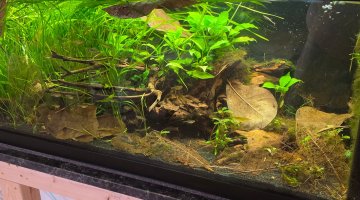
Now that I’m a couple of weeks in with my new plants, I thought I’d post an update. So far, with the addition of some liquid fertilizer once a week, and root tabs, they are all looking healthy and showing new growth. I am ever so slowly working in the gh and kh.
 
Advertisement


Advertisement


Advertisement


Back
Top Bottom