
You are using an out of date browser. It may not display this or other websites correctly.
You should upgrade or use an alternative browser.
You should upgrade or use an alternative browser.
New Aquascaping aquarium establishment


Advertisement

- Messages
- 12,570
Stag horn is one of the red algae - definitely more troublesome than many others.Staghorn algae,, undoubtedly
Advertisement
Right, did you take a look at the pics ? Looks like definitely that type.Stag horn is one of the red algae - definitely more troublesome than many others.
In relatively experienced hobbyists this algae is rare, cause they not addressing a point where their CO2 levels are low or fluctuating.
I have "regular" thread algae on the other plants, however the Ludwigia took the staghorn which is the reason behind its complete rotting, more virulent algae type than others.
- Messages
- 12,570
I am no pro when it comes to identifying algae by its appearance - except for the Black beard or Black brush kind because it’s pretty distinctive.Right, did you take a look at the pics ? Looks like definitely that type.
In relatively experienced hobbyists this algae is rare, cause they not addressing a point where their CO2 levels are low or fluctuating.
I have "regular" thread algae on the other plants, however the Ludwigia took the staghorn which is the reason behind its complete rotting, more virulent algae type than others.
There are just too many species and too much resemblance between them.
Frankly, I don’t think it matters very much just which algae species one finds.
Observation will soon make it clear whether it’s a type that has holdfasts that will damage leaves or not.
The underlying causes are the same regardless of what species are involved.
I’m just grateful that the algae that showed up in one of my tanks ( not long after I put on a new light that is too intense & not dimmable) just happened to be a hair type that doesn’t have holdfasts and is thus very appealing to most algae eaters & does no damage to the plants.
I need to replace the light fixture to amend the underlying cause.
Hi, Following on from what was discussed, regarding the Ludwigia specifically, suppose I don't do a hydrogen peroxide treatment right now, should I:
a. Prune infested leaves, leave plant for additional growth
b. Prune infested leaves plus trim stem half way through and replant
c. Prune infested leaves plus trim stem half way through and discard cut off
d. Uproot entire stem plant and discard
a. Prune infested leaves, leave plant for additional growth
b. Prune infested leaves plus trim stem half way through and replant
c. Prune infested leaves plus trim stem half way through and discard cut off
d. Uproot entire stem plant and discard


Advertisement
- Messages
- 12,570
They do look etiolated - the nodes are quite widely spaced.Is this considered a leggy growth, of the limnophila?
It does somehow leggy, and the following is a reasonable cause:
Leggy stems (long internode distance) is a typical sign of poor/insufficient CO2 at the plants stem level. You do have an impressive filter output for the tank size but do the CO bubbles reach the substrate level and is there reasonable flow at that level eg bubbles fluttering about one way or the other.
i just added a 2nd co2 source today, so a sufficient, stable, consistent CO2 supply is available.
how do you reach substrate level co2 distribution?
I did realized that the far side of my tank not receiving enough flow, so I intend on purchasing a low output power head.
- Messages
- 12,570
Right,,,
"ETIOLATION
Plants will often show signs of problems long before it is too late to fix.
When you obtain a healthy plant,take note of its' appearance.
Your powers of observation can make the difference between success and failure.
Here is one thing to take note of.....
THE DISTANCE BETWEEN NODES ON STEM PLANTS.
Let's say you just got a nice healthy stem of Hygrophila.
Take note of the distance between the pairs of leaves!!
In a week or so,the plant will tell you if it isn't receiving enough light!!
If the distance between the newest set of leaves is much longer than the previous set,
you have Etiolation....the plant is stretching toward the light.
This indicates that it is not getting as much light as it was in the previous tank.
If it is getting MORE light than previously,the internodal length will decrease.
Just explaining what is happening guys."
- Messages
- 12,570
Personally, I find that etiolated stems generally don’t return to normal internodal spacing if lighting is increased, so I trim them back to the node below where the etiolation began.Right,,,
"ETIOLATION
Plants will often show signs of problems long before it is too late to fix.
When you obtain a healthy plant,take note of its' appearance.
Your powers of observation can make the difference between success and failure.
Here is one thing to take note of.....
THE DISTANCE BETWEEN NODES ON STEM PLANTS.
Let's say you just got a nice healthy stem of Hygrophila.
Take note of the distance between the pairs of leaves!!
In a week or so,the plant will tell you if it isn't receiving enough light!!
If the distance between the newest set of leaves is much longer than the previous set,
you have Etiolation....the plant is stretching toward the light.
This indicates that it is not getting as much light as it was in the previous tank.
If it is getting MORE light than previously,the internodal length will decrease.
Just explaining what is happening guys."
If caught early that might only require nipping off a couple of leaf pairs (or whorls in the case of the limnophila), but if there’s a lot of etiolated growth it can mean taking off a lot more.
Advertisement
- Messages
- 12,570
It is the light that drives plant growth, not CO2. Underwater plants do grow much better (from our point of view at least) with supplemental CO2 because carbon is in such short supply underwater, but supplemental carbon of itself can’t make plants grow faster. Only light can do that.So it turns out of an already insufficient light, and..
I just added a 2nd source of co2 which means an even additional
lighting supply is needed.
It is the reason why growing with CO2 becomes a balancing act.
Most plants have evolved in locations where they get what they need but we go and try growing them in our tanks where that’s no longer the case.
So we tend to end up having to experiment some, to find a sweet spot with enough but not excessive light intensity & nutrient supply, (which includes carbon).
Etiolation, in and of itself, doesn’t necessarily pose a problem for the plant - but if you don’t care for the look of the etiolated plant then it’s a problem for you. Solving it may take some tweaking of light intensity vs carbon supply.

- Messages
- 4,102
So it turns out of an already insufficient light, and..
I just added a 2nd source of co2 which means an even additional
lighting supply is needed.
Not necessarily. More CO2 -> less light required.
And given your algae problem, the longer node intervals of a species prone to showing this may not be your primary concern.
The algae was only the result of the week or so of co2 supply shortage,
so I'm expecting a decline, which can already be observed.
I do have a quick question though:
because the 2nd co2 diffuser is located in a relatively section of the tank with the least flow (at least observable) , so I did notice today the whole surface is full with tiny bubbles, which are essentially accumulated co2,
1. Is there is such thing too much co2?
2. Should I install power head near that diffuser?
I did take a look now, and since the lights went on most of the bubbles disappeared, which is essentially been consumed by the plants, so I do believe an adequate amount of co2 is being handed in the tank.
Can now refer to the lighting issue
Indeed btw, the container is still filled with filamentous and staghorn
Large wc is needed
Tell me this isn't staghorn algae..
Attachments


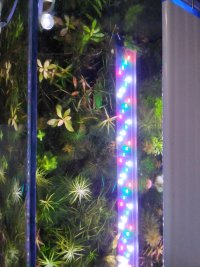
Although the led lighting I have is relatively cheap, non familiar brand, one bar so not widely spread of light for the entire tank and probably the par not reaching the substrate level (or low),
It is a 20w lighting and the tank is 20 gallons (60 liter), so the leggy growth of the limnophila a bit surprising me.
I'm considering an upgrade to the weekaqua 40w
It is a 20w lighting and the tank is 20 gallons (60 liter), so the leggy growth of the limnophila a bit surprising me.
I'm considering an upgrade to the weekaqua 40w

- Messages
- 12,570
Reasonable for what?Is this reasonable?
I'm removing lots of filamentous green algaeReasonable for what?
- Messages
- 12,570
Then I’d say you’ve been busy! Keep up the good workI'm removing lots of filamentous green algae
.Advertisement
- Messages
- 12,570
If it was staghorn it would be tightly attached to infested leaves and leave a lot of holes & damage behind.Just for preciseness following up some determinations I made,
it probably wasn't staghorn algae (at least the leave from the Ludwigia I just checked), so most probably GBA (along with plenty of "regular" thread algae) .

- Messages
- 560
Why is that? Staghorn is more destructiveI would much rather have staghorn than green hair.
- Messages
- 560
Just my personal experience. I have been able to get rid of.staghorm but green hair always seems to be there.Why is that? Staghorn is more destructive
Hi, there's no direct sunlight, however plenty of ambient light, is that ok ?
in addition to the tank led lights
This late infestation completely destroyed the ludwigia repens rubin and ludwigia brevipes
I'm considering transitioning half part of the tank to easier plants.
What would be considering easiest plants
in addition to the tank led lights
This late infestation completely destroyed the ludwigia repens rubin and ludwigia brevipes
I'm considering transitioning half part of the tank to easier plants.
What would be considering easiest plants
Attachments




Prevent algae:
- Reduce light intensity
- Cool water (hence why I'd choose subtropical fishes over tropical fish for planted tanks)
- Large, frequent water changes
My experience is that the first two are sufficient to ignore the third. But with normal to strong light, I would conduct large water changes to reduce the organics produced by plants.
Reduce algae:
- Chemicals
- Blackout
- Shrimps, snails
++++++++++++++++
Trimming is something you have to figure out a little for yourself as there is no wrong or right.
For instance, you can plant plants that are labelled for background also in the foreground and trim those more often.
Does neon tetra cardinal is subtropical or tropical?
Why am I asking, I took your advice reducing the heater temperature from 26 Celsius to 24 Celsius, it looks like a bit cold for them? Their activity has been somewhat declined?
I following your clauses, did V on temperature and large frequent wc, light intensity looks less relevant as the 20w led lights I have apparently is more of insufficient light intensity for the tank as was indicated by the limnophila leggy growth.
If at all I need to upgrade my lights, considered the weekaqua 40w
Well, here is the whole story of planted tanks
The Balanced Planted Tank
- Messages
- 4,102
According to Ivan Mikolji, who measured the water parameters in the natural habitat of these fish, the temperature ranges between 73°F and 79°F.
Water temp can be significantly lower than air temp due to tree canopy and evaporative cooling.
"Their activity has been somewhat declined?"
Is this a bad thing? If I give my kids less sugar, they are less active too.
"light intensity looks less relevant as the 20w led lights I have apparently is more of insufficient light intensity for the tank as was indicated by the limnophila leggy growth."
Insufficient to reduce the interval between nodes of a specific plant species, sufficient to get algae. Why take the former as the yardstick? I bet I run my tanks in much weaker light.
If you want a bushier look, add CO2, trim plants, re-plant the cuttings, perhaps choose different species, and above all, patience.
Advertisement
- Messages
- 12,570
I didn't know I have pogostemon erectus..
Though I haven't figured out what is this plant, is it Hemianthus micranthemoides?
It was called H.micranthemoides but is now formally identified as H.glomeratus.
According to Ivan Mikolji, who measured the water parameters in the natural habitat of these fish, the temperature ranges between 73°F and 79°F.
Water temp can be significantly lower than air temp due to tree canopy and evaporative cooling.
"Their activity has been somewhat declined?"
Is this a bad thing? If I give my kids less sugar, they are less active too.
"light intensity looks less relevant as the 20w led lights I have apparently is more of insufficient light intensity for the tank as was indicated by the limnophila leggy growth."
Insufficient to reduce the interval between nodes of a specific plant species, sufficient to get algae. Why take the former as the yardstick? I bet I run my tanks in much weaker light.
If you want a bushier look, add CO2, trim plants, re-plant the cuttings, perhaps choose different species, and above all, patience.
"I bet I run my tanks in much weaker light."
What do you mean, your lights are less than 20w for a given tank size?
Algae Control: Filamentous, string, hair algae
I had the whole thing, the thread algae due to organic waste build up, it turns out, high phosphorus accumulation, and the supposedly green beard algae due to the week or so shortage of CO2.
Hi, not a clue for meIndication:
10% max output of 70W Chihiros WRGB2 SLIM = 7W for 30G tank
15% max output of 30W Twistar B = 4.5W for 15G tank
That's 0.2 to 0.3W per gallon. And this is only peak, for a few hrs.
Do I win?
lighting is a whole subject of itself.You're indeed light years away..
- Messages
- 4,102
Look at the internodes / interval between nodes of Lucifer's sessiliflora: Beginner to aquascaping/planted tank frustration | Aquarium Aquascaping Forum
What I'm seeing is very typical for this species.
What I'm seeing is very typical for this species.
Indeed, so it could not be a leggy growth for that species after all, so the 20w lighting could be sufficient.Look at the internodes / interval between nodes of Lucifer's sessiliflora: Beginner to aquascaping/planted tank frustration | Aquarium Aquascaping Forum
What I'm seeing is very typical for this species.
Either way an upgrade to a more strong, reputable brand (like Chihiros, week aqua etc) would be in place, however that is ONLY for a well balanced, functioning tank.
I still handling the scorched landscape the most probably GBA left in the left section of the tank where the ludwigia was settled
+ Filamentous, string, hair algae upon most plants.
As I mentioned earlier, I had the whole thing, the thread algae due to organic waste build up, it turns out, high phosphorus accumulation, and the supposedly green beard algae due to the week or so shortage of CO2.
You could say I now control the diy co2 production, I'm renewing it in an hour
- Messages
- 12,570
Plants have nothing to do with algae - they sure don’t create it. Their connection with it in our tanks is just coincidental and they do provide nutrients to algae once it starts to grow, but algae can as easily show up where no plants exist.What is this germination plants produce when wide co2 fluctuations or a complete shortage occur ?
Basically this is the only way plants themselves create algae, right,
because all other situations is due to tank conditions
Algal spores are everywhere in the air which is how they find their way into tanks. Once there, whether or not they cause trouble depends on the conditions in those tanks.
Algae reproduce both sexually & asexually. Asexual reproduction involves the creation of zygospores and the zygospores are stimulated to germinate by various environmental stimuli.
Those stimuli include changes in light, temperature or available nutrients (which most definitely include carbon). Once they germinate they grow for days, weeks or months depending on their species - and they produce more zygospores, so they stay.

- Messages
- 12,570
If you’re referring to this - Quote”Messing with CO2 while keeping all else equal is probably the biggest stressor for plants, leaching organics that trigger algal spore germination.”UnquoteOK, very interesting, nevertheless I was referring to ruud's statement, attached herewith
Stressed plants leach substances that algae can use so it’s another potential environmental trigger for zygospore germination.
No two tanks will have identical conditions so it’s not easy to predict how things will go in a given tank.
We fill a glass box with water & put plants & other life in it with the expectation that we will be able to control everything that then happens within the glass box - which isn’t a realistic expectation.
Advertisement
There is one thing I would like an explanation for.
I now realize from experience that co2 fluctuations/shortage results in stressed plants which produces those more strong algae like gba and staghorn.
However, it widely accepted and well suggested online to have tanks setups without injected co2.
So these tanks without co2 won't stress the plants and deliver algae?
Or is just the fluctuations (after co2 been introduced to the tank) that cause algae? (as if the plants "know" now there's co2 available)
Or uninjected co2 tanks only inhabit undemanding co2 plants?
- Messages
- 12,570
It isn’t quite that simple but it is quite possible to have lots of nice looking healthy plants without the use of CO2 gas. There are more than enough plants that will grow well enough without added carbon. You may not get the most vibrant colouring possible or the most luxuriant growth but it’s still very attractive.
Since carbon availability isn’t being manipulated, the slight changes in it that no doubt occur naturally don’t seem to trigger algae spores to germinate.
The single most common reason for any algae to show up in most tanks, with or without CO2, is excessive light intensity. Intense light, especially a lot of hours of it, trigger algae spores to germinate quite reliably.
I did some experimenting with DIY style CO2 injection and for me, it just wasn’t worth the aggro. It was a very long time ago and I didn’t run it long enough to encounter problems with algae due to an erratic CO2 supply.
For a lot of years I have grown plants without any added carbon from gas or glutaraldehyde either.
I’ve used very little in the way of added fertilizers too - I don’t mind if plants grow more slowly.
Very recently I’ve started to use a little fertilizer - I have enough plants in a couple of tanks that there simply aren’t enough resources for them all. But I’m pretty conservative and currently don’t add any macronutrients, though that might change down the road.
I avoid trying to grow plants that simply don’t fare well without additional carbon. There are certainly plenty of plants that do well enough without, so it’s not a problem.
An example would be Ludwigia inclinata var. verticillata 'White'. It’s just not going to do well without both intense light & additional carbon.
I can grow it emersed if I want to but not in an aquarium unless I set one up as high tech with crazy light intensity, CO2 injection & heavy feeding. That’s just way too much trouble for one plant, gorgeous though it is.
Though in fact I do have intense lighting on all my tanks. It’s how they make them these days and mine aren’t dimmable.
So I mitigate that by growing a lot of floating plants. The blanket of riccia in one tank is a leafy two inches thick & it just loves the intensity. It also provides shade to the water below. I have to keep thinning it so that it doesn’t shade too much. ,
And I rarely have any trouble with algae.
A couple of times I have had a little bit of cyanobacteria show up on the blanket of Riccia fluitans. I’m not sure why it appeared but the patches were small & very easily removed along with a generous handful of the riccia. It didn’t affect anything else and so far it hasn’t appeared in over a year.,
I have only one tank with a green algae issue & I know why that happened - lighting.
I replaced the lights I was using on it with a new fixture that was a lot more intense & much closer to the water surface than the old fixtures, which I wanted to use on other tanks.
The new light was just too freaking intense and too close to the surface - the mounts on it don’t allow adjustments for height. I should have realized it was asking for algae but hey, mistakes are part of life.
The algae, fortunately, is a hair type that does not attach to surfaces or plants. I’m actively cultivating it now in another vessel as a food source for algae eaters.
And though I want it gone from the tank it appeared in, it’s proving to be a very useful species (sadly, I have no clue what species it is) as food for raising scuds & keeping Nerite snails well fed and hopefully it’ll help keep some new ostracods happy.
It will be quite a massive pain to get it out of the tank where it first appeared.
But to prevent it from happening again after I get it cleaned out of this tank, I have to either change the light for one that is a lot less intense or devise a way to suspend the current light much farther away from the water surface - at least a foot away I think.
The worst algae problem I have ever had was also caused by lighting. It was a long time ago but I had a massive outbreak of red algae, the kind we call Black beard or Black brush. It killed about 3/4s of the plants. It was on all the surfaces.
I eventually figured out that the fluorescent tubes I was using were leaking quite a bit of UV light. The costing instead Deb them was defective.
But it took quite some time to figure that out and I ended up losing about 90% of the plants in the end.
Not a fun experience but it was educational.
I'm considering this as well
The T5 lighting, yet, is a good choice even nowadays, it's just there isn't any mounting fixture for them.
"Since carbon availability isn’t being manipulated, the slight changes in it that no doubt occur naturally don’t seem to trigger algae spores to germinate."
Exactly!! The non injected co2 tanks, without CO2, the plants not experiencing these extreme changes --- when ample level of the gas suddenly completely not available, and for a week or so.
The plant is forced to re adjust itself for the new conditions.
So, essentially, algae is present in any tank, consistently, but only triggered when the tank goes out of balance or adequate conditions for its growth are introduced ??
I have another clarification I would appreciate, regarding general maintenance & configuration.
Does this layout, for that matter, is actually providing the 60 liter tank with 70ml fertilizer dosage weekly, that's a lot isn't it ?
Also, this setup uses 150w lighting, extremely exaggerated?
Attachments


Ludwigia inclinata var. verticillata 'White' - rare and very nice plant
Very much resemble the pogostemon stellatus
A layman question here. When planted aquarium fertilizers and co2 circulate through a filter, don't they a bit loose their effect when flowing through the foam? The cleaning function of a filter in such tanks is less important I think. Of course every source strictly recommend using a filter,
however perhaps a powerhead/s is more adequate?
- Messages
- 12,570
Nope. They’re not particles that can be caught by media. They’re dissolved in the water so they just flow past foam, ceramic & floss.Ludwigia inclinata var. verticillata 'White' - rare and very nice plant
Very much resemble the pogostemon stellatus
A layman question here. When planted aquarium fertilizers and co2 circulate through a filter, don't they a bit loose their effect when flowing through the foam?
I'm considering this as well
The T5 lighting, yet, is a good choice even nowadays, it's just there isn't any mounting fixture for them.
"Since carbon availability isn’t being manipulated, the slight changes in it that no doubt occur naturally don’t seem to trigger algae spores to germinate."
Exactly!! The non injected co2 tanks, without CO2, the plants not experiencing these extreme changes --- when ample level of the gas suddenly completely not available, and for a week or so.
The plant is forced to re adjust itself for the new conditions.
So, essentially, algae is present in any tank, consistently, but only triggered when the tank goes out of balance or adequate conditions for its growth are introduced ??
Yes.
It’s a high tech setup, that’s for sure. It’s the problem with most of the lighting being produced now - too intense for most tank conditions & plants.I have another clarification I would appreciate, regarding general maintenance & configuration.
Does this layout, for that matter, is actually providing the 60 liter tank with 70ml fertilizer dosage weekly, that's a lot isn't it ?
Also, this setup uses 150w lighting, extremely exaggerated?
The recommendation for fertilizer appears to be based on an assumption that those using this setup will be diving into the deep end with the high tech approach.
Bear in mind that since high tech tanks need a lot more fertilizer and tweaking of water parameters etc., this hopefully translates into regular repeat sales for the seller which is the holy grail of the ‘business must always grow & profits continually increase’ model.
Take the ‘advice’ provided with descriptions like these accordingly - or perhaps with a shaker full of salt
.
- Messages
- 12,570
Appreciate the replies, though couldn't find online the meaning of the saying "shaker full of salt"
Ever hear the saying ‘ take it with a grain of salt’? It means to be a little skeptical.
I was taking liberties with that saying by substituting ‘a shaker full’ for a grain.
Random Great Topic!

Today's Deals
Advertisement
Advertisement
Advertisement