I'm highly considering leaving the hobby

BlueRaccoon

Well Known
Member
Messages
1,463
This post isn't a question. I just wanted to share how I was feeling. Feel free to share any thoughts, tips, or experience. Just be nice please.

I haven't made a decision, but I am highly considering leaving the hobby. I just can't take the non-stop health issues and deaths I have had. Over the last two years, I have lost probably 10 fish from my community tank. Six of them were all related and all died of the same condition, that no one on here has ever been able to name. It appears to be genetic. I then had another fish die from a mouth tumor, and then I had two females die from breeding exhaustion. These were all fish from a local pet store. I then bought fish from a quality online company. These fish have always been healthier and more beautiful. Many of these fish were the same species as the ones I lost from the pet store. However, after euthanizing two fish tonight, I noticed one of my better fish has cotton around it's mouth.

I'm tired. I've always researched a lot. My parameters are proper for my my fish, and they are stable. My fish have never, under my care, experienced ammonia or nitrites. The nitrates are usually between 10-20ppm max. Stable temperature. The tank is moderately planted. There is lots of Driftwood and rocks for hiding also. I always buy small fish for large tanks because I believe they deserve room. So think nano fish in a 55g. I feed a varied diet of quality foods, including some frozen. I do large water changes weekly.

I honestly just don't know if I want to be in this hobby anymore. I'm tired of sick fish. I'm tired of euthanizing to end suffering and to prevent the potential spread of disease. I can't take knowing all these fish are dying under my care. I hate to get rid of it because I feel like it's so good for my children and I to be exposed to nature and to learn to research and care for amazing living creatures. But honestly, the pain is getting too much. I'm considering rehoming everyone. It bothers me because I know not everyone takes the time to research like I do, but I also know I'm apparently not doing a great job.

Sincerely, a tired and hurt fish keeper.
 

Advertisement
I am so sorry to hear that you’re feeling so defeated and I know it’s very tough to live with. I struggle with chronic depression and a lot of health issues and often feel like nothing is going my way and nothing will. It can drain you dry.

I take my meds and do the best I can. That’s all anyone can do - the best they can. One day at a time.

Sometimes the best thing is to take a break or even a permanent vacation if the pleasure and rewards are not enough to offset the stuff that makes you feel rotten. It is very stressful and stress is no better for us than it is for fish. You have to do what works best to take care of you.

But I also think you are being very hard on yourself. It sounds to me like you have had a harsh run of abysmal luck.

That’s not a reflection of your skills or practices as a fishkeeper, it’s a reflection of how unfair life can be sometimes.

Life can be extremely unkind. Bad things happen to the nicest people and it can seem as if you’re being punished for no reason.

I wish I had magical words that could fix problems - maybe then I could fix mine and yours too. Sadly, magic is not real.
 

Advertisement
Unfortunately deaths happen. How many fish do you have in your tank total? (Like what is the ratio of healthy fish to deaths?) I think everyone gets a little burned out from time to time, especially when you run into a string of bad luck. When I get burned out with my fish, I usually play around with my aquascaping for a bit or just let things ride out with adequate but minimal care until the feeling passes. I wonder if there is a more obsure issue causing low level stress to your fish that is increasing the likelihood of illnesses, like stray voltage in the tank, not enough dark time, a stone leaching something or something like that?
 
Ten fish deaths over two years is nothing for some fish species. You don't mention what kind of fish you have but from my experience, tetras (looking at you, neons) die super easily and tetras are great at catching diseases from newcomers. If your fish are tetras, I have had almost too much luck with endler's livebearers. Fancy guppies are wusses, but endlers seem to be much hardier and more prolific. If you buy females along with males, you will find that you have the opposite problem because they reproduce faster than they die (as long as the fry survive to adult stage). Happy fishkeeping!
 
Well it’s like this. First these fish in the wild may have a life span of 24hrs. Just hatched they are on the bottom of the food chain. Everything is eating them. Now you’re breeding them in factories and all survive. You take survivors and breed them and they all survive. See all that’s being done is they are just getting weaker and the gene pool is continuing. So a fish with a life span of 24hrs living in your tank for a month has outlived its life expectancy. You’ve done a great job. What you’re now reading in books is from the 30s to the 70s. These fish are so much less than they were. The written life expectancy is not a given. It’s a guess. Someone somewhere managed to keep one alive for a certain amount of time. But the thousands of others had there’s die and that’s not taken into account. Smaller nano fish will be harder to keep than say Oscar’s. Small is lower on the food chain. Larger longer. Yes there are always oddities that live very long. But the average fish live about a year.
The longer you keep fish the more you understand fish keeping. Once set up the worst thing to do is add new anything. The amount of diseases out there now coming out of factories is staggering. One new fish added to an existing community can either knock out the whole tank or just some individuals. Some fish have built in immunities others don’t. The ones not immune to what the new fish has die the others being immune live till the next thing enters the tank. I learned this with discus keeping. It’s amazing how many things can kill discus.

It’s always best to qt any new fish for at least 6 weeks. Any!! I just recently got reminded of this. Bought 6 bronze corys from a place I’ve never had a problem with. My community tank I usually don’t qt. Never had a problem. Day after adding those cories I lost over 10 fish some close to 10 yrs old. It was an external bacteria killing them. Changed 80% water and started treating with rid-ich plus. No more deaths and those that looked like they weren’t going to make it made a strong come back. With what’s out there now you have to qt everything. Yes everything including plants. In 6 weeks of daily water changes your new fish will get stronger and anything bother them will be killed off. A treatment of poly-guard while in qt is a great start to kill off anything still on them. before you add them to your tank.

Nano fish a relatively new. Many still wild caught. Life expectancy is unknown. Added to fish that have been in captivity since the 30s and factory grown can lead to all sorts of problems. As a keeper it’s very hard to impossible to see what can happen. Unfortunately you have to start with low expectations. And remember in the wild the average life span may be 24hrs
 

Advertisement
Sorry about your fish issues and I understand your feelings. I’ve gone for periods of time with no problems and then….wam….some disease or health issue arises that sets me back. And I’ve seen/experienced such things for 55 years of fish keeping. What it comes down to is two factors.

First, caring for fish to the best of your ability is all any fish could ask for. You obviously care, are doing research to learn, and are carrying out actions as best you can. This is SO superior to those who don’t care to learn or even care for fish well being. Sometimes…..no matter what’s done, things don’t work out. Fish genetics, disease, stress, and earlier life history play a part that you have no control over.

Second, think what the life of those deceased fish would have been like in some dingy pet shop or fish farm all stressed and overcrowded had you not taken them in. Under your care, they had good water, temps, etc that you were providing, were treated to the best of your ability and then, when it became obvious it was best to euthanize, you did that…the right thing....in their best interest with the least suffering. You treated them with respect all the way to the end which is more than I can say for many out there who are not deserving to handle life.

I can understand your hurt…..I’ve been there many times. Recently, I had two orders of Cardinal Tets arrive that just didn’t have what it took to survive and, despite all my efforts over a long period of time, I lost them all. The next batch actually pulled through. Was I discouraged with the first two failures? You bet. The third time, however, was the charm. I remember losing a couple of very pricey top of the line Discus back a few years ago and I was devastated. I was so upset, I almost tossed in the towel. The Discus supplier (Kenny Chung….now passed on) spent much time coaching me on strategies etc to fix matters and taught me much. He wisely stressed to me that my care, researching data, seeking help, and respect for the fish made me worthy to be a continuing caretaker of fishlife.
Maybe a break would be best for you, I don’t know, but from what I can gather from your post, you are, in fact, just what the hobby and the fish themselves need. Based on your post, I really think you just had a spell of bad luck which you had no control over.
Lastly, while Forums like this are fantastic, perhaps you might appreciate an actual talk/discussion. If so, PM me and perhaps we could end up chatting on the phone. Just a thought. No matter your decision, I wish you the best and hope you find happiness.
 
I once left the hobby.

A few years later I started with a large vase. Just adding plants, some sand and water. OK, that was easy.

Next came a cube tank, but the approach was exactly similar. Zero technology. But this time I added a scarlett badis and had some fun finding live foods for the little bulldog. That turned out to be a walk in the park also.

Zero technology has remained the basis ever since.

Nowadays I very much appreciate water flow and keeping the water surface crystal clear. An old school airstone is what it takes.

Letting go of your tank might not be a bad idea. Just leave the tank where it is. Perhaps stick to a species only once you get there in a sort of natural way. A species from the subtropics would be ideal as they are fine with room temperature. Perhaps change the light you have with ordinary light for living rooms. Let the tank blend in its surroundings.

It's not neglect. The pace of a tank is slower than our personal agenda's. You can let go of it more than you think. Feeding fish a few times a week. Trimming plants on the go. Probably wouldn't work for the average community tank, but 'nano fish' in a large, moderately planted tank? No sweat.
 
I kept the generic petstore fish as a kid for a few years and stopped. In my very early 20s I kept African cichlids for about 10 years and stopped after I 1. Got tired of them killing each other and the cost and 2. Go physically sick myself with GBS and couldn't work or walk for about a year. 3 years of recovery and strength training and back to work and got a couple kissing gouramis. They grew and lived 10-12 years and got big and I started my larger tank back at the beginning of the pandemic. Been keeping some fish in 3 tanks since.

Anyways. The point is I didn't stick to it my entire life, it gets in the way, life gets in the way also, I had to take breaks and come back to it when I feel like I can, if I feel like I can.

And that's OK. And not coming back to it is OK if you are happier without it. Or just keeping plants and aquascaping if you like if the fish dying bothers you, I rarely buy fish. I buy what I want and I ride it out to the last fish before I move on to others. If they die too quick I try something else, or I stop keeping fish for a while.

Gotta do it on your terms and what makes you happy. And cut out things you don't enjoy and don't like about it.
 
Whatever you decide Blue, I'm wishing you and your fish all the best. The replies you have received here show what a treasure this group is.
 
  • Thread Starter
  • #11
First, thank you everyone for taking the time to give such thoughtful and kind responses. I read every response, and they all meant a lot to me. I'll try to respond to some of the questions and comments mentioned.

This amount of fish in this tank has changed. For a very long time there were 6 cherry barbs, 6 pristella tetras, and a bristlenose pleco. Those numbers increased to 13 cherry barbs and 13 pristella tetras. After losing the fish over the last two years and getting some new ones, my currently stocking is 9 cherry barbs, 7 pristella tetras, a bristlenose pleco, 5 zebra loaches, and 11 lambchop rasboras. I am done adding fish because I personally don't want a higher stock for ease, and because I don't know how I will be moving forward. I also understand that what is considered a 'nano' fish is opinionated. From everything I have read, I would consider them all somewhat 'nano' fish other than the pleco and loaches.

I have not had success with aquascaping. I am still moderatly planted, but it is by no means thriving. I also reasearched and picked very easy plants. The reason I have not had success is because of diatoms. They have never gone away. I have lowered light, nitrates, lessened feeding and fertilizers, and provided current to prevent sticking. Nothing has worked, so at this point I assume I have high levels of a compound in my tap water that I haven't tested for, such as silica. And it has only gotten worse since my loaches eliminated my bladder snails.

How would I know if there was a stray voltage in my aquarium?

My generic tank light that came with the 55g tank is too bright. I know this; however, I have not upgraded it yet. I just run the tank for less hours each day. They probably get 6-7hrs per day, plus some ambient light from the room.

86 ssinit - Your comments on lifespan are very helpful and relieving. I know their lives are not perfect in the wild, if they have much of one. It is hard to see articles saying your cherry barbs should reach 5-7 years, and they die at 1-2. It just doesn't seem right, but I know the breeding system we have isn't great. I've often wondered if I should even support the system.

I have never not quarentined a fish for this specific tank. I have always tried to protect my big community tank. Everything has been quarentied for around 4 weeks, which maybe that wasn't long enough. It probably wasn't recently, because I just put in some lambchop rasboras, and I have a columnarius infection in a cherry barb now.

bgarthe - Thank you for the kind words. It means a lot.
 

Advertisement


Diatoms. There's one fix for that that I do and it works. Don't water change. Just clean off objects that are the biggest eyesores and the glass and don't water change. In 2-4-6 weeks the diatoms will multiply consume the resources they are exploiting and have a massive die off and they will settle and the water will clear and stay clear and you can do water changes again.

It's counter intuitive. You think the water gets better after you water change, and it does, but it lowers their population and refreshes the resource they are exploiting and in a day or two it's cloudy again, even worse than before. Water changing keeps the bloom running in perpetuity. Once it goes clear they have died off. Then you can water change and it's not going to be an issue anymore for you the bloom collapses as they keep reproducing and run completely out of resources.

That's an easy one. :)
 
  • Thread Starter
  • #13
Diatoms. There's one fix for that that I do and it works. Don't water change. Just clean off objects that are the biggest eyesores and the glass and don't water change. In 2-4-6 weeks the diatoms will multiply consume the resources they are exploiting and have a massive die off and they will settle and the water will clear and stay clear and you can do water changes again.

It's counter intuitive. You think the water gets better after you water change, and it does, but it lowers their population and refreshes the resource they are exploiting and in a day or two it's cloudy again, even worse than before. Water changing keeps the bloom running in perpetuity. Once it goes clear they have died off. Then you can water change and it's not going to be an issue anymore for you the bloom collapses as they keep reproducing and run completely out of resources.

That's an easy one. :)
Thank you! I have never not done a water change every 1-2weeks. Should I just keep an eye on nitrates? 6 weeks worries me......also, my water is clear. So I'm not sure exactly what you are referring to.
 
Sometimes the hobby can be frustrating, even for old dogs like me.
Catastrophes like 86 ssinit experienced happens to most of us at one time or another. My tank killer incident occurred ten years ago, an Oodinium infestation. Since then no major illnesses.
Here's my words of wisdom, "Buy bullet proof fish".
You rarely read on the forums about maladies affecting Rosy Barbs, Denison Barbs, Tiger Barbs, Ruby Barbs or Giant Danios & so many more.
Keep the more durable species. Rest up, regain your confidence & start enjoying the hobby again.
 
Thank you! I have never not done a water change every 1-2weeks. Should I just keep an eye on nitrates? 6 weeks worries me......also, my water is clear. So I'm not sure exactly what you are referring to.
When you are referring to diatoms you are most likely referring to the brown dust algae that is settling on everything?
I've had it on a lightly stocked aqaurium and the waters looked clear to the eye, and I've had it on a heavy stocked aqaurium where it's so thick in the water you can't see the fish if they are 3 inches from the glass.
Either way, the brown dust algae is diatom activity. When it's gone the water will appear less yellow to your eye "more clear".

Diatoms consume nitrates and phosphates and they use silica to build their shells, it's a single celled organism not an algae although it does use light like a plant does.

There's two paths to follow. Some will say it's normal, and it is, for a new tank to go through a diatom phase and it goes away once it's balanced and established on its own, just clean the brown off the surfaces and do the routine and in time it will go away. This has never been my experience with doing this. For me, the diatoms go on and on forever.

The other path is to stop doing water changes and adding new nutrients to the water with those changes,
the fish will produce nitrates and they will build up, then the diatoms will reproduce like crazy and consume the nitrates, and phosphates, and use silica and at some point they will exhaust the phosphates or the silica or both, and the colony collapses with a massive die off. Any phosphates or silica in excess they were capitalizing on is zeroed, doing this the water will get hazy brown as the diatom population grows, sort of milky in a way depending on how much fuel they have to reproduce with, then it goes clear with the die off then it can be cleaned up and nitrates zeroed again and it should not return again (unless you introduce new diatoms again in sufficent numbers by putting other people's tank water in you tank that have them.)

There's increased lighting also to use the nutrients instead for green algae or plants, which will stop the diatoms also. With more lighting higher order organisms like algae will thrive, and diatoms will be pushed out. And with more plants, another higher order organism above algae, they can starve the algae out. This works but unless you are doing plants, replacing diatoms with algae is just harder to clean. Diatoms just wipe off.

I don't keep plants, I barely make it past the diatom phase to actual algaes and nothing to consume the extra nutrients that are present at set up so the diatoms rule my tanks unless I do something to cause them to collapse in a massive die off to be rid of them.

The more nitrates the fish produce the more visible the diatoms become as they multiply. they can build a massive colony in an overstocked tank that produces a lot of daily nitrates, and make it look like mud or milk water. In a lightly stocked tank you might not really see them with water clarity but notice the brown dust build up on surfaces or plants. Stopping water changes and letting them populate and then collapse and die off, you will see them in the water eventually as it gets cloudier with them, it will get worse before it gets better, but once the population has collapsed, the water will be even more clear than you started with.

You will have a nitrate run up by not water changing, however as the diatoms populate more and more they will offset some of this nitrate build up, meanwhile they will use the other resources with the nitrates to reproduce and silica for their shells and will exhaust one thing or another that they need and go extinct, they reproduce every 15 minutes so when they really get going with nitrates in supply they will collapse it. The colony of living diatoms in the tank will double every 24 hours, Diatoms have a lifespan of about 6 days. If they all hit a roadblock where they can't reproduce (they use asexual reproduction through multifission, the parent cell splits into many smaller daughter cells, "nucleus splits") and then grow and split themselves, it collapses and they go extinct with no new diatom left with resources enough to reproduce.

Sometimes doing less works better than doing more. If changing water every week or two hasn't gotten rid of them, not changing water to make them overpopulated and collapse would be the next thing to try.

Diatoms don't hurt the fish, they are an eyesore though, and they can coat and kill plants if left to build up though blocking their ability to take in light.
 
It sucks when they die, but it's part of the hobby. You sound like a responsible owner, but sometimes there is just nothing we can do for various reasons. I get you, perhaps you can shift to planted tanks for a while like I did, take a break from fish. I still keep a Betta, but my main focus is plants. I started with fish and no plants and slowly shifted in the opposite direction. I have 1 Betta fish now going on 2 years old (some luck involved) but my main focus is the plants, the Betta benefits from it, plants may help you situation as they are great for fish.
 
  • Thread Starter
  • #17
When you are referring to diatoms you are most likely referring to the brown dust algae that is settling on everything?
I've had it on a lightly stocked aqaurium and the waters looked clear to the eye, and I've had it on a heavy stocked aqaurium where it's so thick in the water you can't see the fish if they are 3 inches from the glass.
Either way, the brown dust algae is diatom activity. When it's gone the water will appear less yellow to your eye "more clear".

Diatoms consume nitrates and phosphates and they use silica to build their shells, it's a single celled organism not an algae although it does use light like a plant does.

There's two paths to follow. Some will say it's normal, and it is, for a new tank to go through a diatom phase and it goes away once it's balanced and established on its own, just clean the brown off the surfaces and do the routine and in time it will go away. This has never been my experience with doing this. For me, the diatoms go on and on forever.

The other path is to stop doing water changes and adding new nutrients to the water with those changes,
the fish will produce nitrates and they will build up, then the diatoms will reproduce like crazy and consume the nitrates, and phosphates, and use silica and at some point they will exhaust the phosphates or the silica or both, and the colony collapses with a massive die off. Any phosphates or silica in excess they were capitalizing on is zeroed, doing this the water will get hazy brown as the diatom population grows, sort of milky in a way depending on how much fuel they have to reproduce with, then it goes clear with the die off then it can be cleaned up and nitrates zeroed again and it should not return again (unless you introduce new diatoms again in sufficent numbers by putting other people's tank water in you tank that have them.)

There's increased lighting also to use the nutrients instead for green algae or plants, which will stop the diatoms also. With more lighting higher order organisms like algae will thrive, and diatoms will be pushed out. And with more plants, another higher order organism above algae, they can starve the algae out. This works but unless you are doing plants, replacing diatoms with algae is just harder to clean. Diatoms just wipe off.

I don't keep plants, I barely make it past the diatom phase to actual algaes and nothing to consume the extra nutrients that are present at set up so the diatoms rule my tanks unless I do something to cause them to collapse in a massive die off to be rid of them.

The more nitrates the fish produce the more visible the diatoms become as they multiply. they can build a massive colony in an overstocked tank that produces a lot of daily nitrates, and make it look like mud or milk water. In a lightly stocked tank you might not really see them with water clarity but notice the brown dust build up on surfaces or plants. Stopping water changes and letting them populate and then collapse and die off, you will see them in the water eventually as it gets cloudier with them, it will get worse before it gets better, but once the population has collapsed, the water will be even more clear than you started with.

You will have a nitrate run up by not water changing, however as the diatoms populate more and more they will offset some of this nitrate build up, meanwhile they will use the other resources with the nitrates to reproduce and silica for their shells and will exhaust one thing or another that they need and go extinct, they reproduce every 15 minutes so when they really get going with nitrates in supply they will collapse it. The colony of living diatoms in the tank will double every 24 hours, Diatoms have a lifespan of about 6 days. If they all hit a roadblock where they can't reproduce (they use asexual reproduction through multifission, the parent cell splits into many smaller daughter cells, "nucleus splits") and then grow and split themselves, it collapses and they go extinct with no new diatom left with resources enough to reproduce.

Sometimes doing less works better than doing more. If changing water every week or two hasn't gotten rid of them, not changing water to make them overpopulated and collapse would be the next thing to try.

Diatoms don't hurt the fish, they are an eyesore though, and they can coat and kill plants if left to build up though blocking their ability to take in light.
I'm 2.5 weeks into no water changes for diatoms. I do think they are dying back. My nitrates are around 20-30ppm, and I've lost around 2 inches of water. Does this all sound ok? Like I'm good to continue?
 
Death is part of the hobby, and it is especially common if you keep community tanks. Every fish increases the odds of disease. There's 2 overall options.

1. Accept the risk. Understand that no matter your best efforts, fish will die and disease will break out, especially if you keep delicate species or keep them in shoals. Insisting on disease prone fish in substantial numbers will create these issues, even when you quarantine and test and medicate and everything else, and you have to be ok with that.

2. Change your approach. Keep only a single or couple of larger charismatic creatures instead of a dozen little things. Keep fish that have a reputation for disease resistance. Keep an invert-only tank where the creatures breed faster than they die out. Go for a single-species tank and attempt a small breeding project. Still maintain an understanding that death is possible, but decrease your odds of infection by decreasing the number of fish in contact with eachother at a given time. Or even turn your focus entirely to plants and only add fish back in once the plants are thriving.

I personally favor the second approach, overall. It gives the hobby more aspects to enjoy while decreasing a major factor in disease outbreak. I got very annoyed with community tanks, and pivoting to species-only and planted setups kept me interested.

Also, add floating plants if you haven't already. They destroy nitrates, nitrites, and ammonia.
 
I'm 2.5 weeks into no water changes for diatoms. I do think they are dying back. My nitrates are around 20-30ppm, and I've lost around 2 inches of water. Does this all sound ok? Like I'm good to continue?
yeah it's good to carry on, you want to top off just to keep the filter running IF needed but if not, and the filter is good, the evaporation isn't an issue.except for the filter concern, and test KH and GH and pH make sure those are still good. Nitrates are going to burn some of the KH off which might lower the pH depending on how low the KH was when you started but if it's 4-8 degrees, it shouldn't do that and wouldn't only start to drop when the KH is at less than 1 degree.

The diatoms have nitrates to use but they must be running out of silicates or phosphates. If you feel like it's getting better and not worse now, then it's very likely it's hit the point where they are missing something and it's starting to disrupt their reproduction cycle. an individual diatom lives for about 6 days, so when it appears like they've settled and not really suspending and the water seems to be clearing up, it's likely they've stopped reproducing and are dying back and it's just giving it a little longer to ensure it. If you can give it another week and a half would be good but if you see the pH has dropped or the KH is depleting or the water level is just too low or nitrates are too high, you could top off, then give it a 50% water change with vacuum, then the next day or two another 50% change and clean glass and surfaces, and this should knock the nitrates back down again and get it all in line to continue.
Although backing off too early if they aren't all dead could cause them to bloom again. I like to wait an extra 6 days when I feel like the water is clearing up. Your diatoms might just be the brown dust coating on things, and not very visible otherwise in the water, but again, if you feel like it's getting better/improving then it's not coating things like it was meaning theres a population decline, then it likely is improving, meaning it's peaked and in the die off phase.

personally I don't think nitrate levels can really get "too high" to where they become "toxic" except in extremes, I've had them like crazy high and not lost fish. However, I'd say for breeding, reproduction, or development of fry, it's critical to be low to nothing, and not so critical with adults until it hits a point it's really high above 100pm and beyond where the nitrogen is taking more of the space than dissolved oxygen, then they can get high levels in their blood and low oxygen levels, and it becomes serious, called "brown blood disease". but like I said, it's a high threshold and at 100ppm, it would just be the most sensitive species being affected, not necessarily the hearty species.

for aquaculture, like farming fish, they recommend lower than 75ppm nitrates, but this is due to the density of the livestock and their O2 consumption, it's for faster growth and weight gain, and not necessarily to limit losses. Anyways, it's less about the nitrates themselves, and more about the dissolved oxygen in the water that the nitrates will push out and replace when nitrates are at high levels, then nitrogen could replace oxygen in the fishes blood.

It shouldn't be a problem for nitrates to go up to 50ppm even really, you won't keep it like that permanently, it's a problem for juvenile fish though so I'd say if that's the case, breeding, fry, juveniles, it's best not to push the nitrates too far, for adult fish that are hearty it's not too big of a deal IMHO.
 
Although backing off too early if they aren't all
personally I don't think nitrate levels can really get "too high" to where they become "toxic" except in extremes, I've had them like crazy high and not lost fish. However, I'd say for breeding, reproduction, or development of fry, it's critical to be low to nothing, and not so critical with adults until it hits a point it's really high above 100pm and beyond where the nitrogen is taking more of the space than dissolved oxygen, then they can get high levels in their blood and low oxygen levels, and it becomes serious, called "brown blood disease". but like I said, it's a high threshold and at 100ppm, it would just be the most sensitive species being affected, not necessarily the hearty species.

for aquaculture, like farming fish, they recommend lower than 75ppm nitrates, but this is due to the density of the livestock and their O2 consumption, it's for faster growth and weight gain, and not necessarily to limit losses. Anyways, it's less about the nitrates themselves, and more about the dissolved oxygen in the water that the nitrates will push out and replace when nitrates are at high levels, then nitrogen could replace oxygen in the fishes blood.

It shouldn't be a problem for nitrates to go up to 50ppm even really, you won't keep it like that permanently, it's a problem for juvenile fish though so I'd say if that's the case, breeding, fry, juveniles, it's best not to push the nitrates too far, for adult fish that are hearty it's not too big of a deal IMHO.

It’s interesting to read some of the studies on the effects of nitrate on fish. At least one study indicated 80opm will harm shrimp but when it comes to adult fish in good health in aquaria, levels well over 400ppm did not appear to be a problem.

I have also read that nitrate is detoxified in the liver of fish ( as it is for most animals) so long term exposure might cause issues that short term exposure wouldn’t.

Fry appear to be much more susceptible than adult fish, which makes sense, juveniles are rarely similar to adults in terms of how assorted substances affect them.

I still think it makes sense to keep nitrates as low as possible but they’re not worth the same level of concern that nitrite and ammonia are unless you keep species known to be very sensitive to them or you’re breeding.
 
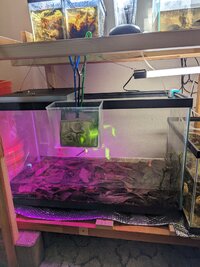
That's a 30 gallon with leaves and mud. It has zero filtration and just random pond critters and microfauna.

PXL_20240319_202310655.jpg
I stare at that more than the Endlers tanks lol

But not as much as the baby Bettas lol


It doesn't have to be complicated to bring joy.

Why not go bare tank and a nice gold fish?

Easy and relaxing. Big fish, big poop you can net out and put straight onto plants.
 
It’s interesting to read some of the studies on the effects of nitrate on fish. At least one study indicated 80opm will harm shrimp but when it comes to adult fish in good health in aquaria, levels well over 400ppm did not appear to be a problem.

I have also read that nitrate is detoxified in the liver of fish ( as it is for most animals) so long term exposure might cause issues that short term exposure wouldn’t.

Fry appear to be much more susceptible than adult fish, which makes sense, juveniles are rarely similar to adults in terms of how assorted substances affect them.

I still think it makes sense to keep nitrates as low as possible but they’re not worth the same level of concern that nitrite and ammonia are unless you keep species known to be very sensitive to them or you’re breeding.
I think we've been reading some of the same studies. I've found that due to aquaculture and aquapoincs and farming, THAT is where all the real scientific data is. Not so much in the hobby even after all these years, where most of the info is experince, antedotal, or myth passed down.
I'd guess its all in aquaculture and aquaponics to keep it safe and productive and profitable, that it's worth all the testing and science for those fields. Sort of like talking to big time farmers vs. Gardeners.

Anyways yeah, my own experiences and what I've read leads me to believe for adult fish nitrates could be really high and long term maybe cause premature deaths, or insanely high and kill all fish, and even horses or cattle if they are drinking the water and eating the grass but not something we'd have to necessarily worry about in an aqaurium at 100 ppm or less if not breeding or developing fish.
Still though for optimum fish health keeping them low is beneficial, even though plants still need nitrates/nitrogen for them to thrive.... balance is always the key. Too much of anything I suppose is a bad thing.
 
If you change your water weekly nitrates will never get high. Thing is people don’t want to change water. But even for these people it didn’t mater. Most people don’t breed so high nitrates works for them. The only time high nitrates comes into play with fish deaths is when adding new fish without proper acclamation. Next because of the new fish dying they test their water and see the high nitrates and change large amounts of water. Thus killing the existing fish because of the drastic change of water. All blamed on high nitrates not mismanagement of the tank. Change water weekly no problem:).
 
I think we've been reading some of the same studies. I've found that due to aquaculture and aquapoincs and farming, THAT is where all the real scientific data is. Not so much in the hobby even after all these years, where most of the info is experince, antedotal, or myth passed down.
I'd guess its all in aquaculture and aquaponics to keep it safe and productive and profitable, that it's worth all the testing and science for those fields. Sort of like talking to big time farmers vs. Gardeners.

Anyways yeah, my own experiences and what I've read leads me to believe for adult fish nitrates could be really high and long term maybe cause premature deaths, or insanely high and kill all fish, and even horses or cattle if they are drinking the water and eating the grass but not something we'd have to necessarily worry about in an aqaurium at 100 ppm or less if not breeding or developing fish.
Still though for optimum fish health keeping them low is beneficial, even though plants still need nitrates/nitrogen for them to thrive.... balance is always the key. Too much of anything I suppose is a bad thing.
Agreed,

There is a ton of stuff out there for both commercial and organic aquaponics using tilapia, catfish etc...

But that's part of it, fish that can withstand things like poor water quality, low aeration and crowding (catfish love group cuddles and that's literally aquaponics lol)

I keep hemming and hawing over doing a garage based tilapia or catfish farm with kale year round and other things as temps allow.

At some point I will need to upgrade the pond and will probably use the old pond setup, just in the garage using an old industrial light over the surgical table for extra horror show points lol
 

Random Great Topic!

Advertisement


Advertisement


Advertisement


Back
Top Bottom