Emersed Planting

Sagi

Active Member
Member
Messages
252
Hi,
Just about to set a few plastic boxes for emersed growth, but didn't quite understand if the body of water level has to be just an inch or so below the soil for the plants to just wick the humidity through the holes in the boxes, or, higher than that in which the soil will be in contact with the water through those holes? Or both are valid ? These are high tech setups?

Low tech would suggest no body of water whatsoever, and just keeping the soil consistently wet and moist?

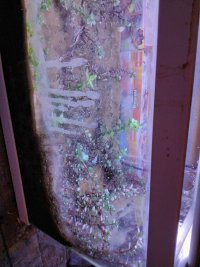
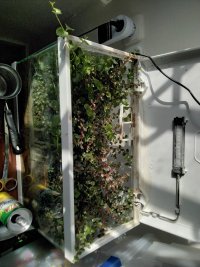
Plants from this tank are going to be introduced to emersed growing.. (left pic is just recently new layout)
 

Attachments

  • 20260426_112935.jpg
    20260426_112935.jpg
    336.1 KB · Views: 31
  • 20260304_105028.jpg
    20260304_105028.jpg
    371.4 KB · Views: 55

Advertisement
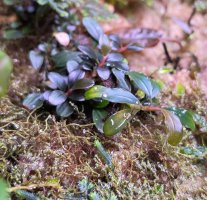
The important thing isn't the water level but that leaves stay moist. There can be very little actual water if the leaves remain moist - this is one of my favorite emersed plant:

qq.jpg

I have a lot of crypts growing emersed and a couple of this and that. The cyrpts do pretty well but are not horribly different from submersed growth. Echinodorus have a larger variance in leaf form when grown emersed but i've not done very many and most have not done as well as i would like.
 

Advertisement
  • Thread Starter
  • #3
I just left them openly uncovered. They won't survive the transition without full humidity being kept for a while?

Well, "transition aquatic plants from submerged to emersed without keeping high humidity", yields,
Transitioning aquatic plants to emersed growth without high humidity requires picking hardy, amphibious species (like Hygrophila, Hydrocotyle, or Anubias), maintaining saturated substrate (water level just below the soil surface), and allowing slow, partial adaptation. Use nutrient-rich, wet soil and spray plants daily, rather than relying on sealed high-humidity container

For that matter, m. Umbrosum and Hemianthus glomeratus won't be considered hardy, amphibious species ?
 
The emersed leaves will need to remain moist for many species; after all these plants grow in very high humidity location. I can't comment about all plants of course but anubia emersed leaves will very quickly turn brown and die if not kept moist.
 
  • Thread Starter
  • #5
I initiated a transition phase for rotala and micranthemum umbrosum. The initial setup was not covered, so humidity dropped off I assume, the rotala melted completely. I then went to covered with a bit of gas exchange, though the rotala still functioning with little melting, no transitioning is seen whatsoever. The m.umbrosum though does show acclimation, is relatively thin and so robust as one would expect from free access to atmospheric co2. This is indoors so lights are led not too strong, with substrate consist of loam soil mixed with peat. Something is missing. Way too long for transitioning phase.

BTW, the former setup had hols for drainage, but the substrate went dry too quickly. The current setup don't have drainage, so the soil is a bit over saturated and waterlogged, but I don't think this is the issue.
 
Strictly for whatever it may be worth, if I want something that’s currently growing submersed to grow emersed instead, first thing I’ll do is let it grow above water all by itself, which most emergent species will do, though not all of them.

Even Pearlweed will do this once it’s thick enough, though the emersed part doesn’t get very far out of water (not even an inch) though I can’t say I ever bothered to let it grow that way long enough to see how tall it might get above water.

More robust stem plants like Ludwigias or Hygrophilas, Rotalas, etc., are generally very willing (if not wildly determined) to send stems above water.

If they are growing in relatively shallow water they will hit air faster.

Once an emersed stem is a few inches long or has at least 3-4 nodes above water, I snip it off and then grow the cuttings in a prop box with closed lid & very damp substrate such as coir or orchid moss.

For plants like Pearlweed I snip off whatever there is and simply rest on damp substrate.

For my needs, the substrate doesn’t have to be sopping wet and I find it’s actually easier if it’s simply very damp rather than swimming in water.

This because many of the plants I grow this way are intended to grow on later in terrariums where they won’t ever be submersed.

If you intend to grow the resulting emersed plants underwater once they’re established, then keeping their substrate absolutely sopping wet makes good sense, since they will have no need to produce new water-adapted roots once they are placed underwater.
 

Advertisement
  • Thread Starter
  • #7
Hi, rotala won't breach the water surface, once reaching it, it will continue growing along the surface, with aerial roots developing mimicking natural habit for expansion.

Natural sunlight is the ultimate full-spectrum light, encompassing all colors of the visible spectrum (from violet to red) as well as invisible infrared and near-ultraviolet wavelengths.

Once established and get used to atmospheric co2, I will transfer them probably into indirect south facing sunlight source.
 
  • Thread Starter
  • #8
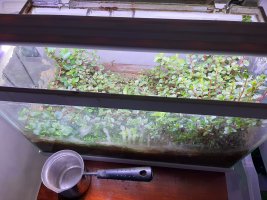
Hi, is this considered time to fully open the lid for maximum access to atmospheric co2? So far only a slight fraction was opened for ventilation and gas exchange. Emersed growth is fully shown on the bacopa and horizontal growth of the rotala.
It also time I believe for move the container near indirect sunlight south window for additional light.
 

Attachments

  • 20260727_093713.jpg
    20260727_093713.jpg
    452.2 KB · Views: 17
  • 20260727_093655.jpg
    20260727_093655.jpg
    519 KB · Views: 18
If you open it up fully the humidity will drop quite a bit all at once. Better to gradually reduce coverage so changes to humidity are also gradual.
 
  • Thread Starter
  • #10
If you open it up fully the humidity will drop quite a bit all at once. Better to gradually reduce coverage so changes to humidity are also gradual.
Right, however, even widening the opening gradually, which is what I actually do, just lately expanded the gap a bit more plus introducing 1 to 2 hour daily of fully opened, will eventually get to where it is fully open.

There must be a specific phase for that, which is obviously when emersed growth is clearly visible with most of the panted plants, and you can assume transformation completes.

As I understand, when reaching a somewhat satisfactory emersed growth, one can keep it fully open, as long as humidity is at least 60% ?
I think that’s somewhat species dependent. Some plants need more than 60%.

Just curious but what’s the ambient humidity in the room?
 

Advertisement


  • Thread Starter
  • #12
I think that’s somewhat species dependent. Some plants need more than 60%.

Just curious but what’s the ambient humidity in the room?
According to Google in this time of the season, swings between 60%+ to 40% in the afternoon and to 60% in the evening.

You know, I see with all the emersed farms online keeping them even with full direct sunlight (or shaded with a screen sheet) in open containers, so the obvious conclusion is once the plants finish their transition phase, or at least observable as such, restrictions can be lifted.
Makes sense.
 
  • Thread Starter
  • #14
One of my favorite farms

I find it equally appealing if not more to submerged form
 
  • Thread Starter
  • #16
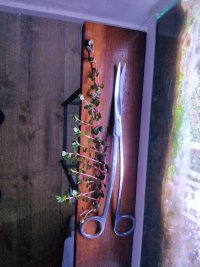
Do I need to trim this bending rotala?
 

Attachments

  • 20260811_191919.jpg
    20260811_191919.jpg
    551.8 KB · Views: 16
  • 20260811_191917.jpg
    20260811_191917.jpg
    397.6 KB · Views: 12
  • 20260811_191857.jpg
    20260811_191857.jpg
    363.7 KB · Views: 15
  • Thread Starter
  • #18
I would - plant the cutting as well.
Exactly, I wasn't sure this is the same as submerged implementation
However as this will be a fully emersed stem, I will save it till I setup another container, this time properly substrate. The current has no nutrients in it, it's made of sandy loam and peat, no organic matter. I will mix potting soil with compost (if it hasn't contains any) and maybe add some loam.
 
  • Thread Starter
  • #20
Rotala behave differently in emersed growth, lots of side shoots, submerged form is strictly upright
Now I understand how they got this section of rotala to cover it like that
There is no replanting here, maybe a few to kick start some areas but the rest is done by the plant itself
 

Attachments

  • Screenshot_20260813-234602_Kiwi Browser.jpg
    Screenshot_20260813-234602_Kiwi Browser.jpg
    234.7 KB · Views: 15
  • Thread Starter
  • #21
How do I divide and replant this rotala stem?
 

Attachments

  • 20260824_215134.jpg
    20260824_215134.jpg
    376 KB · Views: 14
  • 20260824_215125.jpg
    20260824_215125.jpg
    373.5 KB · Views: 12
  • Thread Starter
  • #22
Well, told you I would know how they got this section of rotala to be such dense and compact ;)
 

Attachments

  • 20260902_192135.jpg
    20260902_192135.jpg
    431.5 KB · Views: 15
  • 20260902_192152.jpg
    20260902_192152.jpg
    480.2 KB · Views: 13
  • 20260902_192141.jpg
    20260902_192141.jpg
    364.1 KB · Views: 14
  • Thread Starter
  • #23
Emersed aquatic plants growth
 

Attachments

  • 20260918_162220.jpg
    20260918_162220.jpg
    398.6 KB · Views: 10
  • 20260918_162202.jpg
    20260918_162202.jpg
    437.1 KB · Views: 12
  • 20260918_165441.jpg
    20260918_165441.jpg
    379.4 KB · Views: 12

Random Great Topic!

Advertisement


Advertisement


Advertisement


Back
Top Bottom