
- Messages
- 5,747
They just arrived at my local shop, from Colombia, the fisherman says they are a dwarf species. The female has a red and black dorsal fin ocellus, I couldn't show this on a photo but saw it briefly.
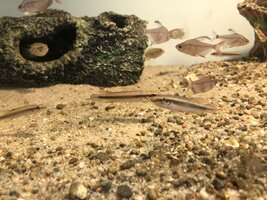


I have looked at pictures of both and I think they look more like the Orinoco ones. Also they came from the same place as altums apparently.They could be C. sp. regani "Orinoco" but I'm not sure. I was first thinking of C. compressiceps when I read the headline.
In any case, hard to combine with other species.
When I got my Hemigrammus filamentosus in September I was offered Crenicichla compressiceps and I was a bit unsettled to hear the store had to move all Corydoras from that tank because the Crenicichla bit off their dorsals and all tetras because the Crenicichla would (try to) eat them too.Why do you think they are hard to combine with other species? I have to read a bit more about them...

Compressiceps are merciless and will kill everything in their pathI was first thinking of C. compressiceps when I read the headline.
In any case, hard to combine with other species.
The cichlids with them were definitely fine. I doubt they reach the agression levels I know from Mbuna.Compressiceps are merciless and will kill everything in their path
I've seen a compressicep kill an oscar beforeThe cichlids with them were definitely fine. I doubt they reach the agression levels I know from Mbuna.
So are they closest to C. regani?it should be C. sp. Orinoco II.
No, to C. notophthalmus. In the hobby they're usually just called Crenicichla sp. Orinoco, but in papers they are referred to as Crenicichla cf. notophthalmus Orinoco II. There are other species labelled under the hobby name, but the one from Colombia (Inirida) is the one I named.So are they closest to C. regani?
I doubt it. Are you sure you have the right ID? Crenicichla compressiceps only grow to 8cm and at best can kill fish their own size.I've seen a compressicep kill an oscar before
What fish did you have them with? Do you think they would be OK in a heavily planted tank 160 x 60 x 60 cm along with Laetacaras, angelfish, tetras and pencilfish? Do they dig up plants?Yeah, comps in particular are known to be nasty. My notos were quite well behaved. Certainly not peaceful as they would chase every now and then, but they never harmed other fish. Mostly they focused their attention on each other.
I had them in a 200x40x55 tank (cm). The other fish were Bolivian rams, diamond and lampeye congo tetras, whiptail cats and some others. They didn't bother the other fish very often. Occasionally the male would shoo tetras away from him and would at times chase the rams out of the area he was in. No harm was done but I did always feel I needed to keep a close eye on the male around the rams.What fish did you have them with? Do you think they would be OK in a heavily planted tank 160 x 60 x 60 cm along with Laetacaras, angelfish, tetras and pencilfish? Do they dig up plants?

Thanks for this information, well that is a shame, I would not want to risk the pencilfish being eaten so that rules out that tank. And yes, I can imagine that happening if they do get to 5-6". The ones I saw were still small. I was actually quite surprised to see Heiko Bleher's list of suggested tank mates that includes Nannostomus marginatus and N. eques.I find that many of the published sizes on Dwarf Pikes are woefully short of reality. I have seen C. compressiceps around 4-5 inches (10-12cm), they were extremely aggressive to one another. I bred a pair of C. regani many years ago, the male was between 5 and 6 inches(12-15cm), female just short of 4 inches. I think most of the discrepancies are due to reported sizes from wild fish. They can get much larger in aquaria but are still far short of the lengths of "normal" pikes.
Because I was breeding them, one pair was isolated in a long 20. Female had a coconut shell with a very small entrance. Male fertilzed from outside the cave. A second pair was being kept in a 55-gallon tank with a few other fish that I don't recall. However, they were quite shy, spending much of their time skulking around driftwood and rocks. I don't recall seeing any interaction with other species.
I would not put them with Pencilfish, as they are skinny and would likely be eaten. Deep bodied Tetras are less likely to be taken, as they present a different head-on profile than minnow-shaped fish. The Dwarf Pikes seem to prefer small invertebrates but are opportunists.
From your photos, I can safely say that those are not strigata, though there are some similarities between young strigata and notophthalmus group dwarf pikes. The sp. "Orinoco" is usually considered closer to regani than notophthalmus, often being labelled "regani-Orinoco". C. notophthalmus is the senior name within the group. It is easily recognized when males raise their dorsal, as they have filamentous rays at the start of the dorsal.
Heiko usually lists biotope appropriate species, in this case I'd rather presume it was about what would work in his opinion. He is more of an expedition guy who imports the fish but doesn't keep many himself (besides wild discus and blackwater species). He was on expeditions basically non-stop for over 50 years.An article in PFK by Heiko Bleher. He says (of C.notopthalmus) "As tank mates I suggest only small characoids such as Nannostomus marginatus, N. eques, Carnegiella strigata and Moenkhausia oligolepis, and/or dwarf cichlids, Corydoras, Otocinclus and Ancistrus species".
It is unclear whether this is based on experience or if he is just listing biotope appropriate species.
Yes, I have seen a lot of his articles, and I did imagine that it probably was more of a biotope list.Heiko usually lists biotope appropriate species, in this case I'd rather presume it was about what would work in his opinion. He is more of an expedition guy who imports the fish but doesn't keep many himself (besides wild discus and blackwater species). He was on expeditions basically non-stop for over 50 years.
This is what people thought initially, but more recently they analyzed the mtDNA of a bunch of Crenicichla and found that the described species that the Orinoco pikes are most closely related to was notophthalmus. It's also made up of at least 3 species. I'll have to dig up that paper when I get home.The sp. "Orinoco" is usually considered closer to regani than notophthalmus, often being labelled "regani-Orinoco". C. notophthalmus is the senior name within the group. It is easily recognized when males raise their dorsal, as they have filamentous rays at the start of the dorsal.
I'm not sure where you saw it labelled as this. Was it the chronogram as I suspected?No, it still seems to be referred to as sp regani orinoco in that paper.
No, I admit I didn't read it all properly, but downloaded one of the appendices or links that listed all species and it had C. cf regani -orinoco listed, but not cf notophthalmus orinoco. But I have since found the part you quoted! Just checked again the same download and don't know how I missed it sorry! It all does make sense now and I am sure the ones at the shop did come from just that region of Colombia.Knew I forgot to do something. That is indeed the paper that discusses, it. I'll show the quote and then explain the figure:
"The type of C. notophthalmus is from the Rio Negro by Manaus and is in our analyses clearly delimited as a distinct species. Undescribed populations from the Orinoco basin, referred to as either C. cf. notophthalmus or C. sp. Orinoco in the cichlid hobby literature are in our analyses composed of highly divergent clades, distinct from the nominal C. notophthalmus and delimited as at least three distinct allopatric species C. cf. notophthalmus Orinoco I (Ventuari), C. cf. notophthalmus Orinoco II (Inirida/Colombia), and C. cf. notophthalmus Caroní. The divergence between the nominotypical C. notophthalmus and C. cf. notophthalmus in the Orinoco basin is fully 10.0 Ma and within the here analyzed C. cf. notophthalmus in the Orinoco basin ranges between 3.4 to 5.9 My based on our calibration (Fig. 3) demonstrating long isolation between the allopatric species sensu stricto."
When you look at the figure you can see the chronogram laying out where each species fits in relation to each other. The locality of regani that the type specimen came from, the Rio Trombetas, as well as a very common locality in the hobby, Rio Topajos, are both more closely related to comps and wallacii than to notos and sp. Orinoco. The closest relation that sp. Orinoco has to a described species is to notophthalmus, which dates back around 10 million years.
I can see the cladogram potentially confusing people. The names in black in the middle are locality names that were used for the corresponding purple/black names on the right. These are using old names that the localities went by, the name on the right is the one that they actually fall under.
So:
C. cf. notophthalmus Caroní is the name for the cichlids that come from the localities designated cf. regani group Mayupa, cf. notophthalmus Caroni and another cf. regani group Mayupa.
C. cf. notophthalmus Ventuari is the name for those in the localities often labelled under the names cf. notophthalmus Laguna Lamani and Manapiere
C. cf. notophthalmus Inirida/Colombia is the name for cf. regani group Orinoco and cf. regani group Kolumbien
I'm not sure where you saw it labelled as this. Was it the chronogram as I suspected?


C. sp. Orinoco usually has white around it's ocellus similar to regani, it just has an additional red layer that develops over the white. When they're younger it can be harder to see. It's tricky to tell as their dorsals aren't flared, but one of the pics in the first post looks like it has red around the ocellus. Red might be slightly visible on the young one above too.Another thing I would like to be certain about is the correct id. Although I am sure I saw red round the dorsal ocellus when I first saw these fish, the female in the big tank now appears to have a lighter colored ring around the black, not red. I will try to get some photos but its difficult as most of the time they don't have their fins extended, and when they do spread their fins its very quick....
Yes, actually later today I saw clearly the smallest one with her fins flared and she definitely had the red, like two semicircles around the ocellus, didn’t manage to get a picture. But the biggest one (the first female I got) does not seem to have this red around the ocellus. I will try to get a better look tomorrow.C. sp. Orinoco usually has white around it's ocellus similar to regani, it just has an additional red layer that develops over the white. When they're younger it can be harder to see. It's tricky to tell as their dorsals aren't flared, but one of the pics in the first post looks like it has red around the ocellus. Red might be slightly visible on the young one above too.


Yes, I am very pleased I got them, I was quite surprised how confident they are even in the tank with much bigger cichlids, and so far no problems with either the Apistogrammas or cardinal tetras in the other tank. Though the smallest pike cichlid is thinner than the cardinals! It will be interesting to see what happens as they mature.Nice pic. They are indeed a fantastic fish. One of the better fish I've had the pleasure to keep.
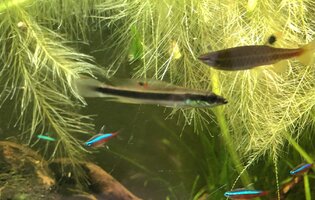
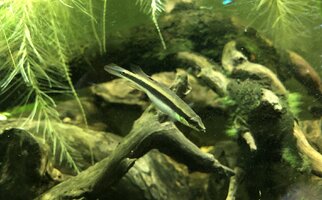
As she gets larger will she stay passive or will she turn into a predator eating everything but the kitchen sink?This female (the biggest) is getting a second ocellus!
View attachment 875052
I really don’t know, the biggest male and female are with bigger cichlids and the tetras in that tank are mostly quite big too, I don’t think there is anything they could eat in there, except maybe a couple of small diamond tetras. The ones in the smaller tank are still very small and are with cardinal tetras…will have to decide what to do when they get bigger…As she gets larger will she stay passive or will she turn into a predator eating everything but the kitchen sink?

Thanks for this information, well that is a shame, I would not want to risk the pencilfish being eaten so that rules out that tank. And yes, I can imagine that happening if they do get to 5-6". The ones I saw were still small. I was actually quite surprised to see Heiko Bleher's list of suggested tank mates that includes Nannostomus marginatus and N. eques.
So what about the big tank with the bigger cichlids, or would the pikes themselves then risk being eaten?
Well in the end I put them with my large cichlids. The smallest fish in that tank are diamond and bentosi tetras, they have not tried to catch them.I have kept this species before and they literally bite off the heads of dwarf rainbowfish. They don't just eat anything that can fit in their mouth, they will rip it in half if they have to.
Those are cool!They just arrived at my local shop, from Colombia, the fisherman says they are a dwarf species. The female has a red and black dorsal fin ocellus, I couldn't show this on a photo but saw it briefly.


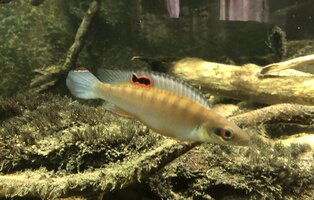

They are not usually available here either, I just got lucky, occasionally we have imports from Colombia with a few more interesting species.Very cool fish. I've never seen one over here.


