
You are using an out of date browser. It may not display this or other websites correctly.
You should upgrade or use an alternative browser.
You should upgrade or use an alternative browser.
Review of Nitrate Reducers
Advertisement
Advertisement
- Messages
- 1,789
Hey Cindi, I came across this, and wanted to know what you think. It reads like it removes waste from water using bacteria.
Let me know what you think. I took it was a liquid form of matrix.
Let me know what you think. I took it was a liquid form of matrix.
Advertisement
- Messages
- 1,789
the only bad thing is some denitrifying heterotrophic bacteria can be an opportunistic pathogenic (Pseudomonas vs ones that aren't, I think: Thiobacillus denitrificans, Micrococcus denitrificans, Paracoccus denitrificans) , so you have to be careful. Heh. That is why I kinda want to know which it would contain.
OP

- Messages
- 15,314
No, its like Quick Zyme, just land bacteria. And when there is not a lot of organics but an abundance of heterotrophs in the water they will compete with BB for the ammonia. A number of companies make the zyme stuff now and I don't see the point of it.
Stability is a bottle of nitrifyers, autotrophic bacteria made up of different strains of nitrosonomas, nitrobacter etc. Aqua Vitro Seed is the same thing.
This article talks about the differences:
Auto vs Hetero Bacteria
There is no way that I know of to bottle it since the second you open a bottle oxygen will reach it. They require zero oxygen (anaerobic) to survive vs the aerobic BB that require lots of oxygen to survive. Your denitrate and/or matrix will grow these on their own, it just takes 4-6 weeks.
Stability is a bottle of nitrifyers, autotrophic bacteria made up of different strains of nitrosonomas, nitrobacter etc. Aqua Vitro Seed is the same thing.
This article talks about the differences:
Auto vs Hetero Bacteria
well I personally would like to buy some that can help to seed my denitrate and those are heterotrophic.. can't seem to find it anywhere though. I will look that stuff up. I want denitrifying heterotrophic bacteria
There is no way that I know of to bottle it since the second you open a bottle oxygen will reach it. They require zero oxygen (anaerobic) to survive vs the aerobic BB that require lots of oxygen to survive. Your denitrate and/or matrix will grow these on their own, it just takes 4-6 weeks.
- Messages
- 1,789
OP
- Messages
- 15,314
Advertisement
- Messages
- 1,789
Hmmmm. I still don't fully understand the product, so I'm going to read more about it. Sorry for adding it to your thread, because after I read the bottle, I thought it was a liquid version of Matrix and might be helpful in this thread. Feel free to delete it. Thanks for the answers even though I don't totally get it.
There is a chance that seachem stability will, however, I'm uncertain about this.
- Messages
- 1,789
so, I want to be sure I am interpreting it correctly... seachem stability does contain the denitrifying bacterium?
OP
- Messages
- 15,314
Will, here is an email between me and them some months back regarding stability. It contains faculative bacteria as well as the regular. I guess I should correct myself. If the faculative bacteria can find a place to grow (like matrix) then yes, I guess it does contain de-nitrifiers. Though I never had any luck with any of that until I added matrix. My sand or gravel was not enough....
I had totally forgot about this...sorry
Seachem Support 100215 (Seachem Laboratories)
Dec 15, 10:59
You are very welcome!
Facultative bacteria are bacteria that can adapt to either an aerobic or anaerobic environment. They will perform in either environment as they are needed. It is very important to have a good biological media in place in your filter that will provide the proper environment for both types of bacteria. Our Matrix is a great option, because it is extremely porous and will house the anaerobic bacteria inside the pores, while the aerobic bacteria live on the outer surfaces where they can receive plenty of oxygen. Inside the aquarium, the denitrifying bacteria will live in the substrate/gravel or in some of the more porous places/objects (rocks, decorations) within the aquarium.
I hope this helps. Let us know if you need further assistance.
Seachem Support 100215
Edit: And I should say I have used stability in the past so maybe it was around in my tank available to seed the matrix. It did take awhile though so it may have just formed on its own.
OP
- Messages
- 15,314
Hmmmm. I still don't fully understand the product, so I'm going to read more about it. Sorry for adding it to your thread, because after I read the bottle, I thought it was a liquid version of Matrix and might be helpful in this thread. Feel free to delete it. Thanks for the answers even though I don't totally get it.
Just try and remember. Your nitrifyers live on inorganics, ammonia and nitrites. Heterotrophic bacteria always live on organics first, breaking them down and consuming them. If they run out of food then they can consume nitrate which is why we see nitrates disappearing sometimes in fishless cycles where there are no organics. Hope that makes sense.
Edit: I forgot to mention there are also the anaerobic hetertrophs that only consume nitrates within the interior oxygen free spaces of matrix and other porous material like volcanic rock. This is all greatly simplified of course. My favorite two articles are the following. Simple but covers it all:
- Messages
- 1,789
It does make sense. Thanks Cindi.Just try and remember. Your nitrifyers live on inorganics, ammonia and nitrites. Heterotrophic bacteria always live on organics first, breaking them down and consuming them. If they run out of food then they can consume nitrate which is why we see nitrates disappearing sometimes in fishless cycles where there are no organics. Hope that makes sense.
Yup. Both nitrifying, beneficial bacteria are aerobic, but can switch to consuming nitrates in a pinch. It isn't a very strong reliance because they do switch to being anaerobic for this process and easily die off in higher oxygenated climates without a natural food source of ammonia or nitrite.Just try and remember. Your nitrifyers live on inorganics, ammonia and nitrites. Heterotrophic bacteria always live on organics first, breaking them down and consuming them. If they run out of food then they can consume nitrate which is why we see nitrates disappearing sometimes in fishless cycles where there are no organics. Hope that makes sense.
I would assume that using Matrix from the get go could help cultivate them faster by starving them for short periods of time to encourage nitrogen production and populate the inner pores, but it's only a loose untested "theory".
This is a great thread with lots of helpful information. I am surprised that there has not been any mention of Seachem Purigen. On my 65g I'm running two canister filters. Both have Matrix and activated charcoal. My API XP-M also has 250 ML of Purigen.
I have been running at 0 ppm Nitrate for a couple of weeks now.
I have been running at 0 ppm Nitrate for a couple of weeks now.
Advertisement
OP
- Messages
- 15,314
Yup. Both nitrifying, beneficial bacteria are aerobic, but can switch to consuming nitrates in a pinch. It isn't a very strong reliance because they do switch to being anaerobic for this process and easily die off in higher oxygenated climates without a natural food source of ammonia or nitrite.
I would assume that using Matrix from the get go could help cultivate them faster by starving them for short periods of time to encourage nitrogen production and populate the inner pores, but it's only a loose untested "theory".
The nitrifiers cannot switch. It's the non-nitrifyers , the heterotroph organic consumers that can switch when starved of organics.
Edit: Its easy to over simplify but in a normal aquarium setting with loads of O2 I should say they cannot switch. In low oxygen sludge its a different story.
Whoops. Lol. Got a little excited and mixed the two. The organics that consume "wastes" into ammonia.The nitrifiers cannot switch. It's the non-nitrifyers , the heterotroph organic consumers that can switch when starved of organics.
I've been on a research binge again and recovering from overload before punishing myself again with it. Recalling non recent information gets jumbled sometimes.
OP
- Messages
- 15,314
Whoops. Lol. Got a little excited and mixed the two. The organics that consume "wastes" into ammonia.
I've been on a research binge again and recovering from overload before punishing myself again with it. Recalling non recent information gets jumbled sometimes.
I have the same problem, go up a few threads to #70, I linked a couple of my favorite articles on bacteria in the aquarium.
Thanks cindil. You're so helpful
So what sort of bacterium would seed and remediation have
I want to add that I am now using my denitrate media canister and I have no nitrates anymore- despite that I still use blood worm feedings...
So what sort of bacterium would seed and remediation have
I want to add that I am now using my denitrate media canister and I have no nitrates anymore- despite that I still use blood worm feedings...
OP
- Messages
- 15,314
- Messages
- 1,789
My nitrates are almost to 0 on the 29g, which brings up a new question for me.
What does this do to planted tanks? A lot of the plants feed off of ammonia and nitrate, and with a 0 nitrate, did we just cut off their food source?
What does this do to planted tanks? A lot of the plants feed off of ammonia and nitrate, and with a 0 nitrate, did we just cut off their food source?
OP
- Messages
- 15,314
Good question. I don't think so.....at least I have lots of new growth on my plants. You have to figure that you actually have excess nitrates that the plants are not consuming when you have a reading of anything greater than 0. Also, the majority of aquarium plants utilize ammonia before they utilize nitrates for uptake. The fish put out ammonia all day long so its still a constant food source. By the time it turns into nitrates, it has gone through being cycled and not consumed during that time.
I hope it works as well in my pond I ordered!
I hope it works as well in my pond I ordered!
- Messages
- 1,789
That makes sense. Then that kind of does not make sense.
I'm thinking about Co2 systems, and when in use can raise the nitrate. So can some ferts. So if the increase for nitrate is part of the fert system, wouldn't you need nitrate in tanks for plants? Especially if your adding more of them?
Don't shoot me! lol
I'm thinking about Co2 systems, and when in use can raise the nitrate. So can some ferts. So if the increase for nitrate is part of the fert system, wouldn't you need nitrate in tanks for plants? Especially if your adding more of them?
Don't shoot me! lol
CO2 tanks flirt with the very edge of disaster. Using the Estimative Index, weekly schedules of your ferts should get you ideal. Introduce nitrates, as this bit pertains to the subject, in the beginning, [weekly] water change takes the excess out and the process starts again.That makes sense. Then that kind of does not make sense.
I'm thinking about Co2 systems, and when in use can raise the nitrate. So can some ferts. So if the increase for nitrate is part of the fert system, wouldn't you need nitrate in tanks for plants? Especially if your adding more of them?
Don't shoot me! lol
I'm still in the process of learning the basic botany of the home aquaria, but I think that the plants uptake the nitrogen compounds to use them to grow by breaking them down into nitrogen. Even if the last of the true nitrogen cycle bacteria consumes the nitrates into nitrogen, the diffused gas would still be used by the plants, just as terrestrial plants take from the atmosphere. Both ammon(ia/ium) and nitrates are used as a nitrogen source for chlorophyll in photosynthesis, while ammonia and water provides hydrogen for sugars and protein. CO2 is essentially carbon required for the acids, proteins, and sugars.
Advertisement
OP
- Messages
- 15,314
Nice research Grimund
You already know way more about it then most of us.
Dragones550918 - I do dose flourish once or twice a week, perhaps that's enough.....all I know if my plants don't look at all like they're suffering and I have new growth.
You already know way more about it then most of us.
Dragones550918 - I do dose flourish once or twice a week, perhaps that's enough.....all I know if my plants don't look at all like they're suffering and I have new growth.
Nice research Grimund
You already know way more about it then most of us.
Dragones550918 - I do dose flourish once or twice a week, perhaps that's enough.....all I know if my plants don't look at all like they're suffering and I have new growth.
Hence why I suffer from information overload
Flourish, is essentially, micro nutrients. They are the trace minerals that plants need, just like our fish need theirs. The big three, Nitrogen, Phosphorous, and Potassium are missing. Luckily, fish waste produces nitrogen and phosphorous, but lacks potassium.
Maybe adding a bit of potassium would help your plants out. If your dosing liquids, API Leaf Zone would suffice, based on my current research that is.
- Messages
- 1,789
lol Well Grimund, you talked way over my head, but I got the gist.
CindiL, I have been using flourish as well twice a week, and Excell once to twice a week. Only plant that still is not doing good is my bocopa. Has not done well since I got them. Just got worries with my nitrate heading to 0, that the plants will start to suffer.
CindiL, I have been using flourish as well twice a week, and Excell once to twice a week. Only plant that still is not doing good is my bocopa. Has not done well since I got them. Just got worries with my nitrate heading to 0, that the plants will start to suffer.
OP
- Messages
- 15,314
Interesting. My bacopa is doing great as well as my others but I do add in Replenish and fresh trace as well since I use RO on this tank. I think they like the extra calcium maybe.
- Messages
- 1,789
Yeah, but my bocopa has been doing leaf melt from day one, but the rest us growing like weeds. Even as my nitrate heads to 0, even my java moss is growing. The hornwart is out if control and has been trimmed back twice. Everything is a luscious green, except the bocopa. And I have been using the matrix since day one. Connection?
OP
- Messages
- 15,314
- Messages
- 1,789
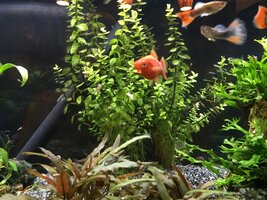
This is off topic here, but I'm going to answer. I'm running 3 over the tank CFL 6500k 13w lights that are about 28 inches above the substrate. Here is pictures.
I'm lightly planted with 3 moss balls, java fern, java moss, anubias, hornwart, and 3 pothos cuttings...I've tried what my fish guy said and even separated them and moved them around to different points of light. No good. Still melting leaves off the bottom while the tops grow...and now leaf melt is showing up higher up.
I'm lightly planted with 3 moss balls, java fern, java moss, anubias, hornwart, and 3 pothos cuttings...I've tried what my fish guy said and even separated them and moved them around to different points of light. No good. Still melting leaves off the bottom while the tops grow...and now leaf melt is showing up higher up.
CO2 tanks flirt with the very edge of disaster. Using the Estimative Index, weekly schedules of your ferts should get you ideal. Introduce nitrates, as this bit pertains to the subject, in the beginning, [weekly] water change takes the excess out and the process starts again.
I'm still in the process of learning the basic botany of the home aquaria, but I think that the plants uptake the nitrogen compounds to use them to grow by breaking them down into nitrogen. Even if the last of the true nitrogen cycle bacteria consumes the nitrates into nitrogen, the diffused gas would still be used by the plants, just as terrestrial plants take from the atmosphere. Both ammon(ia/ium) and nitrates are used as a nitrogen source for chlorophyll in photosynthesis, while ammonia and water provides hydrogen for sugars and protein. CO2 is essentially carbon required for the acids, proteins, and sugars.
Yes, but unlike land plants they only use nitrate as a last resort and aren't as efficient at the uptake and do not get as much nourishment from it. I'm not sure about the nitrogen gas component...
Also my denitrate factory is keeping my nitrate at 5 ppm for over a week. along with plants of course!
I never said that they were efficient, just that they do use them. Terrestrial plants take up nitrates, but most of their nitrogen comes from atmospheric consumption anyway.Yes, but unlike land plants they only use nitrate as a last resort and aren't as efficient at the uptake and do not get as much nourishment from it. I'm not sure about the nitrogen gas component...
Also my denitrate factory is keeping my nitrate at 5 ppm for over a week. along with plants of course!
Advertisement
OP
- Messages
- 15,314
Well... There are studies that show that aquatic plants take up ammonium before they will nitrate and that is the main way that they reduce nitrates. https://www.sciencedirect.com/science/article/abs/pii/0304377086900938
Both terrestrial and aquatic, use the most readily available source of Nitrogen. Usually, it's ammonium in the aquaria setting. All plants uptake ammonium (NH4+) and nitrates (NO3), just that terrestrial, post establishment, has access to gaseous N2.Keep searching. You'll find that aquatic plants take up ammonium or ammonia first. If all they have is nitrates they actually have to convert it back to ammonium in order to be able to uptake it. I'll see if I can find my information on that.
It's not the plant that is different, just the medium and availability in which it gets the resources that dictate the consumption. Nitrogen -> Ammonium > Nitrates
Both terrestrial and aquatic, use the most readily available source of Nitrogen. Usually, it's ammonium in the aquaria setting. All plants uptake ammonium (NH4+) and nitrates (NO3), just that terrestrial, post establishment, has access to gaseous N2.
It's not the plant that is different, just the medium and availability in which it gets the resources that dictate the consumption. Nitrogen -> Ammonium > Nitrates
The paper shows it depends upon the type of aquatic plant. Typically, it would suggest that most plants we use, use ammonium.
- Messages
- 314
Thanks so much for the informative thread. A couple of questions:
Does anyone know if the salt recharge of Nitra-zorb would be harmful for a tank with corys (salt sensitive IIRC)?
And along the same lines, is instant ocean's natural nitrate reducing product also a risk for salt sensitive cory's? I have extraordinarily soft city water and like the concept of increasing the buffering capacity.
Thanks!
There are always exceptions to ruleswith genetics and evolution, there's bound to be them. Like I said, still early in my research and I haven't had much time to sit down and sift through more gritty stuffThe paper shows it depends upon the type of aquatic plant. Typically, it would suggest that most plants we use, use ammonium.
The NitraZorb should be safe. You rinse it off before each use, getting the salt off.Thanks so much for the informative thread. A couple of questions:
Does anyone know if the salt recharge of Nitra-zorb would be harmful for a tank with corys (salt sensitive IIRC)?
And along the same lines, is instant ocean's natural nitrate reducing product also a risk for salt sensitive cory's? I have extraordinarily soft city water and like the concept of increasing the buffering capacity.
Thanks!
As far as the Instant Ocean, it doesn't seem like it's got salt in it, just initially designed for marine applications but entirely freshwater safe.
Have you tested the GH and KH of your water to be sure?
Random Great Topic!

Today's Deals
Advertisement
Advertisement
Advertisement