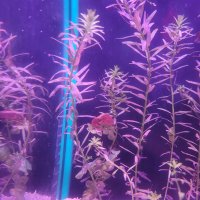
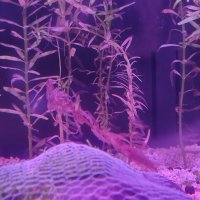
Why is my rotala rotundifolia's leaves so weak?

IzzBizz

Active Member
Member
Messages
51
Hi everyone! I recently decided to try out live plants so I set up an 8g tank and added my first aquatic plants. I chose rotala rotundifolia, redroot floaters, anubias barteri, pearlweed, and Java moss. I really love how it looks, but My rotal rotundifolia started to get severely weak and some turned brown. I'm a beginner with the aquatic plant world so I'm not sure how to help it. I dose it with fertilizer 4x every week 2 ml. It has a light and the other plants seem to be doing pretty good. Except for the red root floaters have some pinholes but they did start like that. There is a twintail halfmoon Betta as well. The substrate is a mixture of sand and clay based plant substrate for nutrient. I've tested the water and it read really good, with the pH at 7.5, barely any nitrate, no nitrite, no ammonia.

Thanks for reading, I'd really appreciate help.
 

Attachments

  • 17277466248852177175612595370006.jpg
    17277466248852177175612595370006.jpg
    601.6 KB · Views: 122
  • 1727746651744414753976236846348.jpg
    1727746651744414753976236846348.jpg
    604.1 KB · Views: 58
  • 17277466636744123558153522212995.jpg
    17277466636744123558153522212995.jpg
    446 KB · Views: 97
  • 17277466840088791479754001468224.jpg
    17277466840088791479754001468224.jpg
    333.4 KB · Views: 68

Advertisement
First off, how long have you had the plants? Were they bunched, potted or TC (tissue culture).?

Are you aware that plants we grow in tanks are for the most part emergent plants? This means they prefer to grow in the air but can adapt to growing submerged when necessary. Most grow where seasonal flooding is a part of every year,

Nurseries that grow these plants grow most of them ‘emersed’ which means the whole plant is on the air except the roots, which are kept very wet.

When you bring them home and plant them underwater, all the leaves that grew in the air become useless because they cannot function underwater.

So the plants have to discard all their emersed leaves and replace them with leaves that are able to function underwater.

This adaptation takes time and while it’s happening the plants generally do look very sad and even as if they are dying. Anubias can take six months or more depending on their size, most stem plants take a couple of months.

Usually they aren’t actually dying even if they look terrible, but not every cutting will make it.

Based on what I can see the rotalas don’t look too bad.

Your anubias looks to be planted and that’s not good. Anubias and Java ferns also will rot if the rhizome is in the substrate. It must be above the substrate with water freely circulating around it. Typically we mount them to wood or rock with gel super glue or ties.
 

Advertisement
The basal or even mid part of stem plants can look bare over time due to abscission. If the established leaves are not delivering, and more favourable areas are sensed (higher up the water column), a plant will sacrifice the inefficient leaves. In worst cases the stem will autofragment (/ rot) to disconnect itself from its location.

In the first years of the planted tank hobby, it seems fingers are mostly pointed towards substrates, fertilizers and water parameters. But the decision to shed leaves is mainly driven by light intensity, which can be circumvented by CO2 management.

- Improved water flow helps, but fish might not enjoy it.
- Injecting CO2 gas helps big time, regardless.
- Injecting CO2 gas + increased light intensity gives the best results, but requires water (organics) and mineral management.
- Increased light intensity only is risky on several grounds.

My recommendation: choose rosulate (like crypts) and rhizomatous (like nymphoides, ferns) species, and true aquatic plants (like hornwort).


Of all the minerals in the world, plants require nitrates and potassium the most. Some planted tank owners dose 30 ppm (a lot of ml) nitrates weekly.
 
  • Thread Starter
  • #4
First off, how long have you had the plants? Were they bunched, potted or TC (tissue culture).?

Are you aware that plants we grow in tanks are for the most part emergent plants? This means they prefer to grow in the air but can adapt to growing submerged when necessary. Most grow where seasonal flooding is a part of every year,
When I got them, they were bunches. I have a picture of when I first got them, which I'll attach. I got the Rotala rotundifolia 12 days ago.

That's really cool that they shed their leaves to develop 'aquatic' ones. I'll wait, continue to dose it with fertilizer, and try to be patient. I'm glad that it's normal for them to do that, I was getting worried.

My Anubias is sorta planted .. I'll put it on the rock instead of planted in front of it. Thank you for helping out! That was super helpful.

The basal or even mid part of stem plants can look bare over time due to abscission. If the established leaves are not delivering, and more favourable areas are sensed (higher up the water column), a plant will sacrifice the inefficient leaves. In worst cases the stem will autofragment (/ rot) to disconnect itself from its location.

In the first years of the planted tank hobby, it seems fingers are mostly pointed towards substrates, fertilizers and water parameters. But the decision to shed leaves is mainly driven by light intensity, which can be circumvented by CO2 management.

- Improved water flow helps, but fish might not enjoy it.
- Injecting CO2 gas helps big time, regardless.
- Injecting CO2 gas + increased light intensity gives the best results, but requires water (organics) and mineral management.
- Increased light intensity only is risky on several grounds.

My recommendation: choose rosulate (like crypts) and rhizomatous (like nymphoides, ferns) species, and true aquatic plants (like hornwort).


Of all the minerals in the world, plants require nitrates and potassium the most. Some planted tank owners dose 30 ppm (a lot of ml) nitrates weekly.
Okay! Thank you so much for all the suggestions!! I really appreciate it :)
 

Attachments

  • 20240920_164542.jpg
    20240920_164542.jpg
    451.1 KB · Views: 78
Another factor not mentioned is the plants could well have come from a different water source if they were submerged. I know when I moved a couple months ago to about 40 min away with a different water source, my entire plant collection melted and looked completely different to what they were only days before.....but did grow back quickly. It was just adjusting to the different water parameters etc. I think the water source where I am now is from a creek compared to the big town water source.

I only have dirted tanks with two low energy and two high energy.

The two lower energy ones just had low lighting, plenty of plants and they look after themselves.
The two high energy have an even higher number of plants, both have C02 and balanced with higher lighting (though I have no expensive lights) and they accelerated quickly once an equilibrium was attained.

So for those two I would put the balance of lighting and C02 first and having a suitable amount of macro & micro nutrients second. Can't beat carbon for plants!
 
Some plants, like rotala and java moss, wouldn't grow in my water. Others, like crypts, anubius, and vals do very well without the initial melting that many people experience.

I wouldn't put a lot of time or energy into plants that are struggling, I'd try some others.
 

Attachments

  • 55.jpg
    55.jpg
    343.6 KB · Views: 70

Random Great Topic!

Advertisement


Advertisement


Advertisement


Back
Top Bottom