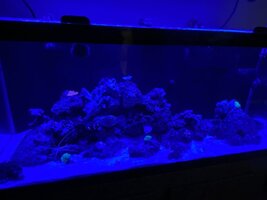
CONGRATULATIONS Sean!!! She's a beast!! It's gonna be AWESOME!!
It appears we're on the discussion of rock, so here's my take. If you want purple rocks without waiting for coralline growth, Life Rock is worth its cost. Is it worth it to me? Nope, but I'm not a coralline chaser to be quite honest and don't care if my rocks are ever purple. Why? Because I don't want to see much bare rock in the first place... I want to cover it with coral.
I also am a fan of using dry rock over
live rock. Both have their benefits and drawbacks. Live rock - can insta-cycle a tank, brings with it all kinds of beneficial microfauna and such but... it can also bring pests of both the fauna and flora kind. Also, it is difficult to build the rockscape of your dreams when you're dealing with rock that must be kept wet all the time. Dry rock - will not bring pests, or anything else, including the cycle and beneficial fauna but the aquarist can really take their time in building a really nice scape, which is important since this is the backbone of your reef... you'll look at it a long time and it will shape the overall display of your corals, not to mention, be the safe zones for fish to feel comfortable and sleep. Aaanndd... I know it's a right pain in the rear to change a rockscape in an established tank because although I have done so, I've wanted to for a long time. Last thing about dry rock and perhaps what's seen as its biggest negative is that it needs to be cured, which is a process that rids the rock of any dead organics that may be and are likely to be contained within. Dead organics break down into
nitrates and
phosphates, the favored foods which cause nasty algae outbreaks.
So, what's the verdict? For me, it's Reef Saver Dry Rock from Bulk Reef Supply. It's nice-looking rock, excellent to scape with, and though it is natural Marco rock (natural meaning, not man-made and thus capable of holding dead organics within), and BRS recommends curing any and all dry rocks before adding them to a setup... well, many, many reefers report that when curing Reef Saver rocks, they never gave off a level of
ammonia, nitrates, or phosphates and this means... we can be 99% sure we'll be fine if we skip the curing process. I didn't know all this when I set up my own little reef so we have FijI rock, also from BRS, which wasn't really cured. We put it,
sand, saltwater, pumps, and a filter on the tank and left the lights off, figuring it could cure in-tank while the tank was cycling. Worked for us.
To be fully clear, the reason why we had a quick and easy, hardly noticeable cure while some rocks (think Pukani) can take months to cure... well, it really just depends on the source as well as the porosity of the rocks. FijI is rather dense, full of many very tiny holes with very few which are any larger. Because of its density, when my rock was in nature, it was capable of holding less life than a much more porous rock like Pukani.