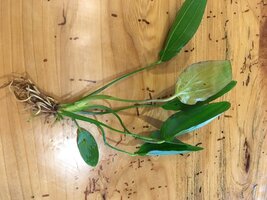
Quarantine Plants?

Thank you for all your replies!! You guys are so helpful! But I am addicted to fish keeping I think!! My plan was to just get my son a betta - 3 weeks later, now he has one in a 5.5, going to be upgraded to a 10G this weekend, I have a betta in a 10G, my future plans are a planted shrimp tank (I love the idea of the Walstad method, but it may be out of my league!) and a 20G planted with a nano community! I have a problem!!

So my plan is to google and see if peroxide is okay for the plants that I purchase - today it is just wisteria and java fern, but more will be coming in the future

After peroxide dip (if it's safe), I will quarantine - is a week a decent amount of time? I have an extra heater on stand-by in case either of mine break, so I can use that. I also have an empty 4 G tank without a lid, so will use that as my bucket.

Does this filter look okay?? I would also need an air pump, correct?

Or I can use the canister filter coming this weekend with my 10G (previously used)??

I currently do not have any fertilizers, but am fine with starting to use them - but my plan is to add a few shrimp and a snail with the betta once it is cycled and stable. Is it a problem to have dosed the plants with copper (granted it will be a month prior)? Also, if I dose copper and use the sponge filter in the QT tank while dosing it, it that filter ever safe to use on my shrimp tank?

And just so I am understanding, SeaChem Flourish takes care of micronutrients with only a tiny bit of macros correct? Thrive is more comprehensive and I likely wouldn't need it at the moment?

If it makes any difference, we have well water, and when I tested with the 5-in-1 strip a few weeks ago (since then have been using the master kit), KH was 180 and GH was 120-180.

Thank you so much for everyone's help! I have learnt a ton since starting into this hobby and I can't wait to learn more!!
 

Advertisement
This is what I do, I use h202, but any one of these three methods work for parasites and pathogens:

1. 10mg/l of Potassium permanganate for 10 minutes and rinse
-1 tsp per gallon of Jungle Clear water (12 hours)

2. Bleach solution of 1:19 (bleach:water) for 3 minutes

3. Hydrogen peroxide 1:3 (H2O2:water) for 6 minutes


To rid bugs and snails, use Alum after one of the above soaks:

Directions for using Alum:
Soak in Alum (Alum USP or Aluminum Sulfate found in spices section, McCormick) for 72 hours
- 10 teaspoon per 1 gallon

To make sure snails are killed, after using Alum:
2-3 drops of Seachem Cupramine per gallon for 1 month
 

Advertisement
And just so I am understanding, SeaChem takes care of micronutrients with only a tiny bit of macros correct? is more comprehensive and I likely wouldn't need it at the moment?

If you don't have any ferts on hand, you're better off getting a larger bottle of Thrive and using it for your display tank and quarantine tank. I only use Flourish as I buy it in my bulk as my micro fert (I use separate macro ferts).

You needn't dose much ferts at all in the quarantine tank. Perhaps 1/4 to 1/2 the normal amount once a week, and that's it.

Does this filter look okay?? I would also need an , correct?

You technically needn't even use a filter: just the air pump. Filtration isn't especially useful in a plant quarantine tank, and I only use it to provide water circulation for the ferts and heater.

I will quarantine - is a week a decent amount of time?

Length of quarantine time is a difficult thing to establish. From my understanding, most people who do quarantine plants try and quarantine them for as long as they would fish: about 4 weeks. This ensures that most species/strains of parasites/bacteria/other pathogens progress their life cycle to a stage at which they're vulnerable to copper.

As for whether you need to QT plants for 4 weeks (or at all): I think it's just a trade-off with risk. I find most people who QT plants for the full 1 month tend to have very well established display tanks with rare/expensive plants (along with fish) to which they're unwilling to subject to any potential pathogens.

Most (seemingly 80-90%) of people just soak plants in any of the various dips.

Is it a problem to have dosed the plants with (granted it will be a month prior)?

This is a complexity. Most people who keep shrimp avoid any possibility of copper entering their system, and they wouldn't cross-contaminate any plants/decoration that've been in a copper-medicated tank with their shrimp tank.

That being said, one safe way to minimise the risk of copper toxicity if using Cupramine is to simply dose copper for a week, then use some activated carbon in the QT's filter for a few days, then give the plant a thorough wash with tap water before moving it into the display tank.
 
Carbon is not so effective at removing copper, better to use Cuprisorb or PolyBio Marine (the pad turns bluish when copper is absorbed).
 
Actually I have to ask, do plants (absorb) copper? My understanding is that it is difficult to remove copper from surfaces and I always stayed away from it in case because low doses can cause issues longterm for fish and especially baby fish and inverts. I'm really curious!
 
Actually I have to ask, do plants (absorb) ? My understanding is that it is difficult to remove copper from surfaces and I always stayed away from it in case because low doses can cause issues longterm for fish and especially and inverts. I'm really curious!

There's a lot of conflicting information about copper in tanks. I haven't read extensively into it, but this is the gist of my understanding:

  • Free copper (and some other metals including cadium and potassium) will be adsorbed onto the surface of glass as a silica complex
  • Free copper in the water column will bind with various organic compounds and adhere to most other surfaces, but will otherwise not present toxicity issues to fish
  • Accumulated free copper toxicity is more an issue with reef tanks due to the infrequency and limited water changes (10-15% once a month)
Plants will take up copper (which is a trace element necessary for their biological functioning). Regular pruning of old growth will essentially remove copper that has been taken up by the plant. The effect is, I think, more noticeable with fast growing stem plants (e.g. wisteria, hygro).

And of course, the other issue is being using water conditioner when dosing copper: it causes copper ions to convert to Cu3+, incredibly more toxic to fish/inverts.
 

Advertisement
Thank you everyone!

Safe to say I am thoroughly confused!! Haha!! I have 60+ houseplants, some I have cared for for over a decade, but aquatic plants are proving to be a whole different entity!!

So, I picked up the java fern and wisteria, in addition to an amazon sword. The wisteria looks terrible!!!! I have attached a photo...do you think it can come back?? The other two look pretty good.

This evening I am going to read through the copper info again to understand it more thoroughly (maybe caffeine will help!), but what happens if I just avoid copper?? What do people use in planted shrimp tanks as a fertilizer? Should I just use that to be safe?

I was out picking up the plants prior to me reading your responses so I naively was convinced at the pet store to purchase Nutrafin Plant Gro (the lady said it was like Flourish, but a different company) which contains copper! Gah! It says it contains 0.0005% chelated copper, the ingredients say the form is copper sulphate. Should I return whatever this is and just order Thrive? It is $30+ for a 500ml bottle on amazon, does that sound right? It wouldn't be here for days, but I am sure the plants will be okay okay in the meantime (right?!?)

Right now all the plants are just floating in a QT bucket (well the wisteria is decomposing ) with water conditioner while I sort everything out!! I will likely go with a dip of some sort (likely the peroxide because I have it), and I just might be the the 80-90% that simple puts the plants in after rinsing, even though I would love to quarantine the plants just to be thorough. Each tank only has one betta as an inhabitant, but we're already pretty attached and I really don't want to do anything to hurt them!

Thank you so much for helping me, and I apologize about the numerous questions!!
 
Oops, forgot the pictures!!
One further question, should the amazon sword be planted in substrate ASAP, or can it float for a while?
Thanks again! IMG_9277.JPGIMG_9278.JPGIMG_9280.JPG
 
ah! It says it contains 0.0005% chelated copper, the ingredients say the form is copper sulphate.

No, no. It should be fine. Copper is an essential trace element for nearly all organisms. Like any chemical substance, copper is only toxic at certain concentrations. As another example, we all need table salt in our diet. But give enough to a person, and they'll start feeling quite ill.

Copper in ferts is in too low a concentration to cause toxicity issues to either fish/inverts. Because of this, people use the same ferts in shrimp tanks as they do in non-invert tanks.

I think a dip sounds like the best option. If you're worried about the wisteria, let it grow in quarantine for a little while to ensure it's a bit more robust before subjecting it to a dip.
 
Thank you Minnowette!!
That makes sense! Thank you for setting my mind at ease.
Do you recommend that I return my fertilizer and get Thrive? Or use it, and once this bottle is done, change to Thrive then?
Thanks again!
 
I would recommend returning it and switching to Thrive. Both wisteria and amazon swords, on account of their fast growth pattern, are quite greedy when it comes to macronutrients.
 

Advertisement


For the a.swords, they will benefit from a root tab placed under the substrate. They take up most of their nutrients from the roots and are huge nutrient hogs! I just use those DIY Osmocote tabs and they work so well!
 
Thank you angelcraze !! Is the Osmocote different than the Thrive tabs? I don't have them, but noticed they were available and was just wondering if the Osmocote was better

I have to order Thrive, there is no where to purchase it around me, so have to place an Amazon order tonight or tomorrow. I hope my plants will be okay without fertilizers for about a week or so! :/

Thank you!!
 
Is the different than the tabs?

Slightly different. There's two types of Osmocote root tabs, those made from regular Osmocote (which has macros) and those made from Osmocote Plus (macros + micros). In addition, Osmocote uses ammoniacal nitrogen, while Thrive root tabs uses potassium nitrate.

Because ammonia is much more easily taken up as a source of nitrogen (compared to nitrate), Osmocote can be very useful for substrate fertilisation. The downside is that they need to be used sparingly and/or with a deep substrate (2-3 inches), otherwise it just leads an excess leaching of ammonia into the water (with all its associated side effects).

But in practice, I think most people pursue DIY Osmocote root tabs simply because it's super affordable. The only major competitor is Seachem Flourish root tabs, and that's just a micro supplement with next-to-no macro content.
 
Thank you!! That is very helpful!! So I will just make sure the capsule is buried under the gravel. What size capsule do people generally use?
And it's okay to use with fish as well as invertebrates, correct?
Is it safe to start this prior to having my tank cycled?
 
I live in Canada where Osmocote is not available. So I order some size 00 gel capsules filled with Osmocote Plus granules from the US. Sometimes I bury the whole capsule, sometimes I open it and (with my planting tweezers) bury some individual granules around the smaller heavy root feeders.

If the granules float out of the substrate, they will rest on top easily visible. Then I just carefully place them back under the substrate. I actually prefer them to the API root tabs because if they are accidentally exposed to the water column, they cloud up and dissolve. At least the Osmocote keeps contained in a granule.

I use all the root tabs mentioned, I have the best growth with Osmocote. My tanks are big enough that I don't notice any nitrate increase or ammonia. I still wouldn't put them all over my tank or anything. At the base of heavy root feeders seems to work well IME.
 
Thank you angelcraze !! I am also in Canada (Ontario), so I guess I need to do the same thing...where do you order the Osmocote already in capsules from, if you don't mind me asking?
The only place to purchase Thrive that I have found is Amazon, is this right? The chain pet stores around me don't seem to have it!
Thank you for all your help!!
 
There's an LFS near me, Critter Jungle, they are trying to bring Thrive into the store, it's gaining a lot of popularity, so hopefully an LFS near you might start carrying it too. For now, I would say Amazon is your best bet. If I can find that link to a provider in Montreal I once had, I'll let you know!

I actually ordered the Osmocote tabs off evilBay. I buy 100 of them at a time.
 

Advertisement


If you're having problems finding Osmocote/Plus in gel capsules, it's worth noting that the gel capsule is optional: the capsule is mostly there to simplify use as you can bury ~20 Osmocote pellets at once rather than having to use tweezers and burying 50-100 individual pellets into the substrate. Osmocote pellets can also be frozen into small ice cubes and buried into the substrate.

Deeper is always better, many people bury it straight against the glass. Osmocote dissolves based on temperature (not in exposure to moisture concentration), so the further it is in the substrate and away from the water column, the nutrients will be released more progressively.
 
Thank you both!!

Burying 50-100 individual pellets is not likely something I will do, that seems a little tedious.

I seem to be able to order Osmocote on Amazon, but I did see that they sell prepacked tabs on Ebay, but they are $20 shipping, so maybe I am further ahead to order the Osmocote Plus and the gel capsules both from amazon and make my own.

Dosing wise, is it one capsule per month per rooted plant (approx)? I only have one rooted plant, at the moment, but plans to get more eventually.

I saw Amazon also has these


but I think it is just straight Osmocote, so no micros, am I correct?

Thanks again for your help!!
 
It's Osmocote Plus that you want.
20180628_233450.png
I'd guess it's every 6-12 months that a new tab can be added. Basically, I add a tab when if ever I see yellow pinholes or the plant just looks like it needs a boost. I also always prune away old ugly leaves at the base to encourage new healthy growth instead of the plant putting energy into repairing old leaves.

Btw, I don't bury 50 at a time. I just feel that dispersing them a bit is more beneficial, plus I don't think my dwarf sag plants need a whole gel tab filled. I took one apart last night and buried about 15 granules around the sag and crypts in my 33g.
 
Dosing wise, is it one capsule per month per rooted plant (approx)? I only have one rooted plant, at the moment, but plans to get more eventually.

It's usually replaced every 3-4 months, and people tend to bury 1-2 every square foot (generally close to whichever plants need it).

Again the issue is "too much of a good thing": too many Osmocote tabs and it'll start leach more ammonia into the water column than can be taken up by your plants and filter. I had read of someone planting 40 or so in their 20 gallon: in a day their fish were dead because of ammonia toxicity.
 
Perfect, just the info that I need!

It will take me a long time just to use just 50 capsules then, so I will probably order them from eBay too

Thank you so much, everyone here is so helpful!!
 
It's not an exact science haha. You'll get a idea of how much you want to use once you see how it works in your tank. I tend to stay on the cautious side.

Oh and btw, my 33g last night, I'm trying to grow the sag, so I didn't have plants all over yet. Once they fill in, I'll need more root tabs dispersed in a larger area.
 
IMG_9297.JPG Thanks angelcraze !! I am quickly learning there is quite an art to the science of fish keeping, unfortunately science is my strength and have never been good at the arts!!

I have ordered Thrive, should be here I. a week or so, I hope the plants are okay that long without it!!

I will order the osmocote tabs tomorrow, once the kids go back to school I will have more time for me (and the fish!)

The water wisteria that I bought looking like , has just continued to deteriorate. It's still in its own heated bucket, but every day more of it rots. I am really not sure what it's supposed to look like, but don't think it's going to make it.
 
Awwww No, it doesn't look very good, but you never know. See all those segments in the stem? Techically a new shoot is able to grow out of the stem part at those segments if it's not rotten, but it would need some nutrients. Sometimes a stem plant will revive, sometimes it melts completely.

I don't have wisteria myself because it tends to do best in harder water, but it looks lacy and feathery. It can get quite bushy with enough light and provide some great hiding areas for small fish.

Sometimes you have to experiment a little and find out which plants grow well in your tank. It can vary even between my own tanks with the same water source. If a particular plant is doing poorly in one tank, I'll move it to another to try. (I'll find out whichever plants do well in each tank and roll with it, so maybe one tank has hygro rosenervig and another is filled with stargrass.)

Do you have a place to buy plants nearby? Sometimes I'm able to get tidbit plants to try in my tanks without spending a ton on full bunches (that could all melt away on me AND it's happened)
 
Thank you so much for taking time to help me, I really appreciate it!!

I think it's melting completely, every day more leaves and more of the stem turns to jelly I can bring terrestrial plants back from the brink of death, but I am not having the same luck with aquatic ones!!

My water is very hard, so maybe I will try the water wisteria again with a better specimen!!

I don't have a great choice of good stores for aquarium plants around me. These last ones had to be special ordered for me, the store is 25 mins away from me. I knew the wisteria looked bad from the get go, but took it because it was ordered for me (and I hate confrontation...I am working on that!! ).

There is a store 45 minutes from me, but 10-15 mins from my work, and the next is an hour from home. So not a great selection, no.

There is a greenhouse that has duck weed close to me, could I put that in my aquarium? I also have hornwort in my outdoor pond, but I was too afraid of transferring badness bringing it in (there are goldfish, frogs, snails in the pond)

I like the idea of just trying a small amount of plant without buying a whole bunch, I will see if I can do that! Thank you!!

Thanks again for all your help!!! This aquarium business is much more difficult than I anticipated!!
 
Planted aquariums are a very different thing to house plants for sure.
For a newly planted aquarium, I used a soil substrate under a thin layer of gravel - damping the soil should keep it in place just be gentle when adding water to your tank. Add just enough water to cover the soil then plant, then slowly. For the first few weeks I like to add a water based plant fertalizer until the plants are established. You can add you fish once the tank have been active for at least a few days (more is better) - note that tanks with this kind of setup are prone to rapid algae growth so you might want to add a bit of a cleanup crew to help keep it in check.

If your plants are dying it could be that they are not getting enough neutrients - fertalizer should help with this.
 

Advertisement


HI all. Just a question. I bought the osmocote and it a lot bigger than I expected. I have a 90gal with many different plants. How many of these should I put in? Should they go under roots or in the vicinity of a group of plants. Thanks 06ED809D-C866-4709-96E0-71CEBC96D412.jpeg also it just osmocote not plus. Just saw there is a plus.
 
1-2 per square foot. Place it near plants. Don't plant too many at a time. I'd say a max of 10-15. They leach ammonia into the water column, so bury it as deep as you can into the substrate.
 
Thank you. I thought 6 might be to many. I just want to put them around the sword plants to see if that gives them a boost.
 
I am planning on acquiring some new plants from someone on a local Facebook group. Are there any steps I should take of quarantining the plants so as to not transfer any nasties to my tank?
 
members swear by bleach and vinegar dips to rid of pest snails and possible disease, bleach dips are done at 1 part bleach 10 parts water for plants, and 2 parts bleach 10 parts water for decor and other items.
Vinegar isn't as harmful as bleach, and I believe can be done at a 2 parts vinegar 10 parts water dilution on plants.
When using it as a pesticide in my garden I use 2 parts vinegar, 1 part dawn soap, and 1 part commercial oil, the rest is water, so I know it's safe in that concentration.
 
what I did was take a 5 gallon bucket of old tank water (with nitrates) and placed the plants in there for a few weeks. about 1 week later found some tiny snails. the eggs are tiny.

some ppl will dip them in H2O2, and other chemicals.
 
I suggest a rinse, dip, rinse, and quarantine to mitigate the risk of transferring unwanted snails, planaria, ich and other parasites, bacteria, etc.

A three day QT is the minimum I'd do but longer is better.

I use alum but potassium permanganate is a more popular choice.

 
members swear by bleach and vinegar dips to rid of pest snails and possible disease, bleach dips are done at 1 part bleach 10 parts water for plants, and 2 parts bleach 10 parts water for decor and other items.
Vinegar isn't as harmful as bleach, and I believe can be done at a 2 parts vinegar 10 parts water dilution on plants.
When using it as a pesticide in my garden I use 2 parts vinegar, 1 part dawn soap, and 1 part commercial oil, the rest is water, so I know it's safe in that concentration.
Are you sure about 1:10 for the bleach, I've only ever heard and done one part bleach, 19 parts water which seemed plenty strong... Quarantining a few days wouldn't hurt either, any parasites that don't find a host in a few days usually don't survive anyway and you'd find out if any snails managed to survive the dip somehow.
 
Are you sure about 1:10 for the bleach, I've only ever heard and done one part bleach, 19 parts water which seemed plenty strong

That is much stronger than the typical suggestion of 1:19 (5%) and I think it could be pretty harsh on plants. The only time I've used 1:9 (10%) was to sterilize non porous equipment after parasites and in retrospect it was probably excessive.
 

Advertisement


I am planning on acquiring some new plants from someone on a local Facebook group. Are there any steps I should take of quarantining the plants so as to not transfer any nasties to my tank?

Hello Loveland, Greeley here...

New plants will sometimes carry the eggs of Ramshorn snails. But, won't carry anything like a virus or parasite that could infect healthy fish in pure water conditions. When I get new plants, I typically rinse them well in warm tap water to remove the snail eggs and then they're ready for the tank. Be sure to remove any lead bands, or rock wool that my be holding the plants together. You don't want any of that stuff in the tank.

Have fun,

Old
 
I absolutely recommend quarantine for plants. I had an alarming experience recently with an order online from an individual on YouTube. I put my plants in a white bucket and later when I checked on them (anxious to get them planted), the bottom of the bucket had lots of creepy looking worms squirming around. I will always quarantine. I also added some aquarium salt to the water which did the trick.
 
I absolutely recommend quarantine for plants. I had an alarming experience recently with an order online

I've removed worms from new plants too - yuck! They might have been harmless but I'm glad I didn't put them in my tank.

Folks have brought pest snails, planaria, ich, bacteria, and other nasties into their display tanks on plants. Do folks have to dip and QT plants? Not at all. But an ounce of prevention is worth a pound of cure.
 
I absolutely recommend quarantine for plants. I had an alarming experience recently with an order online from an individual on YouTube. I put my plants in a white bucket and later when I checked on them (anxious to get them planted), the bottom of the bucket had lots of creepy looking worms squirming around. I will always quarantine. I also added some aquarium salt to the water which did the trick.

Hello Bev...

You may be talking about a type of Planarian. It's a harmless worm that lives on some plants and in very wet soil. If you're maintaining a tank that gets large, weekly water changes, you have nothing to worry about. These worms can't harm health fish in pure water conditions and are most times lunch for the fish. Adding a bit of standard aquarium salt is fine for quarantining or in the main tank. Pathogens, viruses or parasites aren't able to tolerate traces of salt in pure water conditions. It retards reproduction.

Old
 
Are you sure about 1:10 for the bleach, I've only ever heard and done one part bleach, 19 parts water which seemed plenty strong... Quarantining a few days wouldn't hurt either, any parasites that don't find a host in a few days usually don't survive anyway and you'd find out if any snails managed to survive the dip somehow.

I did mention you didn't have to use bleach, and could use vinegar as well /shrug
But I suppose it is 20 parts and not 10 like I remembered.
Though another person saying they used a standard spray bottle (they're usually about 4 cups or so?) And said they'd use a whole cup of bleach. Which is quite a lot more than 1:10... Lol so I don't think it will kill the plants if you do something like a 3 minute dip.
Vinegar definitely works quite the same and is less harmful.

A note on planaria.
They may be harmless to fish but they are still a parasite, and they feed on shrimp and crustaceans. Maybe even snails, I'm unsure. They have been said to take out entire colonies of shrimp without anyone noticing there were worms in the tank. Sneaky flat things.

Hello Crazy...

Planaria live off uneaten food and live in tanks that are allowed to get a little dirty. If you change out a lot of water, often and do a good job of vacuuming the bottom material, planaria have no food source and won't reproduce. Planaria only target weak or otherwise diseased fish, shrimp or whatever you have living in the tank. The chances of the parasite infecting a healthy fish or shimp in near pure water conditions, is pretty remote.

Old
 
Thanks for info on the "worms". Regardless of whether they are harmless or not, I do not prefer to have worms in my tank. This is my second time around with maintaining this aquarium ( I took a long break from it but I'm giving it another try) and I never had worms in it before. I do try to do regular water changes, at least weekly, and vacuum the gravel each time. I have serpae tetras (8) and silver tip tetras (6) with 3 siamese algae eaters. They are fun to watch.
 
Another simple but sure shot is add natural salt 50 grams to 3 litres of water and dip them fully for 5 to 10 minutes and rinse and plant even if algae spores and other parasites in egg forms get killed.
 
I've always stuck with one cup of bleach to three gallons of water and dip hardy plants for 5 minutes and less hardy for 3 minutes then washed in clean water then s dip in fresh with prime, on a side note I use RO water weekly changes and still had planaria and can assure you they will kill shrimp your plants could also transfer hydra that again is lethal to shrimp and young fish to say planaria only infest dirty water I'm sorry to say that's not true
 

Random Great Topic!

Advertisement


Advertisement


Advertisement


Back
Top Bottom