That's interesting I didn't know that. I have two hang on back filters (but I have a soap dish with a sponge at the base to decrease flow for the chillies) plus a little
sponge filter that I use like an
air stone for additional surface agitation. There aren't any areas that form biofilm.
Ok, so we can almost certainly rule out some sort of anoxia issue.
Yes, I use Prime. Perhaps it's that there's often been dead fish. I remove them, grab samples to test, then do a water change.
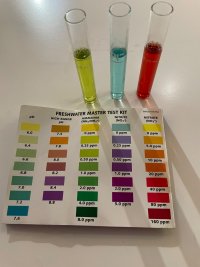
Yes it could be the dead fish given that nitrites don't seem to be appearing, it depends how long they were left there for though.
Ha that's so true. I'm still awaiting the pathology report, hopefully I'll have it this week! The pathologist warned me that it can be difficult to get a definitive diagnosis in fish but hopefully he figures it out.
Perfect! They will at least be able to rule whether it was toxic i.e. nitrite poisoning or infectious.
Are they able to give prescriptions for somewhat stronger/more effective drugs if they do identify a likely infectious cause?
The closest thing I have is IchX but I think that's
malachite green.
I have no idea how viable it is to directly treat with malachite green, but from what I've heard it's generally not as effective and can cause other problems anyway.
Malachite green was one of the chemicals responsible for completely nuking my tank's microsphere when I used a tankwide treatment - In the end it was one of the major causes of the early 2020 mass extinction which along with the late 2019 was my tank's Permian-Triassic.
My biggest question of the moment is whether to treat my 75 gallon with any medication (
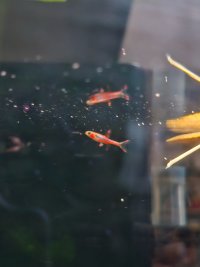
Kanaplex is the antibiotic I have on hand)? I think moving the chilis to a hospital tank would be super stressful for them so I'd rather treat the 75 gallon.
Seachem claims that Kanaplex isn't safe with inverts, and I've heard conflicting reports online, so I wouldn't risk it unless it's medicated food, in which case it should be fine.
It "shouldn't" interfere with the cycle or kill plants.
Always make sure you follow the dosing instructions and
never overdose.
Unless you have the medicated food form of Kanaplex, I would not move the fish and treat them with it if it's going to be too stressful, or treat the whole tank with a solution that dissolves in the water.
Kanamycin (which is what Kanaplex is) is an old antibiotic that is generally only used in humans when other antibiotics have failed or it's a serious infection and the chance of resistance to more common antibiotics can't be risked.
It is generally not favoured in use because it has several potential side-effects. Because of that I can see why it might be toxic to some organisms in a dose that is theraputic for others.
In reality all use of antibiotics, antifungals etc. is just chemotherapy but almost always with far fewer side effects, in both aquaria and humans - You're trying to kill the causative agent before you kill the patient, because the patient would probably die anyway without treatment. Antibiotics etc. are not miracle cures, they are merely treatments which sigificantly slow down the pathogen so the immune system can begin to overwhelm it. This is why microbes can become resistant to antibiotics fairly quickly on human timescales, but you're never going to get microbes that are resistant to bleach for instance (waiting for someone to link me a bacterium or archaeon that lives in extremely alkaline conditions

) - Antibiotics do not just simply destroy all the pathogens, they interfere with a specific metabolic pathway to cause the bacteria to either slow down, stop reproducing or eventually run out of energy. Some bacteria will inevitably overcome this, but by then they should be few enough in number that the immune system can deal with them.
And of course the vast majority of antimicrobrials don't even work against viruses because
they have no metabolic pathway to interfere with. The only way to kill viruses is to interrupt the process of them binding to the host cell, or somehow stopping the infected cell from transcribing viral genetic material. Any drug that attempts to do this must also somehow not have some sort of serious drawback for the host. HIV is the only virus we have really managed to control with drugs, partly because of how serious a disease it is and partly because HIV's life cycle in particular is so specific that we're able to build drugs that specifically target phases of it.
But to get back to the point, that's why we have to be extremely cautious about putting antimicrobials in the water, because you're not just messing about with a miracle cure - It's a form of chemotherapy that will almost certainly become toxic to innocents past a certain dose, and sometimes that includes the normal/beneficial microflora or other macroscopic residents of the tank.
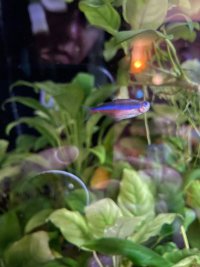
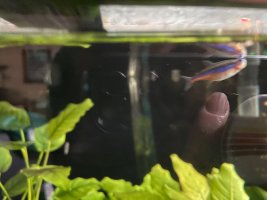
Also, here's a photo of the same fish today (other photo was from yesterday). Looks like the pale/white patches are a bit more pronounced
Had they just eaten? The stomach looks a bit distended which is normal if they've just eaten, but if they hadn't eaten then we have another sign.
Although I can't zoom in much, from what I can see, it's starting to resemble the viral lymphocystis I saw images of online (specifically other rasboras for a fair comparison).
As I and Fishfur said earlier it's not fatal on it's own most of the time, but if you also have other pathogens like columnaris* doing the rounds in your tank then contracting lymphocystis now is probably going to be a death sentence given it will weaken the fish for some time.
*Note that all bodies of water will have
Flavobacterium in them at all times to some degree, but active pathogenic columnaris outbreaks will only occur when certain virulent strains are introduced, when their numbers are high enough and when the inhabitants of the tank are stressed to some degree. They're a bit like what
E. coli is for humans.
That is of course if you even have columnaris, it might not be the cause given there are several families of bacteria that can cause similar generalised disease.
Unfortunately at the moment it's very much an "I don't know" situation, because the nitrite poisoning hypothesis has likely been disproven and there's no other signs that are even remotely specific to a single disease aside from the potential lymphocystis which of course will not be responsible for the previous deaths.