Lost some fish -- Help me learn from my mistakes!

comfycat

New Member
Member
Messages
40
I'll start with my setup:
75 gallon, running for 1.5 years
Ammonia: 0
Nitrite: 0
Nitrate: 20
I tested the water every day since adding fish, and did a water change today mostly out of desperation
Filtration: two Aquaclear 110s and a Fluval 207 canister

I started this tank by combining three smaller ones and adding some new fish, so from the beginning there were 11 chili rasboras, 12 albino sterbai corys, 10 green neon tetras, 15 cardinal tetras, ~7 amano shrimp, one lonely least rasbora

Three days ago I got fish from a local store I think is trustworthy:
15 chili rasboras (they were quite small, they must have been pretty young ones)
10 kuhli loaches
3 least rasboras

I drip acclimated them over 2 hours but did not quarantine.

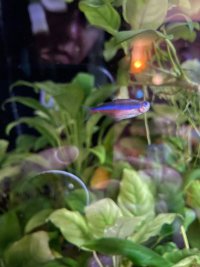
Today I think at least 2 of my original chilis are gone, and there's only about 5 of the new ones left. I haven't seen any bodies, where could they be?? Can the amanos really be that quick?? I've seen all of the least rasboras today, but the original one looks a bit off (pictured) and is hanging around by the surface on and off. A cardinal tetra was dead this morning (no obvious lesions or anything). I have only seen a couple loaches today. I feel like I'm going to end up with fewer fish than I started with! I'm heartbroken over here. Help!
 

Attachments

  • IMG_3189.jpeg
    IMG_3189.jpeg
    666.5 KB · Views: 109
  • 20250311_215501_Original.jpeg
    20250311_215501_Original.jpeg
    553 KB · Views: 109

Advertisement
Your water parameters seem fine, but have you tested for chlorine/did you add dechlorinator? The rasbora pictured seems to have very red gills, which is a sign of chlorine poisoning (as is gasping for air at the surface). Additionally, have you noticed any lethargy or faded coloring?
(Also, don’t panic about the loaches, as they’re naturally shy fish.)

Edit: I’ve searched up some images of least rasboras and they do seem to have naturally red gills, but check for chlorine just in case.
 

Advertisement
  • Thread Starter
  • #3
Your water parameters seem fine, but have you tested for chlorine/did you add dechlorinator? The rasbora pictured seems to have very red gills, which is a sign of chlorine poisoning (as is gasping for air at the surface). Additionally, have you noticed any lethargy or faded coloring?
(Also, don’t panic about the loaches, as they’re naturally shy fish.)

Edit: I’ve searched up some images of least rasboras and they do seem to have naturally red gills, but check for chlorine just in case.
Thanks for your response! I did use Prime with my ~20% water change today. I have a Python system and treated the tank accordingly.

Oh, and the all the chili rasboras have had faded coloring, though the established ones have colored back up a bit. The new ones are not nearly as vibrant (though I wasn't sure if the little ones are just not as colorful when small). The new ones are more shy and the established ones are perhaps lethargic, at least they're not swimming in their usual pattern back and forth across the tank all day,
 
How long has the tank been running before you added the 28 new fish? That is a lot to add all at once.
 
  • Thread Starter
  • #5
How long has the tank been running before you added the 28 new fish? That is a lot to add all at once.
It's been running 1.5 years. A clear mistake to add so many fish in retrospect of course

my thinking was that the tank could handle the bioload, and that the rasboras would prefer a larger group so they'd be happy about the additions. But change is hard on animals and I should've appreciated that more
 
  • Thread Starter
  • #6
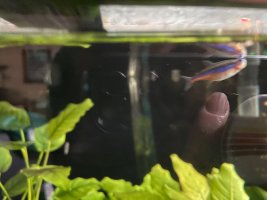
Now this morning one of the tetras is at the surface as well. Are there any diseases that would affect fish so quickly?
 

Attachments

  • IMG_3214.jpeg
    IMG_3214.jpeg
    636.1 KB · Views: 124
  • IMG_3217.jpeg
    IMG_3217.jpeg
    695 KB · Views: 116

Advertisement
  • Thread Starter
  • #8
Looking at that tetra, I'd definitely suspect that the cycle has been overwhelmed.

What did you use to measure the water parameters? I don't believe that there's 0 nitrite.
I use the API liquid test kit. I was worried about ammonia last night and tested it again. The liquid test kit read 0 for ammonia, but I didn't recheck nitrites. I'll have to redo it when I get home and I'll test ammonia, nitrite, and nitrate
 
Common misconception.

Ammonia would not cause this much distress in such little time unless your pH was already high enough to chemically burn the fish.

What we're looking at here is potential nitrite poisoning based on the signs - Hovering at the surface, struggling for air, also looks like the symptomatic fishs' gills are discoloured and browned which is a telltale sign.

Nitrite can start causing serious toxicity at 0.5ppm and >2ppm is usually going to be fatal, at least for fish of this size. It goes without saying that much larger fish can tolerate higher levels, although the limit for any fish is going to be a relatively low concentration.

Why only some fish are displaying obvious symptoms and others aren't? For the same reason that some people have to lie down after three beers while others can drink a bottle of whisky in one night and barely even notice the next morning. Every individual has a unique susceptibility to toxins. Although if nitrite levels continue to rise, you will see almost every fish in the aquarium rapidly develop serious toxicity.

Although I would posit that your older fish have developed serious illnesses and passed away due to lower-level nitrite toxicity - Even in concentrations as low as 0.25ppm it can have a notable stressing effect on the fish which leaves them wide open for opportunistic pathogens who are largely invulnerable to nitrites until much higher concentrations.

If you can, I would get a bottle of Tetra SafeStart or Seachem Stability asap, and until then do daily water changes. You really don't want to wait for the cycle to just recover on it's own, this could take weeks and even a single missed water change could spell a Permian-Triassic level extinction. Seriously, people wake up in the morning to find their tanks full of dying and dead fish when nitrites start to spike. Nitrites are the stuff that kills fish in uncycled tanks, not ammonia. The fact that you have a planted tank is good, they will help and eat some of the nitrite being left in the water, but they will by no means eat it fast enough to make it safe.

The reason you're getting nitrite poisoning now is because the bacteria that convert ammonia to nitrites grow much faster than the ones that convert nitrites to nitrates. So you've added a ton of new fish, ammonia has spiked beyond what the current cycle was capable of and then the NH3/NH4+ > NO2- bacteria have grown to replace it, however the NO2- > NO3- bacteria haven't yet, so the nitrite is beginning to build. I've also read that ammonia/um is toxic to the NO2- > NO3- bacteria, so it's possible that the influx of ammonia (which will not have significantly harmed the fish at a pH in the 7s) outright caused a significant dieback of the existing bacteria in the first place which has now contributed to the nitrite problem. But that's just word on the internet that I've seen and could easily be false; the mechanism is clear even without a direct poisoning effect.

Now all we need to prove this hypothesis is a positive nitrite test. I guarentee a test done correctly with in-date products will produce a nitrite reading of at least 0.25ppm, if not 0.5ppm. I doubt higher than 0.5ppm as nearly all of your fish would be beginning to show visible signs of serious toxicity by then, but don't get the wrong idea, this is still an unacceptable level of nitrites and needs to be addressed.

Is the gospel test kit within the hobby, so if done correctly the results should be reliable. If it's providing 0ppm across the board and exactly neutral pH each time it's used then either the test kit has gone bad or the tests aren't being performed correctly.
 
Common misconception.

Ammonia would not cause this much distress in such little time unless your pH was already high enough to chemically burn the fish.

What we're looking at here is potential nitrite poisoning based on the signs - Hovering at the surface, struggling for air, also looks like the symptomatic fishs' gills are discoloured and browned which is a telltale sign.

Nitrite can start causing serious toxicity at 0.5ppm and >2ppm is usually going to be fatal, at least for fish of this size. It goes without saying that much larger fish can tolerate higher levels, although the limit for any fish is going to be a relatively low concentration.


If you can, I would get a bottle of Tetra SafeStart or Seachem Stability asap, and until then do daily water changes.

I’ve also read that ammonia/um is toxic to the NO2- > NO3- bacteria, so it's possible that the influx of ammonia (which will not have significantly harmed the fish at a pH in the 7s) outright caused a significant dieback of the existing bacteria in the first place which has now contributed to the nitrite problem. But that's just word on the internet that I've seen and could easily be false; the mechanism is clear even without a direct poisoning effect.
It is true that high enough levels of ammonium - NH4, can kill nitrifiers and it is nitrosomonas, which oxidize ammonia to nitrite, that are the most vulnerable to this effect.

But it doesn’t happen at any level you’d get in a fish tank. In a sewage treatment plant it might happen.

One study showed that the level of NH4 at which this happens is pretty high. The study measured in mg-dm-3, which is equivalent to mg/l, which in turn is close enough to ppm that it makes no appreciable difference.

Ammonium - NH4 must reach 60.00 mg·dm−3, or 60ppm, in order to inhibit nitrification.

I can’t see how this could possibly be of concern with respect to an aquarium.

Toxic Effect of Ammonium Nitrogen on the Nitrification Process and Acclimatisation of Nitrifying Bacteria to High Concentrations of NH4-N in Wastewater

As for adding bottled bacteria to help boost the reestablishment of the cycle, it could help but if you go that route don’t get Stability. I can’t understand why anyone uses it - it makes no sense to me.

Seachem will not divulge what types of bacteria are in it but it is definitely not all nitrifiers. It can’t be, because they mention it being beneficial for reducing sludge, a task that nitrifiers have nothing to do with.

It is assorted heterotrophs that do the organic breaking down & since the average tank already has more heterotrophs than it needs, I think paying Seachem to add more of them makes no sense.

Dr.Tim’s One & Only & Tetra SafeStart are the same product by different names - a deal Dr. Tim Hovacs made when he left Tetra, so either one is good and so is Fritz Turbo Start Freshwater.
 
It is true that high enough levels of ammonium - NH4, can kill nitrifiers and it is nitrosomonas, which oxidize ammonia to nitrite thst are the most vulnerable to this effect.

But it doesn’t happen at any level you’d get in a fish tank. In a sewage treatment plant it might happen.

One study showed that the level of NH4 at which this happens is pretty high. The study measured in mg-dm-3, which is equivalent to mg/l, which in turn is close enough to ppm that it makes no appreciable difference.

Ammonium - NH4 must reach 60.00 mg·dm−3, or 60ppm, in order to inhibit nitrification.

I can’t see how this could possibly be of concern with respect to an aquarium.
:eek: More nonsense on the internet then I see.

As for adding bottled bacteria to help boost the reestablishment of the cycle, it could help but if you go that route don’t get Stability. I can’t understand why anyone uses it - it makes no sense to me.

Seachem will not divulge what types of bacteria are in it but it is definitely not all nitrifiers. It can’t be, because they mention it being beneficial for reducing sludge, a task that nitrifiers have nothing to do with.
Yet more internet nonsense then. I had heard good things about Stability, but

Dr.Tim’s One & Only & Tetra SafeStart
Are the only two I've ever known to work for sure, hence why I recommended them first.

I know a lot of cycle-starters in the wild don't contain the right bacteria; I've heard of quite a few containing land bacteria which are bound to eventually inactivate in water.

Generally the trick is to avoid any that instruct you to re-add the product after x time period.

Fritz Turbo Start Freshwater
Never actually heard of that one. The bottle art looks cool :D I'd use it just for that haha, provided it works of course.

It is assorted heterotrophs that do the organic breaking down & since the average tank already has more heterotrophs than it needs, I think paying Seachem to add more of them makes no sense.
The only reason I might see a need to add new heterotrophs into a tank is if some sort of strong medical treatment completely messed up the healthy microflora of the ecosystem. This happened to me back in 2020 and even adding aged tankwater from another healthy tank did nothing to reestablish the healthy microsphere. I could see that adding pre-mixed heterotrophs may work as a last resort for such a scenario and could prevent the Permian-Triassic level extinction that occurred as a result. I don't remember if I tried dosing the tank with any SafeStart; I may have done. Even if the cycle wasn't necessarily disrupted, the normal microflora of the tank was so disturbed that the tank became extremely cloudy to the point of being nearly opaque in only a day or two after a water change, it stank of sulphur (hence probably an overproliferation of sulphur-producing microbes) and whatever nasty stuff had overproliferated was getting into the filter I had at the time and completely destroying the pads with horrible biofilm. I think when I had to replace the corrupted media the first time I redosed with SafeStart along with cross-fertilisation from the healthy tank, but within about a week or two the replacement media was completely destroyed too. In the end I had to completely tear the tank apart and that involved moving everyone to the 15 gallon I had running at the time and in the end I'd lost almost everything because it was the middle of lockdown and it wasn't really viable to try and rescape the aquarium and get it all cycled again.

Overall a number of factors came together and that's why I call it the Permian-Triassic of my tank, along with how many fish I lost as a result. I think by the time I added the survivors back there were only a few swordtails, my BN pleco and a few tetras left. I can't remember if any cories had survived but I don't think so. If any survived then they died out in the late 2022 extinction, I know I lost a lot of cories in particular that time.

Out of interest, the medication I used was myzaxin. I know it contained malachite green as one of the ingredients, which I now know is really not the best thing to use and is controversial in the hobby. I also know I increased my lifetime chances of developing skin cancer in my hands a couple percent by handling that stuff :( The other ingredient was acriflavine hydrochloride which is a broad antiseptic. No wonder it bombed everything.
 

Advertisement


I know a lot of cycle-starters in the wild don't contain the right bacteria; I've heard of quite a few containing land bacteria which are bound to eventually inactivate in water.
To the best of my understanding, the heterotrophs in all those bottles initially came from sewage treatment plants, wherein they are abundant. They are grown on from there but so far as I know that’s where the original organisms were sourced from.

I rather expect a lot of them live also live on land - there are plenty of organics needing to be broken down on land after all.

The nitrifiers all come from the soil. They live in soils where they perform the same nitrification as they do in water - without them, legumes could not fix atmospheric nitrogen in their root nodules. Without them, soils would be devoid of nitrogen and plants would starve..

Put a few teaspoons of healthy soil into a little cotton cloth bag & try suspending that in a new aquarium. It will seed nitrifiers a lot more directly than the air will - and land is where air picks up nitrifiers to blow into water. Of course it’ll contribute more than nitrifiers which might be why it’s not recommended as a seeding technique.
Generally the trick is to avoid any that instruct you to re-add the product after x time period.

Stability advises monthly dosing for ‘maintenance ’.


Never actually heard of that one. The bottle art looks cool :D I'd use it just for that haha, provided it works of course.

It does work but with the same caveats as the others.
 
  • Thread Starter
  • #13
Very interesting conversation!

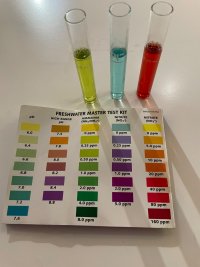
I tested my water when I got home today. That tetra that was struggling had passed. Here's my water testing today. My tap water has chloramine, do I need to worry about making things worse with frequent water changes? I use Prime to treat the water.

(I'm planning to do daily water changes, but just about 10%. For now, the fish seem pretty calm and none look stressed at the surface)
 

Attachments

  • IMG_3223.jpeg
    IMG_3223.jpeg
    566.7 KB · Views: 74
Very interesting conversation!

I tested my water when I got home today. That tetra that was struggling had passed. Here's my water testing today. My tap water has chloramine, do I need to worry about making things worse with frequent water changes? I use Prime to treat the water.
Nope.

Prime works for chloramine too - the minimal amount of ammonia that’s freed when the chemical bond between it & chlorine is broken would usually be oxidized by the nitrifiers quickly. In the QT that won’t happen of course but -

unless your pH is about 8 or higher, ammonia isn’t likely to ever be a problem anyway.

That’s because ammonia has two forms. NH3 & NH4 -aka ammonia & ammonium.

They occur together always in any pH that most fish could live in and have a highly predictable ratio between them which is controlled by pH (& temperature to a lesser degree).

The higher pH is, the more NH3 relative to NH4 there will be and vice versa.

At any pH from around 8 on down, virtually all of it is NH4 and by the time you get to pH 7.2 or less, there are mere traces of NH3.

In the context of fish keeping, ammonium (NH4) is nontoxic. Only NH3 harms fish and even it has a safe dose. It doesn’t start to cause harm until it gets to .6ppm. Below that level it’s safe.

Most ammonia tests give you a total result, one which combines both NH3 & NH4. A test that says 2 ppm can’t tell you how much of that is NH3 or NH4. ( they do that by using one reagent to raise the pH of the water sample to about 12 so that all of it actually is NH3 & then a second reagent reads the amount of NH3.)

But there are charts online you can look up that will tell you how much NH3 there is at any combination of pH & temperature and there’s even a handy ammonia calculator on one site.

An example -

If I assume the temperature of the tank water is 80F, pH is 7.5, and that an ammonia test reads ten ppm ( yes, 10 ppm) there won’t be anywhere near enough NH3 to harm fish.

The level of NH3 will be a mere 0.1007ppm. If Thats a very long way from .6 ppm. If you had a test that could distinguish NH3 from NH4 it wouldn’t be able to detect such a tiny trace.

So in a QT without a filter, so long as you do water changes, the ammonia will never rise high enough to harm the fish.

In the average tropical fish tank it’s very rare for ammonia ever to rise high enough to cause harm to fish unless it’s an African cichlids tank where pH may be as high as 9.

It is nitrite you need to worry about but in an uncycled tank there won’t be any nitrite.
 
Very interesting conversation!

I tested my water when I got home today. That tetra that was struggling had passed. Here's my water testing today. My tap water has chloramine, do I need to worry about making things worse with frequent water changes? I use Prime to treat the water.

(I'm planning to do daily water changes, but just about 10%. For now, the fish seem pretty calm and none look stressed at the surface)
How much nitrate does your tapwater contain? That's an awfully high reading for a heavily planted tank that is having daily water changes.

My tapwater has up to 20ppm of nitrates according to the official website and even that is generally quite a bit higher than what you'd usually find.

Although of course if your tank is producing ammonium then the plants may be preferentially eating that over the nitrates.

I don't suspect that the nitrates are the issue, I've heard of tanks having dark red nitrate tests without fish showing any signs of distress. The reason we do water changes and the reason fish deteriorate without them is to replenish essential minerals that the fish, plants and microflora consume. There is no magical nitrate level to keep your tank under as it's not toxic until much higher concentrations, although of course less is always better. Even in a heavily planted tank which will keep nitrates below a certain level indefinitely you will observe the same sort of decline if water changes are withheld.

A high nitrate concentration is a bit of an oddity with a positive ammonia test - Some nitrates are bound to be in the water whether it be leftovers from the previous cycle or the tapwater, which is why I'm always so suspect of tests that come up with 0ppm for everything and 7.0pH, but 40+ppm of it with a positive ammonia test is unusual. How often were you doing water changes before and how much water did you typically replace?

A negative nitrite test would seemingly disprove the previous hypothesis even though the signs all lined up and I even observed the brown discolouration of the gills. As Fishfur said this level of ammonium is not toxic so the next explanation is infectious disease. It's possible that the young fish were carrying various pathogens and they spread to your older fish, who had weaker immune systems and couldn't hold them off.

The apparently disrupted cycle may be a red herring, or in this case a red rasbora :D

Disease of various kinds is absolutely rampant in fish farms and LFSs these days and oftentimes it's simply down to new stock introducing pathogens.
 
  • Thread Starter
  • #17
What are my options once the fish are all in my display tank? Wait it out? Treat the tank?

I guess I'm surprised the fish would have issues so quickly from disease. I figured parasites and other diseases would primarily affect the new fish and be a longer disease process. I really thought it would be a water quality issue!

As for symptoms, I haven't seen anymore fish swimming up at the top anymore. Occasionally a fish will swim around really quickly (maybe like they're bothered by something) and I'm not sure if that's normal because it's mostly the corys swimming up and around or an occasional rasbora glass surfing. Haven't seen any abnormal poops.
 
What are my options once the fish are all in my display tank? Wait it out? Treat the tank?
I don't understand what you mean. I thought all of your fish were already in a single tank?

I guess I'm surprised the fish would have issues so quickly from disease.
We are largely unable to detect subtle signs of discomfort, so from our perspective it looks like the fish was fine one day and then was in critical condition the next.

Fish disease can also come on very quickly in general. Think how quickly sepsis can come on in people.

I figured parasites and other diseases would primarily affect the new fish and be a longer disease process.
As those fish are younger it's quite plausible that they can carry the pathogens without showing obvious signs of disease as they have stronger immune systems - They may eventually develop a noticeable illness later.

Unless it's active fish TB, internal parasites or some kinds of viral disease, illness in fish tends to not be a drawn out process, and the fish either starts recovering or they deteriorate fairly quickly.

I really thought it would be a water quality issue!
So did I. In fact I don't even have much evidence for infectious origin, it's just a case of ruling out the nitrite poisoning unless something else has caused a further retrogression in the cycle, which really shouldn't happen.

If it was nitrite poisoning, you will have also expected other fish to have started deteriorating by now.

As for symptoms, I haven't seen anymore fish swimming up at the top anymore. Occasionally a fish will swim around really quickly (maybe like they're bothered by something) and I'm not sure if that's normal because it's mostly the corys swimming up and around or an occasional rasbora glass surfing. Haven't seen any abnormal poops.
Cories will occasionally dart to the surface to take a gulp of air - This is normal.

I also have no reason to think glass surfing is an issue.

At this point, I would watch for anymore fish showing signs of distress and especially watch the nitrite. I would regularly redo tests to be on the safe side. Best case scenario is the cycle recovers and the ammonia gradually declines.

Even though the ammonia level is not harmful, you don't want to let it sit as at any moment it can start being converted to nitrite and cause a mass extinction before you can address it. As long as you keep seeing positive ammonia tests, continue with the daily water changes. Especially do so if nitrite starts appearing.

I would strongly recommend getting a bottle of any of the aforementioned pre-mixed nitrifying bacteria to try and speed the process up and reduce as much risk as possible. Make sure to follow the instructions on the bottle if you do this. Avoid any that advise to reuse the product - These are the junk ones.

Without any definitive or even likely causal agent of potential disease, it's very hard to recommend treatment and I would not attempt it unless an infectious cause has been established.

I rather expect a lot of them live also live on land - there are plenty of organics needing to be broken down on land after all.

The nitrifiers all come from the soil. They live in soils where they perform the same nitrification as they do in water - without them, legumes could not fix atmospheric nitrogen in their root nodules. Without them, soils would be devoid of nitrogen and plants would starve..

Put a few teaspoons of healthy soil into a little cotton cloth bag & try suspending that in a new aquarium. It will seed nitrifiers a lot more directly than the air will - and land is where air picks up nitrifiers to blow into water. Of course it’ll contribute more than nitrifiers which might be why it’s not recommended as a seeding technique.
Very interesting!

I would've thought that different species of nitrifiers lived in different environements.

Such is the incredible adaptability of some microorganisms.

The latter technique does sound like a very good way to save money, although there is the risk of introducing other things too as you mention. However the average spoon of soil is probably very limited in anything nasty it could introduce.
 
  • Thread Starter
  • #19
Today one cory and a loach were dead when I got home from work. One other cory looks stressed near the surface, it's pale with increased respiratory rate/effort, definitely not long for this world. The rasboras color is more dull than normal. Definitely looking like the Permian-Triassic level extinction event you mentioned :(

I don't understand what you mean. I thought all of your fish were already in a single tank?
Oh, I was wondering if fish in planted tanks can be medicated? When I had a Betta with gill flukes I moved it to a separate, bare bottom tank and treated it and basically burned down his original tank and started over after his medication was finished. But it was only a 9 gallon. I've never tried to just treat a bunch of fish in a big planted tank. (Not sure why I didn't learn my lesson 5 years ago when that happened.. I otherwise have gotten away with just adding fish to my display tank until now. What a fool I've been )

I'm planning to take the dead fish (and any that look really sick) to my local veterinary diagnostic lab in the morning (I live near a vet school) to see if they can give me a diagnosis so I know what I'm treating. I'll still continue daily water changes in the meantime I guess, though it doesn't seem to be helping.

When I get fish next time I'll have a quarantine tank and medicate them and do it all the right way. Learned a hard lesson that definitely could've been avoided.
 
Today one cory and a loach were dead when I got home from work.
I'm so sorry for your losses :eek:
One other cory looks stressed near the surface, it's pale with increased respiratory rate/effort, definitely not long for this world.
That's really not good. Any other symptoms? Did any of the deads have browned or otherwise discouloured gills? What about this cory?

A cory sitting at the surface is a really bad sign to be honest. Without any other leads I can't really offer any sort of specific treatment.

The rasboras color is more dull than normal
All of them?

Broad discolouration is a sign of generalised stress and usually means something toxic is in the water. Cories are the most well-known fish to greatly discolour when chemically stressed like this but virtually all fish discolour in the same way.

Definitely looking like the Permian-Triassic level extinction event you mentioned :(
Don't go into panic overload just yet, this is more of a Devonian-Carboniferous or Triassic-Jurassic extinction right now so it's still more than salvageable.

However from the sounds of it, things are starting to get bad.

Given the mentioned symptoms of stress and further surface-sitting, I'd start resuspecting nitrite poisoning tbh.

Are you absolutely positive that there's nothing else in the water that could be causing toxicity?

I would repeat several nitrite tests. Make sure you do them before any water changes. If you do them after a water change then you've already reduced the concentration potentially below detectable levels and disposed of any evidence. If you must do them at the same time as a water change due to time constraints then test the water being removed from the tank.

I'm planning to take the dead fish (and any that look really sick) to my local veterinary diagnostic lab in the morning (I live near a vet school) to see if they can give me a diagnosis so I know what I'm treating. I'll still continue daily water changes in the meantime I guess, though it doesn't seem to be helping.
If you have access to one, then I would definitely take them. They can look for any signs of pathology or toxicity far better than any of us. If nitrite poisoning is the culprit here then they should be able to easily see it.

Oh, I was wondering if fish in planted tanks can be medicated? When I had a Betta with gill flukes I moved it to a separate, bare bottom tank and treated it and basically burned down his original tank and started over after his medication was finished. But it was only a 9 gallon. I've never tried to just treat a bunch of fish in a big planted tank. (Not sure why I didn't learn my lesson 5 years ago when that happened.. I otherwise have gotten away with just adding fish to my display tank until now. What a fool I've been )
Of course they can. Just make sure to carefully read the labels of anything you're adding to a tank first to make sure it's not going to nuke the cycle, plants or inverts. Anything that won't kill one of those three can be added.

Gill fluke medication should not be able to kill microflora as it specifically targets eukaryotic cells, unless it was a very broad spectrum antiseptic.

When I get fish next time I'll have a quarantine tank and medicate them and do it all the right way. Learned a hard lesson that definitely could've been avoided.
While that is definitely recommended if you have the space, I'm still very suspicious as to whether pathogens are the true cause of your problems here.

I would suggest in future to gradually add new fish over a period of weeks or months. This would also allow you to replace any deads.
 
  • Thread Starter
  • #21
Given the mentioned symptoms of stress and further surface-sitting, I'd start resuspecting nitrite poisoning tbh.

Are you absolutely positive that there's nothing else in the water that could be causing toxicity?

I would repeat several nitrite tests. Make sure you do them before any water changes. If you do them after a water change then you've already reduced the concentration potentially below detectable levels and disposed of any evidence. If you must do them at the same time as a water change due to time constraints then test the water being removed from the tank.
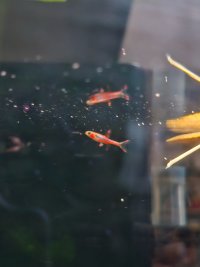
Since I lowered the tank temperature to 74, I haven't noticed any more fish at the surface. I just see that the chili rasboras have pale patches on them. They are still eating and acting normal but the pale patches are getting more noticable. It's hard to capture in a photo but I included one.

A majority of the loaches have died 7/10, 5/25 tetras, 15/25 chili rasboras, 3/5 corys, but all the inverts seem fine (amanos and snails).

One of the remaining loaches looked sick today so I put it in a hospital tank and dosed Kanaplex just to see if it'll help it.

I've been doing about 40% water changes every other day and testing the water regularly but haven't seen any nitrite spikes at all. I'll see what looks like 0.25 ammonia but maybe that's because my tap water has chloramine.

I can't think of anything that could be toxic in the tank since it's been running over a year without an issue until I added the new fish.

Of course they can. Just make sure to carefully read the labels of anything you're adding to a tank first to make sure it's not going to nuke the cycle, plants or inverts. Anything that won't kill one of those three can be added.

Gill fluke medication should not be able to kill microflora as it specifically targets eukaryotic cells, unless it was a very broad spectrum antiseptic.
I was considering using Kanaplex to see if that helps? There's no way for me to remove my amano shrimp from the tank though. I've heard anecdotally it's okay for shrimp though. And it's not supposed to damage your cycle either.

While that is definitely recommended if you have the space, I'm still very suspicious as to whether pathogens are the true cause of your problems here.

I would suggest in future to gradually add new fish over a period of weeks or months. This would also allow you to replace any deads.
I will be very careful in the future. I can't imagine what toxicity it could be, so I'm more thinking disease, maybe columnaris?

I'm planning to add more chili rasboras and sterbai corys or perhaps more kuhli loaches (though I'm worried they brought whatever disease I'm dealing with) once the dust settles. But I'll do it slowly this time and only one group of fish at a time. I hope to have a stable quarantine tank or two up and running soon.

(the picture I included shows the "pale patches" on a chili rasbora. It looks almost like a reflection in the picture, but it's actually just how most of the chilis look. I'm worried they'll die if I don't do anything)
 

Attachments

  • 20250317_123211_Original.jpeg
    20250317_123211_Original.jpeg
    286.8 KB · Views: 61

Advertisement


Since I lowered the tank temperature to 74, I haven't noticed any more fish at the surface.
Lower temperature means more oxygen is dissolved in the water.

Is your tank correctly aeriated? No stagnant areas with biofilm forming on top?

A majority of the loaches have died 7/10, 5/25 tetras, 15/25 chili rasboras, 3/5 corys, but all the inverts seem fine (amanos and snails).
Wow, I'm sorry. It sucks when you have a mass extinction.

Currently 46.2% of your fish have died out, so this is now closer to a K-Pg level extinction than Tr-J.

The fact that the inverts are fine probably suggest that your instinct is correct and this is down to pathogens.

I was considering using Kanaplex to see if that helps? There's no way for me to remove my amano shrimp from the tank though. I've heard anecdotally it's okay for shrimp though. And it's not supposed to damage your cycle either.
From what I've heard, kanaplex shouldn't harm inverts or the cycle. I'm not sure it'll help but it can't hurt at this point.

I've been doing about 40% water changes every other day and testing the water regularly but haven't seen any nitrite spikes at all. I'll see what looks like 0.25 ammonia but maybe that's because my tap water has chloramine.
You are adding dechlorinator correct? In which case there should be no detectable levels of ammonia or chlorine.

I will be very careful in the future. I can't imagine what toxicity it could be, so I'm more thinking disease, maybe columnaris?
Columnaris is blamed for just about every presentation of fish disease known to man, so I strongly doubt it's responsible for everything that is pinned to it.

However there are several different strains that can cause different presentations, and I've been seeing a lot of columnaris cases on here recently, so it's possible that there's a major outbreak going on right now and you have it.

The only way to know is to take the affected fish to that vet you mentioned previously. They will be able to tell you if there is an infectious cause or not.

(the picture I included shows the "pale patches" on a chili rasbora. It looks almost like a reflection in the picture, but it's actually just how most of the chilis look. I'm worried they'll die if I don't do anything)
After some research, this could be the start of lymphocystis, a viral disease. As it's viral there's no cure but it usually isn't fatal - It instead gradually causes unsightly cysts and tumours to form over time.

However that was just from some googling and looking at some old threads, so this is far from a diagnosis.

Fishfur Anything else you could add?
 
Lymphocystis is very rarely fatal. Known as Lymphocystis disease virus (LCDV), it’s in genus Lymphocystivirus in the Iridoviridae.

It causes chronic but benign hypertrophic lesions or tumours, usually of cutaneous fibroblasts though may also show up in the coelomic cavity, muscle tissue or organs.

If tumours form internally & end up compromising muscle or organ function too much, or interfere with a fish either being able to swim well enough to eat or with mouth function to the point the fish can’t eat, then it may be fatal.

The rest of the time it is just very unsightly but the presence of the virus does compromise immunity to some degree. Eventually it should run its course & fade away, in most cases.

Because it compromises immunity, as any infection can, it makes fish more vulnerable to other opportunistic infections.

I’d want to apply a little Methylene blue to those patches on the boraras to see if they’re protected by slime coat or not.
 
  • Thread Starter
  • #24
Lower temperature means more oxygen is dissolved in the water.

Is your tank correctly aeriated? No stagnant areas with biofilm forming on top?
That's interesting I didn't know that. I have two hang on back filters (but I have a soap dish with a sponge at the base to decrease flow for the chillies) plus a little sponge filter that I use like an air stone for additional surface agitation. There aren't any areas that form biofilm.

You are adding dechlorinator correct? In which case there should be no detectable levels of ammonia or chlorine.
Yes, I use Prime. Perhaps it's that there's often been dead fish. I remove them, grab samples to test, then do a water change.

Columnaris is blamed for just about every presentation of fish disease known to man, so I strongly doubt it's responsible for everything that is pinned to it.

However there are several different strains that can cause different presentations, and I've been seeing a lot of columnaris cases on here recently, so it's possible that there's a major outbreak going on right now and you have it.

The only way to know is to take the affected fish to that vet you mentioned previously. They will be able to tell you if there is an infectious cause or not.
Ha that's so true. I'm still awaiting the pathology report, hopefully I'll have it this week! The pathologist warned me that it can be difficult to get a definitive diagnosis in fish but hopefully he figures it out.

I’d want to apply a little Methylene blue to those patches on the boraras to see if they’re protected by slime coat or not.
I can order some but don't have any on hand. The closest thing I have is IchX but I think that's malachite green.

My biggest question of the moment is whether to treat my 75 gallon with any medication (Kanaplex is the antibiotic I have on hand)? I think moving the chilis to a hospital tank would be super stressful for them so I'd rather treat the 75 gallon.

Thank you both, I really appreciate your thoughtful responses to my post

Also, here's a photo of the same fish today (other photo was from yesterday). Looks like the pale/white patches are a bit more pronounced
 

Attachments

  • 20250318_185131_Original.jpeg
    20250318_185131_Original.jpeg
    355.2 KB · Views: 49
That's interesting I didn't know that. I have two hang on back filters (but I have a soap dish with a sponge at the base to decrease flow for the chillies) plus a little sponge filter that I use like an air stone for additional surface agitation. There aren't any areas that form biofilm.
Ok, so we can almost certainly rule out some sort of anoxia issue.

Yes, I use Prime. Perhaps it's that there's often been dead fish. I remove them, grab samples to test, then do a water change.
Yes it could be the dead fish given that nitrites don't seem to be appearing, it depends how long they were left there for though.

Ha that's so true. I'm still awaiting the pathology report, hopefully I'll have it this week! The pathologist warned me that it can be difficult to get a definitive diagnosis in fish but hopefully he figures it out.
Perfect! They will at least be able to rule whether it was toxic i.e. nitrite poisoning or infectious.

Are they able to give prescriptions for somewhat stronger/more effective drugs if they do identify a likely infectious cause?

The closest thing I have is IchX but I think that's malachite green.
I have no idea how viable it is to directly treat with malachite green, but from what I've heard it's generally not as effective and can cause other problems anyway.

Malachite green was one of the chemicals responsible for completely nuking my tank's microsphere when I used a tankwide treatment - In the end it was one of the major causes of the early 2020 mass extinction which along with the late 2019 was my tank's Permian-Triassic.

My biggest question of the moment is whether to treat my 75 gallon with any medication (Kanaplex is the antibiotic I have on hand)? I think moving the chilis to a hospital tank would be super stressful for them so I'd rather treat the 75 gallon.
Seachem claims that Kanaplex isn't safe with inverts, and I've heard conflicting reports online, so I wouldn't risk it unless it's medicated food, in which case it should be fine.

It "shouldn't" interfere with the cycle or kill plants.

Always make sure you follow the dosing instructions and never overdose.

Unless you have the medicated food form of Kanaplex, I would not move the fish and treat them with it if it's going to be too stressful, or treat the whole tank with a solution that dissolves in the water.

Kanamycin (which is what Kanaplex is) is an old antibiotic that is generally only used in humans when other antibiotics have failed or it's a serious infection and the chance of resistance to more common antibiotics can't be risked.

It is generally not favoured in use because it has several potential side-effects. Because of that I can see why it might be toxic to some organisms in a dose that is theraputic for others.

In reality all use of antibiotics, antifungals etc. is just chemotherapy but almost always with far fewer side effects, in both aquaria and humans - You're trying to kill the causative agent before you kill the patient, because the patient would probably die anyway without treatment. Antibiotics etc. are not miracle cures, they are merely treatments which sigificantly slow down the pathogen so the immune system can begin to overwhelm it. This is why microbes can become resistant to antibiotics fairly quickly on human timescales, but you're never going to get microbes that are resistant to bleach for instance (waiting for someone to link me a bacterium or archaeon that lives in extremely alkaline conditions :D ) - Antibiotics do not just simply destroy all the pathogens, they interfere with a specific metabolic pathway to cause the bacteria to either slow down, stop reproducing or eventually run out of energy. Some bacteria will inevitably overcome this, but by then they should be few enough in number that the immune system can deal with them.

And of course the vast majority of antimicrobrials don't even work against viruses because they have no metabolic pathway to interfere with. The only way to kill viruses is to interrupt the process of them binding to the host cell, or somehow stopping the infected cell from transcribing viral genetic material. Any drug that attempts to do this must also somehow not have some sort of serious drawback for the host. HIV is the only virus we have really managed to control with drugs, partly because of how serious a disease it is and partly because HIV's life cycle in particular is so specific that we're able to build drugs that specifically target phases of it.

But to get back to the point, that's why we have to be extremely cautious about putting antimicrobials in the water, because you're not just messing about with a miracle cure - It's a form of chemotherapy that will almost certainly become toxic to innocents past a certain dose, and sometimes that includes the normal/beneficial microflora or other macroscopic residents of the tank.

Also, here's a photo of the same fish today (other photo was from yesterday). Looks like the pale/white patches are a bit more pronounced
Had they just eaten? The stomach looks a bit distended which is normal if they've just eaten, but if they hadn't eaten then we have another sign.

Although I can't zoom in much, from what I can see, it's starting to resemble the viral lymphocystis I saw images of online (specifically other rasboras for a fair comparison).

As I and Fishfur said earlier it's not fatal on it's own most of the time, but if you also have other pathogens like columnaris* doing the rounds in your tank then contracting lymphocystis now is probably going to be a death sentence given it will weaken the fish for some time.

*Note that all bodies of water will have Flavobacterium in them at all times to some degree, but active pathogenic columnaris outbreaks will only occur when certain virulent strains are introduced, when their numbers are high enough and when the inhabitants of the tank are stressed to some degree. They're a bit like what E. coli is for humans.

That is of course if you even have columnaris, it might not be the cause given there are several families of bacteria that can cause similar generalised disease.

Unfortunately at the moment it's very much an "I don't know" situation, because the nitrite poisoning hypothesis has likely been disproven and there's no other signs that are even remotely specific to a single disease aside from the potential lymphocystis which of course will not be responsible for the previous deaths.
 
  • Thread Starter
  • #26
So far I've settled on just waiting it out and performing 25% water changes about every 3-4 days. I've kept the tank at 74 degrees. No more fish have died in over a week now. The chilis look about the same or better and are coloring up again, though they still have those paler patches on them.

I'm going to start cycling a quarantine tank or two so that I can repopulate the tank. My final count:

9 Chili rasboras (originally 11, added 15)
3 Least rasboras (originally 1, added 3)
17 tetras, mix of cardinals and green neons (originally 25)
2 albino sterbai corys (originally 5)
0 Kuhli loaches (I think? I lost track, but I added 10 and I'm almost positive I've lost that many)
Amano shrimp and snails are unscathed

I'm planning to cycle two quarantine tanks. But I'm a little worried about new fish going into the display tank and being affected by whatever killed all these other fish. Hopefully it's a non issue by the time the tanks are cycled and new fish are quarantined and ready to go since it'll probably be a good 6-8 weeks from now.

Should I stagger the addition of new fish by a couple weeks, or will the display tank need more time to adjust between additions?
Staggering introductions is a very good idea. With larger groups, adding them 1/2 at a time is also a good idea.
 
  • Thread Starter
  • #28
Update from the pathologist is they didn't find any infectious causes of death in the fish. They in fact found no clear causes of death. This leads me to think that the issue was the rapid change of adding too many new fish rather than any specific disease or pathogen.

My display tank remains stable with the following fish:
10 chili rasboras
3 least rasboras
2 albino sterbai corys
17 mix of cardinal & green neon tetras
7 or 8 amano shrimp
1 rabbit snail
Many ramshorn and other small snails

I have been cycling two 10g quarantine tanks, they're currently sitting in the nitrite phase and I think they'll be cycled soon. It's been two weeks so far even though I used cycled media, so I'm glad I didn't add fish too soon.

I plan to get more chili (10-20) and least (10) rasboras. I never see sterbai corys at my lfs, much less albino sterbais so I don't think I'll be able to add to their number. What other fish should I add?
 

Random Great Topic!

Advertisement


Advertisement


Advertisement


Back
Top Bottom