- Messages
- 1,837

You are using an out of date browser. It may not display this or other websites correctly.
You should upgrade or use an alternative browser.
You should upgrade or use an alternative browser.
Brita Filter water purifier
Advertisement
Advertisement
- Messages
- 12,768
If using the Brita filter, you likely wouldn't have to add anything. I'm starting with water that's between 8.2 and 8.4 and has a really high calcium and iron count. If I were to do this, I would likely end up with water around 7.8, with a moderate calcium and iron count. Other minerals would be lessened, but not completely wiped out.
On the other hand, if I were to use RO water, I'd get the RO additives from Drs Foster and Smith. That would allow me to get the precise pH and mineral level that I wanted.
On the other hand, if I were to use RO water, I'd get the RO additives from Drs Foster and Smith. That would allow me to get the precise pH and mineral level that I wanted.
- Messages
- 1,837
- Messages
- 12,768
Thanks. RO additives sound like they would be good for a tank with only softened water, too.
With softened water, you wouldn't want to add anything except maybe a little bit of calcium. The technique used in water softeners replaces calcium with salt. The water technically isn't any softer (lower in minerals) than it was before going through the softener, it just doesn't have any calcium (salt doesn't stick to things the same way that calcium does, which is why "softened" water works so much better for washing things, and doesn't leave hard water stains), so if you add any minerals, you'll actually making the water effectively harder than it was before it was softened. This will likely wreak havoc on most fishes' cells due to the osmotic stress.
Better, in my opinion, to use non-softened water. Most houses with softeners are set up with at least one un-softened tap for drinking and cooking water.
Advertisement
- Messages
- 12,768
You are the first person to agree with me in a sence. But I don't plan on using additives I just want to know if something specific is taken out of the water that could harm the fish. Seeing my Betta just started getting fin rot symptoms it makes me wonder even more.
It's not that everyone has disagreed with you, it's that they're suggesting that you get all of the information before suggesting it to other people.
A Brita water filter is not effective enough to remove enough minerals from hard water to harm fish. However, I just realized that it might be using resin similar to what is used in water softeners to replace calcium with sodium, which could be bad for fish.
I know there are calcium tests (hardness tests) for water. I wonder how difficult it would be to get a sodium test. You could test the calcium and sodium levels before and after filtration.
It's also possible that some form of dust is getting into the water and harming the fish, or that the filtration has nothing to do with the fishes' illness.
I know that in a recent thread, you recommended that someone get a Brita when they complained that their fish were dying:
When someone's problems are most likely related to cycling, my personal opinion is that those issues should be addressed directly, rather than a secondary issue, like pH.
Here are the concerns I shared with you in my PM:
"I don't think it is wise to recommend a Brita for pH changes when we don't know for sure that pH has anything to do with a member's problems, especially when pH is likely to fluctuate during cycling.
Another concern with recommending the Brita are that it's another expense that many can't afford, and this is after we are telling them to go buy Prime and a really expensive test kit, and sometimes a bigger tank, a bigger filter, etc. The filter replacements are also pricey.
My last concern is that as the filter weakens with age, it may cause fluctuations in the pH."
--
Anyway, thanks for letting me know that your research is ongoing. I look forward to seeing the results.
Good advice in my opinion.
elodea
Maybe it depends on 1) what your pH was starting out, or 2) what caused your pH to be what it is.
What I mean by 2 is that if your pH is high because of something that Brita doesn't filter, then it won't change the pH. But if your pH is high because of something the filter will remove, then you'll see a noticeable difference.
It's late, and my son is sick, so I'm tired. I would not be surprised at all if this makes no sense to anyone but me. lol...
Advertisement
- Messages
- 12,768
elodea
Maybe it depends on 1) what your pH was starting out, or 2) what caused your pH to be what it is.
What I mean by 2 is that if your pH is high because of something that Brita doesn't filter, then it won't change the pH. But if your pH is high because of something the filter will remove, then you'll see a noticeable difference.
It's late, and my son is sick, so I'm tired. I would not be surprised at all if this makes no sense to anyone but me. lol...
Nope, it made sense.
There's another possibility; the filter cartridge could be used up.
- Messages
- 1,837
Instead of using Seachem Prime, could I just run the water for my tank through a brita filter?


- Messages
- 11,266
From what I understand having used the Brita, it "reduces" the chlorine - I don't think it removes it 100%.
Why not use Prime anyway? There are other benefits to using it besides the Chlorine factor such as removing hard metals, converts ammonia into a safe, non-toxic form, provides slime coat for the fish as well as many other benefits.
Why not use Prime anyway? There are other benefits to using it besides the Chlorine factor such as removing hard metals, converts ammonia into a safe, non-toxic form, provides slime coat for the fish as well as many other benefits.
Will it remove chlorine?
"A Brita water filter claims to remove 99 percent of chlorine as well as heavy metals in tap water such as lead and copper which can be caused by the household installations."
From what I understand having used the Brita, it "reduces" the chlorine - I don't think it removes it 100%.
Why not use Prime anyway? There are other benefits to using it besides the Chlorine factor such as removing hard metals, converts ammonia into a safe, non-toxic form, provides slime coat for the fish as well as many other benefits.
I've been using PRIME while trying to cycle my tank and keep having high nitrites, so I tested my water after using prime at a 5x dose (25 drops per 5 gallon bucket) and STILL had ammonia (based on my API Test kit) - so I'm looking for something else to reduce the Ammonia.
Grasping at straws really...
How are you cycling the tank?
Prime doesn't remove ammonia, nor will a britta filter. Prime will detoxify ammonia and nitrites so it doesn't harm your fish up to 1ppm. If you aren't using TSS plus to cycle your tank best way to reduce ammonia and nitrites is to do water changes. You don't want the ammonia to go past 2PPm with a fishless cycle or else it can stall your cycle.
Prime doesn't remove ammonia, nor will a britta filter. Prime will detoxify ammonia and nitrites so it doesn't harm your fish up to 1ppm. If you aren't using TSS plus to cycle your tank best way to reduce ammonia and nitrites is to do water changes. You don't want the ammonia to go past 2PPm with a fishless cycle or else it can stall your cycle.
How are you cycling the tank?
Prime doesn't remove ammonia, nor will a britta filter. Prime will detoxify ammonia and nitrites so it doesn't harm your fish up to 1ppm. If you aren't using TSS plus to cycle your tank best way to reduce ammonia and nitrites is to do water changes. You don't want the ammonia to go past 2PPm with a fishless cycle or else it can stall your cycle.
Interesting.
Well I started a fishless cycle with a shrimp, and about 3 weeks into it I got frustrated and grabbed a bottle of Dr. Tims one and only. So now my Ammonia is very low (shows a light green on the API test kit), but my Nitrites are dark purple. I'm doing 50-75% (depends on my mood) water changes every day.
I assumed that the nitrites weren't going down due to the ammonia in my tap water.
Ah yeah having ammonia in your tap water can make things a little more complicated. @CindiL gives pretty good advice with this.
I assume that in a few weeks the nitrites will disappear, but if I've got ammonia in my water then all that is going to happen is that my nitrAtes are going to be high and then I'll be trapped doing water changes twice a week forever :S
Advertisement
I'd like to point out that brita filters are only good for a certain amount of uses, or 1 month - sort of a whichever comes first situation.
At what point would you decide that the brita cartridge has lost its efficiency? And what if it has before you've decided to change it?
And at their cost, seems like an expensive proposition - far moreso than Prime would cost!
At what point would you decide that the brita cartridge has lost its efficiency? And what if it has before you've decided to change it?
And at their cost, seems like an expensive proposition - far moreso than Prime would cost!
Yeah eventually the nitrites should go down, while nitrates may start to go up. That's the way that cycling works. How high is the ammonia in your tap? If it's only say .25 then the prime should detoxify that.
That is what I thought.
The water tests at a pretty light greenish yellow, around .25ppm. But that should translate to a nitirite of only around 0.5ppm or so. I've read that 1ppm ammonia turns into about 2.7ppm nitrite. BUT..... my .25ppm Ammonia turns into over 5ppm Nitirite in less than 24 hours. I am also getting NitrAte readings, in the same time frame of about 10-20ppm. This has been going on for about 2 weeks now with daily water changes of around 75% usually (some days 50%). I've been using 10 drops per 5 gallon of PRIME - but tried adding 25 drops of PRIME per 5G the past few days just to see if it would change the results.... which it didn't.
So I'm at a bit of a loss.
Yeah I'm not sure what is making your nitrites so high. When CindiL comes here she will probably be able to help more. Prime does detoxify the ammonia and nitrites but it may still show up on the water tests.
The only way to test this for sure is to get a small tank, 5-10 gallon fill it with some plants and substrate and then fill it with water from your brita. Basically set it up as you would any tank. Then start using the water straight from your brita filter. For 1-2 months test your water for the regular stuff to make sure your tank is cycled. Then test for chlorine, pH, kH, and all the good stuff. Update us about the tank. We shall then see if it works. Maybe later on if all goes well we add a fish and see if the fish survive or at least if there are any symptoms (which by them remove the fish to a better quality water tank). If the fish lives and healthy then your plan works if the fish or the test comes back and there are too many metals or something then the plan work!

- Messages
- 15,314
Hi, will you take a tap water sample, add the regular amount of prime and then test it for ammonia and let us know what it is? The API tests for total ammonia so it will register whether its in a detoxified state or not so you will always register for it with ammonia and just have to "know" it detoxes ammonia + nitrites up to 1.0 when dosed daily.
Also, where are those shrimp right now? Did you remove them? If they are still in there then they are putting out ammonia.
I would use prime over a brita I have to agree with the others. If I was going to try and remove chlorine etc for a fish tank I would probably go with something much better and that will last a long time (like hundreds or a thousand gallons) such as a 5 stage filtration unit. It also does provide slime coat ingredients that are good for your fish.
Hi, will you take a tap water sample, add the regular amount of prime and then test it for ammonia and let us know what it is? The API tests for total ammonia so it will register whether its in a detoxified state or not so you will always register for it with ammonia and just have to "know" it detoxes ammonia + nitrites up to 1.0 when dosed daily.
Also, where are those shrimp right now? Did you remove them? If they are still in there then they are putting out ammonia.
I would use prime over a brita I have to agree with the others. If I was going to try and remove chlorine etc for a fish tank I would probably go with something much better and that will last a long time (like hundreds or a thousand gallons) such as a 5 stage filtration unit. It also does provide slime coat ingredients that are good for your fish.
The shrimp is gone, removed it about a week ago.
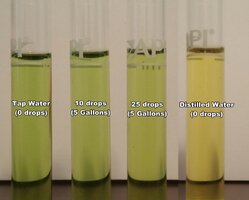
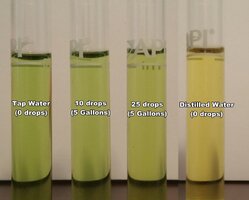
I'll do 3 tests and post photos.
1) No prime
2) 2 drops per gallon
3) 5 drops per gallon
I'll post pics later tonight.

- Messages
- 325
Hey OP. I have an ensuite and I used my birthday money (yes, I'm dedicated) to pay for a Brita filter system to be installed onto my sink. I bought a tap which can have tubing attached to make it easier than lifting a bucket into the sink. I use it purely for fish and I have never had my test kit measure chlorine or chloramines. It works amazingly!
~Mudkipz
~Mudkipz
Hi, will you take a tap water sample, add the regular amount of prime and then test it for ammonia and let us know what it is? The API tests for total ammonia so it will register whether its in a detoxified state or not so you will always register for it with ammonia and just have to "know" it detoxes ammonia + nitrites up to 1.0 when dosed daily.
Also, where are those shrimp right now? Did you remove them? If they are still in there then they are putting out ammonia.
I would use prime over a brita I have to agree with the others. If I was going to try and remove chlorine etc for a fish tank I would probably go with something much better and that will last a long time (like hundreds or a thousand gallons) such as a 5 stage filtration unit. It also does provide slime coat ingredients that are good for your fish.
Attachments
- Messages
- 15,314
Thanks for doing the tests! ok, so that looks like .25 ammonia in your tap?
Have you rinsed the filters in old tank water. The only thing I can think of is you have little bits of rotting shrimp in there or in the substrate which is giving you the ammonia reading.
You're in the second stage of cycling which is great but I know it gets to be a pain if you have to keep doing water changes because nitrites get up to 4.0. Usually I tell people to reduce ammonia to 1.0 during that phase to limit the amount of water changes they have to do. I'd do a thorough gravel vac and filter clean.
Also, you could pick up some Tetra Safe Start Plus after you get your ammonia down to 1.0 and put in a bottle of their start up. People often don't see any nitrites when they cycle with it which makes me think it has lots of the nitrospira/nitrobacter bacteria to convert those nitrites over.
Advertisement
Thanks for doing the tests! ok, so that looks like .25 ammonia in your tap?
Have you rinsed the filters in old tank water. The only thing I can think of is you have little bits of rotting shrimp in there or in the substrate which is giving you the ammonia reading.
You're in the second stage of cycling which is great but I know it gets to be a pain if you have to keep doing water changes because nitrites get up to 4.0. Usually I tell people to reduce ammonia to 1.0 during that phase to limit the amount of water changes they have to do. I'd do a thorough gravel vac and filter clean.
Also, you could pick up some Tetra Safe Start Plus after you get your ammonia down to 1.0 and put in a bottle of their start up. People often don't see any nitrites when they cycle with it which makes me think it has lots of the nitrospira/nitrobacter bacteria to convert those nitrites over.
That's what I've been thinking, that there must be shrimp bits. Will a thorough vacuum of the gravel and filter clean not remove too much bb?
- Messages
- 15,314
That's what I've been thinking, that there must be shrimp bits. Will a thorough vacuum of the gravel and filter clean not remove too much bb?
The BB is in your filter (mostly) and is microscopic. Just do a gentle swish of the media through some tank water to get any food off of it. If you do weekly vacuums you won't disturb the growing bacteria, it adheres via a sticky matrix and does not come up easily.
- Messages
- 4,895
So, you added dr. Tims, and now are considering adding TSS, and you have moved the shrimp out....
What fish do you have in your tank? How many gallons? You started cycling 3 weeks ago?
Adding dr. Tims or TSS isn't worth anything unless you are doing a fish in cycle... So, if you are adding it without fish you are wasting you money and energy
Also, the ammonia in your water doesn't make your nitrites high. As you cycle you need a source of ammonia (one shrimp won't cut it). Some people use fish with TSS, stability, or dr, tims. With TSS you can not change the water for two weeks, with the other bacteria you can do water changes.
If you choose to do a fish less cycle then you need an ammonia source kept up to a certain level to get your cycle going...
So first you have ammonia. Eventually enough bacteria will be present to nitrify even the ammonia from your tap. Using prime will help to detox that amount before it gets broken down.
When enough bacteria has multiplied to process the ammonia you will start seeing nitrites. This is good for fish in vs fishless cycling the levels you want to see are very different, but eventually, bacteria will colonize and break down your nitrites into nitrates. When both your ammonia readings and nitrite readings are at 0, AND you are showing some nitrates, then you are cycled.
Ammonia doesn't turn into nitrites, the bacteria breaks down ammonia and the nitrite is a by product of that...
So, the ammonia in your water isn't why you are seeing high nitrites, it is just the nature of the cycle. However nitrites that are off the charts will stall your cycle. You need to do water changes to bring those down and keep your cycle going.
A 50% water change will reduce your levels by 50%... I.e. Nitrite is 5, 50% water change would bring it to 2.5. For a fish in cycle this is way too high still, even with prime. Another 50% change will bring it back down to 1.25, followed by a third to bring it to .75, where prime can help to detoxify. If doing a fish in cycle, you may need to do 50% water change three times a day to keep your levels down, if a fishless cycle maintaining them under two should be fine...
- Messages
- 15,314
Adding dr. Tims or TSS isn't worth anything unless you are doing a fish in cycle... So, if you are adding it without fish you are wasting you money and energy
You can use these products just fine using an alternate ammonia source. Pure ammonia is the best but some people cannot find it and end up using food or shrimp. The fact that she has high nitrites even after water changes that brings them down tells us there is still an ammonia source. I agree, she needs an ammonia source but probably has too much of one now
I vacuumed the gravel this morning and did a 75% water change. I didn't have time to clean the filter, I'll do that later.
The gravel didn't seem very dirty and the water that came out of it was pretty clear. I couldn't find any bits of shrimp, so if they are in there they must have been pretty tiny.
Assuming that there is some shrimp in there that I simply cannot find, how long do you think it will take to cycle the tank? I'm already showing nitrates.
- Messages
- 15,314
You need to wait for the nitrites to drop and assuming they don't skyrocket again (make sure to rinse your filter media) you will need an ammonia source. Are you able to get some pure ammonia (ammonia and water) no surfectants, soaps etc, should not foam when shaken?
If not then once the ammonia is at 0 and nitrites drop to 0, I think the easiest thing to do would be to purchase ONE small fish per 10 gallon (not goldfish) and add in a bottle of TSS+. If ammonia and nitrites stay at 0 (which I think they will if you don't overstock initially), then after a week slowly add more, 2 or 3. How big is your tank? What are you going to stock it with?
If not then once the ammonia is at 0 and nitrites drop to 0, I think the easiest thing to do would be to purchase ONE small fish per 10 gallon (not goldfish) and add in a bottle of TSS+. If ammonia and nitrites stay at 0 (which I think they will if you don't overstock initially), then after a week slowly add more, 2 or 3. How big is your tank? What are you going to stock it with?
Probably more expensive to buy Brita filters than prime. You can make your own prime for much less too.
Also, from my experience with brita filters is that they lower pH for about 10min, then it rises to the normal ph.
My brita filter would leave my water at 6.8 ph, after about 10min, the water was back to 7.6
Also, from my experience with brita filters is that they lower pH for about 10min, then it rises to the normal ph.
My brita filter would leave my water at 6.8 ph, after about 10min, the water was back to 7.6
You need to wait for the nitrites to drop and assuming they don't skyrocket again (make sure to rinse your filter media) you will need an ammonia source. Are you able to get some pure ammonia (ammonia and water) no surfectants, soaps etc, should not foam when shaken?
If not then once the ammonia is at 0 and nitrites drop to 0, I think the easiest thing to do would be to purchase ONE small fish per 10 gallon (not goldfish) and add in a bottle of TSS+. If ammonia and nitrites stay at 0 (which I think they will if you don't overstock initially), then after a week slowly add more, 2 or 3. How big is your tank? What are you going to stock it with?
Sounds goodI'll find something... It's a 20 tall, and I'm going to be stocking with Mollies and/or Plattys. My local Big Als is getting stock in about a week from Singapore, so we're going to wait till then.
Thanks for your help!
- Messages
- 15,314
I would go with platies then. Mollies easily get to 4 inches, especially the females and will be too big for your tank. The platies and/or guppies would be perfect. The combination is often nice of the two. Go with all males unless you want to have a million fry!
I'm probably going to get assorted platies. Keeping that in mind, what is a good single fish to buy to keep the cycle going?
Advertisement
Well, that didn't work.
I vacuumed the gravel and cleaned the filter. Then I did a 90% water change. Woke up this morning with a dark purple nitrite reading again.
I have not added any ammonia to the tank in a week.
I ordered Tetra safestart today. It doesn't arrive for about 2 weeks so I guess I'll just keep doing water changes until then. #lame. When I had my 125G tank it cycled so easily....so this tiny tank has been pretty frustrating.
- Messages
- 15,314
What was it at after the water change? Sometimes they're so high off the chart that even a 90% leaves you with a high reading. And just to double check, you're sure you do not have nitrites in your tap water?
It was very low, the test was light blue. And yeah, no nitrites in the water.
- Messages
- 15,314
There is something decaying somewhere in that tank. You rinsed the filter good? I'd take it apart and rinse out anything in there. Should be done monthly anyways so if you haven't done it yet, couldn't hurt?
Any new plants that might be rotting under the substrate?
The good news is once they drop you'll be cycled Trying to find something good about this!
Any new plants that might be rotting under the substrate?
The good news is once they drop you'll be cycled Trying to find something good about this!
There is something decaying somewhere in that tank. You rinsed the filter good? I'd take it apart and rinse out anything in there. Should be done monthly anyways so if you haven't done it yet, couldn't hurt?
Any new plants that might be rotting under the substrate?
The good news is once they drop you'll be cycled Trying to find something good about this!
I rinsed it really well. There was a bunch of gunk in there, so I was *sure* that after rinsing it the problem would be solved. I was devastated when I saw the DARK purple again today~!
On the bright side I know that there is bacteria in there because I am getting nitrate readings also. Guess I just need to wait it out. either its going to cycle in the next 2 weeks, or I'll use the TSS. Either way - 2 or 3 weeks to go till fish!
- Messages
- 31
I’m trying to cycle my 10gal tank with 4 guppies. I’ve been using Prime and Stability for 10days and ammonia has stayed at .25ppm and nitrites at .50ppm (no sign of nitrates). I tested my well water (ammonia .50ppm nitrites 0 and nitrates 0). So then I tested my brita filter (ammonia 0 nitrites 0 nitrates 0).
So my question is, can I cycle my tank with the brita water? Since all parameters are at zero, the the fish will be producing the ammonia to create the nitrogen cycle.
Sorry I’m so new to this
So my question is, can I cycle my tank with the brita water? Since all parameters are at zero, the the fish will be producing the ammonia to create the nitrogen cycle.
Sorry I’m so new to this

- Messages
- 676
Random Great Topic!

Today's Deals
Advertisement
Advertisement
Advertisement