
You are using an out of date browser. It may not display this or other websites correctly.
You should upgrade or use an alternative browser.
You should upgrade or use an alternative browser.
Black Beard Algae (your advise needed)
Advertisement
The best way to control BBA is to have enough plants growing fast enough to outcompete the BBA for nutrients.
If your BBA is growing on plants or rocks that you can remove from your tank and treat using a dip, that may be the best way to deal with it.
What product containing gluteraldehyde did you use and how much did you add? Were you using a product diluted to a concentration suitable for aquarium use? Did you follow the directions carefully?
Gluteraldehyde is a powerful disinfectant that will kill lots of stuff if used improperly. Hospitals use it at higher concentrations as a high level disinfectant.
I dose Seachem Excel into my aquarium on a daily basis without issues. I use 1 tsp per 50 gallons of water. At that concentration, it helps control algae without being detrimental to fish and snails.
Advertisement

- Messages
- 1,573
Pretty sure they do, I've seen mine grazing on it & my 90 gallon tank is as clean as a whistle.I'm not sure nerite eat BBA; pretty sure they don't. Don't know anything about military helmet.
- Messages
- 158

- Messages
- 18,074
I have not seen a single hair since I put them in there.I've read repeatedly that Siamese Algae Eaters shred BBA. I've done alot of reading on them since I just bought some.
- Messages
- 158
I have 5 small plants in one of my 20's. All had BBA 3 days ago. 2 SAE 1" long has rid 2 plants of it already since acquiring them Thursday afternoon. I'm sold.I have not seen a single hair since I put them in there.
Advertisement
- Messages
- 18,074
Their only downfall is adult size.I have 5 small plants in one of my 20's. All had BBA 3 days ago. 2 SAE 1" long has rid 2 plants of it already since acquiring them Thursday afternoon. I'm sold.

- Messages
- 2,949
This is literally the only reason I don't keep SAE.Their only downfall is adult size.

- Messages
- 2,455
If you don’t want to deal with the adult size of SAE, then guppy grass or hornwort. Both grow insanely quickly and use enough nutrients to starve the algae. Hornwort also produces a chemical that affects algae growth. Both are also dirt cheap and easy to remove once the job is done. I had an infestation of BB and hair algae, and it was gone within a month of buying some guppy grass and just plopping it in the tank. If you can’t find either at your LFS, it’s super easy to get online.

- Messages
- 45
I had massive BBA on all my plants, particularly my swords and wisteria. I researched and found that the cause of my issue is excess phosphates, since I maintain my tank well, regular water changes, and don't have excessive lighting. I purchased an API phosphate test kit and sure enough it's off the charts. Been using PhosGuard for a few weeks and it's greatly improved. Just an idea in case you might want to check your phosphates.How do you get rid of it? I am trying to stop it in its tracks. I started dosing Glutaraldehyde daily and the fish reacted EXTREMELY negatively after only 3 days. Rainbows lost most of their color and one has developed a small white strip on his fin. Rainbows and tetras have completely stopped breeding. I did a couple large water changes, and Rainbows have recovered some color, but still no breeding activity from anyone. I can't believe they sell this as being fish safe, but regardless, I won't be using it anymore. What can I do to beat this BBA? I read the Siamese algae eaters may help, but then I read that they will just poop out the algae spores, ultimately just spreading it around the tank. I have read many people ended up shutting down the tank as they concede defeat to the BBA. I'd like to not follow that path, so any advice is appreciated. Thank you
- Messages
- 1,573
And the fact that they can be aggressive to other fish when they mature.Their only downfall is adult size.
Advertisement
I've never observed any aggression in an SAE; nor heard of anyone else observing aggression in SAE. Now there is the chinese algae eater which is extremely aggressive but that is not the same fish despite looking very similar....
And the fact that they can be aggressive to other fish when they mature.
I've read repeatedly that Siamese Algae Eaters shred BBA. I've done alot of reading on them since I just bought some.
The only problem with Siamese Algae Eaters is that they are often misidentified at the LFS. There are a number of species with similar appearance that are sometimes called SAE that are species that won't touch BBA. So if you are planning on getting SAE, be sure you know EXACTLY what a real SAE looks like. Do not count on your LFS to get it right.
- Messages
- 434
I've over dosed excel in my tank 10xs what is supposed to be used without harm to fish or shrimp.
Hard to for me to think that's causing problems.
Co2 has helped back down the bba but it's still clinging on in my tank.
I don't think it was solely the excel, but that definitely pushed them over the line. It's not as safe as everyone acts. Do some research on how Glutaraldehyde affects proteins within the fish, its really toxic.
Regardless, the fish are fighting tapeworms and the stress from dosing excel pushed them over the edge and they lost all color.
- Messages
- 434
I've over dosed excel in my tank 10xs what is supposed to be used without harm to fish or shrimp.
Hard to for me to think that's causing problems.
Co2 has helped back down the bba but it's still clinging on in my tank.
It is banned in the UK for a reason. Seeing it’s effects on already weakened fish was painful. I’m kicking myself for putting such a strong chemical in the tank, no one should be doing this.
https://www.future-science.com/doi/10.2144/04375RV01

- Messages
- 3,042
I 10x overdosed my tank with excel several days ago, followed by a 5x overdose the next day, then 3x overdose for the last 3 days. My tank is completely blacked out as well because I'm having more than one issue, so you would think my fish should be super stressed. But I haven't noticed any issues with my fish or shrimp at all. They're just swimming around happily doing fish stuff. Shrimp too. I even have otos in my tank.
That being said, I know excel causes problems for a lot of people. I'm not contesting that at all. I just don't understand why. Like, how can I 10x overdose my tank full of sensitive fish and inverts without any problems, but others just whisper the word excel and all their fish die? I'm sure my fish are still in a delicate spot but I'll be doing a full water change tomorrow anyways.
Super weird if you ask me.
- Messages
- 158
I did ask my LFS to get these, and they got them. Confirmed in a thread I made in the fish ID section here That's twice I asked this store for something specific, and they got it exactly. I guess lucky me!The only problem with Siamese Algae Eaters is that they are often misidentified at the LFS. There are a number of species with similar appearance that are sometimes called SAE that are species that won't touch BBA. So if you are planning on getting SAE, be sure you know EXACTLY what a real SAE looks like. Do not count on your LFS to get it right.
I did ask my LFS to get these, and they got them. Confirmed in a thread I made in the fish ID section here That's twice I asked this store for something specific, and they got it exactly. I guess lucky me!
You are lucky to have such a good LFS. Hopefully, they will eliminate your issue.

- Messages
- 1,723
It is banned in the UK for a reason. Seeing it’s effects on already weakened fish was painful. I’m kicking myself for putting such a strong chemical in the tank, no one should be doing this.
https://www.future-science.com/doi/10.2144/04375RV01
Maybe ... as stated in the article you provided. It's the Ph of the water with the glut that made it react worse for your fish.
I use 10 cc with a syringe directly to the bba. I've used up to 30cc in 75 gal without negative impact on shrimp or fish.
I have read that phosphate levels cause bba. Yet I have not tested for this or attempted to counter phosphate levels.
Advertisement

- Messages
- 4,173
Spot dosing with Hydrogen Peroxide can help. I don't find it to be quite as effective as spot dosing with Excel but it's the next best thing IMO.
- Messages
- 3,042
- Messages
- 434
Lots of good info in this thread... thanks for everyone’s input. First step is gonna be check phosphates, I feed a lot of frozen foods that use binders which supposedly contain high amounts of phosphate.
Hi
I read some threds in the forum about usage of Flourish Excel to get rid of BBA
I have been using it for 8 days and would appreciate your opinion on the usage and any good advise you can give.
I have a 200L fresh water tank with soil and decoration + Invertebrates and some tetras
my main concern was the Invertebrates in my aquarium.
I reduced the water level as much as I could to 136L of water
I started using Flourish Excel 8 days ago and I think I can see some good results
it looks like some kind of algae bleeching has started.
day1 - 20ml Flourish Excel
day2 - 37ml Flourish Excel
day3 - 3.5ml Flourish Excel
day4 - 7ml Flourish Excel
day5 - 7ml Flourish Excel
day7 - 8ml Flourish Excel
day9 - 7ml Flourish Excel
day10 - 10% water change + 25ml Flourish Excel
would appreciate your further advise and recommendations
day 3
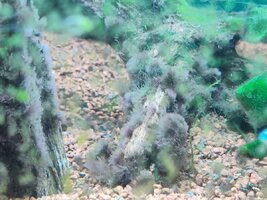

day 4

day 5

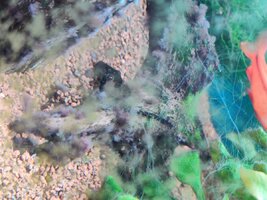

day 7

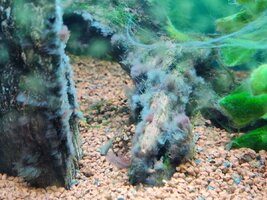
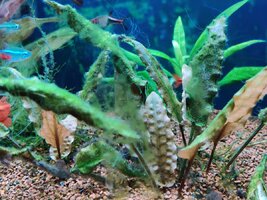
day 9

I read some threds in the forum about usage of Flourish Excel to get rid of BBA
I have been using it for 8 days and would appreciate your opinion on the usage and any good advise you can give.
I have a 200L fresh water tank with soil and decoration + Invertebrates and some tetras
my main concern was the Invertebrates in my aquarium.
I reduced the water level as much as I could to 136L of water
I started using Flourish Excel 8 days ago and I think I can see some good results
it looks like some kind of algae bleeching has started.
day1 - 20ml Flourish Excel
day2 - 37ml Flourish Excel
day3 - 3.5ml Flourish Excel
day4 - 7ml Flourish Excel
day5 - 7ml Flourish Excel
day7 - 8ml Flourish Excel
day9 - 7ml Flourish Excel
day10 - 10% water change + 25ml Flourish Excel
would appreciate your further advise and recommendations
day 3
day 4
day 5
day 7
day 9

- Messages
- 200
Yes, I can see that the algae is starting to turn red so that means it is dying. For the driftwood and any other hardscape, I would take it out of the tank, fill a spray bottle with the Excel and spray it down. It would make this more efficient. Hang in there, you will win the war with algae!

- Messages
- 12,262
Next for the driftwood fill a bowl with hydrogen peroxide and dip the wood in it for about 5 min. Or even better take the wood and using a plastic scruby clean off the bb as best you can than do the peroxide dip. You can also do it. With plants for 3min but the results can be mixed and leaves may die off

- Messages
- 456

- Messages
- 1,924
I agree, a Siamese algae eater will eat that up in no time.
You can also use hydrogen peroxide to get rid of it, but like 86 ssinit said it may kill off some plants
You can also use hydrogen peroxide to get rid of it, but like 86 ssinit said it may kill off some plants

- Messages
- 1,974
Hi tamirh! Welcome to Fishlore!! I have had some success using Excel on my tanks too.
The one thing that I would recommend is to try to figure out what is causing the BBA and fix that. The BBA is caused by an imbalance...IME of typically too much light or too much nutrients in the water or a combination of both. If you use Excel to kill off the BBA but don't address what brought it on, it's like being allergic to a cat and using an anti-histamine to address your allergy symptoms. The real problem is the cat and until you get away from the cat, you'll keep needing medication. Same with the BBA. If you use the Excel, it should kill off the BBA, but unless you continually use it (which probably isn't such a good idea), it will keep coming back.
For me, when BBA shows up, it's typically because I've over time gotten to the point of feeding my fish too much. It can also crop up if you're having too small or infrequent water changes. Also, if you leave your light on for too long during the day, it will be a factor too.
I don't even use Excel anymore. Now, when BBA shows up, I assess how much I'm feeding and try to dial it back. I may even add a fast day or two to help. If you have your lights on more than 8 hours a day, that could be too much. Finally, definitely don't skip the water changes. They can really make that BBA appear from out of nowhere in very little time.
Good luck!! Would love to see a pic of your tank!!

- Messages
- 946
Advertisement
Hi all and thanks for answering
so I never turn the lights on more then 8 hours. It is on from 3pm-11pm
I change 10% water every week
I did try total blackouts but the plants were affected not the algae. plants literally died while the bba and other algae was not affected at all.
what is causing the BBA is THE question. the only thing I can think of is that it started close to the time I installed an air Diffuser. but Im not sure its related.
A question regarding hydrogen peroxide, I never used it. is there a safe form that can be purchased commercially? Im concerned that the driftwood will absorb it and release it back to the water?
- Messages
- 1,924
You need to start doing bigger water changes. I would say 50% at least for nowHi all and thanks for answering
so I never turn the lights on more then 8 hours. It is on from 3pm-11pm
I change 10% water every week
I did try total blackouts but the plants were affected not the algae. plants literally died while the bba and other algae was not affected at all.
what is causing the BBA is THE question. the only thing I can think of is that it started close to the time I installed an air Diffuser. but Im not sure its related.
A question regarding hydrogen peroxide, I never used it. is there a safe form that can be purchased commercially? Im concerned that the driftwood will absorb it and release it back to the water?
Peroxide is the stuff you buy at the store for wounds. It’s essentially water with an extra oxygen attached. It’s safe for fish in moderation. Scrub your wood, douse it in peroxide, let it dry, apply the other stuff if you want, rinse and try it back in the tank. Test your water, nitrate, nitrate, see if they are out of normal specs. If they are, start a vigorous water change regularly for a while. Add more plants, and a few cutting of pothos if you can. I’ve just added some to my filters, as I was still getting higher than expected nitrates. Minimal ammonia, nitrite, but 5ppm and 10ppm nitrates in various tanks. So more plants for me!
weekly partial water changes of 10 percent is not enough...do 35% to 50% weekly.. Hydrogen peroxide turns to water and oxygen with use... HOWEVER you can overdose it if you use too much and kill fish... Hydrogen peroxide dips work to kill BBA on ornaments and driftwood outside of the tank..google how to do it properly with live plants. Most importantly,you can kill off all the BBA in your tank BUT if you do not fix the initial cause IT WILL JUST RETURN...In your case i think overfeeding your fish combined with too small of partial water changes. Possibly too much light for your amount of plants ....suggest getting red root floaters or water lettuce to help to eat nitrates that BBA will thrive on if your other plants are not eating enough of it to outcompete the BBA

- Messages
- 2,543
BBA will take over an entire tank in short order an kill all other plants off... People who want planted tanks DO NOT want BBA in their tanks whatsoever
- Messages
- 2,543
BBA will take over an entire tank in short order an kill all other plants off... People who want planted tanks DO NOT want BBA in their tanks whatsoever
That is definitely not true lol. It is better to understand the reason behind algae proliferation than to nuke it at first sight.
Here is my tank with lots of BBA:
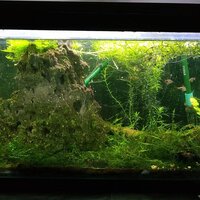
Guess what, now there is almost none. I did not treat it with algaecide or any chemicals and the plants simply took over the BBA.
Understanding what makes BBA grow is key.
1) They like high water flow and high light. Reducing flow or redirecting flow will reduce BBA significantly. Blocking the light with another plant will also reduce BBA signficantly.
2) Algae likes phosphates. Fish flakes are usually high in phosphates. Changing fish food from a generic flake to a high quality protein pellet can have an effect long term. (This is what I did for the above tank)
3) Feed less, feeding less means BOTH nitrogen and phosphorus will be reduced. Algae growth will be inevitably limited.
If you read my post you might not have responded like that... Not to meantion the original poster does not the stuff in his tank... On this thread and one other thread also.That is definitely not true lol. It is better to understand the reason behind algae proliferation than to nuke it at first sight.
Here is my tank with lots of BBA:
View attachment 760321
Guess what, now there is almost none. I did not treat it with algaecide or any chemicals and the plants simply took over the BBA.
Understanding what makes BBA grow is key.
1) They like high water flow and high light. Reducing flow or redirecting flow will reduce BBA significantly. Blocking the light with another plant will also reduce BBA signficantly.
2) Algae likes phosphates. Fish flakes are usually high in phosphates. Changing fish food from a generic flake to a high quality protein pellet can have an effect long term. (This is what I did for the above tank)
3) Feed less, feeding less means BOTH nitrogen and phosphorus will be reduced. Algae growth will be inevitably limited.
- Messages
- 2,543
If you read my post you might not have responded like that... Not to meantion the original poster does not the stuff in his tank... On this thread and one other thread also.
If he reads the 3 points I listed and put it into action then BBA will not take over his entire tank... There is nothing wrong with BBA in planted and non-planted tanks and understanding them will help address any issues.
As long as there are nutrients and light then algae will grow. Is there a reason you want to remove the BBA? It is playing a crucial role of absorbing nutrients from waste so you should have an alternative way of removing waste once the algae is removed.
I find BBA to be ugly as well as problematic for the other plants. if it attaches to the leaves, they will rot and die fast.
They like high water flow ...
I think this might be the problem. I do have high water flow.
Advertisement
IF you happen to like BBA more power to you...this thread, this issue, for the original poster, the member did NOT want BBA in his tank... as almost all aquarium and fish keepers do not wish to have BBA . if you like it keep it and enjoy iy. i know one person here where i live that has it in one tank in a controlled area of one of his tanks. but he also knows what he is doing and keeps it in one area ...BUT he also does not like to take any vacations because he knows his BBA will get out of control if he was not there to control it
- Messages
- 12,262
The thing with bba is it’s always in your tank. High water flow does promote it but I also get it in the dark low to no flow areas in the tank. Yes more plants reduces algae of all types. Fast growing plants are best. But than the plants take over the tank and again the bba starts low in the tank. Me I’ve found that if you remove and manually remove it off of wood and ornaments and remove the leaves that are just to far gone than do your peroxide dip. This keeps it at bay. When I dip in peroxide I rinse in sink and than soak in a bucket of tank water. Usually for the amount of time it takes to clean off the next piece. Than return to tank. I use api co2 booster it’s api’s version of excell. These need to be used daily to keep algae away. A uv steralizer is also good for removing algae out of the water not from plants.
Like. Said it’s allways going to be there you just have to keep it at bay. I do all of above and keep ottos,nerite snails and SAE to also work on algae. And yet another thing I use is the doctors 3 in 1. Yes it a fight.
Like. Said it’s allways going to be there you just have to keep it at bay. I do all of above and keep ottos,nerite snails and SAE to also work on algae. And yet another thing I use is the doctors 3 in 1. Yes it a fight.
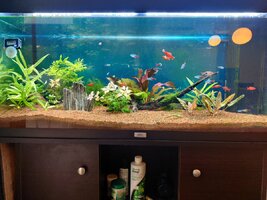
Hi All
I implemented some of your advise:
I changed the direction of water flow so that it will bump the back wall of the tank, thus decreasing the flow.
I took out the big stones and driftwood and treated with small amount of peroxide
lowered the lights to 7 hours
a bit less feeding
this is my Aquarium state for now
I implemented some of your advise:
I changed the direction of water flow so that it will bump the back wall of the tank, thus decreasing the flow.
I took out the big stones and driftwood and treated with small amount of peroxide
lowered the lights to 7 hours
a bit less feeding
this is my Aquarium state for now
- Messages
- 200
Random Great Topic!

Today's Deals
Advertisement
Advertisement
Advertisement