
Common Name: Carassius auratus (Common and Comet Goldfish, Goldfish, Feeder Goldfish)
All Goldfish were bred from the Crucian Carp (Carassius carassius), which are found throughout Asia. Common and Comet Goldfish are a commonly kept aquarium and pond fish that come in a variety of colors. They grow quite large if they provided with the space they need to so.
They tend to be very peaceful, though some individuals can get pushy when they feel cramped or when breeding and they do have spines on their dorsal and analfins, so care should be taken when netting and handling larger fish, and check over females and other fish for injuries during breeding season. Goldfish have been known to live into their teens, and accept a wide range of water conditions. They enjoy rooting around in the substrate for food.
Sexing: The only sure way to sex Goldfish is to wait until they are of breeding age, usually 1 ½ to 2 years old. Males will develop tubercules around their gill plates, face, and the front edge of their pectoral fins. Some will even develop tubercules down on to their bodies and fins.
Males tend to be slimmer than females, and the area between their ventral and pelvic fins will be concaved. Females are fuller in the body, and are more flat or rounded out between their ventral and pelvic fins.
Fish Size and Housing: Given the space and care, Common and Comet Goldfish will grow more than 10 inches long. In one year, they can typically grow from a few inches long, to more than 8. A minimum of 55 gallons for a single Common Goldfish is recommended, and no more than 2 in a tank of this size, as they are major contributors to the bioload, though an even wider tank is better, to provide extra room to turn around. Really, large pond is ideal.
More surface area allows for more fish, in a reasonable sense, as there is more room for gas exchange. In a pond environment, you can afford as little as 20 gallons per fish, as long as you are willing to step up on water changes a bit. In the aquarium, provide a sandy substrate (or no substrate at all), and thick leaved plants like swords, anubias, cryps, and java ferns (or silk plants), and décor large enough for them not to get stuck in.
Plants are typically targeted as toys and treats. Keep this in mind when adding them to your aquarium or pond, as they may be uprooted, or eaten. Goldfish are a hardy fish that accept a very wide range of conditions, as long as Ammonia, Nitrites and Nitrates are kept at their proper levels. They do seem to prefer water that is not too hard, but if acclimated properly, usually do just fine.
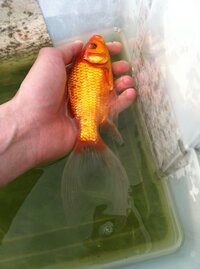
1 ½ year old Female Common Goldfish
Food: Goldfish seem to enjoy a diet that is mainly made up of plants and vegetables, through a higher protein food, with more frequent feedings (and more frequent water changes) will increase growth. Avoid foods containing corn, corn meal, and the like. If keeping your goldfish in an outdoor pond, it is best to feed a diet with wheat germ in the fall, and early spring.
This helps them digest their food in lower temps, and also provides some extra protein when the insect populations are lower. When the water temperature is below 50*F, you should not feed them. They will slow their metabolisms and eat very little.
Breeding: If kept outdoors, Goldfish typically breed during spring, as water temperatures start to rise. They can easily breed year round, as well, as long at the temp is high enough, and their diets are right. As temps start to fluctuate in fall, they will attempt to spawn a few more times, before becoming dormant for the winter.
Aquarium Goldfish seem to breed whenever they are ready, but do stick with the usual springtime fling, as well. Males will get pushy and sometimes even aggressive with females and each other. Males will nose and push at the females ventral area, trying to entice the females to release their eggs. The fastest male to make it to the spawning female will fertilize the eggs. Be sure to keep more mature females than males, to reduce stress levels, and remove any females that are being pushed around too much and are unwilling, or not ready, to breed.
Tank Mates: Goldfish are typically very peaceful fish.They are commonly kept with other Goldfish and other temperate community fish. It is not suggest to keep Long Bodied Goldfish, such as Commons, Comets, Shubinkins, and Wakins, with smaller Fancy Goldfish, like Ranchu’s and Lionheads, or Fancy Goldfish with deformed eyes, like Bubble Eye’s, Celestial Eye’s and Telescope’s, and with Oranda’s with exaggerated wen growth.
Suggested tank mates: Other temperate community fish, most other Goldfish (see above), Hillstream Loaches, Mollies, Rosey Minnows, Dojo Loaches, Danio’s, Bristle Nose Pleco’s*. I have also kept Endlers with my large Goldfish with no problems. Always research each individual fishes needs before bringing them home!
*Pleco’s can be tricky to keep with Goldfish. Some individuals will eat away at Goldfishes slime coats, scales, and skin. This is true for most types of Pleco’s, and especially true for Common Pleco’s. I am currently housing a 4 inch long Common Pleco in my 150 gallon pond with Goldfish ranging from 3 to 8 inches, and a 4 inch Goldspot Sailfin Pleco in my 65 gallon pond with Fancy Goldfish ranging from 4 to 5 inches, with no problems. As the Pleco’s both age, issues may arise, so if you do decide to try housing any type Pleco with Goldfish, always keep an eye out, and keep both parties well fed. The most common type of Pleco housed with Goldfish are Bristlenose Plecos.
Common or Comet? While all Goldfish share the same scientific name, selective breeding has produced a large variety of true-breeding body types, fin types and colors, like how we have such a variety of dogs, from Chihuahua's to Great Danes. The difference between Common Goldfish and Comet Goldfish is simply fin length. Comet Goldfish will have longer, flowing fins, while Commons will have shorter rounded fins.
As both types age, their fin length will increase dramatically, and it is possible that may be difficult to tell apart. Common Goldfish will typically have caudal (tail) fins that make up less than half their total length (from nose tip to fin tip) and Comets will have a fin length that makes up more than half of their total length. Fin length may or may not need to be taken into account when housing these fish. Fish with very long fins may need larger tanks that allow for more space so that their fins are less likely to get caught on plants and décor.

Young Common (Orange and White) compared to a young Comet (White). Note the difference in fin length.
Source:
-fishbase.se
All Goldfish were bred from the Crucian Carp (Carassius carassius), which are found throughout Asia. Common and Comet Goldfish are a commonly kept aquarium and pond fish that come in a variety of colors. They grow quite large if they provided with the space they need to so.
They tend to be very peaceful, though some individuals can get pushy when they feel cramped or when breeding and they do have spines on their dorsal and analfins, so care should be taken when netting and handling larger fish, and check over females and other fish for injuries during breeding season. Goldfish have been known to live into their teens, and accept a wide range of water conditions. They enjoy rooting around in the substrate for food.
Sexing: The only sure way to sex Goldfish is to wait until they are of breeding age, usually 1 ½ to 2 years old. Males will develop tubercules around their gill plates, face, and the front edge of their pectoral fins. Some will even develop tubercules down on to their bodies and fins.
Males tend to be slimmer than females, and the area between their ventral and pelvic fins will be concaved. Females are fuller in the body, and are more flat or rounded out between their ventral and pelvic fins.
Fish Size and Housing: Given the space and care, Common and Comet Goldfish will grow more than 10 inches long. In one year, they can typically grow from a few inches long, to more than 8. A minimum of 55 gallons for a single Common Goldfish is recommended, and no more than 2 in a tank of this size, as they are major contributors to the bioload, though an even wider tank is better, to provide extra room to turn around. Really, large pond is ideal.
More surface area allows for more fish, in a reasonable sense, as there is more room for gas exchange. In a pond environment, you can afford as little as 20 gallons per fish, as long as you are willing to step up on water changes a bit. In the aquarium, provide a sandy substrate (or no substrate at all), and thick leaved plants like swords, anubias, cryps, and java ferns (or silk plants), and décor large enough for them not to get stuck in.
Plants are typically targeted as toys and treats. Keep this in mind when adding them to your aquarium or pond, as they may be uprooted, or eaten. Goldfish are a hardy fish that accept a very wide range of conditions, as long as Ammonia, Nitrites and Nitrates are kept at their proper levels. They do seem to prefer water that is not too hard, but if acclimated properly, usually do just fine.
1 ½ year old Female Common Goldfish
Food: Goldfish seem to enjoy a diet that is mainly made up of plants and vegetables, through a higher protein food, with more frequent feedings (and more frequent water changes) will increase growth. Avoid foods containing corn, corn meal, and the like. If keeping your goldfish in an outdoor pond, it is best to feed a diet with wheat germ in the fall, and early spring.
This helps them digest their food in lower temps, and also provides some extra protein when the insect populations are lower. When the water temperature is below 50*F, you should not feed them. They will slow their metabolisms and eat very little.
Breeding: If kept outdoors, Goldfish typically breed during spring, as water temperatures start to rise. They can easily breed year round, as well, as long at the temp is high enough, and their diets are right. As temps start to fluctuate in fall, they will attempt to spawn a few more times, before becoming dormant for the winter.
Aquarium Goldfish seem to breed whenever they are ready, but do stick with the usual springtime fling, as well. Males will get pushy and sometimes even aggressive with females and each other. Males will nose and push at the females ventral area, trying to entice the females to release their eggs. The fastest male to make it to the spawning female will fertilize the eggs. Be sure to keep more mature females than males, to reduce stress levels, and remove any females that are being pushed around too much and are unwilling, or not ready, to breed.
Tank Mates: Goldfish are typically very peaceful fish.They are commonly kept with other Goldfish and other temperate community fish. It is not suggest to keep Long Bodied Goldfish, such as Commons, Comets, Shubinkins, and Wakins, with smaller Fancy Goldfish, like Ranchu’s and Lionheads, or Fancy Goldfish with deformed eyes, like Bubble Eye’s, Celestial Eye’s and Telescope’s, and with Oranda’s with exaggerated wen growth.
Suggested tank mates: Other temperate community fish, most other Goldfish (see above), Hillstream Loaches, Mollies, Rosey Minnows, Dojo Loaches, Danio’s, Bristle Nose Pleco’s*. I have also kept Endlers with my large Goldfish with no problems. Always research each individual fishes needs before bringing them home!
*Pleco’s can be tricky to keep with Goldfish. Some individuals will eat away at Goldfishes slime coats, scales, and skin. This is true for most types of Pleco’s, and especially true for Common Pleco’s. I am currently housing a 4 inch long Common Pleco in my 150 gallon pond with Goldfish ranging from 3 to 8 inches, and a 4 inch Goldspot Sailfin Pleco in my 65 gallon pond with Fancy Goldfish ranging from 4 to 5 inches, with no problems. As the Pleco’s both age, issues may arise, so if you do decide to try housing any type Pleco with Goldfish, always keep an eye out, and keep both parties well fed. The most common type of Pleco housed with Goldfish are Bristlenose Plecos.
Common or Comet? While all Goldfish share the same scientific name, selective breeding has produced a large variety of true-breeding body types, fin types and colors, like how we have such a variety of dogs, from Chihuahua's to Great Danes. The difference between Common Goldfish and Comet Goldfish is simply fin length. Comet Goldfish will have longer, flowing fins, while Commons will have shorter rounded fins.
As both types age, their fin length will increase dramatically, and it is possible that may be difficult to tell apart. Common Goldfish will typically have caudal (tail) fins that make up less than half their total length (from nose tip to fin tip) and Comets will have a fin length that makes up more than half of their total length. Fin length may or may not need to be taken into account when housing these fish. Fish with very long fins may need larger tanks that allow for more space so that their fins are less likely to get caught on plants and décor.
Young Common (Orange and White) compared to a young Comet (White). Note the difference in fin length.
Source:
-fishbase.se

