Using Potassium Permanganate


Advertisement
Cale anaerobic gases usually come with sand substrate. I have gravel in all tanks and have never had a problem. Uv sterilizer is a very good choice. I have one in my 90 after a similar accuracy. Thing is how olds are your fish?

Since your tank is planted and your worried about substrate releasing gasses there are 2 things I can think of to do. 1 vacuume weekly at every water change. Do a different section of the tank at every water change. 2 get mts snails. Sounds drastic but mts live in your substrate and eat whatever is in it and are constantly moving it. Even in big numbers they add little to the waste load. They don’t eat plants but do eat algae. Also with all there substrate movement they are beneficial to plant growth.

Unforunatly with mts the pp treatment can’t be done. It will kill snails. I have bought the pp but have not used it. I’m not one to use meds and pp is even more than a medication.

Also h2o2 will kill your hair algae. Dip the plants or whatever into it. Plants for 3 min anything else for 5 rinse and put back in. Than use an algaecide like excel or apI co2 booster to keep it away. Takes longer but either of the algaecide will kill off the hair algae in a few weeks. Another thing is shrimp. They will eat hairalgae. Another creature I keep in my tanks.

Hope some of this helps. Another thing is fish do die. People think that something is wrong but fish sometimes just die.

Thanks - will look into MTS snails. Someone also suggested just planting the substrate wall to wall with crypts or vallis as that helps the issue.
The gravel in question is quite fine so its possible that the issues are anaerobic, but considering I had fish die a month later the same way in a totally different tank has made me question things again. In any case the tank is now drained and I'll give it a thorough, nuclear clean and start over. The gravel is now in a bucket and I'll clean that separately but may not use it in the next setup.

And will try H202 for the algae. I have a pair of rams in the tank so shrimp are probably not on the cards - amano maybe? Never kept shrimp before but have very soft water and may try them out in a different tank to start.

Then the fish dying - some continue to seem fine in the other tanks - hope it remains this way . Those that died were not old, and different species too. In fact, they were mostly vibrant, strong fish - its been quite unreal to witness just how fast they died.
Thanks again for the input.
 

Advertisement
That was what my columnaris experience 7-9 years ago was like .1 day fish was fine next I knew it was on 24 hour watch ! This was my first experience with PP !
I will never waste money on the antibiotic cocktails again .Firstly because they only work if the fish can heal itself and I don't believe for one second they can just kill the disease??
PP kills the issue ,maybe a weak fish you missed too ! It is how I 'cured' columnaris ..I only needed to euthan any visibly infected fish ,treat 2 times at 4ppm maybe 2 days apart and done ..I kept the fish that were infected for over 8 months without any other losses before just euthing the whole tank ...
It worked and is the only thing that ever worked for me ..
The symptoms your fish are displaying is type 4 columnaris ...
Sending you a pm as some of my best info is not allowed to be posted ..

Thanks! I've been looking through various disease related topics and columnaris (after so called fish 'tb') seems really brutal as well.
All my remaining fish that were in my community are spread across 3 tanks now. Only one fish looks sick, the angel I mentioned with a slight protruding eye on one side (although it has improved a little).

All other fish seem fine. I'll nonetheless try the PP at 4ppm as advised and ensure I have the H202 at the ready! I'll also look into Type 4 Columnaris especially.
Back into the lab I go today...
 
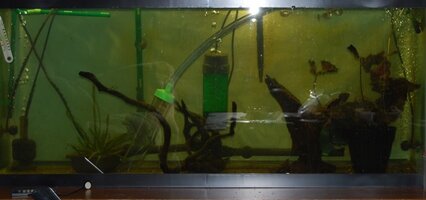
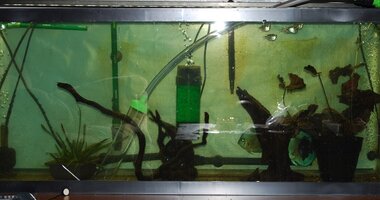
I performed the "PP" treatment on the 55 gallon Discus tank. Went well @ 2 ppm. And I even have pics...

Start "PP"
Start PP.jpg
After 1 hour
1 hr PP.jpg
After 2 hour
2 hr PP.jpg
After 2.5 hour
2.5 hr PP.jpg

After Water Change and Tank cleaning
55g after PP.jpg
 
Looks like you did a good job there. I'm pleased it went well for you.

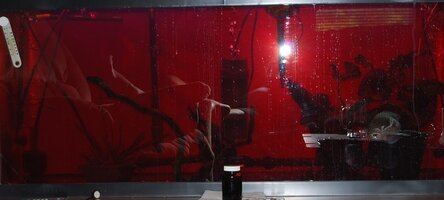
I'm a little surprised by the red colour you got using PP.

In other photos and when I've used it, it has always been a purple colour. Did it look that red in real life or only in the photo?
 
Did it look that red in real life or only in the photo?

Nick72 Your Right.
It was purple, I suppose with the combination of the backgound, the flash and processing it does appear red.
 

Advertisement
That was what my columnaris experience 7-9 years ago was like .1 day fish was fine next I knew it was on 24 hour watch ! This was my first experience with PP !
I will never waste money on the antibiotic cocktails again .Firstly because they only work if the fish can heal itself and I don't believe for one second they can just kill the disease??
PP kills the issue ,maybe a weak fish you missed too ! It is how I 'cured' columnaris ..I only needed to euthan any visibly infected fish ,treat 2 times at 4ppm maybe 2 days apart and done ..I kept the fish that were infected for over 8 months without any other losses before just euthing the whole tank ...
It worked and is the only thing that ever worked for me ..
The symptoms your fish are displaying is type 4 columnaris ...
Sending you a pm as some of my best info is not allowed to be posted ..

6167f0c578ead0ba504e522c0c9b73d5.jpg

This..
 
  • Thread Starter
  • #59
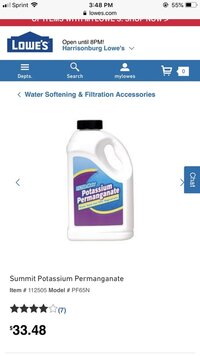
I got the 5 lb bottle like in the picture above !
 
I got the 5 lb bottle like in the picture above !

Awesome! I’ve been doing research in your thread! I am looking into giving it a shot! After seeing how well jmaldo did using your method I am seeing my way into making the jump myself! Main reason for the longevity of the fish as it seems to be a rational solution to impulse medicating fish not being fully aware of exactly what parasite or ailments I may be dealing with. I’m sure not many of us have a microscope lying around! However I do follow a fb group that strictly focuses on different types of parasites and exactly how they look up close. So that’s something I’ve been getting into lately also.
 
I got the 100 gallon bottle plus a scale. Looks like I overpaid, but I did not think I would use 5 lbs.
Oh, well the 100 gallon will last awhile.

Good Luck Thedudeiam94
 

Advertisement


I got the 100 gallon bottle plus a scale. Looks like I overpaid, but I did not think I would use 5 lbs.
Oh, well the 100 gallon will last awhile.

Good Luck Thedudeiam94

What is the weight of the pp to liquid ratio to make the solution from powder?
 
I got the 100 gallon bottle plus a scale. Looks like I overpaid, but I did not think I would use 5 lbs.
Oh, well the 100 gallon will last awhile.

Good Luck Thedudeiam94

Just ordered the 100 gallon bottle of powder and already have a scale lol so it worked out perfectly! Still have an extra gallon of distilled water from my carnivorous plants! Which are doing well! Slooooooowly growing but starting to see little pitcher shapes and new heads budding off! Supposed to get some Venus fly trap seeds in the mail along with some other sundews! Yay!
 
coralbandit seen this photo on fb. What is wrong with this ram? Looks almost like a balloon ram and regular ram mixed?

Mod edit: removed for copyright issues
 
  • Thread Starter
  • #67
Funny the mod removed it !
DEATH TO FB and stealing good forum members as far as I care !..
I have not one good word for fb or any help for any of them ..They can sink since they don't know how to swim ~!
And it is us against them so if you don't know who they are then your not one of us !
BOOOOO fb ..BOOOO !

Well... lol I’m not too fond of the fb groups myself mostly just judgmental people and arguments. But I enjoy looking at the photos. Lol I prefer my forum world
 
If you guys just want to mix a single dose for your tank here is the formula to do so:

PP calculation.png
Just replace "Target" and "Gal" with your target for PP and your water amount (tank size minus decorations & substrate) in Gallon and voila.....(If you measure in liters just don't multiply with 3.8)

Note: Although I say "Dry dose" I don't recommend dumping it dry in the tank. Dissolve in water first and make sure it is completely dissolved before pouring it into the tank.

As I currently only treat one tank this is how I do it.
 
Well, treated 4 small tanks today - 3 at 2ppm (where there are no visibly sick fish) and one at 4ppm, and all went smoothly. I left my tank lights on at first, then realising it impacts things, and turned them off 15 minutes in. Not sure how much that affected the efficacy?

Water went pink and then amber within an hour or so for all tanks. Most were generally pretty clean ahead of treatment. After 30 minutes of amber, I added some H202 anyway as there was some algae around, and will do WC for the four tanks in an hour.
For that reason, I dosed the H202 at the 'algae' dose I have (tank volume in litres, divided by 10 = H202 amount needed in ml). That is for 3% strength H202.

Can attest to the fish seeming pretty perky, especially my young breeder rams. Looks like they are on PCP rather than PP! unch:
Thanks again to all, will definitely maintain the regimen.
 
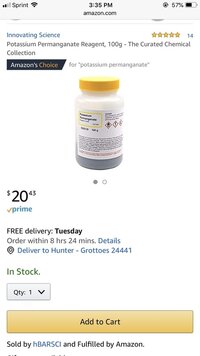
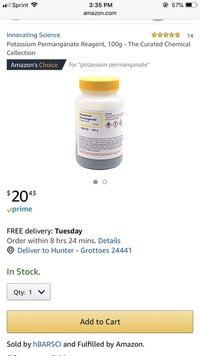
I ordered a tiny bottle (1oz/28grams). It should be here Friday. I am going to try this first on a sterlite container I have out on my covered deck.

There are lots of bladder/pond snails in this container. I am hoping to get rid of them but not hurt the plants I have growing in it. If it does hurt the plants I can live with that though. I will remove the plants I care the most about before treatment.

Doing something new always makes me very nervous but all the posts here tell me it is a safe thing to do as long as great care is taken.

One question though. I have assassin snails in most of my tanks. Will this process hurt them? I plan on not going higher than 2ppm.in the tanks with assassins.
 

Advertisement


I ordered a tiny bottle (1oz/28grams). It should be here Friday. I am going to try this first on a sterlite container I have out on my covered deck.

There are lots of bladder/pond snails in this container. I am hoping to get rid of them but not hurt the plants I have growing in it. If it does hurt the plants I can live with that though. I will remove the plants I care the most about before treatment.

Doing something new always makes me very nervous but all the posts here tell me it is a safe thing to do as long as great care is taken.

One question though. I have assassin snails in most of my tanks. Will this process hurt them? I plan on not going higher that 2ppm.in the tanks with assassins.

Yeah, I had a 30gram bottle and just used it all (with 400ml of RO water). Given I have a few tanks, easier than making more later.
Having a lot of roller-towel on hand helped, and a clean plastic surface to work on.

As to snails, I just have some ramshorns and most seem to have survived the 2ppm treatment. Not looked into the 4ppm tank in detail. If you're doing a therapeutic treatment, I'd imagine most will survive but perhaps Assassin keepers can advise?
Not sure how tough those are, hopefully as tough as their name.
 
  • Thread Starter
  • #74
Any thoughts on this versus Malachite Green, particularly against parasites?
I like MG but we don't really have a way to control the ppm we dose accurately .
I also think like MB that dye based meds work great but are meds ..PP is an oxidizer/killer..It offers no treatment just death to whatever is intolerant of the dose [hopefully].
Your gold fish would love the clean water PP offers IMO ..
 
I've looked into it some more. Interesting stuff. The only thing stopping me right now is the need for a scale. There's a reason I don't bake. I guess another way of saying it is I don't trust myself. Maybe I'll do the 1ppm as you recommended, starting out.

Edit: OK, so 7.5g converts to about 1.5 teaspoon. Does that sound alright? Maybe I'll give this a try.
 
Funny the mod removed it !
DEATH TO FB and stealing good forum members as far as I care !..
I have not one good word for fb or any help for any of them ..They can sink since they don't know how to swim ~!
And it is us against them so if you don't know who they are then your not one of us !
BOOOOO fb ..BOOOO !

So I got my dry pp powder today. It is 7.5 grams of pp per gallon of water. Then take 1 drop per 10 gallons for 1 ppm and 2 drops per every 10 gallons for 2 ppm correct?
 
  • Thread Starter
  • #78
7.5g mixed with 100ml water makes solution that gets 1ppm per drop per gallon.
 
7.5g mixed with 100ml water makes solution that gets 1ppm per drop per gallon.

Solution is done! Thank goodness I had a fluid measuring cup with up to 440 ml on it! Lol
Anyway now what to use for a dropper?! Would a clean eye drop bottle suffice?? And how do you add a “drop” for 5gallons if 1drop per 10 gal is 1ppm and 2:10 is 2ppm being I have a 65 gallon tank.
 
Solution is done! Thank goodness I had a fluid measuring cup with up to 440 ml on it! Lol
Anyway now what to use for a dropper?! Would a clean eye drop bottle suffice?? And how do you add a “drop” for 5gallons if 1drop per 10 gal is 1ppm and 2:10 is 2ppm being I have a 65 gallon tank.
You misread what he said. It's actually 1 drop per gallon, or, in other words, 1 drop/gallon = 1ppm. So 5 drops in a 5 gallon will get you 1ppm, and 2 drops per gallon will get you 2ppm for the entire volume of the tank. Same thing with the 65g. 65 drops = 1ppm. 130 drops (2 drops/gallon) will get it to 2ppm.
 
You misread what he said. It's actually 1 drop per gallon, or, in other words, 1 drop/gallon = 1ppm. So 5 drops in a 5 gallon will get you 1ppm, and 2 drops per gallon will get you 2ppm for the entire volume of the tank. Same thing with the 65g. 65 drops = 1ppm. 130 drops (2 drops/gallon) will get it to 2ppm.

Thank you for clearing that up for me!!
 

Advertisement


7.5g mixed with 100ml water makes solution that gets 1ppm per drop per gallon.

65 drops in 65 gal would be 1 ppm and 130 for 2ppm correct? Also is h2o2 necessary or is it mainly just for emergencies? My solution is done and is a super deep purple will post photos later. Also what’s the best thing to use as a dropper if I don’t have one?
 
65 drops in 65 gal would be 1 ppm and 130 for 2ppm correct? Also is h2o2 necessary or is it mainly just for emergencies? My solution is done and is a super deep purple will post photos later. Also what’s the best thing to use as a dropper if I don’t have one?

You could use an airline with a knot tied in it? Adjust until you get a manageable rate, as if you were drip acclimating, etc. Eye droppers you can get at any pharmacy usually though.
Don't think H202 is necessary? Can't say for sure but you could just do a couple water changes afterward. I used the H202 as I also had some algae issues.
Good luck, its a neat trick to have in the arsenal, PP.
 
For those in the US, Walmart has H2O2 in liter bottles for 87¢. I usually keep a few bottles on hand and use it for disinfecting stuff that goes into multiple tanks (hoses, nets, d'n'p, etc)
 
coralbandit would it be okay to do the pp treatment with my new 2.5 inch? At 1ppm
 
The main reason I bought some PP is hoping I would be able to save a neon tetra that is experiencing some issues. I suspect a swim bladder problem but didn't know that for sure..

It started having trouble after each meal. Swimming erratically, seemed unable to control direction, spinning. Just all round not well. This little guy is close to 3 years old so not a youngster.

I have had the little guy in a 1 gallon container with air stone and twice a day water changes for about a week now. I have done 3 - 2 drop treatments. I did one every other day for a total of 3 treatments. Today was the first one that turned a true purple and finally went to amber before I did a water change.

Sadly I think I will have to give up on this little guy since there is no improvement at all. In fact I've not seen him eat for several days now and he still can't control where he goes or how he gets there.

Thank you for giving me some hope that if it was something other than swim bladder I had a chance to help him.

I really love my little neons. This will leave me with just 4 left. Once they are all gone I won't be getting any more unless I find someone that has known healthy ones. I know that is wishful thinking though.
 
  • Thread Starter
  • #89
Adding new info I just found in a link posted from a member here on columnaris .
Whilst I personally prefer the use of salt - it should not be forgotten that there are several alternatives. In relation to discus, various combinations of: potassium permanganate, formalin, temperature, hydrogen peroxide, acetic acid, large water changes, and so on, have been used to help CONTROL the external infection - with the likelihood of success being dependent on the virulence of the strain involved. For the sake of will summarise the use of potassium permanganate (as an insitu bath [not a dip]).
Important Notes:

1. Potassium permanganate and formalin must never be used in the same water, nor should they be stored together. When combined, their vapours are highly explosive.

2. I only use PP in BB .

3. Wear rubber gloves, eye protection and old clothes the aI'm is to treat fish not to become blind, to have sun-tanned hands or to stain your best outfit. PP is a powerful oxidising agent and shows no discrimination between human skin, fish gill filaments, mucous layers etc it will start with the top layer and continue to oxidise, until exhausted therefore, it must be handled and used with appropriate respect. If you do get PP on your clothes or work surfaces, the resulting brown stains of manganese dioxide can be removed by using a solution composed of 1 parts 9% hydrogen peroxide, 4 parts white vinegar, and 3 parts tap water. If you end up having to use this solution to remove the stain from your skin, wash off the excess once the stain is gone. Do not use: if the skin becomes red or irritated, or on open wounds, or burns etc.

4. When working with PP in , it is probable that you will be working with very small amounts e.g. 1 gallon and dilutions of . . .

A 1 gallon spoon can be purchased from some of the older style chemists which can be used for making up 2l of stock solution at a time; however, many chemists will weigh out the necessary amount for you, if you tell them what you are using the substance for. If you are new to the use of PP, I strongly recommend you let the chemist weigh the necessary amounts for you, so that you can see precisely what you are supposed to be working with you may be surprised at how small the amounts are.

5. Never expose discus that have open wounds to PP treatment.
Potassium Permanganate (KMnO4-)
Potassium permanganate (PP) can be used to treat external columnaris. It is added to the water, where it oxidises all matter, until it reaches a point of exhaustion. Commonly, 2 mg/l of PP is added to the water, and the tank is then monitored to ensure that the water retains the resulting purple/red for at least 4 hours. If the colour begins to fade, then more PP will have to be added.
In my opinion, it is all to easy to overdose and kill you fish when you simply rely on subtle changes in colour; therefore a 15 minute PP demand test should be performed. By performing this test you will be able to calculate the correct amount of PP to use, in respect to the loading of the aquarium water in which the fish are to be treated.
Methodology to perform a 15 minute PP demand test on and ponds that have a high organic load

Note: If you have a bare bottom tank and perform regular water changes, siphoning off any debris each day you may find that even at 1mg/l the water will retain a degree of pink colouration if this is the case I suggest that you use the standard treatment dose of 2mg/l PP and maintain the colouration for four hours Perform the test first, though Don't guess!

Step 1

Prepare a water stock solution. This is achieved by adding 0.5g of PP to 1 litre of distilled water.

Step 2
Label four, 1 litre, transparent containers (e.g. 1, 2, 3, 4)

Step 3
To each container add 500 ml of water taken from the tank that is to be treated.

Step 4
Then add the following:
Container 1 - add 1ml of stock solution (results in a 1mg/l solution of PP)
Container 2 - " 3ml " " " 3mg/l
Container 3 - " 5ml " " " 5mg/l
- " 7ml " " " 7mg/l
Step 5
After 15 minutes note the colour of the solution
Step 6
Calculate the quantity of PP to use in the aquarium to be treated
A. You will find that the solution in one container will be slightly pink, and in another the solution will be clear.

The concentration you use is the concentration that falls between the two

B. You then multiply the PP concentration selected, by a factor of 2.5

This is the concentration of PP that you would use on the tank containing the infected fish.
E.g.
After 15 minutes -
Container 2 (3 mg/l PP) has a slight pink colour
Container 1 (1 mg/l PP) is clear
Therefore you would use 2 mg/l x 2.5= a treatment dose of 5mg/l of PP
Worked example:
1. You are treating 200 litres of water
(see method below; it is important that you know precisely how much water will be left in the tank after you have drained 50% or so off, and it this amount you will be treating

cm divided by 1000 = amount in litres; dont forget to deduct the thickness of the glass if you are measuring external edge to edge

2. You have calculated that the appropriate dose for treatment is 2mg/l

3. You therefore need to add 200 x 2=400mg of potassium permanganate to your 200 litre tank

a. This can be achieved be adding 800ml of the previously created stock solution (remember it was made to a strength of 0.5g/l)

b. Or you could make new stock solution with 1 litre of distilled water and add 1gram of PP to it.

i. You would then add 400ml of this solution to your 200 litre tank
Once the final dose is calculated, there are two schools of thought, in regards adding the PP to the aquarium. On the one hand, there are those (myself included) that prefer to divide the total dose into 2mg/l portions adding each portion, only after the initial purple-red turns brownish (tip: remove the and look into the tank from above to judge colour most accurately). Others prefer to add the total amount of PP to the tank as a single dose. There can be no doubt that the first scenario is safer and less stressful, especially if you have severely infected fish; therefore, it should be given some consideration. In addition, as with the salt dip, discus can react in different ways to PP. In a tank of 6 5 may swim around normally and 1 may appear highly disorientated.
Now that the dose has been calculated, the next step is to siphon of the water out of the tank, cleaning up any waste material that you can. This is followed by bypassing the filter system of your tank (PP will kill you filter bacteria if you do not do this). If you use a canister filter, you can use a spare 5 gallon bucket, filled with aquarium water and a heater, and simply place the filter inlet and outlet into the bucket. An air supply that can provide heavy aeration is then added to the tank. The next step is to add the first portion of the total dose to the tank and monitor the behaviour of the fish. Once the initial shade of purple/red starts to turn brown, you should continue with the next portion of the total dose.
The most important points during this stage are:
1. Monitor the reaction of the fish; if they are severely stressed

a. you can either remove them, or

b. add hydrogen peroxide to neutralise the PP (dose given below in table 2)

2. Ensure that the purple-red colour is maintained for a minimum of 4 hours

3. Remember that during this process you are stripping the slime layer from the fish and that they will subsequently be vulnerable, until a new slime layer develops; therefore, post treatment, tank hygiene must be of the highest order.
Finally, once the 4 hour period is completed, you can neutralise the PP and clear the tank by adding hydrogen peroxide to the water. The dosage I use is ~ 1.3 ml of 9% hydrogen peroxide, for every 10 imperial gallons of tank water, treated at a dose of 2mg/l of potassium permanganate. The hydrogen peroxide and a 1ml syringe can be purchased from most chemists; please check the strength of hydrogen peroxide you purchase as this varies in strengths from 3% rising to 9%. The table below is provided for easy conversion. If you require the molecular weights and conversion factors used in creating table 1, please contact me.
Gallons treatedPotassium permanganate
dosage used
mg/l
Amount of Hydrogen peroxide required in ml @ strength
0.3%
Amount of Hydrogen peroxide required in ml @ strength
0.5%
Amount of Hydrogen peroxide required in ml @ strength
0.9%
1024.022.411.34
1036.033.622.01
1048.044.822.68
50220.1012.066.70
50330.1418.0910.05
50440.1924.1213.40
100240.1924.1213.40
100360.2936.1720.10
100480.3848.2326.79
Table 2
Table illustrating the amount of Hydrogen peroxide required in ml, at various strengths, to neutralise a given amount of potassium.
Once the treatment is finished, I continue the aeration and add a drip-feed of fresh conditioned water to fill the tank to its previous level. Once the tank is full you can reconnect the filtration system. Keep an extra eye on the ammonia and nitrite levels for the next couple of weeks, and maintain a healthy regime of water changes; further treatments may be necessary if they are please remember that discus become less tolerant to PP exposure.
 
If using on bio-media for disease, watch for a mini-cycle it was said.

Would it be a mini-cycle or an out right restart? How long do yahll think it would take to go back to normal if it was a minI cycle? Has anyone got any experience with using on bio-media filtration?
 
If using on bio-media for disease, watch for a mini-cycle it was said.

Would it be a mini-cycle or an out right restart? How long do yahll think it would take to go back to normal if it was a minI cycle? Has anyone got any experience with using on bio-media filtration?

I treated a couple tanks at 2ppm with filtration running to wipe out a Columnaris infection. After testing I found only a moderate ammonia reading but used Stability for a few days regardless. Tanks were also lightly stocked, and I fed sparingly during those first few days...
 

Advertisement


Interesting, what about nitrites to nitrates?

As I recall nitrites were at 0 by the time I tested and nitrates I think were the usual 12 - 15.
If you have some seeded media in a healthy tank, or can get some, it'll be an added benefit to just using Stability (or similar) after your treatment. Again, because the tanks in question were lightly stocked I wasn't too worried and have since used PP a few times, but only at the 1ppm therapeutic dose.
Prior to the treatment I did a 3% salt dose - removed that all with water changes. Then a few days later the PP, disabled with H202 and finally ran a UV sterilizer for a week on the tanks to ensure all badness was killed off. All worked out well.
 
I'm getting an ounce of dry powder tomorrow, I'm having trouble with the gallon to ml yahll have been using. How do I convert of Oz of powder to gallons. Even for half a gallon, its like hundreds of ounces.

How many GRAMS or mg of PP powder to mL or gallons of distilled water to reach the concentration for the 1 drop = to 1PPM per gallon? I got a gallon of distilled water and an ounce of powder PP, and I got a tinted glass medicine jar with a dropper.
There was the 1.5 teaspoon or tablespoon measurement, but that's not even an exact weight, like if the powder is more compressed there would be more per weight than if one wasn't.
 
  • Thread Starter
  • #95
1 ounce is 28 grams ..Lets just say that is 1/2 of 75 grams for ease ..
Mix your ounce with 500ml water and that will get you a solution between 1.5 to 2ppm per drop for each gallon .
So if you want the solution to be 1ppm then add 1,000ml..I use a 16 ounce soda bottles to make up my 500ml solution ..It is only off by 1 ounce or so ..
This is what I did. I just poured all of the 28 gram bottle of PP into 500 ml of distilled water in a brown boston round bottle. This way I didn't have to do any measuring. The bottle may have had a few mls less than 500 but not much less. I labeled the bottle and when not in use I keep it in my refrigerator.
 
1 ounce is 28 grams ..Lets just say that is 1/2 of 75 grams for ease ..
Mix your ounce with 500ml water and that will get you a solution between 1.5 to 2ppm per drop for each gallon .
So if you want the solution to be 1ppm then add 1,000ml..I use a 16 ounce soda bottles to make up my 500ml solution ..It is only off by 1 ounce or so ..

O_O that's 21 grams un accounted for in the equation though???

Can the PP mixture be stored/mixed in plastic?

AAHHH this is reminding me how frustrating math is, becuz I just want to be exact, rough estimations of PP is making me uneasy >_<
 
I mean .5 of ppm can be difference of life and death right?


and yes. . . .*ahem*. . .PuRpLe DRaNk MF!!!!!
 
  • Thread Starter
  • #100
I tried to make it easy and safe for you ..Your missing 21g so the mix is lite and not heavy ?? Not seeing eminent death unless you widely overdose ?? I mean my math was lite in the favor of safety ?? If you want to make it correctly and stronger sounds better to you then get a gram scale and do the 7.5 grams as I mentioned .It will be more then you will likely use ...
If you dose at 2ppm per gallon you really should be safe ..The mix is lite ,closer to the 1ppm you want ?
You should not use this if you can not sit and watch the tank the entire time you are treating ,especially your first time . 4 hours.
So if all goes wrong and fish start jumping out trying to live [seen it] you then detox the tank with H202 ,take a deep breath and start over with a little lighter dose ? You may also see the purple go brown very quickly and need to redose or atleast know the product did not last long enough to have effect .
If you are real concerned get a gram scale .I got one for like $10 and can measure down to 1/10 of gram ..I don't have to guess..
It helps if you can measure both water and the dry mix ..

Purple drank!
mattgirl I am not sure I would chance keeping it in fridge ..It is poison for sure !
I leave mine in a 16 oz plastic coke bottle away from light ..The bottle is permanently stained to look full even when only half full..
Tough stuff not to be fooled with ..
 

Random Great Topic!

Advertisement


Advertisement


Advertisement


Back
Top Bottom