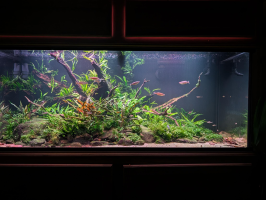
Switching tank from low-tech to high-tech?

olives101

New Member
Member
Messages
29
Hi, I have a ~70 L (I think approx a 20 Gal 'tall'?) low-tech tank with a Tidal 75 HOB, as pictured.
Lights are on medium-ish, maintenance is a WC and squirt of ferts once a week. Plant trimming/replanting as required (every 2~3 weeks).

Most of the plants aren't really growing, in the sense that whatever they do grow will be counterbalanced by gradual loss/trimming of older leaves (then replanting and having to grow new roots), and as a result a gradual decline in health and appearance.
- Rough plants list: Vallisneria, java fern, micro sword, easier species of Hygrophila and Ludwigia, Myriophyllum, Samolus red, Pogostemon, S.repens.

I also have some minor BBA (hardscape, glass, vallisneria blades, micro sword blades) and green algae (glass, java fern roots) issues.

I'm looking at adding a pressurised CO2 system to improve growth and resolve algae. Sorry for all the questions!
  • How badly will my plants melt in the transition? Can I minimise this by gradually increasing CO2, or something?
  • Is there any risk to the animals (BN, cherry shrimp, rasbora, gourami) in my initial adjusting of the CO2 levels?
  • What change in maintenance am I likely to have?
  • Do people find the bubbles/mist to detract from the appearance? Or is it not really noticeable?
  • Where would be a good in-tank diffuser position, with the HOB as pictured?
  • With the HOB flow on low, will there even be enough movement for the CO2 dispersion?

I read that one downside to CO2 can be too much growth and thus more maintenance ? But as I'm currently having to carefully select, manage, and trim my plants since they aren't growing well, that may actually be an overall improvement to my time and stress.

But idk! and there are probably aspects of high-tech maintenance I have not considered. Thoughts welcome on whether it's worth it and how to do it best.

Thanks for any help!
 

Attachments

  • PXL_20260629_095957826.jpg
    PXL_20260629_095957826.jpg
    506.9 KB · Views: 54

Advertisement
  • How badly will my plants melt in the transition? Can I minimise this by gradually increasing CO2, or something?
When my plants were already established, as yours seem to be, melting was always minimal when switching to CO2 or away from it. So, I don't think this is too much of a concern.
  • Is there any risk to the animals (BN, cherry shrimp, rasbora, gourami) in my initial adjusting of the CO2 levels?
Yes. When you first start figuring out the CO2 system, mistakes are likely. One mistake that can kill all the animals in your tank is adding too much CO2. So, it's important you don't overdo it. Also, if you get a cheap regulator, the last bit of CO2 in the tank could "dump" into the water, spiking the CO2 levels and potentially killing your animals. Therefore, getting a quality regulator is a very good idea.
  • What change in maintenance am I likely to have?
You'll likely have to trim the plants far more often. And, you may need to increase your fertilization and water changes. Also, you'll need to occasionally refill/replace your CO2 tanks. My 5-pound CO2 tank lasts about 3 months or so on my 50 gallon. Having 2 tanks is convenient. That way I always have one ready to go and can take my time refilling the old one.
  • Do people find the bubbles/mist to detract from the appearance? Or is it not really noticeable?
I don't like the bubble mist. Therefore, I use CO2 reactors that mix the CO2 without making bubbles. Most people don't seem to care though.
  • Where would be a good in-tank diffuser position, with the HOB as pictured?
I'd probably place the diffuser under the filter. That way, the bubbles would go up and then get blown across the tank with the current, maximizing the time they're in the water.
  • With the HOB flow on low, will there even be enough movement for the CO2 dispersion?
Yes, likely. Your tank's not too big, so the CO2 should disperse.
I read that one downside to CO2 can be too much growth and thus more maintenance?
More growth and more maintenance are highly likely. Whether that's a downside or not is up to you. I don't use CO2 in my large tank, because trimming the plants in that tank gets uncomfortable. But, I enjoy the trimming and maintenance in my smaller tank.
...there are probably aspects of high-tech maintenance I have not considered. Thoughts welcome on whether it's worth it and how to do it best.
Keeping the CO2 at a stable level the entire time the lights are on is important. If the CO2 levels change too much during this time, the plants could actually get stressed, and algae will start to grow even more.

Whether or not it's worth it is totally subjective. If you just want a nice, planted tank without a lot of maintenance, it's not worth it. But, if you want that extra lush plant growth you might see in one of those ADA tanks, it is.
 

Advertisement
  • Thread Starter
  • #3
Thanks for all the info!

Keeping the CO2 at a stable level the entire time the lights are on is important. If the CO2 levels change too much during this time, the plants could actually get stressed, and algae will start to grow even more.
I assume this is resolved with a solenoid on the reg for timing?

For the tank, here in Aus I can get a 2.6 kg (5 lb?) or even 6 kg (~13 lb) tank... So by your numbers the 2.6 kg would hopefully last half a year for my aquarium. 6 kg might be overkill haha
 
I've seen some wonderful hi-tech aquariums and i ran co2 myself for a couple of years but these days never again - it takes a fair amount of work and you can get pretty good results without co2 with the right kind of water and plants.

I will warn you that if you do go hi-tech - turning off the co2 or running out of co2 will cause a disaster so just be aware if you ever decide to stop injecting co2 you should pretty much pull all the plants and start over.
 
  • Thread Starter
  • #5
I've seen some wonderful hi-tech aquariums and i ran co2 myself for a couple of years but these days never again - it takes a fair amount of work and you can get pretty good results without co2 with the right kind of water and plants.
Do you know anything about limiting, e.g., light (or ferts?) while injecting CO2 to modulate growth? I.e. if I don't want to trim too much, leave light as the limiting factor?
 
Just for what it’s worth, and I’m guessing you don’t want to hear this, but I think your tank looks great the way it is. You can adjust light duration, type, and intensity to adjust plant growth too. Many here could only hope to have a set up looking like yours. If you have a specific reason for going w CO2 and are willing to address/accept the risks, then fine. Just don't do it for “change for change” sake.
 

Advertisement
  • Thread Starter
  • #7
Thanks! and that's valid.
I just feel CO2 is the limiting factor, especially with seeing (some) algae growth and certain plants consistently not looking too good (looking at you, H. corymbosa, Ludwigia spp.).
There's also the occasional BBA outbreak, what with fluctuating CO2 in the tap water.

But plant choice is definitely a part of wanting to go CO2, as without it I'm quite limited when it comes to stem plants in particular.
I am also a bit tired of researching whether a plant will work, buying it, then watching it crumble to dust over a couple of weeks haha.

I think I would prefer to keep it low-tech though, so maybe I just need to reassess what plants I want.
 
Keep in mind that your particular water is not going to make every plant happy, whether it's low tech or not. I have low tech aquariums and no problems growing rotala, val, or dwarf sag, but every type of hygrophila that I've tried, including water wisteria, just withers away and dies over a period of several weeks no matter what I do with the lights. My barteri anubias do well, the anubias afzelli are in a perpetual state of suspended animation.

I agree that your tank looks quite nice but if plant health is a problem take a closer look at light levels and duration, water chemistry, and even the type of fertilizer you're using. Keep trying different plants and if a particular type just doesn't do well, stop growing it and focus on the ones that seem happier in your water.
 
I assume this is resolved with a solenoid on the reg for timing?
In part. I think this video explains things very well:
Do you know anything about limiting, e.g., light (or ferts?) while injecting CO2 to modulate growth? I.e. if I don't want to trim too much, leave light as the limiting factor?
I think this is an underrated approach. The tanks where I've had low light and CO2 have been some of my most stable and algae free.
There's also the occasional BBA outbreak, what with fluctuating CO2 in the tap water.
Unfortunately, CO2 injection is not a cure for BBA. If used incorrectly so that CO2 levels aren't stable, BBA will flourish even more than it would otherwise. And, even if CO2 injection is done correctly, BBA can still show up. The plants will grow faster, so there will be less (if any) BBA on your plants (at least the faster growing ones), but the BBA will still be happy to grow on your hardscape and slow growing plants (like anubias).

...turning off the co2 or running out of co2 will cause a disaster so just be aware if you ever decide to stop injecting co2 you should pretty much pull all the plants and start over.
This hasn't entirely been my experience. When I stopped injecting CO2 into my 150 gallon, the algae Rhodophyta sp. 2 took over and my plants didn't look so good:
1784073433816.jpeg
But, after a month or two, everything settled down and started looking much better. Here's how the same tank looks now:1784073516470.png
The algae is mostly gone (although there's patches of BBA on the hardscape), and the plants seem happy.
 
don't like the bubble mist. Therefore, I use CO2 reactors that mix the CO2 without making bubbles. Most people don't seem to care though.
Do you have specific examples of the models that work well ? I’m also looking to buy a Co2 system (Co2 art).
I will warn you that if you do go hi-tech - turning off the co2 or running out of co2 will cause a disaster so just be aware if you ever decide to stop injecting co2 you should pretty much pull all the plants and start over.
Can you explain why ?
 
Thanks for all the info!


I assume this is resolved with a solenoid on the reg for timing?

For the tank, here in Aus I can get a 2.6 kg (5 lb?) or even 6 kg (~13 lb) tank... So by your numbers the 2.6 kg would hopefully last half a year for my aquarium. 6 kg might be overkill haha
I'm from Sydney and I used this setup in an 87 liter tank. I used this because most of the LFS sold big cylinders that ran into the hundreds.
This is a standard soda stream that you can get from any supermarket.
The cost? Besides the standard regulator costs, it was $40 for the special adaptor. The full soda stream cylinder is around $30 for the first and after that $15 for the exchange cylinder.
It lasts me about a month and a half per cylinder running 2bps, low rate of c02.
It may not be to your liking? But it's the option I used. Good luck, yes I had to trim way more regularly and until I got it properly dialed in I had a bit of hair algae.
 

Attachments

  • IMG20230717142841.jpg
    IMG20230717142841.jpg
    291 KB · Views: 34

Advertisement


Do you have specific examples of the models that work well ? I’m also looking to buy a Co2 system (Co2 art).
CO2Art makes the best regulators I've every used. But, I'm not aware of any reactors they sell that don't spread bubbles all over the place.

NilocG sells a nice reactor that keeps the bubbles out of the tank. It's what I was using in my 150 gallon before I switched over to low-tech on that tank. They call it the NA Advanced CO2 Reactor.

I've used the ISTA I-539 External Reactor on a couple of tanks. These worked fine but seemed prone to developing a slow leak. So, it's a good idea to have a backup on hand.

My favorite in tank CO2 reactors (I used for years and years) were made by AquariumsPlants.com, but, unfortunately, they aren't making them anymore. Their design was similar to the Red Sea CO2 reactor 500s, so I'd imagine the Red Sea reactors are pretty nice too...just haven't tried them yet.
 
Allowing bubbles to enter an internal filter can work very well for diffusing and distributing CO2.

The Aquario Neo mixer, attached to an outflow, also works surprisingly well. It is tiny, but I'm sure it is more effective than many setups I see where CO2 bubbles are racing to the surface.

If you have decided to use CO2 but are concerned about maintenance, then yes, making light the limiting factor is by far the most practical way to manage a planted tank. In CO2 tanks, you can even push this to extremes (super dim), while observing much less leaf abscission at bottom stem parts (provided you manage to distribute CO2 rich water to substrate level).
 
Hi, I have a ~70 L (I think approx a 20 Gal 'tall'?) low-tech tank with a Tidal 75 HOB, as pictured.
Lights are on medium-ish, maintenance is a WC and squirt of ferts once a week. Plant trimming/replanting as required (every 2~3 weeks).

Most of the plants aren't really growing, in the sense that whatever they do grow will be counterbalanced by gradual loss/trimming of older leaves (then replanting and having to grow new roots), and as a result a gradual decline in health and appearance.
- Rough plants list: Vallisneria, java fern, micro sword, easier species of Hygrophila and Ludwigia, Myriophyllum, Samolus red, Pogostemon, S.repens.

I also have some minor BBA (hardscape, glass, vallisneria blades, micro sword blades) and green algae (glass, java fern roots) issues.

I'm looking at adding a pressurised CO2 system to improve growth and resolve algae. Sorry for all the questions!
  • How badly will my plants melt in the transition? Can I minimise this by gradually increasing CO2, or something?
  • Is there any risk to the animals (BN, cherry shrimp, rasbora, gourami) in my initial adjusting of the CO2 levels?
  • What change in maintenance am I likely to have?
  • Do people find the bubbles/mist to detract from the appearance? Or is it not really noticeable?
  • Where would be a good in-tank diffuser position, with the HOB as pictured?
  • With the HOB flow on low, will there even be enough movement for the CO2 dispersion?

I read that one downside to CO2 can be too much growth and thus more maintenance ? But as I'm currently having to carefully select, manage, and trim my plants since they aren't growing well, that may actually be an overall improvement to my time and stress.

But idk! and there are probably aspects of high-tech maintenance I have not considered. Thoughts welcome on whether it's worth it and how to do it best.

Thanks for any help!

Truthfully all I’m seeing is a tank that is suffering because of the once a week dosing regimen. Feast or famine dosing. Simply take that same amount of fert and just add it to a 1gal jug and simply top off for evaporation 3x a week while feeding your fish. Keep the nutrient levels in tank flatlined day by day.
 
Truthfully all I’m seeing is a tank that is suffering because of the once a week dosing regimen. Feast or famine dosing. Simply take that same amount of fert and just add it to a 1gal jug and simply top off for evaporation 3x a week while feeding your fish. Keep the nutrient levels in tank flatlined day by day.
I dose some of my tanks a little bit every day, because this seems to make sense to me. But...is it true? Plenty of people have kept their plants happy with once per week dosing...myself included.
 
  • Thread Starter
  • #16
Truthfully all I’m seeing is a tank that is suffering because of the once a week dosing regimen. Feast or famine dosing. Simply take that same amount of fert and just add it to a 1gal jug and simply top off for evaporation 3x a week while feeding your fish. Keep the nutrient levels in tank flatlined day by day.

I'll give it a go, thanks.
Would you also add ferts at WC, or just from that jug as water evaporates (I.e. after a couple days)? Shouldn't matter too much?
 
There's an optimization curve, not a black-white course to take.

Some people don't dose anything and rely on fish waste only and run planted tanks just fine. at the other end of the spectrum we have purists that separate the minerals and dose these at different times during the week.

With a CO2 system (and higher light intensity), you are pushed in the direction of purists.

If you work with an all-in-one ferts, and would like to follow DaveKS suggestions, add your ferts during water change and get a separate NPK fert for additional dosing in between water changes.

If plenty of fish around, you could reduce NPK to KNO3 salt only.
 
If you work with an all-in-one ferts, and would like to follow DaveKS suggestions, add your ferts during water change and get a separate NPK fert for additional dosing in between water changes.
What is the advantage of adding ferts during WC ?

What is a NPK fert and why is it needed when using all-in-one ?
 
There is no particular advantage of adding ferts during water change, except that it is practical. You are doing a water change anyhow, so no big deal.

The comment about dosing frequency is a little debated; that is why I said explicitly if you want to follow this line, add a little extra NPK in between water changes.

NPK is part of an all-in-one fertilizer, but represent those minerals plants demand the most. Most likely not phosphates, but it is typically included in the "primary macronutrient" group. NPK (Nitrogen, Phosphates, (K)potassium) is a household name among farmers.

If someone wants to add a little all-in-one three times a week, I'm sure that will work out fine.

But if someone wants to rely strictly on fish waste as (indirect) fertilizer, that works out fine as well.

Fish deliver ammonia and CO2 to plants 24/7, and release organics which microbes convert to plant nutrients. This principle underpins everything from the Walstad method to aquaculture, and I have seen it work with every plant species in the hobby, including "root-feeders".

The situation becomes trickier for a "high energy" tank (CO2 gas injection + high light intensity + somewhat higher temperatures) or for very densely planted tanks with very few fish, especially when a purist like myself is managing a tank on basis of RO or rain water only.

Some purists will also not dose phosphates, calcium, sulphates and trace elements at the same time (sulphates and chelated trace elements are fine though).

For a high energy tank, I think water changes is pretty important to drain the organics produced by plants in the fight against algae.

During water changes, use RO water with calcium-nitrate.
The next day potassium-nitrate and potassium-phosphate is added (NPK).
The day after magnesium-nitrates and magnesium-sulphates.
Day four some trace elements.
Day six potassium-nitrate and potassium-phosphate (NPK) again.
Day seven, back to water changes with calcium-nitrate.

Estimative Index dosing follows something similar.

Nowadays I restrict anything "high energy" to very small tanks, because I got tired of algae prevention and plant trimming a long time ago.

My main tank is very low energy and densely planted with very few fish, and I manage water changes on basis of TDS measurement and RO water with calcium-nitrate. Calcium is a tough mineral, it reacts easily with a few other ion species, it is not mobile in plants, and most fish species seem to require calcium water, hence special care.

I dose NPK and epsom (magnesium-sulphate) when observing plant chlorosis. It is that simple.

I never add traces including iron, as it should come from fish and plant waste. I also never add
bicarbonates (KH).

But feel free to use tap water and an all-in-one fertilizer, and dose once or several times a week, regardless. :)

As I said, it is an optimization curve that depends on the tank situation. Light intensity, temperature and gasses have much more impact on plant growth and health. Minerals/nutrients are merely a prerequisite. For me, planted tanks is a big deal, hence I'm a bit of a purist, but most hobbyists concern way too much about plant nutrients if water changes with tap water is frequently conducted and when fish are present.

Cheers.
 

Random Great Topic!

Advertisement


Advertisement


Advertisement


Back
Top Bottom