New Aquascaping aquarium establishment

  • Thread Starter
  • #151
OK,.., the GBA was due to co2 fluctuations/shortage, that was cleared by now. What is causing the wide filamentous green thread algae is this: huge amounts of detritus accumulated in the substrate.
Raising the phosphate/nitrate levels.
This is only from deep vacuum of very small section where no plants are there.
I have rotala with leaves turn yellow/green, besides insufficient light, this is due to extreme nitrate levels. I'm not checking the water parameters.
 

Attachments

  • 20250203_091554.jpg
    20250203_091554.jpg
    228.1 KB · Views: 96

Advertisement
  • Thread Starter
  • #152
"Phosphorus and Nitrogen (Nitrates and Phosphates) are vital to growth. Algae will grow uncontrollably if either is available in large amounts, covering a pond, blocking the light to other plants causing them to die and rot which uses up oxygen in the water. This lack of oxygen can be lethal to animal life in ponds."
 

Advertisement
"Phosphorus and Nitrogen (Nitrates and Phosphates) are vital to growth. Algae will grow uncontrollably if either is available in large amounts, covering a pond, blocking the light to other plants causing them to die and rot which uses up oxygen in the water. This lack of oxygen can be lethal to animal life in ponds."
There isn’t a lot of such debris in the one tank I have with filamentous algae - no added nitrogen and no high phosphate.

The triggers for all algae are the same & once they start growing then yes, they are capable of consuming all the available nitrogen & phosphates, whatever is present.

And if algae are allowed to grow unchecked they can choke & smother the body of water they’re growing in to the point that nothing else can live in it.
 
  • Thread Starter
  • #154
Hi, it looks like I will keep posting until the tank is clean of algae :)
What is this ? Bba ?
I thought only Gba and thread algae exists
 

Attachments

  • 20250203_214844.jpg
    20250203_214844.jpg
    293.7 KB · Views: 68
  • 20250203_214842.jpg
    20250203_214842.jpg
    296.3 KB · Views: 56
Hi, it looks like I will keep posting until the tank is clean of algae :)
What is this ? Bba ?
I thought only Gba and thread algae
I think I’m about to overload your brain - there are waaaaayyyy waaaaayyy more than two kinds of algae with more species than I care to think about.

There is so much more to them - a lot more than just considering whether they are Green, Brown or Red.

Algae are protists but they have characteristics like plants & like some animals. Plants have chloroplasts & can photosynthesize - so do algae. Some algae have flagella & centriole (an organelle) & can feed on organic material - like animals.

They may have single cells only a few microns in size (microalgae aka greenwater) or grow into massive multicellular organisms like giant kelp. They can live in salt or fresh water, wet soils, even on wet rocks.

They reproduce sexually, asexually or by a combination of those processes.

Single cell types can divide to reproduce - (which is how a healthy greenwater culture can grow extremely quickly), or release spores which may or may not be able to move independently - that varies with species.

Algae that reproduce sexually are typically induced to produce their gametes when certain environmental conditions regarding variations in temperature, light, salinity, or nutrient availability provide the necessary stimulus.

Species like this produce a fertilized egg or a zygote to create new algae or else dormant zygospores that germinate when conditions are right for them.

There are seven major divisions of algae.

Euglenophyta (euglenoids - some believe they shouldn’t be classed with algae at all)

Chrysophyta ( diatoms & golden-brown)

Pyrrophyta ( fire algae - either dinoflagellates or cryptomonads - responsible for phenomena like Red tides)

Rhodophyta (red - Black brush or beard - Audouinella sp., Staghorn - Compsopogon caeruleus )

Chlorophyta - (green)

There are thousands of different species of green algae which are both uni & multicellular and can have colonies with only a few to thousands of cells.

Some create zoospores that have a flagellum to swim to a favourable spot - (aquarist’s nightmare) and others create aplanospores - which rely on water currents to move them as they aren’t motile like zoospores.

Aquarists tend to divide green algae into a number of types largely based on gross appearances.

Green spot (GSA) Choleochaete sp., stick quite tightly to surfaces - have zoospores.

Green dust (GDA) - no species is known but has zoospores. Doesn’t stick tightly to surfaces

Green fuzz - Oedogoniums - stick to surfaces pretty tightly & have zoospores.

Green Beard (GBA) thought to be a more vigorous species of Oedogonium - same as above

Blanketweed - a Cladophora which is quite different from the one found in ‘moss balls’. It has zoospores and sticks very tightly to surfaces

Hair or Thread

Made up of various filamentous algae, mainly from the following genera - Spirogyra - aka water silk - produces aplanospores, Rhizoclonium - may have either zoospores or aplanospores and Oedigonium - has zoospores.

Paeophyta (brown - seaweeds including kelp)

Xanthophyta (yellow green & with fewer species than any of the others, most are freshwater)
 
  • Thread Starter
  • #156
Oh, I meant this tank I thought was inhabiting thread & gba, but it is most interesting your information.
This is indeed deep knowledge regarding algae :)
I did narrowed now main triggers, at least in context of what I'm dealing with, for the following:
CO2 levels should stay consistent and stable (keeping both of the diy bottles functioning - trigger the more virulent types)
or nit introducingco2 at all,
and keep vacuum your substrate even if it is aquasoil.
How to get rid of Black Beard Algae (BBA)
 

Advertisement
Oh, I meant this tank I thought was inhabiting thread & gba, but it is most interesting your information.
This is indeed deep knowledge regarding algae :)
I did narrowed now main triggers, at least in context of what I'm dealing with, for the following:
CO2 levels should stay consistent and stable (keeping both of the diy bottles functioning - trigger the more virulent types)
or nit introducingco2 at all,
and keep vacuum your substrate even if it is aquasoil.
How to get rid of Black Beard Algae (BBA)
It never hurts to understand the enemy as well as possible, though I’m sorry I misinterpreted the question :-).
 
  • Thread Starter
  • #159
Eleocharis parvula, such a picky plant.
 

Advertisement


  • Thread Starter
  • #164
Hi, any creative manner of warming up diy co2 yeast bottle during these cold months in order to enhance the yeast production?
Besides putting a heater in a container with the bottle. Don't have a spare heater now.
 
If you’re proving bread dough (letting it rise) anywhere in between about 75-110F ( 25–44C) is good. Even at 21C (70F) it will do well enough.,

It will keep growing, albeit very slowly, even at 4C (40F).

If you can’t add heat from some source or other, you won’t be able to raise the temperature of the bottle from the ambient.

I’d suggest having a light source close to it if no heater is available, but be careful that it doesn’t get too warm. Yeast will start to die at 55C (130F).
 
  • Thread Starter
  • #166
Right. Interesting. Yes some says

"The final temperature of a dough after mixing is one of the indications that the dough has been sufficiently mixed to a point where the yeasts are developed. Too low a temperature and the dough won't rise well, too high and the dough will over-ferment. The ideal temperature is between 24°C and 26°C (75 to 78F)"

some says
"80° F—90° F (27° C–32° C) Optimum temperature range for yeast to grow and reproduce at dough fermentation stage"

Some
"The activity of mesophilic yeast is optimal at 20–45 °C, and processes conducted at lower temperatures result in prolonged time of fermentation"

Well, at winter yeast production rate is insufficient, i have wrapped the bottle with a blanket:)

In summer months it has a very satisfactory flow rate
 
Too bad you can’t put the bottle on top of a refrigerator - that’s usually fairly toasty warm all the time.
 
  • Thread Starter
  • #168
Too bad you can’t put the bottle on top of a refrigerator - that’s usually fairly toasty warm all the time.
You're kidding, right?
 
You're kidding, right?
Yeah, I was kidding but hey, I have sprouted seedlings on top of the fridge to take advantage of the warmth up there :-).
 
  • Thread Starter
  • #170
Isn't it's cold, extremely cold, on top of the fridge?
 
Isn't it's cold, extremely cold, on top of the fridge?
No way. A fridge has to lose a lot of heat - it is constantly giving off heat from the coils at the back & heat rises. Er, assuming the fridge coils are on the back of it, which is the standard design for them here.

So the back side of the top of a fridge is usually a very toasty spot - explains why many cats love to snooze up there if it’s accessible to them & their owners don’t object.
 

Advertisement


  • Thread Starter
  • #172
Oh, I get it now. So indeed it would have been ideal for it to sit there.
It works like a heat exchanger the fridge.
Even the Egyptian pyramids builders integrated this mechanism inside the pyramids to dissipate the extremely hot gasses and heat generated inside those structures.
 
  • Thread Starter
  • #173
This forum is blocking users every once in a while ?
 
This forum is blocking users every once in a while ?
It’s a glitch. Try deleting cookies & clearing browser history - so far that’s worked for me.
 
  • Thread Starter
  • #175
Deleted post:) I'll find something else to post
Well I quite managed to balance the tank finally, neat clearness, no algae
and just upgraded the lights to week aqua 50w, so for the time being no questions

BTW, after this upgrade I realized how the pearl weed, ie Hemianthus glomeratus, need at least medium light, now it's green and thicker
 
  • Thread Starter
  • #176
Though there is one thing. I'm not manage to replicate the extreme pearling I used to have, that is the photosynthesis is apparently less effective now..
 
  • Thread Starter
  • #178
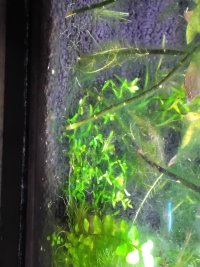
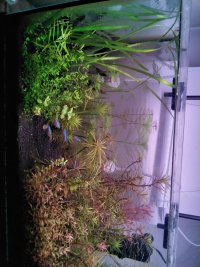
Attached herewith
 

Attachments

  • 20250405_183159.jpg
    20250405_183159.jpg
    386.5 KB · Views: 45
  • 20250405_183138.jpg
    20250405_183138.jpg
    328.6 KB · Views: 37
  • Thread Starter
  • #179
I have the following question: based on the plant species and mass as shown in the previous picture, what is the requested weekly/daily fertilizer dosage one would implement ?
 
I have the following question: based on the plant species and mass as shown in the previous picture, what is the requested weekly/daily fertilizer dosage one would implement ?
What fert do you have and how big is the tank. What light on what percentage? How much co2 do you add?
 
  • Thread Starter
  • #181
What fert do you have and how big is the tank. What light on what percentage? How much co2 do you add?

Tropica Specialised, plus I have a bottle of easy life potassium dosing from time to time. 60 liter. Just upgraded (only few days ago, so plants haven't been adapted completely), to week aqua 50w, after a long period (from establishment actually), of using 20w led lighting from aliexpress.
Been set on 40%.
Using diy co2 yeast based, however operating two reactors simultaneously, with regular on schedule renewing.
Also there are several root tabs sparsely distributed.

One thing important to mention is that I quite adequately vacuumed the whole detritus/mulm/waste from the soil substrate using the well known technique using turkey baster, it does looks like I have taken away a lot of natural fertilization from the plants, however it DOES helped me get over the algae.

I'm intentionally not specifying the amount of fertilizer I'm dosing, interested of hearing the requested quantity.
 

Advertisement


  • Thread Starter
  • #182
Can someone give me a number based on the plant species and mass as shown in the previous picture, what is the requested weekly/daily fertilizer dosage one would implement ?
I want to know if I'm dosing sufficiently
 
Can someone give me a number based on the plant species and mass as shown in the previous picture, what is the requested weekly/daily fertilizer dosage one would implement ?
I want to know if I'm dosing sufficiently
What are you dosing right now? They recommend 5ml a week for 50L. They say a pump is 2 ml. So you could try 3 or 4 pumps. A week. For easy life potassium try 6 ml per week. They reccommend 10 ml per 100L a week. You do have quite a few plants maybe try these doses but slightly more. Plus you have fast growing plants.
 
  • Thread Starter
  • #184
What are you dosing right now? They recommend 5ml a week for 50L. They say a pump is 2 ml. So you could try 3 or 4 pumps. A week.
Yes, according to the recommended dosage more or less, I was thinking more is needed, ok than.
 
Yes, according to the recommended dosage more or less, I was thinking more is needed, ok than.
You could try slightly more because you have a pretty good plant load and some fast growers.
 
  • Thread Starter
  • #186
Though no scape whatsoever, I'm seriously considering resetting the tank with advanced planning regarding aquascaping layout.
Either way I'm lacking great amount of substrate in most of the tank.
 
  • Thread Starter
  • #187
Oh, the light upgrade starts To show his signs, the cryptocoryne which was peacefully settled at the far corner, which relatively sent new leaves, and with leaves of dark green in color,.. just noticed one leaf starting to brown, typically melting due to light changes.

What is being asked now is if any action needs to be taken place?

After a long research I believe I have figured out why the pearling disappeared.
This is not co2 related nor nutrition related, the lighting upgrade, besides the great improvements in power, quality and distribution of the light, due to the fixture nature, been set 20 cm from water surface, as opposed to the previous light that was (well I never measured it but according to the current setting), roughly 5 cm from the water surface.

So, to retrieve pearling, while maintaining the current height of the lights, what need to be done ? Increase the intensity ? I'm on 40% currently.
 
  • Thread Starter
  • #188
If some amount of substrate is lacking in some portions of the tank, what would be one procedure of adding more substrate?
I assume cycling it independently in a bucket with frequent wc for several weeks would be sufficient?
 
  • Thread Starter
  • #189
What are more COMMON dry salts for planted aquarium diy fertilizer PHOSPHORUS source ?
 
  • Thread Starter
  • #190
Hi, noticed that and just realized now, could this be a cryptocoryne runner?
I was wondering what this plant is and where it come from
 

Attachments

  • 20250425_180051.jpg
    20250425_180051.jpg
    262.2 KB · Views: 46
  • 20250425_180048.jpg
    20250425_180048.jpg
    292.1 KB · Views: 98
Hi, noticed that and just realized now, could this be a cryptocoryne runner?
I was wondering what this plant is and where it come from
Yep, that appears to be a baby crypt popping up.
 

Advertisement


  • Thread Starter
  • #192
Yep, that appears to be a baby crypt popping up.
Is it going to get the size of the main plant ? It will suffocate the Hemianthus glomeratus, isn't it? Btw, another cryptocoryne runner popped up. I attribute this to the lighting upgrade.
 
Is it going to get the size of the main plant ? It will suffocate the Hemianthus glomeratus, isn't it? Btw, another cryptocoryne runner popped up. I attribute this to the lighting upgrade.
Yes, eventually it will mature to the size of the parent plant. You may want to sever it from the parent & move it or sell it once it’s a bit more mature.
 
  • Thread Starter
  • #194
Hi, I have the following question, I managed, as aforesaid, to bring the full green color to the pogostemon erectus, as shown in the picture. Obviously A LOT of nutrients were missing in the tank. Nevertheless, one leaf of it is turning yellow, again as seen in the picture.
I just reduced the green spectrum channel significantly in favor of the others. Can this be the cause ?
 

Attachments

  • 20250428_105757.jpg
    20250428_105757.jpg
    452.9 KB · Views: 63
  • Thread Starter
  • #195
"Green plants appear green because they are reflecting green light not absorbing it."
"The main reason why green light is purportedly not useful to plants is because it is poorly absorbed by plants."
It almost useless the green spectrum, or is it ?
 
"Green plants appear green because they are reflecting green light not absorbing it."
"The main reason why green light is purportedly not useful to plants is because it is poorly absorbed by plants."
It almost useless the green spectrum, or is it ?
Nope, definitely not useless to plants but used with less efficiency than red or blue wavelengths. Most plants do reflect the majority of it but not all of it & it serves them better than we may expect. .

In fact, green light is used for photosynthesis & where growth is thick, for example, in a forest, green light penetrates to lower levels than blue or red light can, giving leaves lower down some light they can utilize to photosynthesize.

It also regulates plant architecture and the link below explains what that is better than I can.

https://www.sciencedirect.com/topics/agricultural-and-biological-sciences/plant-architecture

The link below has some interesting information on the effect of green light.

https://www.canr.msu.edu/news/green_light_is_it_important_for_plant_growth#:~:text=Green light is considered the,photosynthesis and regulates plant architecture.
 
  • Thread Starter
  • #197
I was wondering, fluorescent lights,like T5, are still widely acceptable in both low and high tech setups. What is the spectrum range, or more specific the general colors this light omits? I assume blue to bright white only.

I have these excerpts:
The spectrum of light emitted from a fluorescent lamp is the combination of light directly emitted by the mercury vapor, and light emitted by the phosphorescent coating

Although fluorescent light approximates natural, white light, the spectrum of a fluorescent light is not the continuous spectrum of an incandescent light. Figure 3 shows a comparison of the two types of bulbs. The incandescent light gives off a continuous spectrum as it approximates a blackbody. The fluorescent light, however, is composed of broad but discrete parts of the spectrum. This is what accounts for the perceived difference between the output of the two different types of light bulbs

Or this:
It’s called a band spectrum.

Fluorescent lights actually produce ultraviolet light, with frequency too high for the eye to perceive. The glass envelope of the fluorescent light has a covering of phosphor, which converts the UV light into visible light. But this visible light has only frequencies which match the energy gaps in the phosphor. So the light is made up only of those frequencies, and not of any others that might lie in between. Therefore it’s not a continuous spectrum.

They make fluorescent lights in a variety of white tints: daylight (the bluest), cool white, and warm white. (This is done by putting different types of phosphors on the envelope.)

Well,, one can setup a few T5/T8 lights and forget about intensity or spectrum tweaking :)
They used to make flourescent tubes specifically for plant growing and before the LEDs took over, those lamps worked quite well.

No, you could not tweak the individual wavelengths, but they served well enough and for quite a long time there were few alternatives that were usable by the average hobbyist

There were (still are so far as I know) HID lights - metal halide (MH) & high pressure sodium
(HPS), but those fixtures were very big & very expensive.

MH lamps get extremely hot and HPS offers pretty poor colour rendering - they were used for greenhouses (& no doubt for grow-ops too T one time).

LED lights are not perfect but the flexibility they allow aquarists is something that was never available to us until quite recently.
 
  • Thread Starter
  • #199
Hi, a completely hypothetical question, a hinch. Is there's something to the idea that new fresh (dechlorinated, or sat for a few days for that matter) water can absorb, hold and deliver freshly dosed nutrients for plants, more efficiently than used tank water that have been filled the tank for a week or so ? Sort of less saturated, even if regular dosing is completely consumed by plants, and assuming no excess nutrients is present in the water column.

Here's an answer I liked:
"Water changes are to remove bad things, including but not limited to excess nitrates from the water and replenish trace minerals. Topoffs are doable, but aren't any replacement for a good 40% water change. Eventually, with Topoffs, you run into the issue of elevated TDS, which can hinder plant growth and cause poor osmotic function in plants and fish. Especially if you use a fertilizer, any unused molecules will quickly accumulate in a tank that only gets Topoffs. I'm not going to say you shouldn't do topoffs ever, but just keep in mind it isn't entirely sustainable for extended periods, especially if your topoffs are with tap water that contains some minerals already."

Why am I asking, suppose I'm doing a 25-50 percent weekly wc, and dosing fertilizers daily, when it would be inefficient for a daily dose (in terms which some portion of that daily amount would essentially won't be dissolved in the water column efficiently)
Suppose I'd like to extend the wc interval to every two weeks, this matter would then be more significantly.

It looks like to me, one should dose half to two thirds of the weekly recommended dosage right after a wc, and the rest on daily dosing, assuming of course this is not a high tech setup with very large amounts of fertilizers.

Well, I need to aquire the salts ingredients for a diy fertilizer..
 
  • Thread Starter
  • #200
Hi, I'm baffeld whether to increase light duration from a solid 8 hr to 9 hrs.
I notice photosynthesis is still taking place, the tank is mature with a relatively pretty good plant load.
 
Advertisement


Advertisement


Advertisement


Back
Top Bottom