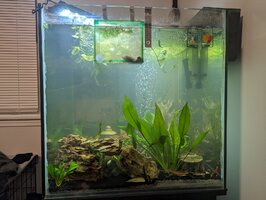
Cube tanks aquascaping suggestions.

JustAFishServant

Well Known
Member
Messages
1,618
Hey all, yesterday I bought a new 6 gal (23L) cube to replace my old 3 gal (11L) cube the ramshorns scratched. Most of my scapes include jungle tanks since I think they're the most natural (unless you want to talk about tinted water, true blackwater, various cichlid lakes and other plant-less environments in the wild but...you get my point.)
Wondering if anyone can share pics of their cube tanks for ideas. Thanks all :) IMG_20230724_084101.jpg
(Right) old tank; 9.75" (25cm) cube
(Left) new tank; 12" (30cm) cube
 

Advertisement
Hey all, yesterday I bought a new 6 gal (23L) cube to replace my old 3 gal (11L) cube the ramshorns scratched. Most of my scapes include jungle tanks since I think they're the most natural (unless you want to talk about tinted water, true blackwater, various cichlid lakes and other plant-less environments in the wild but...you get my point.)
Wondering if anyone can share pics of their cube tanks for ideas. Thanks all :)View attachment 885418
(Right) old tank; 9.75" (25cm) cube
(Left) new tank; 12" (30cm) cube
You could try a wild betta biotope. I've listed what you need below:

Decor: spiderwood, river stones of various sizes.

Substrate: 5 lbs of sand. You could also get some peat moss (the only ingredient can be peat moss, no additives) and add about 2 inches of the substrate. You should only have one or the other in a tank this small. Also be aware that the peat moss will float for a while before waterlogging, so you could add about an inch of sand to cap the peat moss.

Plants: Java fern x1, duckweed.

Lighting: basically any LED light meant for an aquarium of this size.

Filter: Sponge filter meant for a tank of this size.

Inhabitants: basically any wild betta x1. I'd prefer if you get a Betta smaragdina guitar since they look pretty, very hardy, and are also a wild-type betta. Wild types in general are better than store types because they are healthier both physically and genetically, and they look better IMO.

Parameters: PH 5.5 - 6.5, temp 78 F, hardness 18 - 179 ppm.

Instructions:
  1. get the substrate ready.
  2. Place the spiderwood into the middle of the tank. Make sure the base of the wood is stuck into the substrate (the base is where all of the branches branch out from) and the branches are sticking out. Boil the spiderwood beforehand to waterlog it.
  3. Place the river stones around the tank until it looks the way you want it.
  4. Fill the tank up with a 50/50 mix of dechlorinated tap water and distilled water in order to prevent the water from becoming too hard. Also, add the sponge filter.
  5. Add Indian almond leaves to help with maintaining the low PH and to add tannins. Then, add fish food or other sources of ammonia to the tank until the ammonia levels read about 5 ppm. Then, introduce beneficial bacteria. If you want the PH to be 6 or lower, there is no need to add the beneficial bacteria, since a new type of bacteria will grow and convert the ammonia into harmless ammonium. Remember that this new type of bacteria will only grow if the PH is roughly 6 or lower.
  6. Once the tank is cycled, add the duckweed and java fern. Instead of planting the java fern into the substrate, place it on top of the spider wood in a way that allows the leaves to be above the water while the roots are underwater.
  7. Then, once everything is ready, add the betta.

Additional notes:
  • You can collect some rainwater in a bucket outside and leave it to sit. This will cause the collected water to grow microscopic creatures and bacteria that you can add into the tank which will allow for a much healthier ecosystem.
  • I did not describe the entire method of cycling this tank. The style of tank described is a "true blackwater". You can find some more info on it here. It mentions using an RO system but if you can't you can just do the 50/50 mix I said earlier.
  • You could buy some rotala rotundifolia (dwarf rotala) and let it float along with the duckweed. This way it will provide more oxygen to the tank and will help prevent jumping.
EDIT: I skimmed over the part where you mentioned sharing pictures of cube tanks for inspiration. Still, what I've said here is basically what I'm doing for my 10 gal, just on a larger scale.
 

Advertisement
  • Thread Starter
  • #3
You could try a wild betta biotope. I've listed what you need below:

Decor: spiderwood, river stones of various sizes.

Substrate: 5 lbs of sand. You could also get some peat moss (the only ingredient can be peat moss, no additives) and add about 2 inches of the substrate. You should only have one or the other in a tank this small. Also be aware that the peat moss will float for a while before waterlogging, so you could add about an inch of sand to cap the peat moss.

Plants: Java fern x1, duckweed.

Lighting: basically any LED light meant for an aquarium of this size.

Filter: Sponge filter meant for a tank of this size.

Inhabitants: basically any wild betta x1. I'd prefer if you get a Betta smaragdina guitar since they look pretty, very hardy, and are also a wild-type betta. Wild types in general are better than store types because they are healthier both physically and genetically, and they look better IMO.

Parameters: PH 5.5 - 6.5, temp 78 F, hardness 18 - 179 ppm.

Instructions:
  1. get the substrate ready.
  2. Place the spiderwood into the middle of the tank. Make sure the base of the wood is stuck into the substrate (the base is where all of the branches branch out from) and the branches are sticking out. Boil the spiderwood beforehand to waterlog it.
  3. Place the river stones around the tank until it looks the way you want it.
  4. Fill the tank up with a 50/50 mix of dechlorinated tap water and distilled water in order to prevent the water from becoming too hard. Also, add the sponge filter.
  5. Add Indian almond leaves to help with maintaining the low PH and to add tannins. Then, add fish food or other sources of ammonia to the tank until the ammonia levels read about 5 ppm. Then, introduce beneficial bacteria. If you want the PH to be 6 or lower, there is no need to add the beneficial bacteria, since a new type of bacteria will grow and convert the ammonia into harmless ammonium. Remember that this new type of bacteria will only grow if the PH is roughly 6 or lower.
  6. Once the tank is cycled, add the duckweed and java fern. Instead of planting the java fern into the substrate, place it on top of the spider wood in a way that allows the leaves to be above the water while the roots are underwater.
  7. Then, once everything is ready, add the betta.

Additional notes:
  • You can collect some rainwater in a bucket outside and leave it to sit. This will cause the collected water to grow microscopic creatures and bacteria that you can add into the tank which will allow for a much healthier ecosystem.
  • I did not describe the entire method of cycling this tank. The style of tank described is a "true blackwater". You can find some more info on it here. It mentions using an RO system but if you can't you can just do the 50/50 mix I said earlier.
  • You could buy some rotala rotundifolia (dwarf rotala) and let it float along with the duckweed. This way it will provide more oxygen to the tank and will help prevent jumping.
EDIT: I skimmed over the part where you mentioned sharing pictures of cube tanks for inspiration. Still, what I've said here is basically what I'm doing for my 10 gal, just on a larger scale.
Hmm I've thought about this, but this is my living room tank (aka the only tank the family allows in the common area outside of the pet room.) This is an area where my mother spends a lot of time so I let her stock it. These are her ideas (with the help of my input and 10+ yrs of experience lol):

3 Africans dwarf frogs OR
2 honey gouramis OR
1 paradisefish OR
1 pea puffer OR
2-3 guppies

This tank used to be for a rescue betta then for 3 dwarf red coral platies. Right now she's intrigued with african dwarf frogs :)
 
Wouldn't do honeys in tank that small recommend against the puffer unless you have couple tanks to breed food.
 
  • Thread Starter
  • #5
Wouldn't do honeys in tank that small recommend against the puffer unless you have couple tanks to breed food.
Right now she's intrigued with african dwarf frogs :)
"She's intrigued with african dwarf frogs" meaning the tank will have african dwarf frogs, not peas or honeys.

IMO it's big enough for ADFs...especially since it'll be a heavily-planted Walstad

I breed ramshorn, bladder, nerite, pagoda, great pond, assassin, apple/mystery...lots of food for peas if I ever plan to keep any ;)
 
I set up my 60 cube about 6 weeks ago and had a really tough time finding any photos for inspiration, here's where we're at now!

Currently with
2 honeys
5 adult panda corys (+2 juveniles in the main tank and +/- 15 in the mesh breeder)
10 harlequin rasboras
6 kuhlii loaches
5 norman's lampeyes
3 Nerite snails
A few sunburst shrimp, I need to pick up some more to replenish their ranks

This was taken about an hour ago right after I added in several plants, which is why the water is a bit cloudy and the fish are hiding
 

Attachments

  • PXL_20230727_013832702.jpg
    PXL_20230727_013832702.jpg
    394 KB · Views: 61
  • PXL_20230727_013847462.jpg
    PXL_20230727_013847462.jpg
    423.9 KB · Views: 54

Random Great Topic!

Advertisement


Advertisement


Advertisement


Back
Top Bottom