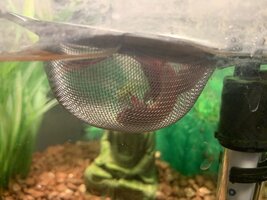
Betta fish C shape, can't swim, bubbly eyes. Please help!

MrDaedalian

New Member
Member
Messages
18
Hi, something weird is going on with my Betta (Tom) and I can't figure it out. Please help me to make everything better for him.

He has a 15-16 liter tank (4 gallon) and lives there by his self. He has a low flow waterfall filter, a heater (set to 26 celcius(79F)). There are some fake plants which he loves to lay on and he's been living there for 1.5 year now. He was always happy and we are having 30% water change in every two weeks. Also he has a light that is set for 8 hours.

Everything was fine until after a 20% water change on friday evening when I realized he is really calm and just laying on the plants. On saturday he seemed to can't move easily therefore I thought maybe he is constipated or having swim bladder and stopped feeding him. On sunday morning I saw him in C or U shape and he wasn't able to move voluntarily at all. Today was the same and I went down to pet store and bought some bacteria medicine (esha 2000) and salt to relieve stress (sera ectopur). In the evening I gave him a cooked pea but he didn't eat it. Right now he is like in the photos all the time and I put him on a sieve to prevent him stayin upside down in the bottom of the tank.

My first guess about his condition was swim bladder but now he seems to have some popeye too. On the other hand water quality is very good and it was also like that before the water change. Therefore I don't know how to continue the treatment. Please help me about this problem! Thank you all in advance!

IMG_0388.jpegIMG_0395.jpegIMG_0396.jpegIMG_0397.jpegIMG_0398.jpeg
 

Advertisement
First of all, please stop using that metal sieve to hold him. Fish nets are soft for a reason. You're likely doing him serious damage by holding him up with metal- Bettas are very delicate. If you're using that in combination with salt I respectfully note that he's probably in a lot of pain at this point.

Popeye is usually caused by an injury combined with a bacterial infection. If antibiotics aren't working, as you mention that you've had him for 2.5 years and he seems to have a large number of serious problems- you might need to consider that he's at the natural end of his life and can't be saved at this stage. If he were my fish I would probably let him go. I prefer "gentle neglect" rather than euthanasia (that is, leaving him alone other than to offer food occasionally until his life ends) but others would recommend using clove oil to bring a quick end. This would be your choice entirely.

I'm sorry I can't give a more hopeful outlook.
 

Advertisement
I've read that fish TB can cause that U like shape. It's a type of mycobacteriosis that's more common in tropical aquarium fish. Unfortunately I don't believe there's a cure. Of course I'm just guessing like everyone else.

Very sorry this is happening.

Also agree with others re: salt > not good for freshwater fish. Probably messes up their osmoregulation for starters.
I've never read any articles citing that kind of acute posturing caused by m. marinum. It can cause spinal deformities over time if the fish lives long enough but it usually kills the fish in just a few weeks. Usually symptoms just include necrotizing granulomas, lethargy, scale discoloration and loss, organ (mostly kidney/heart) failure (dropsy), loss of appetite, difficulty swimming. This has none of those characteristics. It looks like classic nitrate poisoning and secondary popeye as a result of the water conditions to me.
 

Advertisement
I've never read any articles citing that kind of acute posturing caused by m. marinum. It can cause spinal deformities over time if the fish lives long enough but it usually kills the fish in just a few weeks. Usually symptoms just include necrotizing granulomas, lethargy, scale discoloration and loss, organ (mostly kidney/heart) failure (dropsy), loss of appetite, difficulty swimming. This has none of those characteristics. It looks like classic nitrate poisoning and secondary popeye as a result of the water conditions to me.
Just for my own education (I don't have much experience with nitrate poisoning), I was wondering what aside from the water change schedule makes it look like a 'classic' case of that to you? Which symptoms in particular?
And what do you think about the shape, is that related? I'm wondering what would cause that...
 
I would like to know how you treat him. (ex, do you tap on the glass, yell at him, treat him well..) to see if stress could be causing anything.

Ty,

Christian
 
Just for my own education (I don't have much experience with nitrate poisoning), I was wondering what aside from the water change schedule makes it look like a 'classic' case of that to you? Which symptoms in particular?
And what do you think about the shape, is that related? I'm wondering what would cause that...
The fact that the fish is curled in a rigid 'c' shape and essentially paralyzed, unable to eat, has popeye (as you know, bilateral popeye is usually caused by infection that is usually caused by poor water conditions).
Be on Alert for Nitrate Poisoning in Aquarium Fish
Plus, I've seen nitrate shock in several live bearer (Molly) juveniles when a 50% water change was done in a tank with a nitrate level >250. Within 3 hours nearly half the juvenile fish were curled on the bottom of the tank (exactly like this betta), gasping and pale. About half of those died. The other half recovered slowly over the next 24 hours.
 
The fact that the fish is curled in a rigid 'c' shape and essentially paralyzed, unable to eat, has popeye (as you know, bilateral popeye is usually caused by infection that is usually caused by poor water conditions.
Be on Alert for Nitrate Poisoning in Aquarium Fish
Plus, I've seen nitrate shock in several live bearer (Molly) juveniles when a 50% water change was done in a tank with a nitrate level >250. Within 3 hours nearly half the juvenile fish were curled on the bottom of the tank (exactly like this betta), gasping and pale. About half of those died. The other half recovered slowly over the next 24 hours.

Yes, sounds like NP...
 
I would like to know how you treat him. (ex, do you tap on the glass, yell at him, treat him well..) to see if stress could be causing anything.

Ty,

Christian
Well, you test the water first, always. Can't help the fish if you don't know what's causing the problem. Any time a fish acts sick or different than normal, test the water first, then go from there.
 

Advertisement


  • Thread Starter
  • #12
HI all, thanks for your replies! I'm using sera quick test to check water conditions and the results were always in the good part. The recent results from last night are:
No3 = <10
No2 = 0
Gh = average 10
Kh =10
Ph =7.2
I might be wrong on believing the results of a quick test but it should detect the amount of nitrate that is causing NP, right?

About how I treat him, he is with me for a long time and he was a happ betta with frequent bubble nest production and everything. He has a very nice routine with very little stress factors and he is always interacting with me well.

This all happened after a 20% water change and it was instant. Last night I started using esha 2000 and I will keep using it today and tomorrow. Following your recommendations, I will quit using the Sera Ectopur.

By the way, to explain the sieve; I put him there to make him close to the surface and to avoid him being upside down. Otherwise I have a full set of equipment (including nets).

Lastly, what do you suggest on water changes? Should I change it daily or wait until the medication is over? Again, thank you for your replies.
 
Again, please don't use that metal sieve for that purpose. I know you feel that he needs to be held at the surface. The best way to do this is actually lowering the water level in the tank. If this is impossible for some reason, please, please get a plastic breeder box to hold him rather than continuing to do him damage and cause him pain with a metal sieve.

Others have given good information (though given your water parameters I stand by my statement that he is probably too far gone to save- however, this is your call)- but I am very disturbed to see a sick betta in a metal sieve for any reason at all and need to ask you to please remove him from it.
 
  • Thread Starter
  • #14
I already removed him from there, my bad not mentioning it. Now he is on the bottom and I will check the nearest pet store for a breeder box as soon as possible.
 
I already removed him from there, my bad not mentioning it. Now he is on the bottom and I will check the nearest pet store for a breeder box as soon as possible.
Hi! Is your betta swimming erratically? And, more importantly, is he able to use his outside fins (the fins on the outer side of the C shape he is in, judging by the pics, his left side?)? Do you see blood anywhere in or around his eyes?
 
  • Thread Starter
  • #16
Hi!
Yes, he has little blood in his right eye. About the fins, he can use both of them but he doesn't move very much. He is mostly still and seems like only breathing but when he moves its in circles without any direction.

IMG_0402.jpeg
 
Hi!
Yes, he has little blood in his right eye. About the fins, he can use both of them but he doesn't move very much. He is mostly still and seems like only breathing but when he moves its in circles without any direction.

View attachment 637124
You mentioned breathing, if you observe his gills together, is one side moving quicker/stronger than the other? And to clarify, this happened over 1-2 days?
 
  • Thread Starter
  • #18
It is hard to see both sides at the same time because of his shape but it seems like they are moving evenly.
Yes, I made a 20-30% water change on friday evening.
On saturday he was really calm and was sitting on top of his plants therefore I add some stress relievers and stopped feeding him in case of swim bladder.
Then on sunday morning I found him in this C-shape and since it was sunday everywhere was closed so I couldn't do anything.
On monday I bought the medicines that I mentioned before and gave them.
Now, today I guess is the 4th day.
I suspect your fish suffered from a type of stroke, probably a haemorrhagic one, which can cause the retrobulbar area (behind the eyes) to swell and increase in pressure, pushing the eyeballs outwards, as well as weaken an entire side.

Should this be the case, I'm afraid there isn't any treatment readily available, and best you observe and just keep up your maintenance - as it may resolve partially or completely, not improve at all, or worsen, depending on the extent of the affected areas.
 
  • Thread Starter
  • #20
I can see how badly the situation is but thank you for preparing me for it.

The thing that bothers me is what could have caused this type of a problem. Is it something that I did? I admit that sometimes I overfed him when he seemed hungry but that is it, other than that I think I took good care of him therefore I'm quite shocked with this instant, out of no where problem.

Also, is there anything that I could do to make the process easier for him? I will give the second dose of esha2000 this evening and tomorrow evening will be the last dose. After that if nothing improves, I would like to help him make as comfortable as possible (other than euthanasia of course).
 
Gosh, so many differing opinions on here. It’s all very confusing. If he were my fish, I would leave him where he is and do 50% water changes everyday. Be sure water is heated. Finish the Esha treatment. If no better then treat him with fresh daily water changes and 1 tablespoon of aquarium salt per gallon of tank water. Each day if you do a 50% water change then add 1/2 tablespoon of salt back in. Be sure to dissolve it first. Contrary to popular beliefs, temporary use of Aquarium salt is very good for reducing stress, fighting mild bacterial infections and improving gill function. If after a few days of salt/water treatment he hasn’t improved then you can use Kanaplex and Furan-2 together per package instructions. Biggest key for now though is clean water and aquarium salt. You said this occurred after a water change. Could you have forgotten to add the dechlorinator? Normally with a sudden change after water change it is related to water quality issues. I doubt this is fish TB with such a sudden onset. I would not give up yet. If no improvement with above treatment then final decision would be euthanasia with clove oil.
 

Advertisement


  • Thread Starter
  • #22
I will try the 50% water change and salt treatment after these treatment over.

About the chlorine issue, I live in the Netherlands and in my area water has no chlorine in it. I'm also drinking that water therefore I have never used dechlorinator (I asked different pet stores to clarify and they all said its not necessary at all).
 
I can see how badly the situation is but thank you for preparing me for it.

The thing that bothers me is what could have caused this type of a problem. Is it something that I did? I admit that sometimes I overfed him when he seemed hungry but that is it, other than that I think I took good care of him therefore I'm quite shocked with this instant, out of no where problem.

Also, is there anything that I could do to make the process easier for him? I will give the second dose of esha2000 this evening and tomorrow evening will be the last dose. After that if nothing improves, I would like to help him make as comfortable as possible (other than euthanasia of course).
Off the top of my head I do not think there is a direct cause. Just like aneurysms in humans, sometimes it just happens. Although, if you feed a lot of fatty food (beef heart, and similar) it may have contributed to it.

Yes, do complete the treatment regardless, and then see from there. As for comfort, I'm afraid I personally can't offer much except to leave him be and give him as little things to stress about as possible. I'm not a fan of euthanasia myself (left a bad taste after I had to do it on one of my fish. Still question myself if it was the 'right' choice), so I can't offer much in that regard either.
 
  • Thread Starter
  • #25
Just this esha2000 and (now ended) ectopur treatment which I started yesterday
 
Gosh, so many differing opinions on here. It’s all very confusing. If he were my fish, I would leave him where he is and do 50% water changes everyday. Be sure water is heated. Finish the Esha treatment. If no better then treat him with fresh daily water changes and 1 tablespoon of aquarium salt per gallon of tank water. Each day if you do a 50% water change then add 1/2 tablespoon of salt back in. Be sure to dissolve it first. Contrary to popular beliefs, temporary use of Aquarium salt is very good for reducing stress, fighting mild bacterial infections and improving gill function. If after a few days of salt/water treatment he hasn’t improved then you can use Kanaplex and Furan-2 together per package instructions. Biggest key for now though is clean water and aquarium salt. You said this occurred after a water change. Could you have forgotten to add the dechlorinator? Normally with a sudden change after water change it is related to water quality issues. I doubt this is fish TB with such a sudden onset. I would not give up yet. If no improvement with above treatment then final decision would be euthanasia with clove oil.

What about water conditioner? Do you use that?
 
  • Thread Starter
  • #29
I use it approximately in every two water changes or so (I do water changes in every two weeks). I always check the water readings (with sera quick test) before and a day after each water change. Additionally, I never had a problem with water quality that is why I sticked to every-two-week water change schedule
 
You're fishes symptoms started IMMEDIATELY after a water change. Your FISH STORE says there's no chlorine or chloramines in the water. What does your water company say. Where in the Netherlands do you live? Is your water purely ground water? Or are you receiving surface (lake, river, stream) water? If I were you, I'd check with the water company about the chlorine. I know the water wasn't treated with chlorine between the 1970's until 2009, but you might want to see if something has changed in the last 10 years.
 
  • Thread Starter
  • #31
No, I called the company at the time of first setting up the tank (before fish arrived) and they told there is no chlorine in water. I just moved here 3 years ago and that's why I double checked it with the local pet store. Also, the water change procedure I follow is same for 1.5 year. Of course the chlorine issue might have changed through 1.5 years but I'm not sure. I will ask them again for confirmation.
 

Advertisement


I would suggest API E.M. Erythromycin you can find it at PetSmart or if you have access I use Fritz Maracyn, it treats Fungus, Fin Rot, Pop eye, and Gill disease. I use that in conjunction with API general cure and Ich-X. General cure will act as a deworming for any internal parasites.
 
No, I called the company at the time of first setting up the tank (before fish arrived) and they told there is no chlorine in water. I just moved here 3 years ago and that's why I double checked it with the local pet store. Also, the water change procedure I follow is same for 1.5 year. Of course the chlorine issue might have changed through 1.5 years but I'm not sure. I will ask them again for confirmation.
You might also check the tap water parameters and compare them to your tank? It's just really strange that these symptoms occurred suddenly after a simple water change-especially the bulging eyes-a thrombotic stroke is possible in fish, but a hemorrhagic stroke is highly unlikely, especially bleeding in the skull that would be massive enough to cause the eyes to bulge out. Fish just don't have the cardiovascular anatomy to produce that kind of pressure. They only have a 2 chambered heart and just don't have the blood pressure to do that. I also would recommend NOT using salt in the tank. Bettas are freshwater fish. Salt may create osmotic problems that make the problem worse. Epsom salt baths may help though and is a recommended treatment for popeye in fish. Epsom salt (magnesium/calcium) tends to decrease swelling by drawing fluid out of tissues/cells, rather than forcing water and sodium into them as salt (sodium chloride) does.
 
Like I said it was an article quite a while back so my info isn't a good source in this case. I was researching the possible underlying causes of a fish I lost to dropsy (pristine water) and came across the fish TB thing, which didn't fit my fish's symptoms but I remembered the U thing is all. The source wasn't a Veterinary manual so who knows.

Did you mean nitrite or nitrate?

I've heard of but never seen nitrite poisoning, I suppose enough nitrate would be toxic but then the nitrites would be high too? I've never heard of nitrite causing the u shape that's interesting if sad in this case. :/

I realize most fish illness is caused by water - if the OP was changing 25% weekly how could there be such a build up with only one fish? And the fish has been there 1.5 years already? If the fish was a year old when purchased, it could be at the natural end of it's life as someone else pointed out.

I keep the wild type hybrids and have never had such issues with them.
 
  • Thread Starter
  • #36
You might also check the tap water parameters and compare them to your tank? It's just really strange that these symptoms occurred suddenly after a simple water change-especially the bulging eyes-a thrombotic stroke is possible in fish, but a hemorrhagic stroke is highly unlikely, especially bleeding in the skull that would be massive enough to cause the eyes to bulge out. Fish just don't have the cardiovascular anatomy to produce that kind of pressure. They only have a 2 chambered heart and just don't have the blood pressure to do that. I also would recommend NOT using salt in the tank. Bettas are freshwater fish. Salt may create osmotic problems that make the problem worse. Epsom salt baths may help though and is a recommended treatment for popeye in fish. Epsom salt (magnesium/calcium) tends to decrease swelling by drawing fluid out of tissues/cells, rather than forcing water and sodium into them as salt (sodium chloride) does.

So the epsom salt and ectopur are serving different purposes? Then I will start using epsom salt after this treatment.

The conditioner I use is "easy life ultimate water conditioner". It says it is for stress relief and removing harmful substances from water. Is it same as a dechlorinator?
 
a thrombotic stroke is possible in fish, but a hemorrhagic stroke is highly unlikely, especially bleeding in the skull that would be massive enough to cause the eyes to bulge out. Fish just don't have the cardiovascular anatomy to produce that kind of pressure. They only have a 2 chambered heart and just don't have the blood pressure to do that.
I do agree that haemorrhagic stroke is not likely, but thrombotic stroke? in fish? Haemorrhagic stroke has nothing to do with vascular pressure, it is merely the leakage of blood and fluid from a weakened/ruptured vessel, and by extension, has nothing to do with how many chambers a heart has. Any organism with a closed circulatory system, blood, and blood vessels, and a brain can develop haemorrhagic stroke. Where are you getting your information from? Thrombotic stroke is even less likely to occur in fish for several reasons: 1) fish thrombocytes are not known to actively develop spontaneous thrombI - we're not even sure if these cells actually participate in plug aggregation, 2) Some studies have shown that they might, but latent circulating amounts of thrombocytes are apparently not enough for this to occur spontaneously, 3) Fish thrombocytes, although somewhat structurally homologous to mammalian ones, are doubted to have real phagocytic function, thus aren't considered functionally homologous, 4) Most importantly, as you correctly indicated, fish hearts do not have as much pressure as mammalian ones, therefore, they don't have the pressure to actually push thrombI across the vasculature, much less thrombI large enough to cause a stroke.
References below:
https://www.hindawi.com/journals/ah/2012/857058/
Do fish thrombocytes play an immunological role? Their cytoenzymatic profiles and function during an accidental piscine candidiasis in aquarium. - PubMed - NCBI
<80%3A%3AAID-AR9>3.0.CO%3B2-I
So the epsom salt and ectopur are serving different purposes? Then I will start using epsom salt after this treatment.

The conditioner I use is "easy life ultimate water conditioner". It says it is for stress relief and removing harmful substances from water. Is it same as a dechlorinator?
Yes, epsom salts are different, it's meant to be a laxative and osmoregulation aid, and you may safely combine this with esha 2000, should you choose to do it.

I had to look up your water conditioner, and as far as I can tell it also removes ammonia, chlorine, and chloramines (site is in dutch, so relying on google translate here).
 
  • Thread Starter
  • #39
HI all, thank you for your help throughout the process. Unfortunately, this morning Tom died. Before even finishing the treatment. I suppose his little body couldn't take it anymore. I'm left with lots of questions about how any of these happened and how it happened so fast but it really doesn't matter right now. Again, thank you all for your advices and everything.
 
Again, I think old age was probably a factor here. I'm really sorry for your loss.
 
  • Thread Starter
  • #41
Thank you. I would also like to believe that it is resulted from old age. At least that way I can think that I took well care of him.
 

Advertisement


Sorry for your loss. Aside from old age, sometimes fish (as humans, as other animals) just die from unfortunate complications that are no one's fault in particular. I doubt it had anything to do with your care.

(You really don't need to use a water conditioner in the Netherlands, unless it is for clearing heavy metals that you know to be contaminating your pipes. Our water companies do not use the near-universal chlorine/chloramine additives even if your water is not pumped from a well - it is official policy. The only place that is a (possible) exception to this is the south of Limburg or border towns in the east as they may be importing and mixing treated water from Germany or Belgium. Anywhere else and you don't need to bother checking.)
I wish I was drinking your water! How are they treating surface water there now? The only data I was ever able to get was from 2009. I love the policy of not chemically treating water! I understand tons of filtration and UV are used. PM me if you want to/can provide information. I am always interested in how others better handle our resources!
 
So the epsom salt and ectopur are serving different purposes? Then I will start using epsom salt after this treatment.

The conditioner I use is "easy life ultimate water conditioner". It says it is for stress relief and removing harmful substances from water. Is it same as a dechlorinator?
I'm sorry we couldn't help more to save your betta. From what I could find, the main differences between Easy Life and other traditional water conditioners like Prime, is that Easy life is mineral based rather than chemical based, it takes 2-3 hours to actually detoxify chlorine and other pollutants in water rather than doing it instantly like chemical conditioners, it's a flocculant, meaning it causes particulate material to 'clump' together making removal easier (and probably making water clearer), and it gives tank water a positive electrical charge. Positively charged water better resists bacteria growth. When doing water changes, especially when they are large or infrequent as yours were, I'd be inclined to use both. Prime first to immediately neutralize any toxins and easy life immediately after the water change to charge the water and decrease circulating particulate matter.
Easy life is a great product it just doesn't work instantly.
 

Random Great Topic!

Advertisement


Advertisement


Advertisement


Back
Top Bottom