Amano breeding project

Timmy1027

Active Member
Member
Messages
135
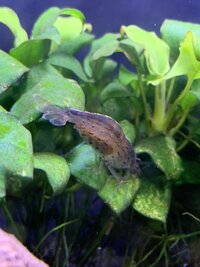
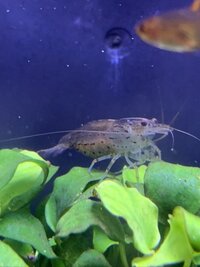
I have an old female Amano shrimp with me for over 2 years and bought a male 1.5 month ago. On Sep 3, I found eggs laid on its swim legs. I was very excited because I did a lot research on Amano/Bamboo shrimp breeding in the past year. I set up a salt water tank with air pump and LED light on for 24 hours a day, hoping to cultivate enough algae for the upcoming babies.

I learnt the mother will release frys in 3-5 weeks, so I am setting up a quarantine tank now to avoid tank mates eating up the frys. I will transfer the mother on Sep 18 when the quarantine tank is ready and before she drops the eggs too early.

I will update later. Any advice or tips are much appreciated.


1D729AE5-D81C-4304-8920-2C6DEAC1CA8B_1_105_c.jpegB5D8A2AB-2A4B-4D29-B500-F7989413DD73_1_105_c.jpeg
 

Advertisement

Advertisement
  • Thread Starter
  • #3
Update on Sep 12:
Today I received a new Fluval spec iii 2.6 gallon tank. I was planning to quarantine the berried Amano in this tank until she releases frys. The scheduled transfer was set on Sep 18, because I think the cycling in new tank can be finished very quick by adding an old bio-media in my old tank. However, I made a big mistake that results in the Amano kicking off her eggs crazily. She was shocked when I remove the bio-media and stir up the substrate. When water is clear again I see only less than 50% of the eggs left on her swim legs... What's worse, she keeps kicking off the eggs... The only good thing is that the kicked off eggs seem hatched, because I can see them randomly jump in a jerky motion!
8901D9CB-EDFF-4354-A202-F361E0F2224A_1_105_c.jpeg
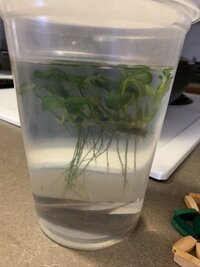
To save the immature frys, I first transfer the Amano into a 1L cup with air pump and some leafs/plants (see above). As expected, she kicks off the rest of the eggs...
The next remedy is to retrieve released frys from my old tank. At the beginning, I use a small cup and a mesh to slowly capture the fry one by one, but it is so inefficient. I save ~20 frys in 2 hours... So I go back to my lab and grap an electronic pipette... I wish I made this choice 2 hours ago. In the end, I save around 50 more. I don't know how to import video in this reply, please tell me if you want to see the day 0 (after release) / day 10 (since berried) babies. They are very tiny, around 1mm long.

FDE2EC22-B47F-4BAB-A48B-CFCA15B4618F_1_105_c.jpeg
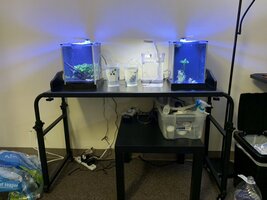
After all the panic, I rearrange all my tanks shown above.
From left to right:
1. Old tank with all my shrimps and ottos.
2-3. Temporary freshwater cups (X2) holding most of the frys.
4. Seawater tank (35 ppt) set up for a week. The light was on 24/7 to cultivate algae. I put ~10 frys immediately after I recover them from the old tank, then I realize they may be immature and be intolerant to saltwater at this stage (10 days since I first spot them on their mother's swim legs). However, it looks they are still alive after 8 hours. I will just leave them in there as a pilot test. If they are still alive in 2 days, I will transfer all the frys from freshwater to seawater.
5. New tank with Neon Tetra and Ember Tetra. I removed Tetras from old tank in order to save as many frys as possible.

Overall, this project happens too early by accident. But I think it is a good lesson to learn and maybe some knowledge to share with you all. I will pick up 2-3 frys tomorrow and try to capture some image in my lab. Hope they will be alive by then.
 
  • Thread Starter
  • #4
Sep 13,
All kicked off eggs hatched today, or at least based on what I can tell, because I didn’t see obvious dead eggs nor egg shell.
The pioneers in seawater tank are still alive, so I transfer all the hatched larvae to seawater. The total number of larvae is estimated to be 100 - 150. Together with the babies, some freshwater was also added to the seawater, the resultant seawater is at 30 ppt, which is what I am aiming for.

First, to balance the ecosystem in the larvae incubator, I added a teaspoon of aquarium soil granules, because they are porous and release silicates. The soil surface can hold nitrifying bacteria and the silicates can facilitate diatom growth, which are essential.
Second, I roughly measured a bit neutral regulator chemicals to prevent pH crash.

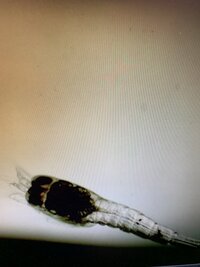
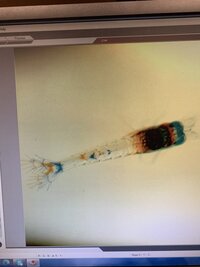
Day 1 larva pics
3EFA2401-4F01-4A42-8E8F-9474F8BD5252.jpeg
This is the ‘forelegs’ of one larva. They look similar to the fans of a bamboo shrimp. The whole body size is between 1.5 mm and 2 mm. A rough calculation can be made that the fans are around 50 micro meter long. Therefore, I guess my Hikari fish baby food is too big for them. Since the seawater tank was set for less than a week. I am afraid there won’t be enough diatoms for larvae to feed on. I placed an order for live phytoplankton on eBay, hoping them can survive before I receive it.
8AD7A138-07C4-4407-BAB4-5B1F47856C49.jpegDFFC3861-94D2-46CA-84F5-A0BD5E107AB8.jpeg7DFA2E02-2569-4CF1-8099-F5B68810E3D4.jpeg34394643-203F-48D5-8D04-8F571B7EB280.jpeg
There are two pairs of dots on the back. 57DAB779-1AB7-40E0-B2C7-272C7E4EC68A.jpeg
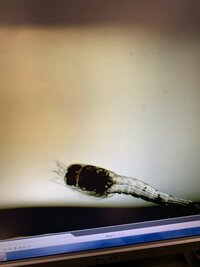
This is the only pic of the whole body from top. But it is off focus, because they are super active, not sitting still. The blue and orange colors are supposed to overlap...
 

Advertisement
Following - I'm very curious to see if you have success getting them to adulthood, as it is quite rare for people to succeed in that endeavor with amanos. Also here for the high quality microscope pics.
 
  • Thread Starter
  • #8
Following - I'm very curious to see if you have success getting them to adulthood, as it is quite rare for people to succeed in that endeavor with amanos. Also here for the high quality microscope pics.
I am glad you like the babies
 
I think DarkOne tried breeding before so he might have some tips but i dont believe he had any luck.
 

Advertisement


I think DarkOne tried breeding before so he might have some tips but i dont believe he had any luck.
I tried a couple of years ago with no luck and gave up. I think I tried with 3 batches. None lived past 12 days. Looking back, it could've been me using dechlorinated tap water to mix the saltwater instead of RO water. I bought a 5.5g tank, refractometer, Instant Ocean salt, Seachem zoo plankton and some other stuff so I gave it a good shot.

This video has a lot of great tips.
 
  • Thread Starter
  • #13
I tried a couple of years ago with no luck and gave up. I think I tried with 3 batches. None lived past 12 days. Looking back, it could've been me using dechlorinated tap water to mix the saltwater instead of RO water. I bought a 5.5g tank, refractometer, Instant Ocean salt, Seachem zoo plankton and some other stuff so I gave it a good shot.

This video has a lot of great tips.
Your experience is valuable for me to adjust the cultural. I will look at the video and see what I can improve. Thank you so much.
 
Your experience is valuable for me to adjust the cultural. I will look at the video and see what I can improve. Thank you so much.
It's been a while so my memory is fuzzy but I remember that my Amano dropped all her eggs before hatching every time. Once the eggs dropped, I moved her back to my shrimp tank and waited for the eggs to hatch. Once they hatched, I moved them to saltwater within 24hrs. I think read somewhere that you have up to 5 days to move them to saltwater but you can move them almost immediately.

There are a few different types of Amano shrimp and each type take different salinity for their larvae to survive. 1st is brackish water (15-20ppt) and the other 2 need full saltwater (32-34ppt). I kept my tank at 33-34ppt.

I had my 5.5g tank set up for a couple of months with the light on 24/7 and never got a lot of algae so that might've been a problem. That's also why I bought plankton in a bottle.
 
  • Thread Starter
  • #15
It's been a while so my memory is fuzzy but I remember that my Amano dropped all her eggs before hatching every time. Once the eggs dropped, I moved her back to my shrimp tank and waited for the eggs to hatch. Once they hatched, I moved them to saltwater within 24hrs. I think read somewhere that you have up to 5 days to move them to saltwater but you can move them almost immediately.

There are a few different types of Amano shrimp and each type take different salinity for their larvae to survive. 1st is brackish water (15-20ppt) and the other 2 need full saltwater (32-34ppt). I kept my tank at 33-34ppt.

I had my 5.5g tank set up for a couple of months with the light on 24/7 and never got a lot of algae so that might've been a problem. That's also why I bought plankton in a bottle.

It is interesting to know there are different Amano species requiring different salinities. I think that's why I read different posts claiming conflicting salt concentration for larvae. Since I cannot afford another seawater tank in no time, I will gradually increase salinity up to 32 ppt for this batch.

As for the algae, Iike I said I only run it for a week with Petco seawater and LED on all the time, there may be insufficient algae growth right now. I did two things trying to fix this problem. I got half liter of seawater from LFS's reef tank and poured it into my tank. I also placed an order for Nannochloropsis live broth, but it won't arrive by the end of this week.

Appreciate your details and knowledge. May the larvae live and strong.
 
You've taken on a very difficult project I really hope you you have full success i believe the only one who's had success with these is -Mak- if I'm not mistaken, follow with intrest
 
  • Thread Starter
  • #18
Thanks for tagging me richiep but it wasn't me, it was this person!
Amano Shrimp Larvae Growth Progress | 375165 | Amano Shrimp

I will be following with interest though!
This is the most detailed documentary I have ever seen!
My larvae looks pretty much alike the ones he video taped from natural hatching, although I think mine are immature because it is only 10 days since I first spot the berried mom. I am pretty sure the larvae are only 10 day old since berried, because I visually check the mom everyday. This could be something new other than the information I read elsewhere that the mother would carry eggs for 3-5 weeks before hatching.

The OP in that link also claimed that the metamorphosis could take much less time than previously thought, 20-25 days rather than 1-2 months. Combining with my experience, the reasonable guess is that this species is very flexible, their development stages are somehow adjustable depending on environmental conditions, such as water parameter shock, food shortage, etc.
 
  • Thread Starter
  • #20
Sep 16
Day 4 after hatching, no obvious loss of larvae, about 100 alive.
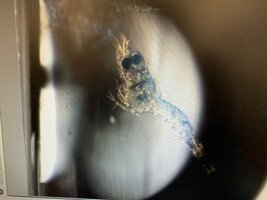
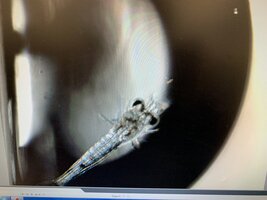
After hatching, larvae are floating passively with head down like a stick, but today I notice a few of them can fold their body in V-shape and swim horizontally.29137111-4E3C-4DB6-A3FA-B954998886A5.jpeg98CBB142-B034-457F-985F-34C9C303369F.jpeg
As you can see in the pictures, their legs are stretched out. The tips of their legs looks hairy, so I think they are still filter feeder.
 

Attachments

  • 362EDE4C-C108-4710-B1D3-81CEFC258F50.jpeg
    362EDE4C-C108-4710-B1D3-81CEFC258F50.jpeg
    62.7 KB · Views: 178
I posted a video of my amamo shrimp filter feeding not so long ago they seem to only do it when they hang upside down, yours certainly seem to be filter feeding
 

Advertisement


I wish you success in this project! If you are able to raise the larvae I may try to follow in your footsteps (if things at work ever slow down)! I have 3 amanos that have been living together in one of my tanks since early 2017 or so. I have two females and a male-both girls are always gravid but so far the larvae have just been live food for the fish...
 
  • Thread Starter
  • #24
Sep 20, day 8 post hatching.
I don't know how to insert video here, but I upload one in Youtube in the link below.
.
It is been over a week, I think I still have a good number of them alive. Really hard to find a dead body on the bottom.

AE9925D8-47F2-4EDA-AD1A-1136D161DA1F_1_105_c.jpeg
The picture shows the recipe in the 1 gallon jar:
1 shell for calcium, a teaspoon of aqua soil for silicate,
1 cup of seawater from a reef tank in my LFS as a head start,
1 gallon of Petco seawater adjusted to be 30 ppt,
2 almond leaves and an air stone.

In my experience, it took about 10 days to have the brown layer of diatoms on the surface of the jar and silicates from soil/rock facilitate this process greatly. I also added 5 ml of live phytoplanktons/green water yesterday, but I think larvae really like the diatoms, because I spot many of them stay still at the bottom for minutes to eat the diatoms.

Will update more if I find something new or interesting.
 
  • Thread Starter
  • #25
Sep 27, day 15 post hatching

I think I made several mistakes that result in huge loss of larvae.
1. I put too much live phytoplanktons that turns water green too quickly.
2. I shut off the light for two nights to avoid over growth of phytoplankton

the outcome of the algae explosion is kind of breaking down the water quality, although I didn’t confirm it using a kit. Turning off light makes the larvae lose direction and fall into the hairy algae on the bottom.

There are a few live larvae left and they are less active. I changed 50% of the water today and I plan to change 30% for the next 3 days. I may lose this batch... it is so sad, but it may be a good lesson to share with you guys. Don’t over feed the larvae any more.
 
Sadness... I do hope some of the remaining larvae survive in the end. If not, maybe next time.
 
Thanks for sharing this knowledge with others- your experimental findings will help you succeed nextbtime and help others too! I am kerping my fingers crossed that some of them make it! This is a challenging project- kudos for attempting it!
 
  • Thread Starter
  • #28
Guys, this is the last update for this project.
It is sad to say I lost all larvae in 16 days. The only good thing I learnt is that a plastic 1 gallon jar with barely no substrate can not hold a stable ecosystem on my hand. The only porous surface which could potentially home nitrifying bacteria is the tiny air stone but it cannot fully cycle the water...

I tested water quality, which I should have done days ago. Although I am using API freshwater test kit, which may be inaccurate for saltwater sample, the readout for ammonia is between 0.25 and 0.5, while nitrite and nitrate are both 0. It is clear that the cycling is not finished, or not even started yet, even though I dose 0.5 ml of bacteria broth every other day... The reason could either be expiration of my bacteria stock or absence of attachment surface.

I went to LFS today and bought a small bag of live sand for reef tank. It is advertised that live sand contains all beneficial micro organisms to maintain the stability of a saltwater tank. I will give it a try and see whether I can establish a stable eco-jar for the next batch.

Now the jar is not completely empty, because I found a baby saltwater snail in it! I think it is coming from the bag of saltwater from LFS that I used to introduce algae. It is a beautiful snail with pattern of red and white colors, just like the crystal red shrimp, lol. So the end of this trial is to learn establishing the saltwater ecosystem and the beginning of a "crystal red snail".
 
It was a good trial run and with a lot of things learned. Good luck creating the saltwater ecosystem for the next attempt. I look forward to it.
 
Guys, this is the last update for this project.
It is sad to say I lost all larvae in 16 days. The only good thing I learnt is that a plastic 1 gallon jar with barely no substrate can not hold a stable ecosystem on my hand. The only porous surface which could potentially home nitrifying bacteria is the tiny air stone but it cannot fully cycle the water...

I tested water quality, which I should have done days ago. Although I am using API freshwater test kit, which may be inaccurate for saltwater sample, the readout for ammonia is between 0.25 and 0.5, while nitrite and nitrate are both 0. It is clear that the cycling is not finished, or not even started yet, even though I dose 0.5 ml of bacteria broth every other day... The reason could either be expiration of my bacteria stock or absence of attachment surface.

I went to LFS today and bought a small bag of live sand for reef tank. It is advertised that live sand contains all beneficial micro organisms to maintain the stability of a saltwater tank. I will give it a try and see whether I can establish a stable eco-jar for the next batch.

Now the jar is not completely empty, because I found a baby saltwater snail in it! I think it is coming from the bag of saltwater from LFS that I used to introduce algae. It is a beautiful snail with pattern of red and white colors, just like the crystal red shrimp, lol. So the end of this trial is to learn establishing the saltwater ecosystem and the beginning of a "crystal red snail".
You did your best, learned things that will help you achieve success next time, and got a new salty pet! Please send a picture of him!
 
  • Thread Starter
  • #31
You did your best, learned things that will help you achieve success next time, and got a new salty pet! Please send a picture of him!
1.jpg
it is tiny so it is hard to get focus. But you may still see the red-white pattern like a CRS
 
View attachment 734179
it is tiny so it is hard to get focus. But you may still see the red-white pattern like a CRS
When you zoom in you can see how cool his color patterns are! Guess you will have to start a reef tank now just for him! hilarious
 
  • Thread Starter
  • #33
When you zoom in you can see how cool his color patterns are! Guess you will have to start a reef tank now just for him! hilarious
Exactly! The more I explore a saltwater tank, the more excited I am. I already have a plan now, but I will only post it when it is mature. Finger crossed
 
Advertisement


Advertisement


Advertisement


Back
Top Bottom