What I’ve Learned With Aquarium Filters

Cichlidude

Well Known
Member
Messages
3,066
This may spark some discussion but discussion is good. After recovering from Old Tank Syndrome (5 years maybe) and getting my 75 gallon (and new 10 gallon) tank back running I have found the following information after many, many hours of research and verification.

My 75 gallon is back on track and new shrimp 10 gallon is running perfect.

First there are basically two types of bacteria, aerobic and anaerobic:

Aerobic bacteria handles ammonia and nitrites which all filters can do. Aerobic bacteria needs oxygen to work.

Anaerobic bacteria which handles nitrate reducing bacteria as long as the filter is set up right using the correct media. Anaerobic bacteria needs no oxygen as oxygen will kill anaerobic bacteria.

It’s all about ANAEROBIC bacteria in your filter to reduce Nitrates.

To start watch these videos here carefully and listen, he is right on.


There are hidden statements in these videos that folks need to heed. Verifying this information took a while but he is correct. I found these after my own observations had myself asking questions.

Things I have learned:

1. Using the proper media in the correct quantities will reduce Nitrates.

2. Using any plastic media (bio balls) in your static filter is useless. Plastic media is only good in moving media filters.

3. Need to have solid media (, Biohome, Lave rocks) for anaerobic bacteria to work at its best.

4. Purigen may, repeat may not be the best.

So here we go.

1. All on the videos above.

2. K1 (plastic media) does not work in home aquariums as you need so much. Does nothing for anaerobic (reduce Nitrates) bacteria. Plastic bio balls you can see through which just lets water through. Even ceramic media with the holes inside will allow water to flow through it. All this causes your filter to move water 2-3 times over the media where it should only need do it once. Water needs to hit the porous material to impregnate it and start the anaerobic process deep into the media. Water flow to this bacteria is now slower which promotes the anaerobic process. See here for K1 moving media filters and why it really doesn’t work unless used in large quantities in a sump.


3. Goes without saying in the above videos.

4. Again, the jury is out on Purigen as the reports may suggest (repeat may) that Purigen has issues. Again, see the videos above. He mentions ‘media that is regenerated with bleach’ may reduce/kill anaerobic bacteria. Only Purigen uses this method, to my knowledge.

My Purigen experience was not good. Used it for the first time to reduce cloudiness in my 75 gallon tank after using my 13watt UV sterilizer for a week. It worked fairly well but still did not clear up. Only thing that worked was . This stuff is amazing. But after 2 days the cloudiness returned. Used Acurel F again and it worked for 2 days and the water started to cloud again. Hummm, what changed? Purigen was added weeks ago. So I removed the Purigen and the cloudiness has not returned. Have not had to use Acurel F again, so far.

So this is what I have done. Removed my K1 Moving Media ‘filter’ in a 2 liter bottle as it was useless (but it was fun to make and watch!). Removed all bio balls from my Sunsun 303B canister and replaced with Matrix. Waiting about a month for this to seed and then I will replace all the ceramic bio rings with Matrix also. Using a also on the 75 gallon and it is fully loaded with Matrix running at the slowest flow to build up the anaerobic bacteria. I would rather filter the water once than run it though 2-3 times to do the same thing with fast flow. Have installed a de-nitrate filter (Seachem which is Matrix just half the size for more area) using a 1.25 liter bottle connected to a 40 gph pump front ended with a dual sponge filter. Will post that build later.

On the 10 gallon I installed my (was on the 75 gallon) filled totally with Matrix and turned all the way down. Tidal filters allow an 80% increase or decrease in the flow with the adjustment knob. Tidal 55 runs at 250 gph and reduced to 80% is only 50 gph and is what Seachem recommends to run for anaerobic bacteria colonization and the Internet agrees.

Well that’s what I have done. Others may agree or not. Do I have proof? Not yet as this will take 2-3 months more to seed anaerobic bacteria to work. Then just wash and shake the Matrix in your tank water to remove the old dead bacteria. Good aerobic and anaerobic bacteria will stick like super glue and not be removed.
 

Advertisement

Advertisement
Acurel and Purigen are different products that work in different ways used for different applications. "Cloudy water" is a generic perception of water quality that could be caused by a plethora of different conditions or combinations thereof. Comparing the 2 products even casually, is apples to oranges.
 
Is there really any huge advantage to bio media in a hob other than it not needing to be replaced like a carbon cartridge?
 

Advertisement
That's what I thought originally, but I've seen tons of people saying you need a low flow rate (50 gph or less) for lots of bacteria types to establish, especially anerobic nitrate reducing bacteria.
None of my hobs have that small of a turnover, so I've gotten kinda confused and avoided getting any bio media.
 
Is there really any huge advantage to bio media in a hob other than it not needing to be replaced like a carbon cartridge?
ceramic media are porous and have a ton more surface area for the beneficial bacteria to grow vs cartridges or even sponges
 
ceramic media are porous and have a ton more surface area for the beneficial bacteria to grow vs cartridges or even sponges
I do know that much, I'm just thrown off by the low gph thing.
But before I continue.... Cichlidude if you feel I'm hijacking your thread I will gladly go make a new one for myself.
 
most reviews I've read are good. needs a low flow rate. really good for larger tanks and ponds, since it'll reduce the frequency of water changes b/c of lowered nitrate levels. also, the larger filters can hold more of the Biohome media.
 
I suppose I can always give it a shot and if it doesn't work I don't need to bother in the future
 

Advertisement


  • Thread Starter
  • #12
I do know that much, I'm just thrown off by the low gph thing.
But before I continue.... Cichlidude if you feel I'm hijacking your thread I will gladly go make a new one for myself.

Bottom-line, it's a balance thing. Canisters are known as Nitrate factories because of the high flow rates and the incorrect media being used. Some can control the flow but most cannot. My Sunsun you cannot regulate the flow. Best I can do is fill it to the brI'm with Matrix (Biohome or lava rock) and when the aerobic bacteria colonizes the anaerobic bacteria starts deep inside with the lower flow rate. If you use a HOB make sure you can regulate the flow rate (Aquaclear and Seachem Tidal work) and it's best to run it on a slower flow rate. I have said this for a while... It’s best to have less water flow over your media than more so the water stays in contact with the media longer and still keeps good movement in your tank.

You just won't know until you try. I'm not a Rocket Surgeon, but researching the information works for me.
 
Only in the minds of people who do not fully understand hydrodynamics.

If you think anyone fully understands anything, you are misunderstanding human perception.
 
Water pumped through a filter media with any amount of internal restriction, will establish an internal flow pattern you cannot see. It follows the path of least resistance, and will in many cases depending on the makeup of the detritus and the media it encounters, establish a minimally-restricted path appearing to flow at or near the full capacity, literally forever. This phenomenon is called "filter channeling" and is not unique to aquarium filters. You can confirm this behavior yourself if you've ever left a used canister filter shut off for more than a day or 2 before cleaning it. It will smell very bad because of the anaerobic breakdown taking place. Why doesn't it stink when you open it up right away?

Water continues flowing (more or less) through the entire media at significantly slower rates than the main channel. It is possible to use a media stack that either minimizes or maximizes channeling, depending the needs or desires in a particular application. High flow, low flow, and everywhere in-between serves a purpose. It's just not a simple, singular purpose.
 
If you think anyone fully understands anything, you are misunderstanding human perception.

Well, you've just created a paradox - if no one fully understands anything then you couldn't fully understand the very subject matter which you were commenting on.
 
We see things through a glass Darkly....
Oh wait . . . that's algae.
 
Just want to say thank you for posting this - very timely! I have just set up my filter today and now learn (surprise surprise) that Ive done it wrong...however, very easily fixed....and learned on day one Yayyy! thank you.
 
Is it possible for anaerobic bacteria to build up on lava rock being used as the rock scape in the tank? It is porous and the flow through it in the tank should be relatively slow.....
 

Advertisement


Is it possible for anaerobic bacteria to build up on lava rock being used as the rock scape in the tank? It is porous and the flow through it in the tank should be relatively slow.....

yes, some people do use it. they recommend you rinse it out very well, there's a lot of dust.
 
I have used lots of ordinary lava rock, both in my sumps and in my tanks. It takes up more room than some products, but for the low cost and wide availability, nothing beats it as a habitat for BB IMO.

I have used less of it in my tanks over the years because it tends to scar the fish. I only have one large lava rock in one tank remaining. I put all the rest of it into my sumps.
 
cichlidude was trying to point out that a "full cycle", as pondguru describes, is having both aerobic and anaerobic bacteria colonize in the filtration system to reduce ammonia, nitrites and nitrates.

Most of us do not have "fully cycled" tanks because of the nitrates, hence we perform water changes.

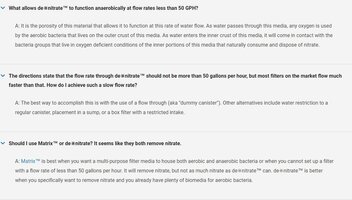
The gph flow rates mentioned have to do with Seachem making reference on their website about recommended GPH flowrates for nitrate reduction.

seachem.jpg

Pondguru pushes his Biohome series of bio-media and states with enough of it and with enough time, it will also support nitrate reduction.

Dr. Kevin Novak (who I learned about from coralbandit) has published a lot of stuff and videos on denitrification through anoxic filtration, in koi ponds, sumps and in tanks with low flowing UGF plenums.
and Link
 
  • Thread Starter
  • #26
cichlidude was trying to point out that a "full cycle", as pondguru describes, is having both aerobic and anaerobic bacteria colonize in the filtration system to reduce ammonia, nitrites and nitrates.

Most of us do not have "fully cycled" tanks because of the nitrates, hence we perform water changes.

The gph flow rates mentioned have to do with Seachem making reference on their website about recommended GPH flowrates for nitrate reduction.

View attachment 508342

Pondguru pushes his Biohome series of bio-media and states with enough of it and with enough time, it will also support nitrate reduction.

Dr. Kevin Novak (who I learned about from coralbandit) has published a lot of stuff and videos on denitrification through anoxic filtration, in koi ponds, sumps and in tanks with low flowing UGF plenums.
and Link

Thanks and good job. I knew this would spark discussion. Correct about the 'full cycle' thing. Many are not even close to a full cycle because of the items pointed out. It's tough to change but you have to start somewhere. All we are saying is changing your media may give you a leg up on the Nitrate issue.
 
I’m not sure it’s a goal worth chasing for me. I have a crowded cichlid tank. My tap produces an acceptable ph so I don’t need to worry about ph swings. It’s too easy to just change water. That being said, I just happen to have twice as much Matrix in My filter than my gallons require. There is also a pretty healthy sized net bag of large Fluval rings. The rings are wellculturedbut the Matrix has only been in there about 3 weeks.
 
  • Thread Starter
  • #28
I’m not sure it’s a goal worth chasing for me. I have a crowded cichlid tank. My tap produces an acceptable ph so I don’t need to worry about ph swings. It’s too easy to just change water. That being said, I just happen to have twice as much Matrix in My filter than my gallons require. There is also a pretty healthy sized net bag of large Fluval rings. The rings are wellculturedbut the Matrix has only been in there about 3 weeks.
Only 3 more months to go.
 
Only 3 more months to go.

So that’s how long it takes? There is a part I don’t understand. Do I need to stop doing water changes so that I have nitrates so that it will develop? ......or do I continue to do the changes until I have it?
 
  • Thread Starter
  • #30
So that’s how long it takes? There is a part I don’t understand. Do I need to stop doing water changes so that I have nitrates so that it will develop? ......or do I continue to do the changes until I have it?
It's called wait and monitor to see if it works. Keep doing your normal thing. I just posted what I am doing. You do whatever you want.
 
water changes won't reduce nitrates to 0, so if you have 40 ppm nitrates and do 50% water change, you'd still have 20ppm for the anaerobic bacteria.

it takes time for the bacteria colony to build up to sufficient levels to consume all the nitrates.
 

Advertisement


But no one seems to mention that plants - and algae - are amazing for nitrate removal!? Why bother with anaerobic bacteria - which is a PITA to set up - when you could just use plants to do the work for you?
 
  • Thread Starter
  • #33
But no one seems to mention that plants - and algae - are amazing for nitrate removal!? Why bother with anaerobic bacteria - which is a PITA to set up - when you could just use plants to do the work for you?
True. But I don't have any plants. And I'm pretty sure plastic plants won't work.
 
True. But I don't have any plants. And I'm pretty sure plastic plants won't work.
Sounds like you need to get to it then. All jokes aside, if you do have plants - or even terrestrial plants growing in a HOB or roots in water - it will help reduce nitrates within the aquarium.
 
  • Thread Starter
  • #35
Sounds like you need to get to it then. All jokes aside, if you do have plants - or even terrestrial plants growing in a HOB or roots in water - it will help reduce nitrates within the aquarium.
Agree, but I bet you 70% of the folks do not have plants. (better?)
 
Most aquatic plants prefer ammonia over nitrate for a food source.

Plants must expend energy to convert nitrates into ammonia as a source of energy.

Here is a table from this website, that lists plants that prefer ammonia as an energy source and those that prefer nitrates......

plants.jpg

That website I linked has a lot of good info about ammonia and nitrate conversion by plants. Very interesting is their discussion of fertilizer and other points of aquatic plants.

Here is a passage from the link "The nitrogen cycle is often presented incorrectly to hobbyists as nitrifying bacteria converting ammonium to nitrates and then plants taking up nitrates. Actually, it consists of both plants and bacteria competing for ammonium. Only if plants are forced to, will they take up nitrates. Thus, nitrates may accumulate even in planted ponds and aquariums."
 
Ok am I reading that the old standard of filtering your tank 8 to 10 times it’s volume an hour is wrong and we should now filter our tanks with the least flow rate and fill our filters with matrix and biohome? Or add this new system to our existing systems?
 
Ok am I reading that the old standard of filtering your tank 8 to 10 times it’s volume an hour is wrong and we should now filter our tanks with the least flow rate and fill our filters with matrix and biohome? Or add this new system to our existing systems?
Earlier in this thread it was explained that lower flow rates are already achieved due to the water not flowing through every pore evenly and most of it taking the path of least resistance. Plenums and deep sand beds are also ways to increase anaerobic bacteria.

Not to be forgotten with plants competing for ammonium with bb, is the fact that plants aren't converting the ammonium nor ammonia into nitrates either.
 
Well I don't really get all the things posted above. I get it but only to a point. My wee little brain gets all knotted up when I try to understand all the techie stuff!

What I do know is once my tanks are established I just take the dang filters off lol. I just stick to my plants to do that job
 
What I do know is once my tanks are established I just take the dang filters off lol. I just stick to my plants to do that job

you'll want to keep the filters, as the beneficial bacteria in the filter consumes the ammonia and nitrites. Plants will help a little bit with nitrates. And keep doing water changes.
 

Advertisement


I will be very interested to read the reports mentioned above.

All this talk about flow rate seems to be neglecting one thing. Flow rate in and out of the tank is not the same as flow rate across your media.

I have a 250 GPH pump pushing a four foot head into my oscar tank. But it's pushing that through a 3/4 inch pipe.

When that 250 GPH hits my sump it goes from a 1.25" drain pipe to a diffuser approximately 100 in square.

That means that the flow rate slows down by a huge Factor, as water goes across the media.


This is possible to achieve with an HOB filter, by putting an appropriately thick intake sponge of 30 PPI foam on the suction tube. This is reduces the flow considerably and at the same time adds about double to your bacterial Colony area. (Though it does nothing for the aerobic bacteria.)

I've been experimenting over the past year with various algae generators and live plant growth experiments.

I'm only having good results in the HOB filtered systems which have more: plants, algae generators, undergravel setups, and low stocking pressures etc.

But we have high nitrates and part of my motivation is to actually have the nitrates reduce when I put new water in the tank. I may have achieved some success at this on a very short-term basis but unfortunately my experiments are not well controlled.

I have 9 different tanks, in six different sizes with different filtration setups and different stocking in each one, so all my judgments and comparisons are going to be in necessarily subjective. But in general I believe that combination methods are the only good solution and that no one single method will suffice perpetually, and without water changes.

I have seen tanks which people claim have not had water changes for 6 months and they're perfectly healthy, but every one of those tanks uses the combination method of very low stocking plus lots of live plants.

When you look at them they are not basically fish keeping aquariums but they are mainly plant growing aquariums.
I think that's a multiple half measures kind of thing. If you go all in on the single measures it will work, but most people don't want to go through full measures.
 
you'll want to keep the filters, as the beneficial bacteria in the filter consumes the ammonia and nitrites. Plants will help a little bit with nitrates. And keep doing water changes.

Nope this is how I do it. I know most don't but it works for me.
 
88ssinit, no I don't think that was the point.

I think the original point of the post was to introduce concepts of nitrate reduction and start a general discussion.

The method introduced was using particular brands of media, and what the manufacturer suggested on how to use it for a particular purpose.

There are other ways for nitrate reduction, such as Dr. Novak anoxic filtration concepts, which does not use Matrix or Biohome.

CerMedia has a product called Marine Pure, which is a 8"x8"x4" block of ceramic bio-media used in dumps. They also claim it can support anaerobic bacteria for denitrification at very low flow rates.

DIY denitrification coils also use very slow flow rates.

None of these setups I don't believe are designed to be the sole filtration of a tank, but part of a system working together for overall filtration and to support a full nitrogen cycle
 
I have seen the Biohome vids before, but not the Dr Novak low-flow under-sand plus bypass skimmer idea.
I endorse his idea without having done it and here's why:

I did something similar for many years, without a canister, and it was my most successful tank so far, in terms of fish longevity.

I had tiny gravel and coarse sand over a regular UGF with one lift tube and a big powerhead. The powerhead bypassed by design, to allow both strong surface circulation with low UGF flow. The rest experienced a much reduced flow. I had Silver Dollars live up to 14 years and a Plecos for 13.

Those fish could have survived years longer too, but I went on vacation and our housesitter poisoned them with love.

After seeing the Novak vid it all makes total sense. Also I want that tank!

. . . multiple half measures . . .

Well you are absolutely right there. To me, it is the belt-and-suspenders road to success, if not the road of the Nirvanaquarist. But I do see that road now.
 
First, let me just say that I love Purigen. I had extensive BBA issues for **** near 2 years and tried every recommended approach I could; long black outs, huge and frequent water changes, big changes in lighting schedule and fert dosing routine. I even tried excel and peroxide spot treatments and picked up Flagfish. Nothing worked until I used Purigen. After about a week of use I saw a reduction in BBA and after about a month it was gone.
I read on another forum about a study that suggested that BBA feeds off of dissolved organics (they said B12, I have no idea of the accuracy of that) anywho, purigen removes dissolved organics (so they say) and my BBA issue disappeared.
Secondly I just see this as another excuse to heavily plant. Granted, I have a high-tech tank so I have to dose extra ferts but my nitrate is always low and I only have mechanical filtration (and my bag of purigen) in my filter. But really, we should all just heavily plant our tanks (low tech is easy and fun too!)
That being said I suppose that I could have anaerobic bacteria doing some of that work in my substrate as I have a custom soil mixture of about 60% clay (2") capped with sand at about 2". And no, I have not ever seen a gas pocket.
It's funny, watching that video made me test my tank, I have not done so for a very long time, this time I actually had some nitrates (5ppm). I don't know if that is from a recent rescape during my waterchange last week or if that is from those darned osmocote balls popping up all over my sand.
 
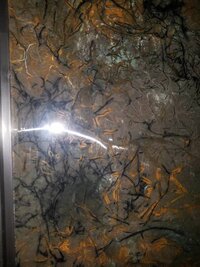
No one in my day to day life finds this interesting but perhaps someone here will (I found it very interesting), this is a picture of the underside of my tank. You can see how thick the clay is and can very clearly see the root systems of plants. I believe the discolorations are from root tabs and such.20181207_181525.jpg
 

Advertisement


Back
Top Bottom