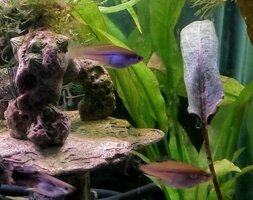
Signs are positive that she's a normal female. Some males will still try mating with 'transitional' or late-developing males, but in my experience most males do seem to know the difference. They'll treat them like they're gender-neutral, neither male nor female, until they're almost fully transitioned; at which time they'll start treating them like a rival male.
From the actions of your male, I'd tend to agree that it's a normal female. But as you'll eventually find out for yourself - being a specialist still doesn't guarantee that any given female is in fact going to be/remain a female, unless you've seen her produce fry (or have seen fry that you could be sure were hers.)
Swordtail males follow one of two paths from birth. Some mature very early and tend to remain small - I have some mature males that aren't much larger than a good-sized guppy, even with 300 gallons to grow into. Other males grow body-wise but don't sexually mature until much later, sometimes even as much as a year after birth - and those will look like females until they transition. Triangular analfin, sometimes even a definite gravid spot.
I'll apologize in advance for the poor quality of the pics - they're crops from larger ones where I was focused on the tank vs. the fish. Didn't realize I was going to have a transitional female-to-male in this group until after it happened. (This is from a year or so ago; I've had others since, but none that I'd documented as well before-and-after.)
View attachment 666573
Top in this pic is the 'female' that later transitioned. Bottom right in this pic is a female near the same age as the top one (and who by this point was definitely pregnant.) Not a lot of difference in body-shape between them, and you can see the darker line of a gravid spot on that top fish.
View attachment 666574
This pic just to show that it did start out with a normal female analfin, triangular.
View attachment 666609
View attachment 666610
In the above two pics, it still looks like a pregnant female, complete with gravid spot. But you can see the analfin has begun transitioning into a gonopodium, though there is no sword on the tail yet.
View attachment 666613
And then here, you can see that he has a full gonopodium by this point, and has begun growing a sword also. But aside from that, even at this point it still looks a lot like a pregnant female, otherwise.
It was about this point that I had to move him, because it was about this point that the resident male started treating him more like a male.
I still have him, he's out in the pool - I'll see if I can get a screen-grab from the camera out there sometime and update this post. He's one of the biggest males I have, as these late-developers usually are.
Some say that actual females can also transition to males, but I personally haven't seen it (haven't seen any fry that I could be 100% certain came from a 'female' that later transitioned to male.) I'm sure you'll see it happen yourself at some point, especially if you keep/raise your own offspring; it's not that uncommon.
By perfect I'm assuming you mean 0, 0, and under 40ppm for
ammonia,
nitrite and
nitrates respectively. Livebearers also prefer a higher
pH (7-8.4) and relatively hard water.
That said, even healthy swordtails do sometimes keep their fins a little clamped, dorsal fin especially; because they also use them to signal one another. Your subordinate female(s) will at times drop their dorsal fin around the alpha female, to indicate submission; keeping it raised is part of a challenge for position.
Males also at times keep their dorsal fin down, when not actively courting a female or challenging another male. And females that are nearing birth or giving birth will often have their fins clamped, staying in a particular spot or even hiding.
Generally, the time to worry is if they aren't enthusiastic about being fed (other than a heavily pregnant female nearing/giving birth, during that time some of them also may not eat for a day, even two days.) I haven't met a swordtail yet that wasn't a chow-hound, wasn't always looking for food even if you just fed them.