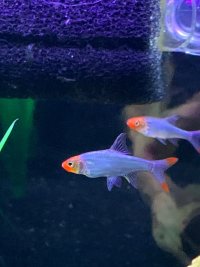
Rummynose Rasbora
(Sawbwa resplendens)
Common names: Rummynose rasbora, Asian rummynose, Sawbwa barb, Naked micro rasbora.
Size: 4cm
pH: 7.0 – 8.0
Tempº: 21ºC - 25ºC
Tank region: All layers
Origin: Endemic to Lake Inle, in Burma.
Gender: Males have a blue and red body, females are all silver. Females aren’t always imported, as they are not as colorful as males.
Notes: A beautiful, if slightly unusual cyprinid the Rummynose rasbora is not related to the Rummynose tetras as they are cyprinids – coming from asia rather than South America/Africa. These fish have unusual requirements for Rasboras – as they don’t enjoy temperatures at the warmer end of the Tropical temperature scale and don’t do well in acidic conditions. This is because they are endemic to Lake Inle (which is located in Burma) which lies of calciferous rock, making it more alkaline than most Rasbora habitats.
These fish can be somewhat difficult to find in shops, and when they are found they are often fairly expensive. Rummynose Rasboras will take almost any foods offered, and are omnivorous. As with all similar fish, they need a school of at least 5-6 individuals to thrive, and enjoy lots of plant cover. It is not recommended that they are kept with much larger tankmates, as they can be outcompeted and intimidated by them. They are very peaceful, and best kept with other tiny species who have similar requirements.