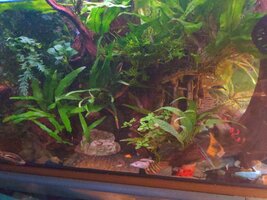
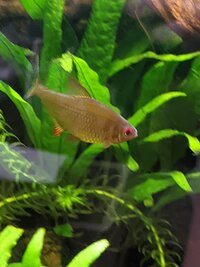
50 Gallon Tank Lone Bolivian Ram harrassing and killing tankmates

Fae

Active Member
Member
Messages
455
I have a 48 long with dwindling stock. I've been super busy the last couple months, so haven't been paying as much attention to my tank. I had added 5 Bolivian rams a year ago, and I'm down to one. The biggest one. I saw them bully each other, but it was always reciprocal (except for the smallest, the rest were similar in size) so I never expected that it was one major aggressor. The tank itself is heavily planted with lots of sight breaks, this is it (recently thinned some plants though):
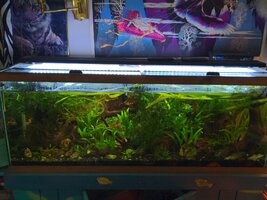
16722809804792699003217016831653.jpg
It's tough to really see it in this picture, but there's a ton of hiding spots and well defined territories, I used a lot of driftwood.

Last night I found my honey gourami dead, presumably murdered as she was quite healthy. Suddenly all the fish deaths I've had lately start to make sense. There is endemic mycobacteria in my tank, so stress/age/weakness is always exasperated by that. I've witnessed the slow decline of some of the lemon tetras who had the disease and eventually euthanized them, so I just assumed I was losing fish to the same thing despite how random it seemed. In hindsight it should have been obvious.

Most of my time observing my tank lately has been during feeding time, so I never really noticed this aggressive behaviour towards non-species tank mates, since the other ram was killed only a month or two ago. I sat and observed for some time today and I noticed he is targetting and attacking the lemon tetras pretty consistently. It appears as though the whole tank is his territory. The cories and otos are left alone, and the embers are small fry I guess who are only worthy of his attention if they're the only ones around and close enough to dart at easily. He is definitely going out of his way, checking corners and hides looking for the lemons. Luckily they are the same size as him, and can hold their own for the most part (he killed any weaker ones).

Current stocking is now one bully Bolivian Ram, 4 lemon tetras (1 red variant who's strong af and the dominant of the lemons), 5 ember tetras, like 8 probably bronze/Venezuelan cities, 3 oto cats, and ?? Cherry and Amano shrimp. He has murdered 4 other bolivians, 2 (teenage) honey gouramis, 7 embers, and assisted 2-4 lemons into an early grave if not murdered outright. I see him look at the cories like he wants to go for it but I assume he's tried and learned his lesson cause he never does, lol.

My original plan with this tank was to let the lemons die out naturally (the oldest of them were coming up on 4 years old), have a big school of around 20 embers, 2-4 Bolivian rams, 3-4 honey gouramis, stick with current Cory numbers and add about 7 more otos. But now I'm starting to think this won't be possible.

Basically the main thing I'm wondering here is if the ram I have is unusually aggressive? I'm not sure of the male/female ratio of the original 5, but none of them ever paired off. I wanted Bolivian rams for years before finally getting them last year, and I would hate to have to give them up entirely. I'd be open to trying a different batch and rehoming this one, but it's really expensive for me to get more Rams since nowhere in town stocks them. So if this is common behaviour, maybe they're not for this tank.
 

Advertisement
First of all: Dwarf cichlids, no matter what genus or species do not just kill tetras and gourami except when breeding in a much too small tank where the tetras can't evade the cichlids. And Mikrogeophagus altispinosus are one of the species absolutely least to do that. Among each other all dwarf cichlids are able to simply stress out one individual that didn't get a territory for itself that it succumbs to stress related bacterial infections.
Some chasing is to be considered normal when it comes to other fish, but what you describe is unlikely, bordering to impossible.


I see some other possible things and red flags though:
I've been super busy the last couple months, so haven't been paying as much attention to my tank.
You are absolutely sure you didn't just miss signs?
My original plan with this tank was to let the lemons die out naturally (the oldest of them were coming up on 4 years old)
Tetras don't get very old. For them it might have just been time.

Also honey gouramis are among the overbred, mass produced species. Sudden deaths are possible.

So if you can: Post pictures of your fish. If there is any kind of disease or parasite going round killing off stressed or immuno-compromised fish this would be obvious very quickly from pictures.

Baseline: I highly doubt the fish you blame it on is a killer. Rather expect a less dramatic or even unrelated reason.
I'm honestly considering the possibility that you might not have Mikrogeophagus altispinosus after all.
 

Advertisement
  • Thread Starter
  • #3
First of all: Dwarf cichlids, no matter what genus or species do not just kill tetras and gourami except when breeding in a much too small tank where the tetras can't evade the cichlids. And Mikrogeophagus altispinosus are one of the species absolutely least to do that. Among each other all dwarf cichlids are able to simply stress out one individual that didn't get a territory for itself that it succumbs to stress related bacterial infections.
Some chasing is to be considered normal when it comes to other fish, but what you describe is unlikely, bordering to impossible.


I see some other possible things and red flags though:

You are absolutely sure you didn't just miss signs?

Tetras don't get very old. For them it might have just been time.

Also honey gouramis are among the overbred, mass produced species. Sudden deaths are possible.

So if you can: Post pictures of your fish. If there is any kind of disease or parasite going round killing off stressed or immuno-compromised fish this would be obvious very quickly from pictures.

Baseline: I highly doubt the fish you blame it on is a killer. Rather expect a less dramatic or even unrelated reason.
I'm honestly considering the possibility that you might not have Mikrogeophagus altispinosus after all.

Hi macz, thank you for the response to this.

Dwarf cichlids, no matter what genus or species do not just kill tetras and gourami

I know this is the common wisdom, but I have definitely observed patterns of intentional territorial (the entire tank being the territory) aggression throughout the year I've had this ram. I will see if I can get a short video of what I mean and post it after this.

Among each other all dwarf cichlids are able to simply stress out one individual that didn't get a territory for itself that it succumbs to stress related bacterial infections


This could be the case, but the problem seems to be then that the entire tank is considered territory for the one ram. before the others died, I would frequently witness this one chasing the others on any given side of the tank. There is tons of room for multiple territories but he seems to enjoy being the big man, if you know what I mean

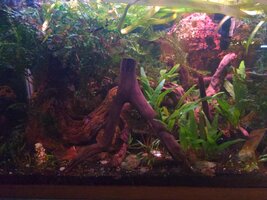
16738520172578750416412726553966.jpg16738520931343626310569830814279.jpg16738521443355639077412076715756.jpg

There is space galore for more than one territory, it's tough to get a sense of depth from the photos but there's tons of little hidden "pathways" between the plants and structure, all the other Rams were content with the amount of space and territories. The tank is 4ft x 13in btw.

You are absolutely sure you didn't just miss signs?

Yes, the honey was my favourite. I also have a personal rule of counting my fish at least every couple days and specifically looking for the honey at least every day. This is because I've had bad luck with honeys that aren't the brightest I guess, I've lost I think 5 honeys to getting stuck in dumb places. Their curiousity is endearing, but I've had to rescue them from the most ridiculous tight spots. So I paid particularly close attention to her. She had zero signs of illness, always fed readily, zero bloating, etc. There's lots of plant cover near the top that she would often hang out in. And I had seen her rushed by the ram before, but didn't realize it could be happening so much that it would cause that much stress. I suppose there's a chance that she could have died from stress and a related bacterial infection, but generally when that happens in this tank there is common signs of infection (due to the endemic mycobacteria being the consistent killer) namely internal bleeding/bruising showing as dark spots and a distended abdomen with slight wasting. Also, that would still leave the culprit as the ram.

Tetras don't get very old. For them it might have just been time.

Yes, I believe it was you who initially told me this in a previous post. That's why I wasn't as concerned when I started losing more lemons and was content to let them slowly die out naturally. My main concern now is that with dwindling numbers and the lone ram having no other targets is that they will be harassed into an early grave. The remaining 4 are only about 2.5 years old, with one being 1 year old and born in the tank. I'd really hate for him to be killed (or harassed to death) as he's the red guy and I have soft spot for him (thankfully he's the most dominant so it's unlikely).

Also honey gouramis are among the overbred, mass produced species. Sudden deaths are possible

I had no idea about this, interesting. That makes sense honestly, I love honeys but I've had probably 12 of them in the 3 years I've been keeping fish because I just can't seem to keep them alive.

So if you can: Post pictures of your fish. If there is any kind of disease or parasite going round killing off stressed or immuno-compromised fish this would be obvious very quickly from pictures

I can already tell you confidently that my tank has endemic mycobacteria and thus all fish could be considered immunocompromised. I know this from ending up with fish handlers disease on my hands when I was dumb and did a bunch of tank maintenance with fresh tattoos on my hands doctor confirmed and was easily treated, but it makes sense with the patterns of disease I see in my fish unfortunately. I've come to terms with it as research seems to indicate it's very common (up to 40% of aquarium fish having it) and nearly impossible to kill. It only takes hold in stressed fish, but I didn't think it could kill so quickly and without any clinical signs (the lemons degrade slowly over about 2 months or more, but I suppose it could be that age lowered their immune systems rather than stress so they were able to fight it off for longer).

I'm honestly considering the possibility that you might not have Mikrogeophagus altispinosus after all.

I am almost 100% positive the fish I have is correctly identified as it came from a very reputable fish store that has an outstanding reputation in my province, but I will see if I can get a good picture for you:

PXL_20230116_073153166_exported_0_1673854486059.jpg

And this is an older photo from around a month after they were added to the main tank, not sure if it's the same fish.
PXL_20220715_024625827.MP.jpg

I know that in full-size cichlids it can be a problem with random fish just being intolerable jerks. Idk if that's very common amongst dwarves, but I'm hoping if I were to add more that were closer in size to this one it would help.
 
It's definitely a bolivian ram. I'm afraid that I don't have any experience with them or really that much experience with dwarf cichlids in general. I've had quite a few other cichlids and I think that once a jerk always a jerk usually rings true. Plus you now have a situation where he has made himself king of his castle and any new introductions are unlikely to be treated in a friendly manner. The other issue you have is that, if the tank contains mycobacteria, you really shouldn't be rehoming him. That leaves euthanasia as the only option if he is going to continue to kill his tankmates. That is unless you want to change course and introduce more robust, semi-aggressive tankmates that can stand up for themselves.
 
I really think the Mycobacteria might be the main cause rather than the Ram. I've also struggled with Mycobacteria in past years, and found there were just some species of fish that were more sensitive to it than others, and I too would have the slow gradual loss of fish. But I had a completely peaceful tank, with no semi-aggressive or aggressive tank mates to blame. Some fish species are just more susceptible to it than others. My Corycats and Harlequin Rasboras thrived, for example. But gradually I lost all the Rainbowfish I tried to put in the tank, and any I added in to try and replace the school numbers also died. Eventually I learned what types of fish did well in the tank despite the mycobacteria and which would gradually die out, and I adjusted my stocking plan accordingly. Slow, awful attrition of sensitive species was the hallmark of Mycobacteria in my tank. And I think that's what you're describing in yours - you lose most of 1 species, and then most of another species, and so on, while some fish that are hardier against the disease are doing just fine and breeding and thriving. I would stop trying to put in any more Lemons, Honeys, or Embers and just accept that those won't do well with a Mycobacteria tank. I personally think you'll likely lose the last Bolivian to it eventually as well, and that you lost the others at least partially because of the Mycobacteria rather than bullying, since Bolivians are known to do okay in groups.

My current tank doesn't have mycobacteria, and I have a community including a Bolivian Ram, 3 Honey Gourami, Corycats, Rasboras, Cherry Barbs, and a Dwarf Pleco. My Bolivian is definitely a loner. If a fish starts to follow him around, he will charge at them. But he's never made contact or done any damage to the other fish whatsoever in the few years I've had him. And everyone is completely unimpressed with his charging and clearly aren't afraid of him. He's like that grumpy old man who yells "get off my lawn!" that the kids saunter away from while rolling their eyes.
 
Some fish species are just more susceptible to it than others. My Corycats and Harlequin Rasboras thrived, for example. But gradually I lost all the Rainbowfish I tried to put in the tank, and any I added in to try and replace the school numbers also died. Eventually I learned what types of fish did well in the tank despite the mycobacteria and which would gradually die out, and I adjusted my stocking plan accordingly.
What other types of fish did you find resistant to it? I also had an outbreak amongst my rainbowfish a few years ago. The survivors are gradually dwindling and at some point I need to decide what to replace them with. I assume that the bacteria is still present in my tank.
 

Advertisement
  • Thread Starter
  • #7
I really think the Mycobacteria might be the main cause rather than the Ram. I've also struggled with Mycobacteria in past years, and found there were just some species of fish that were more sensitive to it than others, and I too would have the slow gradual loss of fish. But I had a completely peaceful tank, with no semi-aggressive or aggressive tank mates to blame. Some fish species are just more susceptible to it than others. My Corycats and Harlequin Rasboras thrived, for example. But gradually I lost all the Rainbowfish I tried to put in the tank, and any I added in to try and replace the school numbers also died. Eventually I learned what types of fish did well in the tank despite the mycobacteria and which would gradually die out, and I adjusted my stocking plan accordingly. Slow, awful attrition of sensitive species was the hallmark of Mycobacteria in my tank. And I think that's what you're describing in yours - you lose most of 1 species, and then most of another species, and so on, while some fish that are hardier against the disease are doing just fine and breeding and thriving. I would stop trying to put in any more Lemons, Honeys, or Embers and just accept that those won't do well with a Mycobacteria tank. I personally think you'll likely lose the last Bolivian to it eventually as well, and that you lost the others at least partially because of the Mycobacteria rather than bullying, since Bolivians are known to do okay in groups.

My current tank doesn't have mycobacteria, and I have a community including a Bolivian Ram, 3 Honey Gourami, Corycats, Rasboras, Cherry Barbs, and a Dwarf Pleco. My Bolivian is definitely a loner. If a fish starts to follow him around, he will charge at them. But he's never made contact or done any damage to the other fish whatsoever in the few years I've had him. And everyone is completely unimpressed with his charging and clearly aren't afraid of him. He's like that grumpy old man who yells "get off my lawn!" that the kids saunter away from while rolling their eyes.

I really appreciate your comment- I've never actually talked to anyone else who's had to deal with mycobacteria (knowingly at least).

Seems like we have similar taste in fish. Honeys are just so cute, but you're right I should probably accept they just aren't hardy enough my situation. And I'd reckon you're correct about the bolivians as well... Lame D;

The lemons have actually thrived this whole time, they are only just dying out now at 4+ years old. They were the first fish I got when I was first starting out, and they've for the most part all lived full happy lives with almost no losses until recently. They used to breed all the time when they were younger, and they even made a baby who survived by hiding in the plants and is now my super cool red variant lemon:
PXL_20220728_004750181.PORTRAIT.jpg

Same with both types of cories (bronze and Venezuelan), also knock on wood but the otos seem to be doing amazing too despite their reputation for being sensitive.

I will have to look at Harlequins, as I'd really like a large school of nano fish that thrives. Can I ask what your ph/gh/kh was? And also I'm curious if you had to nuke everything to get rid of the mycobacteria?

GlennO have you looked into UV sterilizing at all? I'm only just in the financial position to even consider dropping that kind of money on my tanks, but it seems like it's fairly effective from what I remember of the TF magazine article.
In my experience anbantids haven't done well, and celestial pearl danios didnt either. didn't have great luck with live bearers either. The lemons and the cories/otos seem to be the only consistently hardy fish in my case.
 
Hi Fae, yes I used a UV sterilizer for about 12 months after the initial outbreak and it seemed to help. Since then extra-large weekly water changes have been my main management tool. I also value hearing of other people’s experiences with it and it seems to me that hardwater fish such as rainbowfish and livebearers are particularly susceptible to mycobacteria whereas blackwater fish such as tetras and rasboras are more resistant. About six months ago I added some rummynose tetras to the tank and they are doing fine so far. I only have a couple of the original rainbowfish left and when they are gone I think I’ll add some other species of tetra or perhaps rasbora.
 
I had good luck with Cardinal Tetras, Black Neon Tetras, Gold Tetras, and a Bristlenose Pleco in the mycobacteria tank. Plus the Harlequin Rasboras and Panda Corydoras I've already mentioned. I struggled with Rainbowfish the most, but Gourami didn't do too well either. The tank had 6.4 pH, 8 dGH, 74 degrees F. The water was tannin stained.

I ended up having to downgrade in apartment size and rehomed the entire 75 gallon, so I was never actually able to find a way to remove the Mycobacteria permanently from the tank. The reason I don't have mycobacteria in my current 40 gallon is that I had to start all over from scratch after I'd moved.
From the research I did when I had the 75 gallon, the best that could be expected was to use an ultraviolet sterilizer to keep the amount of mycobacteria in the water column down, but it would still be present in the bodies of the fish in small concentrations and so you'd never be completely rid of it. The current fish could spread it to their new tankmates if you added fresh fish to the tank. I think I remember reading the Mycobacteria can even be spread by aquarium equipment like nets and water vacuums. I tried to keep the aquarium in a quiet place with very peaceful tankmates, large weekly water changes, and conditions close to what they would have in the wild to keep everyone as stress free as possible. But a lot of it did seem to come down to species susceptibility anyway.
 
  • Thread Starter
  • #10
Seems like it's fairly ubiquitous in the environment, and it's only when stressed that it can become a problem- then once it's taken hold, it can become deadly and pass amongst fish.

Sort of like if you have one moldy berry in a pack, it will spoil the rest before they would have naturally. But the mold is always present regardless
 

Advertisement


Back
Top Bottom