40g cube planted walstad ideas

Boltaction

New Member
Member
Messages
49
Hi Fishlorer’s,

I took the plunge and bought my second tank… I think it’s safe to say I’m obsessed lol

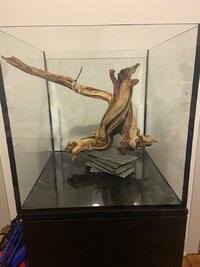
It’s a 40g cube. I’ve read some of Diana Walstad’s book and I’ve been wanting to attempt her method, with some minor differences. I’m just wondering if it’s a good idea with this tank.

I was thinking of using an organic top soil with a gravel/sand cap. Then heavily planted with the driftwood piece shown in the photo. I’ve heard some conflicting things when it comes to filtration, but it seems like it would be safer to have a bit of supplemental filtration. Maybe a 20 gallon HOB?

For the fish, I would like to keep a group of Apistogramma maybe 4-5. My concern is the bio load from the fish. I know in theory the ammonia from fish waste and extra food will be taken up by the plants and I shouldn’t need any other filtration. Would using a filter potentially stunt plant growth if the filter bacteria eat all of the ammonia/nitrogen?

Any suggestions are welcome!
 

Attachments

  • 44ED5A7A-4A80-4240-9E14-FAB36056B467.jpeg
    44ED5A7A-4A80-4240-9E14-FAB36056B467.jpeg
    134.8 KB · Views: 180

Advertisement
I don't have advice, but I can share my small bit of experience. I have a 55 with soil from my yard, capped with sand from my stream. My yard leans toward heavy soil with lots of red clay in it. I soaked and rinsed the soil several times over about a week outside before using. Aiming for heavily planted, but the plants are still mostly small/new, plus about four larger plants and a good chunk of floating hornwort. I have a HOB with foam in it and a pre-filter sponge.

I ran the tank for over a month before fish. It's had fish for about six weeks now (peacocks and mbuna). Ammonia and nitrite stay 0, but nitrates seem high... over 20, often over 40. I'm doing weekly or twice weekly water changes. I'm probably slightly overstocked, but I also think the soil must have something to do with it. My other planted tanks have just gravel, no soil or sand, and I'm lucky if nitrates go above 5 even after three weeks without water changes.

Biggest difference, though, is how much gunk gets stirred up every time I move something, add a plant, or add water during water changes. It gets murky for about an hour, and the pre-filter sponge gets really gunked up with what's basically mud. My sand cap is an inch to inch and a half thick. I'm trying to up mechanical filtration to deal with this. Not sure if this will calm down eventually, if I should use a thicker sand cap, or if I just need to get used to it!
Good luck with yours. It's definitely a fun experiment.
 

Advertisement
What I would do. Is have a DIY under-gravel filter One or two Internal filters (They are cheap and do the job). Plant with stemmed plants first and then the others secondary. This is the under gravel I put into my 150g, made from irrigation hose. 13mm driven by an air pump. I can supply more details if you like.
I have been doing natural build tanks for twenty years. I joined a Forum site and they said that it was Walstad. I said really who is that!! Walstad keeps popping up, I just do what I know works, completely naturally.
 

Attachments

  • 20211116_183220.jpg
    20211116_183220.jpg
    184 KB · Views: 82
The filtration part isn't debated that much. Well, perhaps by those who've read the book and stopped being critical from there on. Seems to be a human thing.... ;)

I think the most debatable part is the effectiveness, and therefore need, for a cellulose rich substrate.

Anyways, the reason ms Walstad did not want to use a filter initially was to prevent CO2 off-gassing.

She uses filters herself nowadays too. Not to stimulate growth of filter bacteria that eat ammonia/nitrogen, but to welcome heterotrophs in the filter, thereby keeping the water column crystal clear.

In nature, there are ammonia eating bacteria in the soil and plants still seem to be able to grow. Guess what, ammonia eating bacteria live in your substrate also. Especially if the substrate is rooted. Filter or no filter.

I run several mechanical filter-less planted tanks. The only issue I run into is biofilm (a large community of all sorts of bacteria) on the water surface. "Beneficial bacteria" love oxygen and there's plenty of that just above the water line. This is bad for life below the water surface, so I use a tiny air tube, releasing only one or a few bubbles per second (depending on tank size), to keep the water surface crystal clear.
 
The only reason I use filtration is for gas exchange it is most important to move the water from the bottom of the tank to the top.
 
  • Thread Starter
  • #6
I don't have advice, but I can share my small bit of experience. I have a 55 with soil from my yard, capped with sand from my stream. My yard leans toward heavy soil with lots of red clay in it. I soaked and rinsed the soil several times over about a week outside before using. Aiming for heavily planted, but the plants are still mostly small/new, plus about four larger plants and a good chunk of floating hornwort. I have a HOB with foam in it and a pre-filter sponge.

I ran the tank for over a month before fish. It's had fish for about six weeks now (peacocks and mbuna). Ammonia and nitrite stay 0, but nitrates seem high... over 20, often over 40. I'm doing weekly or twice weekly water changes. I'm probably slightly overstocked, but I also think the soil must have something to do with it. My other planted tanks have just gravel, no soil or sand, and I'm lucky if nitrates go above 5 even after three weeks without water changes.

Biggest difference, though, is how much gunk gets stirred up every time I move something, add a plant, or add water during water changes. It gets murky for about an hour, and the pre-filter sponge gets really gunked up with what's basically mud. My sand cap is an inch to inch and a half thick. I'm trying to up mechanical filtration to deal with this. Not sure if this will calm down eventually, if I should use a thicker sand cap, or if I just need to get used to it!
Good luck with yours. It's definitely a fun experiment.
Thanks for sharing your experience! I’ll keep that in mind. Seems like a small filter shouldn’t be a problem
What I would do. Is have a DIY under-gravel filter One or two Internal filters (They are cheap and do the job). Plant with stemmed plants first and then the others secondary. This is the under gravel I put into my 150g, made from irrigation hose. 13mm driven by an air pump. I can supply more details if you like.
I have been doing natural build tanks for twenty years. I joined a Forum site and they said that it was Walstad. I said really who is that!! Walstad keeps popping up, I just do what I know works, completely naturally.
Are you using soil with your under gravel filter? I’m thinking it might not work with what I have planned, soil with a sand cap. But internal filters may be a good solution
The filtration part isn't debated that much. Well, perhaps by those who've read the book and stopped being critical from there on. Seems to be a human thing.... ;)

I think the most debatable part is the effectiveness, and therefore need, for a cellulose rich substrate.

Anyways, the reason ms Walstad did not want to use a filter initially was to prevent CO2 off-gassing.

She uses filters herself nowadays too. Not to stimulate growth of filter bacteria that eat ammonia/nitrogen, but to welcome heterotrophs in the filter, thereby keeping the water column crystal clear.

In nature, there are ammonia eating bacteria in the soil and plants still seem to be able to grow. Guess what, ammonia eating bacteria live in your substrate also. Especially if the substrate is rooted. Filter or no filter.

I run several mechanical filter-less planted tanks. The only issue I run into is biofilm (a large community of all sorts of bacteria) on the water surface. "Beneficial bacteria" love oxygen and there's plenty of that just above the water line. This is bad for life below the water surface, so I use a tiny air tube, releasing only one or a few bubbles per second (depending on tank size), to keep the water surface crystal clear.
Thanks for the info! I think I’ll go with a small HOB to start, and maybe add a bubbler on the opposite side.
 
Typically a hob doesn't keep the water surface clean, especially is the water level is below the outlet of the hob. But this is just my personal experience. Perhaps you are able to keep the water surface clean with a hob.

If not, a bubbler would make a great addition. Where you place it, it doesn't matter.

For other purposes of the hob, it's basically up to you. Is does more good than bad (CO2 off-gassing) in my opinion. It might even benefit CO2 concentrations. I've given up on figuring this out. I've read the arguments from all sides.

I run healthy planted tanks (with minimal fish), with or without mechanical filters. And with nothing but sand substrate, by the way. So in no dire need to get this solved.

Good luck with your project.
 

Random Great Topic!

Advertisement


Advertisement


Advertisement


Back
Top Bottom