Stunted angelfish? Help please!

Lexiomibjj

Active Member
Member
Messages
83
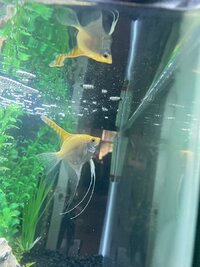
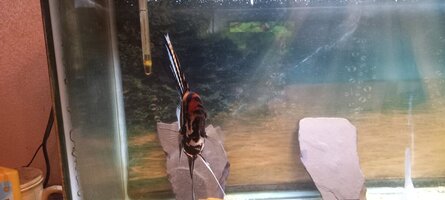
Hello all, I have an angelfish in my 20gal tank, (quarantine tank).
Can you tell if it is stunted? I got it from the pet store like this.

I think it looks ok but just trying to make sure it’s healthy :)
 

Attachments

  • image.jpg
    image.jpg
    205.4 KB · Views: 284
  • image.jpg
    image.jpg
    180.6 KB · Views: 145

Advertisement
Most fish sold are juviniles, so they aren't at their adult size yet. I don't keep angelfish, but the fish looks okay to me.
 

Advertisement
I also see no growth problems. Pretty normal looking.
 
  • Thread Starter
  • #4
I also see no growth problems. Pretty normal looking.
Ok! Thank you guys so much. Some of the other fish at my lfs looked pretty stunted so I was trying to get opinions on this little guy
 
Some of the other fish at my lfs looked pretty stunted so I was trying to get opinions on this little guy
Do you know what species and describe it? It's possible they aren't stunted or something else is wrong.
 
Thats a very normal perfect looking juvenile non-fancy (non veil) angel. I say this because of the ratio of fin/body height, as they grow older the body will become a larger part of that ratio.
 

Advertisement
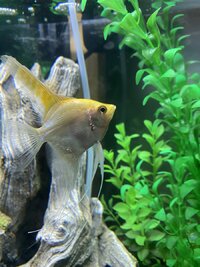
its eyes might be a little large for it's size, but there's nothing obvious at this stage of development indicating stunting. the ventral fins are long and if stunted young, they tend to stay shorter than the analfin.

it wouldn't be a size of tank or water quality issue here though, but could be an underfeeding issue and could be caught up I think if the eye seems a little larger than it should be. I find it acceptable overall and a nice example of a gold.

it's posturing like a male in these pictures, it's not 100% until maturity of course.
 
  • Thread Starter
  • #8
its eyes might be a little large for it's size, but there's nothing obvious at this stage of development indicating stunting. the ventral fins are long and if stunted young, they tend to stay shorter than the analfin.

it wouldn't be a size of tank or water quality issue here though, but could be an underfeeding issue and could be caught up I think if the eye seems a little larger than it should be. I find it acceptable overall and a nice example of a gold.

it's posturing like a male in these pictures, it's not 100% until maturity of course.
Thank you!
 
  • Thread Starter
  • #9
its eyes might be a little large for it's size, but there's nothing obvious at this stage of development indicating stunting. the ventral fins are long and if stunted young, they tend to stay shorter than the analfin.

it wouldn't be a size of tank or water quality issue here though, but could be an underfeeding issue and could be caught up I think if the eye seems a little larger than it should be. I find it acceptable overall and a nice example of a gold.

it's posturing like a male in these pictures, it's not 100% until maturity of course.
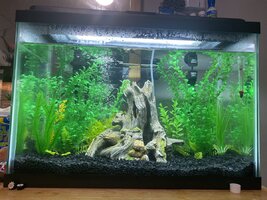
You seem to know your angels pretty well. Could I be alright to end up keeping my angel in the 20gal? He’s by himself and I don’t think I can add other fish, since he takes up the tank. If the tank gets too small, obviously he’ll get a bigger one. But could he be ok in this tank? And could I add something small like a few tetras?
(You can’t see him because he’s swimming behind the rock)
 

Attachments

  • image.jpg
    image.jpg
    272.7 KB · Views: 120

Advertisement


In all honesty, gold angels grow up to 10" / 25cm in height, a standard 20g tank has a height of 16" / 40cm. I personally wouldn't keep them in anything below 19.5" / 50cm, better yet 23.5" / 60cm of height. A tank for growing them is a different story or course.
 
You seem to know your angels pretty well. Could I be alright to end up keeping my angel in the 20gal? He’s by himself and I don’t think I can add other fish, since he takes up the tank. If the tank gets too small, obviously he’ll get a bigger one. But could he be ok in this tank? And could I add something small like a few tetras?
(You can’t see him because he’s swimming behind the rock)

Look. It would benefit from having more room to move around and interact with other fish. Yes, it won't get stunted in a 20 gallon by itself if you are doing water changes regularly, and it will remain healthy also if you are keeping nitrates low, and grow if you feed good, but the fish won't have space to swim around much as an adult and when spooked, it will slam into the glass.

You "can" do it, I get away with a breeding pair in a 20g by themselves and the male is huge, they spend their time basically on top of each other, side by side or sparring between breeding in prep to breed again. It can work in a situation like that and the 20g has no effect on spawn size or frequency.
They have their spawn area (the tank) and they have each other for mental stimulation and interactions, they are very used to me cleaning and water changing all the time, they don't spook becuase I do it so frequently. If they were to break apart as a pair, the male is going to get killed though, and if he doesn't he's going to have to kill her. So one is going to die if the pair breaks up for some reason unless to get to it in time.

With 1 adult angel you can't have other fish with it in a tank that small, except in that one circumstance of a breeding pair, you'll understand why when it grows up. Its not going to be able to hide, it's going to dominate the tank and be more visible than the tree ornament the you have in the center no matter where it is.

Would I recommend keeping a single angelfish for the happiness of the fish? No. They are schooling and shoaling type of fish, they like a group, they like to fight, and lead the group, and like to follow the group, and other dominant angels like to form their own group and the groups interact and join or break off, and they benefit greatly by being kept in a group or a pair, and not solitary. It's their nature to live in this manner, and yes, fight to show strength for control.
A solitary angel is bored, and going to likely be depressed even kept with other species of fish, angels stick to angels.

I've never seen a scalare gold get to 10" or any other scalare. 8"+ yes in some instances with a dominant fish, 6"+ is more of the average for subordinates and females. There's exceptions I'd suppose 10" is a possibility, but it would be exceptional for a scalare.

He's actually small right now, comparing the first pictures to the tank picture and assuming he was in the front and the tree ornament towards the back, he's got a quarter size body, maybe a little bigger. He's going to have a half dollar size body and then silver dollar size body roughly plus the fins 6+ inch from dorsal to analfin in height 5+ inch from nose to tail. They eventually fill out in body mass and thickness as an adult from 1/4" to 3/4" depending on sex and feeding frequency.

For now the 20g is ok for this fish by itself, but its never ideal for the angel as far as happiness. but if I could give you some advice, I'd think about a 55g minimum for a group of 6, and keep the 20g if there's a pair that forms from this group to move the pair to. this will leave you with 4 in the 55g and two that can breed in the 20g. If all males in the 55g, then you can add other fish, tetras, cories, ect.and have the little pack of angels and likely everyone happy.
I won't lie though, pairs forming is rough also. People don't expect what happens when angels mature and a female is in the group so fair warning. It becomes a war zone and the female has to be separated, and best if you can identify her chosen partner and move them both to get a breeding pair, but you can move a female and try different males and see if she will pair with them also.
It's hard work with angels. And it's a learning experience. They aren't the most peaceful, maybe the most graceful, and the most innocent looking, but they are devils when they mature. Kind of have to have your wound care methods and plans down, or you may lose fish from injuries and infections.

The tank isn't a good fit for an angel becuase they should be kept with other angels. Up to you what you decide to do from here but as it grows and sits there bored, you'll come to this conclusion also that a larger tank could be an answer, but it will also need a couple friends.

It's not, let's say, and easy beginner community fish. It starts easy, it gets harder as they mature.
 
  • Thread Starter
  • #14
Look. It would benefit from having more room to move around and interact with other fish. Yes, it won't get stunted in a 20 gallon by itself if you are doing water changes regularly, and it will remain healthy also if you are keeping nitrates low, and grow if you feed good, but the fish won't have space to swim around much as an adult and when spooked, it will slam into the glass.

You "can" do it, I get away with a breeding pair in a 20g by themselves and the male is huge, they spend their time basically on top of each other, side by side or sparring between breeding in prep to breed again. It can work in a situation like that and the 20g has no effect on spawn size or frequency.
They have their spawn area (the tank) and they have each other for mental stimulation and interactions, they are very used to me cleaning and water changing all the time, they don't spook becuase I do it so frequently. If they were to break apart as a pair, the male is going to get killed though, and if he doesn't he's going to have to kill her. So one is going to die if the pair breaks up for some reason unless to get to it in time.

With 1 adult angel you can't have other fish with it in a tank that small, except in that one circumstance of a breeding pair, you'll understand why when it grows up. Its not going to be able to hide, it's going to dominate the tank and be more visible than the tree ornament the you have in the center no matter where it is.

Would I recommend keeping a single angelfish for the happiness of the fish? No. They are schooling and shoaling type of fish, they like a group, they like to fight, and lead the group, and like to follow the group, and other dominant angels like to form their own group and the groups interact and join or break off, and they benefit greatly by being kept in a group or a pair, and not solitary. It's their nature to live in this manner, and yes, fight to show strength for control.
A solitary angel is bored, and going to likely be depressed even kept with other species of fish, angels stick to angels.

I've never seen a scalare gold get to 10" or any other scalare. 8"+ yes in some instances with a dominant fish, 6"+ is more of the average for subordinates and females. There's exceptions I'd suppose 10" is a possibility, but it would be exceptional for a scalare.

He's actually small right now, comparing the first pictures to the tank picture and assuming he was in the front and the tree ornament towards the back, he's got a quarter size body, maybe a little bigger. He's going to have a half dollar size body and then silver dollar size body roughly plus the fins 6+ inch from dorsal to analfin in height 5+ inch from nose to tail. They eventually fill out in body mass and thickness as an adult from 1/4" to 3/4" depending on sex and feeding frequency.

For now the 20g is ok for this fish by itself, but its never ideal for the angel as far as happiness. but if I could give you some advice, I'd think about a 55g minimum for a group of 6, and keep the 20g if there's a pair that forms from this group to move the pair to. this will leave you with 4 in the 55g and two that can breed in the 20g. If all males in the 55g, then you can add other fish, tetras, cories, ect.and have the little pack of angels and likely everyone happy.
I won't lie though, pairs forming is rough also. People don't expect what happens when angels mature and a female is in the group so fair warning. It becomes a war zone and the female has to be separated, and best if you can identify her chosen partner and move them both to get a breeding pair, but you can move a female and try different males and see if she will pair with them also.
It's hard work with angels. And it's a learning experience. They aren't the most peaceful, maybe the most graceful, and the most innocent looking, but they are devils when they mature. Kind of have to have your wound care methods and plans down, or you may lose fish from injuries and infections.

The tank isn't a good fit for an angel becuase they should be kept with other angels. Up to you what you decide to do from here but as it grows and sits there bored, you'll come to this conclusion also that a larger tank could be an answer, but it will also need a couple friends.

It's not, let's say, and easy beginner community fish. It starts easy, it gets harder as they mature.
alright, if I were to get another male, what size tank would be ok? and would they be happy together?
 
alright, if I were to get another male, what size tank would be ok? and would they be happy together?
Difficult question. first things first, are you certain this is a male? I'm sitting at "more likely than not" but it's based off of two pictures and how the fish is presenting itself in them.

males work fine together. the more the merrier. in the wild they would school as juveniles through maturity and beyond until they pair for spawning. Females as they mature would break off from the school, claim a territory and get a mate for spawning. if there is no female, a male will stick to the social hierarchy of the school.

females get territorial, and males looking to be picked by a female get aggressive and territorial. one or more females maturing can be a major problem in an aquarium setting. they get territorial and aggressive, it sets off the males and they get aggressive and if they are in the running they get territorial and before you know it the pair has a territory and everyone is stuck to the glass on the other side of the tank to avoid getting beat up or killed. tanks just aren't big enough for a pair and other fish unless it's 4ft, and probably 6ft if two pairs but that leaves nowhere for anyone else to go with both pairs claiming half the tank.

So, a group of males can work. two males would be alright I think, I've been as low as 3 at one time with no problems sharing a tank though. I wouldn't go less than a 40g. I mean you don't want only two angelfish I'm sure. I learned by keeping them wrong, reading on behaviors, and trying things in order to do it better, less injuries, happier fish, less deaths and stress.

What works best is a larger tank (55g or 75g) , and a group of 4-6 males or maybe a 40g for a group of 3 males and some fish that won't get in their way much, cories, larger tetras that are fast, something like that with the 2 or 3 angel males. probably two works like that also as long as it's not a M/F pair
.
A M/F pair can work in a 20g, as the only fish, a 29g would be better though either way the whole tank is their territory and every time they put down eggs, other fish will be beaten up and maybe killed, there's no way around that hard rule.

If breeding I like a small tank and a pair.
if keeping I like a larger tank and all positively identified males, or juveniles with a back up plan to separate females when they appear from the tank. I never had luck keeping only females together, they end up killing each other off.
I won't tell you not to over filter or not to over stock, I do it, I'll just tell you be prepared for the work and water changes if you decide to do it.

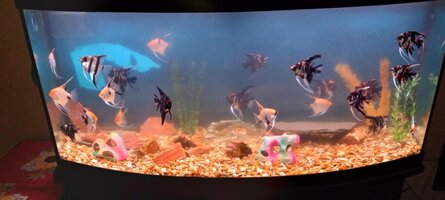
And finally, my 72g bowfront, 150 size wetdry filter, 375gph return pump, 21x 9 month olds, and 3x 2 year+ olds. there's still probably a couple females in there somewhere that haven't matured, I have a tank to move them to, and a store to surrender them to so they can be rehomed. Zebra is a 2yo, so at 9 months these guys are almost all grown. the 9 month olds I raised from eggs. top right marble fish, you see that posture? That I suspect is a female. there's 3 others that just have that really rounded, curved shape to them with how they carry their dorsal and ventral fins. I'll know for sure shortly.

angel3.jpg

A lot of things can be done, if you really want to do it and willing to do the work to do it. I recommend keeping it simple for a while, 2-3 male angels maybe a 29-40 gallon tank so you can keep a couple other fish, or two males or a M/F pair in a 20-29g by themselves and see how that goes. they really don't enjoy being alone though.
In your tank that tree in the center would need to go if you put two angels in the tank, they are going to plow into it when they get bigger.
 
  • Thread Starter
  • #16
Difficult question. first things first, are you certain this is a male? I'm sitting at "more likely than not" but it's based off of two pictures and how the fish is presenting itself in them.

males work fine together. the more the merrier. in the wild they would school as juveniles through maturity and beyond until they pair for spawning. Females as they mature would break off from the school, claim a territory and get a mate for spawning. if there is no female, a male will stick to the social hierarchy of the school.

females get territorial, and males looking to be picked by a female get aggressive and territorial. one or more females maturing can be a major problem in an aquarium setting. they get territorial and aggressive, it sets off the males and they get aggressive and if they are in the running they get territorial and before you know it the pair has a territory and everyone is stuck to the glass on the other side of the tank to avoid getting beat up or killed. tanks just aren't big enough for a pair and other fish unless it's 4ft, and probably 6ft if two pairs but that leaves nowhere for anyone else to go with both pairs claiming half the tank.

So, a group of males can work. two males would be alright I think, I've been as low as 3 at one time with no problems sharing a tank though. I wouldn't go less than a 40g. I mean you don't want only two angelfish I'm sure. I learned by keeping them wrong, reading on behaviors, and trying things in order to do it better, less injuries, happier fish, less deaths and stress.

What works best is a larger tank (55g or 75g) , and a group of 4-6 males or maybe a 40g for a group of 3 males and some fish that won't get in their way much, cories, larger tetras that are fast, something like that with the 2 or 3 angel males. probably two works like that also as long as it's not a M/F pair
.
A M/F pair can work in a 20g, as the only fish, a 29g would be better though either way the whole tank is their territory and every time they put down eggs, other fish will be beaten up and maybe killed, there's no way around that hard rule.

If breeding I like a small tank and a pair.
if keeping I like a larger tank and all positively identified males, or juveniles with a back up plan to separate females when they appear from the tank. I never had luck keeping only females together, they end up killing each other off.
I won't tell you not to over filter or not to over stock, I do it, I'll just tell you be prepared for the work and water changes if you decide to do it.

And finally, my 72g bowfront, 150 size wetdry filter, 375gph return pump, 21x 9 month olds, and 3x 2 year+ olds. there's still probably a couple females in there somewhere that haven't matured, I have a tank to move them to, and a store to surrender them to so they can be rehomed. Zebra is a 2yo, so at 9 months these guys are almost all grown. the 9 month olds I raised from eggs. top right marble fish, you see that posture? That I suspect is a female. there's 3 others that just have that really rounded, curved shape to them with how they carry their dorsal and ventral fins. I'll know for sure shortly.

View attachment 865885

A lot of things can be done, if you really want to do it and willing to do the work to do it. I recommend keeping it simple for a while, 2-3 male angels maybe a 29-40 gallon tank so you can keep a couple other fish, or two males or a M/F pair in a 20-29g by themselves and see how that goes. they really don't enjoy being alone though.
In your tank that tree in the center would need to go if you put two angels in the tank, they are going to plow into it when they get bigger.
Great! Would a 36 gallon bow front work for two males or would a 40 be better
Difficult question. first things first, are you certain this is a male? I'm sitting at "more likely than not" but it's based off of two pictures and how the fish is presenting itself in them.

males work fine together. the more the merrier. in the wild they would school as juveniles through maturity and beyond until they pair for spawning. Females as they mature would break off from the school, claim a territory and get a mate for spawning. if there is no female, a male will stick to the social hierarchy of the school.

females get territorial, and males looking to be picked by a female get aggressive and territorial. one or more females maturing can be a major problem in an aquarium setting. they get territorial and aggressive, it sets off the males and they get aggressive and if they are in the running they get territorial and before you know it the pair has a territory and everyone is stuck to the glass on the other side of the tank to avoid getting beat up or killed. tanks just aren't big enough for a pair and other fish unless it's 4ft, and probably 6ft if two pairs but that leaves nowhere for anyone else to go with both pairs claiming half the tank.

So, a group of males can work. two males would be alright I think, I've been as low as 3 at one time with no problems sharing a tank though. I wouldn't go less than a 40g. I mean you don't want only two angelfish I'm sure. I learned by keeping them wrong, reading on behaviors, and trying things in order to do it better, less injuries, happier fish, less deaths and stress.

What works best is a larger tank (55g or 75g) , and a group of 4-6 males or maybe a 40g for a group of 3 males and some fish that won't get in their way much, cories, larger tetras that are fast, something like that with the 2 or 3 angel males. probably two works like that also as long as it's not a M/F pair
.
A M/F pair can work in a 20g, as the only fish, a 29g would be better though either way the whole tank is their territory and every time they put down eggs, other fish will be beaten up and maybe killed, there's no way around that hard rule.

If breeding I like a small tank and a pair.
if keeping I like a larger tank and all positively identified males, or juveniles with a back up plan to separate females when they appear from the tank. I never had luck keeping only females together, they end up killing each other off.
I won't tell you not to over filter or not to over stock, I do it, I'll just tell you be prepared for the work and water changes if you decide to do it.

And finally, my 72g bowfront, 150 size wetdry filter, 375gph return pump, 21x 9 month olds, and 3x 2 year+ olds. there's still probably a couple females in there somewhere that haven't matured, I have a tank to move them to, and a store to surrender them to so they can be rehomed. Zebra is a 2yo, so at 9 months these guys are almost all grown. the 9 month olds I raised from eggs. top right marble fish, you see that posture? That I suspect is a female. there's 3 others that just have that really rounded, curved shape to them with how they carry their dorsal and ventral fins. I'll know for sure shortly.

View attachment 865885

A lot of things can be done, if you really want to do it and willing to do the work to do it. I recommend keeping it simple for a while, 2-3 male angels maybe a 29-40 gallon tank so you can keep a couple other fish, or two males or a M/F pair in a 20-29g by themselves and see how that goes. they really don't enjoy being alone though.
In your tank that tree in the center would need to go if you put two angels in the tank, they are going to plow into it when they get bigger.
I got some more pictures of him!
 

Attachments

  • 1535F55C-D457-4011-84CF-4529B948F9F6.jpeg
    1535F55C-D457-4011-84CF-4529B948F9F6.jpeg
    209.2 KB · Views: 77
  • DD8CF4B6-BA8F-4544-BC67-25F85C897835.jpeg
    DD8CF4B6-BA8F-4544-BC67-25F85C897835.jpeg
    178.4 KB · Views: 93
  • 6271DD32-2E03-4E3D-9630-B466931D1784.jpeg
    6271DD32-2E03-4E3D-9630-B466931D1784.jpeg
    229.6 KB · Views: 128
  • 8E257A4C-84D8-41EE-9086-7253B23BB522.jpeg
    8E257A4C-84D8-41EE-9086-7253B23BB522.jpeg
    198.7 KB · Views: 147
Cost is a factor for everyone. I'd say buy the biggest tank you can afford without a hardship, it will give you room to do what you want and keep what you want, small tanks are great for specific situations or small fish, and a 20g is great for a quarantine tank also, good to have. Larger is better with angels, people either find out they love them or hate them and if you love them you'll want more to watch them drift around together and interact.
If you find out you hate them, a larger tank gives you more options for your next species to keep, it can be a larger fish species than you could keep in a 20g or 30g or a whole lot of little guys.

Largest you can comfortably afford and have room for is always best. My 72g I've had since the 1990s. If you like fishkeeping as a hobby, a large tank is a better investment than any furniture or a TV or a car, it will last you longer than any of them will last. I've been through 4 cars, 3 tvs and 2 beds ans 2 couches in the time I've had my tank, and the tank is still going strong.
 
Angels are interesting but can be unpredictable and their behaviour rather individual. I have had a group of 6 in a tank that measures 160 x 60 x 60 cm (over 150 gallons). Two of them for over 2 years and the rest just a few months less. Surprisingly they all turned out to be males and until about a month ago got on without any major problems, though one of the original ones always pushed the other around, chasing and butting it. It didn't respond and only hid occasionally, and often those two would go around together. But then, after 18-20 months, the aggression became much worse and the attacked fish started hiding all the time, only coming out to feed, then he would be chased back behind the Vallisneria. Aways the same fish was attacked vicioulsly and became obviously stressed, eventually it even had a bite in its head on one side. I removed the aggressive one to another big tank with some fairly large South American cichlids and now peace reigns, the bite mark has healed up and the remaining 5 angels are all swimming round the tank peacefully. The one I moved has not since caused any problems, though I did not ideally want him in that particular tank, and if I decide eventually to get some altums or other wild type angels he might have to go.

I agree to get the biggest tank you can afford and/or have space for. I think many people are surprised to see how big angelfish can get, mine certainly use all the space in their tank.
 
  • Thread Starter
  • #19
Angels are interesting but can be unpredictable and their behaviour rather individual. I have had a group of 6 in a tank that measures 160 x 60 x 60 cm (over 150 gallons). Two of them for over 2 years and the rest just a few months less. Surprisingly they all turned out to be males and until about a month ago got on without any major problems, though one of the original ones always pushed the other around, chasing and butting it. It didn't respond and only hid occasionally, and often those two would go around together. But then, after 18-20 months, the aggression became much worse and the attacked fish started hiding all the time, only coming out to feed, then he would be chased back behind the Vallisneria. Aways the same fish was attacked vicioulsly and became obviously stressed, eventually it even had a bite in its head on one side. I removed the aggressive one to another big tank with some fairly large South American cichlids and now peace reigns, the bite mark has healed up and the remaining 5 angels are all swimming round the tank peacefully. The one I moved has not since caused any problems, though I did not ideally want him in that particular tank, and if I decide eventually to get some altums or other wild type angels he might have to go.

I agree to get the biggest tank you can afford and/or have space for. I think many people are surprised to see how big angelfish can get, mine certainly use all the space in their tank.
The biggest I could get would be a 40….would that be ok for two males?
 
Maybe...

I have a pair in a 55 that are 1 year old and with fins extended I'd say they're right around the height of a 20oz pop/soda bottle. There is a hierarchy in the tank and since its heavily planted they do take advantage of "me/alone" time. No real aggression but they do nip at each other occasionally. I have had eggs laid on my filter intake in the past, nothing came of them and were eventually eaten by something in the tank - be it the sailfin or bn plecos, the mystery snails, the 4 stripe pictus or just them not knowing what they were doing.

These are easily the largest fish I've ever kept. They're adorable when they're small but they grow...and grow.

**I have a set of 4 juveniles in a different 55 that seem to be getting along OK for the moment.
they are about done growing at 1 year, but they do get thicker and gain mass in year two to three.
if there were eggs there's a female, and might be two females as to why no pair or fertilization, but with a 55g, and them having a side of the tank to themselves pretty far away, spawning territory wouldn't' be much of an issue.it's a 4 ft.

Lexiomibjj​

"The biggest I could get would be a 40….would that be ok for two males?"

a 40g, it's 3 ft, I don't think this is a problem in that respect either, if the two fish take sides for territory if they turned out to both be females.
40 gallon (breeder) is 36"x18"x16" depth.
a 55 gallon is 48"x13"x21" depth.

55 gallon has 5 more inches of vertical space...... I'd say,the 16" depth is decent, I've done 12" depth with breeding angels that are around 7" from dorsal tip to ventral tips. it works in that situation, they share the space quite well they have some vertical movement available and don't have issues laying eggs vertically or fertilizing either.

I would say if you did do a 40 gallon, try to find a 40 long. it's 48"x12"x 16" deep, you lose quite a bit in width, but you gain a foot in length and the same depth as the 40 breeder. the 40 long is similar to the 55g, just shorter in depth. makes a nice display though for a planted tank.

A 29 gallon is a reasonable option also though, it's 30″ x 12″ x 18″ deep. kind of tight horizontally, but it's same footprint as a 20g long, and my spawning pair only ever really uses half of the tank where the slates are and rarely venture to the other 15 inches of tank. the additional 6 inches in depth of the 29g though would be a huge difference for my pair though compared to the 20 gallon Long.
I think 2 males in a 29g or a M/F pair in a 29g are both good. two females both needing their own territory would be a problem in the 29g.

There can still be problems also, the individual fish have to play nice with each other also, that's a big factor.
 

Advertisement


It would be better a couple of inches taller, the length is Ok for two I think. I am not sure, it’s not the best size but might be OK. Certainly fine while they are juveniles, but they do grow quickly! And whether the two will get along together indefinitely I don’t think it’s possible to predict - I think is something you just have to try out and remove one if necessary. They don’t all grow to the same size either. Most of mine are big, probably about half the height of the 40 breeder tank with their fins fully extended, but one is quite a bit smaller.
 
Going past a lot.of.comments but isn't it a bit weird you're asking if the fish is stunted and then saying that it is in a 20G and you'll upgrade if the fish gets too big. To me that is exactly the way how fish get stunted : putting them in a too small tank to grow out properly.

Also keeping one Angel I think isn't the way to go cause they're quite social and certainly as youngster.
They honestly don't get stunted from being in too small of a tank (within reason) it's got a lot more to do with the water quality and feeding. Density of fish in the volume of water is what causes stunting, like too much fish in too small a space, waste buildup, and nitrates and stress causing them to expend more energy on their immune system instead of growing will hold them back and if it happens at certain stages of development it can go from just a set back to a permanent stunting.

Same type of thing with too many fish for the volume of water, the density again, some fish will be aggressive feeders, and some slacking feeders, the slacking feeders will get far less food, gain far less mass, and again at certain stages of development become permanently stunted instead of just a set back, it becomes locked in.

I've experienced no stunting even with high density in small volumes of water when it's maintained clean, like pristine conditions daily, and an abundance of food so that even the slacking eaters are getting their fair share to gain mass and grow in size.
There does however come a breaking point where it's just impossible to keep the small volume of water clean, as they grow it hits a point where you'd need to do multiple 100% water changes per day to keep nitrates and bacteria from building up rapidly, it becomes too much, and then they need more water volume relatively quickly or they will hit that wall, and if kept in that condition, stop growing and in time it will lock in as stunting. It can be avoided or prolonged by starting with more water volume of course,

Just saying its not how deep the tank is or the size of the tank that causes it, its caused by underfeeding or not keeping it clean enough when fish are still growing, the organs will grow while the body doesn't or grows slower than the organs.
And bent dorsal fins from my experience have nothing to do with how deep the tank is and a lot more to do with the genetics the fish get from the parents lineage. A couple are going to turn up out of the hundreds for fry, and can be much more, whether they have 30" vertical or 12" vertical. If the parent are genetically predisposed to a bent dorsal fin due to heredity, the spawns will be heavy with bent dorsal fins every time. I haven't found a way to effect a change to that outcome with water volume, cleanliness, nutrition or temperature, and I concluded its just genetic.

They can be stunted, but its from a keeper not being attentive to water quality, and/or nutrition. It has to be clean for optimal health and they have to gain mass for optimal growth. If a growing fish is constantly fighting off bacterial infections or stressed from nitrates, they waste energy doing that instead of growing at optimal rates. Same way a person won't be shorter from growing up in a tiny house, but will be shorter growing up with a lot of pollution and/or malnutrition, and in general also be unhealthier. They can't reach their full potential.

I agree on the social aspect of angels, they thrive with other angels to interact with. There will be a quality of life problem for a solitary angelfish, how could there not be when their whole world is the school or pairing and spawning. they just aren't a solitary fish.
I didn't mean it's only the size of the tank vs the size of the fish. I think that is a general misconception we can grow out fish like these in a small tank and than upgrade without reaching the bounderies far before that moment.

.
 
My comments about the tank size were more in regards to space for swimming and moving around, so that the full grown fish would not be cramped and too restricted in their movements. The fish in the picture did not really look stunted to me. It is interesting though - people often comment how large my angelfish are and say they have not seen any that big. Mine have grown up in a large tank and I do wonder if that has anything to do with their potential size?
 
I didn't mean it's only the size of the tank vs the size of the fish. I think that is a general misconception we can grow out fish like these in a small tank and than upgrade without reaching the bounderies far before that moment.

.
I can agree, to an extent. A 5g tank is an impossibility let's say but, You can grow one or two angels to full size though in a 20g if you are feeding enough and keeping it clean, I've done it in the past and gotten up to five juveniles to maturity in a 20g Long without stunting, they did need to move to a larger tank at that point though, it was difficult to keep clean, they would dart and hit the glass, a female appeared and took territory and a male, and it was rough for the other 3 so I moved them.
I've also kept that pair in a 10 gallon together for 2 or so months while the fry grew more in the 20g. That was tight, but they were grown and paired, that tank was where they started laying eggs horizontally instead of vertically. It wasn't ideal at all, but temporarily it worked in that situation. I keep a pair in a 20g Long without issue, but I wouldn't do it with a couple male or a couple female mature fish, just in a breeding pair or a small group of juveniles until they mature.
I'd prefer a 29g for a breeding pair but the 20g long works fine, i have it, and its easy to keep really clean for spawning.

I'd say it's very situational, and inexperience will lead to mistakes or the wrong call being made at the wrong time. Keeping 2 angels through maturity in a 20g wouldn't be that hard or that catastrophic for the fish. But they would benefit with more room and more angels to the group for sure,

I wouldn't really recommend a person kept a M/F pair in a 20g either for breeding, unless they have another 20g to move the parents from the fry after a couple weeks, but this is regardless of a tank size, breeding requires more tanks, and then a bigger tank or tanks to move the fry to after like 2 months to finish grow out to a sellable size. And raising the fry to maturity, realistically even more tanks so its not so much work. Even the 21 I have is a ton of work to keep it decent for them... also a ton of food.
 
I've also kept that pair in a 10 gallon together for 2 or so months
I don't think two of mine would actually fit inside a 10 gallon tank!
 

Advertisement


My comments about the tank size were more in regards to space for swimming and moving around, so that the full grown fish would not be cramped and too restricted in their movements. The fish in the picture did not really look stunted to me. It is interesting though - people often comment how large my angelfish are and say they have not seen any that big. Mine have grown up in a large tank and I do wonder if that has anything to do with their potential size?
Not really, different types have different potentials based on genetics, then dominant fish trend larger than subordinates since they always get first food and stay ahead of the curve to remain dominant.

You also have a good eye for quality fish that a lot of people don't have the eye for or don't look for at all.
If you selected them at the store instead of dealers choice, its likely that from that group, you selected the best ones, and have the dominant fishes from the spawn, in which case, you have all dominants, and one of them steps up and is even more dominant, or they change who's tank boss frequently.

Edit* A 20g long is 30"x12"x12" deep. A 2 year old, big dominant mature male looks like this in it:
20221118_080108.jpg
He's a good 3/4" Thick also.
20221118_075939.jpg

Not the largest I have ever had, but the largest I currently have.
 
I like tall over long, all my breeders are in 30 tall, one pair each, the fry start out in 10 gal. then move to 17 and 20 talls, after that they go to market. The only angles I would have in a long would be juveniles, but that's just me.
 
What is the definition of tall opposed to long, when does a long become a tall?
 
The difference is in the dimensions. In North America they sell 80 liter tanks in a high version (60x30x45cm) and a long version (75x30x30cm).
 
Advertisement


Advertisement


Advertisement


Back
Top Bottom