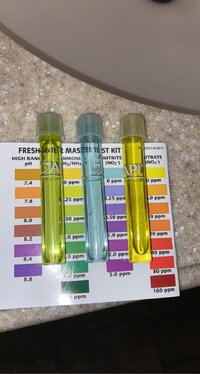
Something is very wrong in my tank, not sure the cause

cdwag29

Well Known
Member
Messages
739
Hello all. I’ve had a 20 gallon tank running for about a year and a half with no issues. Today I did my weekly 25% water change, added a squirt of liquid fertilzer, and went about the rest of my day. This was about 3 hours ago. I noticed just now that my danios are doing some bizare behavior. They’re all huddling under a log, gasping for air, and seem to have red marks under their fins.

I checked my parameters since it seemed like an obvious sign of an ammonia spike, which come to find I was right and my ammonia has spiked for the first time ever. I don’t know why, since I changed nothing in my cleaning routine, so if anyone has any ideas on the cause I’d be very grateful.

Aside from all of that, my danios are swimming very weird. One of them looks to have a crooked spine, while another looks to be very skinny/what looks like a sunken in stomach, and the rest just have been staying stationary and “gittering” a bit. I’ve attached a video of the one with the crooked spine. This fish is struggling to swim, and seems to be almost swimming lopsided, while the others are almost like “rocking” back and forth. A while ago I know I accidently sucked up one of them while cleaning my tank, but since my finger was covering the bottom of the syphon hose and my other hand was squeezing the top he only got sucked up like an inch before getting spat out. Im not sure if the crooked spine is related, but I’d feel awful if it was.

Ive done a 50% water change, but the group of danios are still huddled and stationary under the log. If anyone has any ideas on whats wrong that would be amazing, because I feel that this behavior is completely not normal for such a normally active species.

Crooked Spine fish
Studio Project

Example of them staying “stationary”
Studio Project

EDIT
I also have loaches in this tank, who are acting normal and are still active.

What I meant by rocking back and forth
Studio Project
 

Attachments

  • 28AE7B2A-A655-4C0D-B367-FAAAC2321477.jpeg
    28AE7B2A-A655-4C0D-B367-FAAAC2321477.jpeg
    403 KB · Views: 174
  • 03744CB6-6323-4089-8CEF-C328CAF2166D.jpeg
    03744CB6-6323-4089-8CEF-C328CAF2166D.jpeg
    439 KB · Views: 95
  • 8024F4E8-BE3B-4B60-ADB7-1D270836AA67.jpeg
    8024F4E8-BE3B-4B60-ADB7-1D270836AA67.jpeg
    293.3 KB · Views: 168

Advertisement

Advertisement
  • Thread Starter
  • #3
Have you checked your tap water? Sometimes they use different things in the city supply.
I have not. I think I remember reading somewhere that to test tap water you let it sit overnight in an air tight container or could I just test it straight from the faucet?

I also have 3 other tanks which I use the same tap for. I did water changes on all 4 tanks today, and this one seems to be the only one off.
 
Straight from the faucet is what you add to the tank. I would check that first.
I have not. I think I remember reading somewhere that to test tap water you let it sit overnight in an air tight container or could I just test it straight from the faucet?

I also have 3 other tanks which I use the same tap for. I did water changes on all 4 tanks today, and this one seems to be the only one off.
That is strange. Did you forget dechlor? Its always possible, or maybe too much added? Do you have a air stone you could pop in there and see if that helps?
 
  • Thread Starter
  • #5
Straight from the faucet is what you add to the tank. I would check that first.

That is strange. Did you forget dechlor? Its always possible, or maybe too much added? Do you have a air stone you could pop in there and see if that helps?
So I just checked the tap and everything reads 0. I did remember declor luckily, and I added the same ammount I usually do, which is only a few drops, since the bucket I use for water changes is only 5 gallons and the instructions say 1 mL per 15 gallons. Unfortunately I don’t have an airstone, but I’m removing some of the duckweed I have since it’s blocking surface movement.

I’ve turned off the lights and they’ve come out from hiding, but still are lethargic and now are tilting on sort of a slant so their heads are pointed towards the surface.
 
Did you dig around in the gravel when cleaning? Maybe some gasses came out?
 

Advertisement
Need to determine the cause of the ammonia spike. If they started reacting strangely within hours of a water change it would suggest that something was wrong with the source water. Even if you disrupted your biofilter (substrate or filter media) by cleaning too aggressively you would think that it would take longer than that for the ammonia to build up.
 
  • Thread Starter
  • #8
Did you dig around in the gravel when cleaning? Maybe some gasses came out?
I uprooted a small plant but that was about it. What type of gasses are you refering to?
Need to determine the cause of the ammonia spike. If they started reacting strangely within hours of a water change it would suggest that something was wrong with the source water. Even if you disrupted your biofilter (substrate or filter media) by cleaning too aggressively you would think that it would take longer than that for the ammonia to build up.
It did seem odd to me that they were reacting so suddenly and with such severity right after a cleaning especially with such a low level of ammonia that had no time to really be causing such a harsh affect before I noticed.

The tap water we have is a community well I believe since we live in a condo. There’s a huge water tower right by my house that supplies the whole condominium. Now that I think about it, I have a tank with Rasboras that will sometimes act odd after a water change- hiding and tightly schooling like the danios. I just figured they were skitish but now I’m not so sure. The only fish that never seem to have a problem is my two betas.

If it is the tap water, I have no clue how to go about fixing that since we don’t own an indivudial well. I could ask my parents for the owner to do a check up, but I’m not sure what the odds of them listening are.
 
Just stuff that form under the substrate. One plant shouldnt have done that though.
 
We need to now your pH level to interpret the ammonia level. Test both the tank and the source water.

Ammonia effect on fish is terrible in high pH tanks. It actually displaces oxygen in their blood and causes them to suffocate. That is why you see them gasping for air.

If you have some zeolite (ammonia absorber) please add that to the filter ASAP. Then figure out if you have chloramines in your tap water.
 
Star Girl read my mind. I get notices from the city when they are going to put extra chemicals in the water.
 

Advertisement


  • Thread Starter
  • #12
p
We need to now your pH level to interpret the ammonia level. Test both the tank and the source water.

Ammonia effect on fish is terrible in high pH tanks. It actually displaces oxygen in their blood and causes them to suffocate. That is why you see them gasping for air.

If you have some zeolite (ammonia absorber) please add that to the filter ASAP. Then figure out if you have chloramines in your tap water.
My ph is 7.8. I woke up to half the fish dead and the others are pale and gasping for air. I don’t have any ammonia absorber and im at a complete loss on what to do. My loaches are now struggling as well.

i have to leave for school in two hours and the only thing i can think to do is another huge water change and move the loaches into my beta tank so they dont die too.

My ammonia is reading zero now, but the fish are still clearly suffering.

Edit.
I ended up removing all the fish that are still alive and i set up a qt tank with the same filter.. im not sure if this was a good decision but i really felt that they needed to get out of that water. 7 out of the 11 fish i had died, and the rest are still gasping for air and such.

this loach has little black specs on it and its gill area is looking a little fuzzy. I know the black specs are a sign of ammonia poisioning, but what i still am failing to see is why its just this tank that spiked when every other tank got the same treatment yesterday.
 

Attachments

  • 262993FC-7C82-4CD0-B223-B9E9C5E74D2C.jpeg
    262993FC-7C82-4CD0-B223-B9E9C5E74D2C.jpeg
    408.7 KB · Views: 96
Is this tank stagnant? Do you have good aeration and surface motion? The surface looks still in the picture. You may have low oxygen which also caused your cycle to stall as well as suffocated the fish. It happens. If so you need to add surface motion from your filter and add some aeration to circulate the water in the tank.

At your pH the ammonia level you measured should not have been toxic, so you may have low oxygen. But the low oxygen can stall the cycle and lead to the measurable ammonia.
 
Ok, let’s just ignore all science here for a sec. Trust your gut. What do you think is going on here?

No pressure, it just sometimes works better for me to take a step back from all the complicated sciences and look at the big picture.
 
  • Thread Starter
  • #16
Is this tank stagnant? Do you have good aeration and surface motion? The surface looks still in the picture. You may have low oxygen which also caused your cycle to stall as well as suffocated the fish. It happens. If so you need to add surface motion from your filter and add some aeration to circulate the water in the tank.

At your pH the ammonia level you measured should not have been toxic, so you may have low oxygen. But the low oxygen can stall the cycle and lead to the measurable ammonia.

The tank wasn’t stagnent but I did have a lot of duck weed so the surface movement wasnt as strong as it was with just the filter. The sponge filter I have is very strong, which is why I got the duckweed to baffle it, but since it seems the fish suffocating might be the cause I wont be using duckweed to baffle it anymore. To think this was something I could have easily prevented is very upsetting.

All the fish died except for one, who is in his own tank right now and is doing much better. The loaches lasted until about last night, when they turned pale and started gasping, then passed.


Ok, let’s just ignore all science here for a sec. Trust your gut. What do you think is going on here?

No pressure, it just sometimes works better for me to take a step back from all the complicated sciences and look at the big picture.
I’m gonna be honest, when I sent that last message I was hysterical as the fish were literally dying in my hands, and im sure I didnt make too much sense. My gut told me something was wrong, and FrankTheFishGuy put the science behind it!


What is a squirt of fertilizer?
One pump of Tropica’s All in one fertilizer, that I do after every water change.
 
You did a water change and your fish died, which leads me to believe it may of had something to do with that. I would have checked the parameters from my tap water source. I could be pH shock as well, if the pH from the tap was a lot higher than the tank water it could of easily killed your fish. It happened to my friends fish once, he lost half his stock. Check your water conditioner, not likely but perhaps its bad. You do remember treating the tank with conditioner right? Sorry this happened to you
 
This may be low oxygen from the tap. This is common for well water, but for some city supplies as well.

If the fish suffocate after a water change it is often low oxygen in the source water.

OP my well water is very low in oxygen (4 ppm) and suffocates fish if I use it without aerating for 24 hours first. So I put it in big barrels and aerate it and then use a pump to move it to the tanks.

You would need an oxygen test to know for sure: https://www.amazon.com/Sera-Oxygen-Test-fl-oz-Aquarium-Test/dp/B0013ZCB9E

This is a very common problem actually.
 
  • Thread Starter
  • #19
You did a water change and your fish died, which leads me to believe it may of had something to do with that. I would have checked the parameters from my tap water source. I could be pH shock as well, if the pH from the tap was a lot higher than the tank water it could of easily killed your fish. It happened to my friends fish once, he lost half his stock. Check your water conditioner, not likely but perhaps its bad. You do remember treating the tank with conditioner right? Sorry this happened to you

Another member also recommended that I check the tap waters parameters, which I did the night they started to die. Ammonia, nitrite, and nitrate all read zero, with my pH being the same as it was in my tank. I do remember using water conditioner luckily, and it's pretty new so I think it's ok to use. As unfortunate as this all was, I'm using it as an opportunity to tear down the tank and rescape it. I'm just happy at least one fish made it.

This may be low oxygen from the tap. This is common for well water, but for some city supplies as well.

If the fish suffocate after a water change it is often low oxygen in the source water.

OP my well water is very low in oxygen (4 ppm) and suffocates fish if I use it without aerating for 24 hours first. So I put it in big barrels and aerate it and then use a pump to move it to the tanks.

You would need an oxygen test to know for sure: https://www.amazon.com/Sera-Oxygen-Test-fl-oz-Aquarium-Test/dp/B0013ZCB9E

This is a very common problem actually.
I'm a little short on money right now, but I'll buy the test when I get a chance.

I think you're right about the low oxygen, especially since my rasbora's have started acting strange recently whenever I do water changes. My guess is the only reason the same thing hasn't happened to the rasboras is because I do smaller water changes since the tank bio load was less than that of my 20 gallon, so they had an easier time fighting through the low oxygen level, and I assume that my beta's didn't show any signs of discomfort after water changes because they don't have to rely 100% on the oxygen in the water because of their labyrinth organ. Correct me if I'm wrong.

Anway's this is a stupid question but what do you mean by aerate? Would this just be letting the water sit out or adding a bubbler too it? If it means adding a bubbler, would airline tubing connected to an air pump achieve the same affect?
 
If you can confirm that aerating the water solves the suffocation problem, then you really don't need the Oxygen test. It's a common issue that tap water is low on oxygen, and the fish test works! Sad but true I am afraid.

Anyways, to oxygenate the water, fill a large bucket or barrel with water with an open top. Get an air pump and run an air line to an airstone. Put the airstone at the bottom of the barrel.

What you are actually doing with the air stone is circulating the water from the bottom to the top. It's this circulation that churns the water so all the water can contact the surface where it picks up oxygen. This takes about 24 hours to get the water fish ready.

Here is the amazing thing about fish. They live on a tiny amount of oxygen. 2 PPM oxygen kills them. 4 ppm they suffer. 8 ppm they thrive and this is what they need.

Life is fragile. Life is precious.
 
  • Thread Starter
  • #21
If you can confirm that aerating the water solves the suffocation problem, then you really don't need the Oxygen test. It's a common issue that tap water is low on oxygen, and the fish test works! Sad but true I am afraid.

Anyways, to oxygenate the water, fill a large bucket or barrel with water with an open top. Get an air pump and run an air line to an airstone. Put the airstone at the bottom of the barrel.

What you are actually doing with the air stone is circulating the water from the bottom to the top. It's this circulation that churns the water so all the water can contact the surface where it picks up oxygen. This takes about 24 hours to get the water fish ready.

Here is the amazing thing about fish. They live on a tiny amount of oxygen. 2 PPM oxygen kills them. 4 ppm they suffer. 8 ppm they thrive and this is what they need.

Life is fragile. Life is precious.

Thank you so much! You’ve been a huge ammount of help. I never would’ve thought that the low oxygen might’ve been the problem. I ordered an airstone last night, and although it makes my water change routine a little more difficult, I’ll be following the entire oxygnation process. Defiently don’t want this happening ever again.
 

Advertisement


This may be low oxygen from the tap. This is common for well water, but for some city supplies as well.

If the fish suffocate after a water change it is often low oxygen in the source water.

OP my well water is very low in oxygen (4 ppm) and suffocates fish if I use it without aerating for 24 hours first. So I put it in big barrels and aerate it and then use a pump to move it to the tanks.

You would need an oxygen test to know for sure: https://www.amazon.com/Sera-Oxygen-Test-fl-oz-Aquarium-Test/dp/B0013ZCB9E

This is a very common problem actually.
This is so helpful for everyone, not to hijack the OP, and not talked about enough!
I'm so sorry this has happened. What a horrible loss.
 
The only time that I know that I had an issue with low oxygen was once when there was too much CO2 being injected which reduces the ability for fish to take in oxygen. I knew immediately that there was an issue because all of the fish were gasping at the surface. They went back to normal fairly quickly when I switched off the CO2. I think that gasping at the surface is a typical reaction to low oxygen but it's not a behaviour that the OP reported which makes me wonder if some other contaminant is involved.
 
It is very common for well water to be low in dissolved oxygen. Symptoms are lethargic fish, pumping gills, hiding, panic, and gasping at the surface. Beta fish and cory cats are unaffected since they can gulp air.
 
  • Thread Starter
  • #27
The only time that I know that I had an issue with low oxygen was once when there was too much CO2 being injected which reduces the ability for fish to take in oxygen. I knew immediately that there was an issue because all of the fish were gasping at the surface. They went back to normal fairly quickly when I switched off the CO2. I think that gasping at the surface is a typical reaction to low oxygen but it's not a behaviour that the OP reported which makes me wonder if some other contaminant is involved.
Ah yes, another reason why I'm afraid to try CO2. They weren't really gasping at the surface so much as they were breathing very hard. The kuhli loaches I had would occasionally swim up to the surface during the whole issue, but I didn't really think much of it in hindsight.

It is very common for well water to be low in dissolved oxygen. Symptoms are lethargic fish, pumping gills, hiding, panic, and gasping at the surface. Beta fish and cory cats are unaffected since they can gulp air.
Every symptom you listed they exhibited, unfortunately. Our well water has always had some type of issue, I'm not surprised it finally came back to kick me in the butt.

The surviving danio made a full recovery, eating and very active. I've decided to give him back to my lfs, since I don't want him to get depressed by himself and I don't really want any more danios. Little sad/worried about that but what can you do.
 
The idea of aerating the water is great, the thing that doesn't make sense is you've done water changes this water for a while I'm assuming, so why now? You said you had your tank setup for a year and a half. I have read before that tanks that have been setup for a long time like yours can reach a point when they crash. Build up that isn't removed from water changes or filtration accumulates over time and it gets to a point where it's bad enough to kill your fish. If you routinely check your parameters this shouldn't be the case but if you're like me and you don't then it could be possible.
 
  • Thread Starter
  • #29
The idea of aerating the water is great, the thing that doesn't make sense is you've done water changes this water for a while I'm assuming, so why now? You said you had your tank setup for a year and a half. I have read before that tanks that have been setup for a long time like yours can reach a point when they crash. Build up that isn't removed from water changes or filtration accumulates over time and it gets to a point where it's bad enough to kill your fish. If you routinely check your parameters this shouldn't be the case but if you're like me and you don't then it could be possible.
That’s what I was wondering. I do water changes weekly, and I’ve been pretty ontop of the build up since I have an alage problem so I need to syphon it out all the time to keep it under control. I’ll be honest, I only check the parameters when I feel needed, which isn’t often. Before this whole problem the last time I had checked it was when I went on vacation and my neighbors took care of my fish, which was about a month and a half prior. The only thing that might’ve caused a change in the water is if something with the community well changed, which my parents might’ve gotten a notice about but I doubt would’ve cared to let me know. Like I said earlier, our water has always had something off with it. When I was younger you could literally taste chlorine or something in it, and for a while it would always get oddly cloudly. But idk.

Just returned the danio to a store and I have to say it left a very bad taste in my mouth
 

Random Great Topic!

Saltwater aquarium start-up series:
Part 1
Part 2
Part 3
Saltwater Aquarium Set Up Series
Advertisement


Advertisement


Advertisement


Back
Top Bottom