Ph differing from tank to tap

NotSoAggressiveAquatics

Fishlore VIP
Member
Messages
4,052
Hey everyone, Ive been out of the fish game for a while and im just getting back into it so i probably used to know this but im gonna need a little help remembering/figuring out what’s going on. So I’ve setup a small 5.5 gallon tank that’s going to be for neocardina shrimp soon, and it’s done cycling and everything but I just checked my ph today after a couple weeks of not worrying too much about it and saw it’s at 6.0? Last time I checked my ph it matches my tap water which is mid 7’s so I just can’t figure out what’s going on. My substrate is inert and as far as I know rocks only raise ph they don’t lower it so I don’t think my rocks are the issue. I have one small piece of driftwood but I took it from another tank and it has no tannins left in it so that shouldn’t be doing much if anything. I only have a few snails in the tank already so I’m really trying to figure this out so that I can fix this before the acidity continues to mess with them.

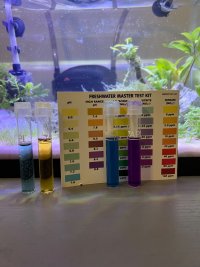
Here’s a pic (left side is tap and right is tank)
IMG_1464.jpeg
 

Advertisement
Check the KH of the tank and the KH of the tap water. You probably don't have that test, but its useful.

When you are cycling, the bacteria requires carbonates to multiply, because of how people usually cycle using ammonia, and going for 2ppm in 24 hours, this can deplete the KH and the pH will bottom out. Atwater change can fix that.

Now if you have an active substrate, like fluval stratum, that's intended to burn off the KH and lower the pH. And over time and water changes it gets better as it wears in but initially the KH is going to get used up and water changes will lessens that effect. Not everyone wants the low pH but it's pretty good for plants for the water to be acidic.


Either way water changes would be the cure. But knowing what the KH is is helpful in determine how fast it runs down and when you need to water change to keep it in line with the tap water, if that's what you are wanting to do.
 

Advertisement
  • Thread Starter
  • #3
Check the KH of the tank and the KH of the tap water. You probably don't have that test, but its useful.

When you are cycling, the bacteria requires carbonates to multiply, because of how people usually cycle using ammonia, and going for 2ppm in 24 hours, this can deplete the KH and the pH will bottom out. Atwater change can fix that.

Now if you have an active substrate, like fluval stratum, that's intended to burn off the KH and lower the pH. And over time and water changes it gets better as it wears in but initially the KH is going to get used up and water changes will lessens that effect. Not everyone wants the low pH but it's pretty good for plants for the water to be acidic.


Either way water changes would be the cure. But knowing what the KH is is helpful in determine how fast it runs down and when you need to water change to keep it in line with the tap water, if that's what you are wanting to do.
Thanks! I just did a 35% ish water change and the color is barely a tinge more blue than it was so that’s a little weird. Just tested my kh and it’s 6, I lost my conversion thing the test kit came with so I don’t know what that is in ppm though

Edit: kh is 6 for both tank and tap
 
Get a glass of tap water, test it. Let it sit for 24 hours to gas off. See what the tap is doing first. That blue is tapped out, do you have a high pH test?
 
1 dKH = 17.9 ppm KH. It's not the KH being low..... it's not acidification doing it in the tank. You could let the water sit out as stargirl suggests, sometimes a city will artificially raise the pH and it offgasses as it sits with the air, they do that if the water is naturally acidic and they are trying to preserve the lifetime of the pipes. Same way they make the alkaline water, the pH drops as it offgasses to the air above it ones it's open to the air.

What is the substrate? I see that tank behind the chart is it all sand or sand topped and what's under the sand if it's topped?
 
  • Thread Starter
  • #6
Get a glass of tap water, test it. Let it sit for 24 hours to gas off. See what the tap is doing first. That blue is tapped out, do you have a high pH test?
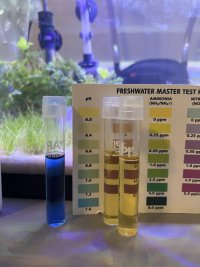
I put out a glass and dechloinated the water but here’s where things get a little weird. I just tested normal ph and high range ph from the dechlorinated cup and straight from the tap. I feel like I should trust the dechlorinated one more but I don’t know why they’re varying so much

Left side is straight from tap (left normal right high range) right side is dechlorinated tap (left normal right high range)

IMG_1465.jpeg
 

Advertisement
Ok. Well what dechlorinator are you using? This is going to happen depending on the brand and how severely you are over dechlorinating. It's far less an issue with let's say prime (not an endorsement) you'd have to really overdo it, while something like amquel plus will do it on a double up, and something like stresscoat+ would do it on a triple up. Do you think you could be over dechlorinating?

If not it. Maybe the city is using calcium hypochlorite for water treatment? When you dechlorinate, you wind up with calcium and hydroxide ions, which will raise the pH also but it's a short term spike, it should bond and re-balance over time, hydroxide is normally a minor ion in water but water treatment with the calcium hypochlorite and then using a dechlorinator can cause a fast spike of alkalinity that will last until the hydroxide (OH-) can bond to hydrogen (H+) in the water to become H2O. Depends on how much free hydrogen there is.

*I edited while I got a couple thumbs up, not sure if yall want to take them back once you see the edited version. Hahaha!
 
  • Thread Starter
  • #9
Ok. Well what dechlorinator are you using? This is going to happen depending on the brand and how severely you are over dechlorinating. It's far less an issue with let's say prime (not an endorsement) you'd have to really overdo it, while something like amquel plus will do it on a double up, and something like stresscoat+ would do it on a triple up. Do you think you could be over dechlorinating?
I’m most likely over decholorinating. I’m using api water conditioner. I’ve been using this same brand for a few years and I haven’t noticed it doing anything like this before but that seems like the only plausible answer on why it’s so different. But even if that’s the case I still don’t understand what’s making the tank ph drop so low if that should be raising the ph if anything
 
  • Thread Starter
  • #10
Ok. Well what dechlorinator are you using? This is going to happen depending on the brand and how severely you are over dechlorinating. It's far less an issue with let's say prime (not an endorsement) you'd have to really overdo it, while something like amquel plus will do it on a double up, and something like stresscoat+ would do it on a triple up. Do you think you could be over dechlorinating?

If not it. Maybe the city is using calcium hypochlorite for water treatment? When you dechlorinate, you wind up with calcium and hydroxide ions, which will raise the pH also but it's a short term spike, it should bond and re-balance over time, hydroxide is normally a minor ion in water but water treatment with the calcium hypochlorite and then using a dechlorinator can cause a fast spike of alkalinity that will last until the hydroxide (OH-) can bond to hydrogen (H+) in the water to become H2O. Depends on how much free hydrogen there is.

*I edited while I got a couple thumbs up, not sure if yall want to take them back once you see the edited version. Hahaha!
I’m not gonna lie I never took chemistry so I don’t get half of the terms you just used. So I get that the ph raise is going to be temporary but when it goes back down will it drop below the original ph and that’s why the ph is so low?
 
I’m most likely over decholorinating. I’m using api water conditioner. I’ve been using this same brand for a few years and I haven’t noticed it doing anything like this before but that seems like the only plausible answer on why it’s so different. But even if that’s the case I still don’t understand what’s making the tank ph drop so low if that should be raising the ph if anything
Ya know what,, I need a chemist also! It's beyond my ability to explain it. The pH should not be dropping down to pH6. Not with 6 degrees KH.

It's possible to temporarily deplete the KH if you were fishless cycling with ammonia with 2ppm ammonia and you redosed and didn't water change for that. The bacterial activity of cycling would create acids and use up carbonates under that condition at a higher rate.

If you have a lot of nitrates, you have a lot of acids being created. Co2, creates carbonic acid, nitrogen gas isn't an acid, but nitrous acid would happen once nitrogen enters the water from the air as those ions bond.

If the source water is heavily processed for delivery, it can be pretty wonky as far as the ionic balance of it and cause instability in the pH. But I don't know.... like I said if you got 6 dKH it really shouldn't be doing that and dropping to pH 6. and if it were acidic enough, your KH would be getting depleted.

I've assumed you're testing correctly... is it possible you aren't following testing procedures to a "T" with the directions or that the reagents aren't expired or contaminated?

I've got to do some reading on some things. See if I can find out how this could be happening... it's wayyyy odd to be sure.
 

Advertisement


  • Thread Starter
  • #12
Ya know what,, I need a chemist also! It's beyond my ability to explain it. The pH should not be dropping down to pH6. Not with 6 degrees KH.

It's possible to temporarily deplete the KH if you were fishless cycling with ammonia with 2ppm ammonia and you redosed and didn't water change for that. The bacterial activity of cycling would create acids and use up carbonates under that condition at a higher rate.

If you have a lot of nitrates, you have a lot of acids being created. Co2, creates carbonic acid, nitrogen gas isn't an acid, but nitrous acid would happen once nitrogen enters the water from the air as those ions bond.

If the source water is heavily processed for delivery, it can be pretty wonky as far as the ionic balance of it and cause instability in the pH. But I don't know.... like I said if you got 6 dKH it really shouldn't be doing that and dropping to pH 6. and if it were acidic enough, your KH would be getting depleted.

I've assumed you're testing correctly... is it possible you aren't following testing procedures to a "T" with the directions or that the reagents aren't expired or contaminated?

I've got to do some reading on some things. See if I can find out how this could be happening... it's wayyyy odd to be sure.
Yeah it’s definitely weird. I’m 99% sure I’m doing the tests right but it might be like 5.5 kh realistically because the color slightly turned on the 5th drop and fully turned on the 6th. I guess I’ll just have to keep an eye on it and see how it changes
 
pH is a measure of hydrogen ions. It's logarithmic, meaning at pH6 there 10x more hydrogen ions than at pH7, at pH6 there's 100x more hydrogen ions than at pH8.

CO2, carbon dioxide, is tied to pH also. When the water takes in CO2 from the air above it and dissolves, it becomes carbonic acid and holds the CO2, this will drop the pH.

I still have no earthly idea on why your pH would go to 6 in the tank with 6 dKH still showing on tests.

If it's excessive CO2 in the homes air, aerating it with an air pump wouldn't make any difference. Opening windows would make a difference though. Even then this doesn't solve why you get different results before and after dechlorination.

I'm afraid I'll I can really do is spit ball possible causes and don't have a solution until you can pinpoint what the cause of the situation is.

With what it's doing though I'd have to question the testing though, as it's the most likely place for errors to happen either by user or the testing kit or even digital testers can go out of calibration. It's also the safest thing to really get into without making matters worse for the tank or inhabitants as a step 1.

I would not move on with the shrimp or any other aquatic critters without figuring out what's going on first, snails are pretty forgiving on water conditions except long term, but fish or shrimp won't be. I really wish I knew what's going on, I'm going to continue down this path and see where it takes me. But I'm not sure I'll find an answer that explains it all. A problem with testing could explain it all, barring that, it's maybe a unique combination of factors that need to be figured out and solved one by one.
 
  • Thread Starter
  • #14
pH is a measure of hydrogen ions. It's logarithmic, meaning at pH6 there 10x more hydrogen ions than at pH7, at pH6 there's 100x more hydrogen ions than at pH8.

CO2, carbon dioxide, is tied to pH also. When the water takes in CO2 from the air above it and dissolves, it becomes carbonic acid and holds the CO2, this will drop the pH.

I still have no earthly idea on why your pH would go to 6 in the tank with 6 dKH still showing on tests.

If it's excessive CO2 in the homes air, aerating it with an air pump wouldn't make any difference. Opening windows would make a difference though. Even then this doesn't solve why you get different results before and after dechlorination.

I'm afraid I'll I can really do is spit ball possible causes and don't have a solution until you can pinpoint what the cause of the situation is.

With what it's doing though I'd have to question the testing though, as it's the most likely place for errors to happen either by user or the testing kit or even digital testers can go out of calibration. It's also the safest thing to really get into without making matters worse for the tank or inhabitants as a step 1.

I would not move on with the shrimp or any other aquatic critters without figuring out what's going on first, snails are pretty forgiving on water conditions except long term, but fish or shrimp won't be. I really wish I knew what's going on, I'm going to continue down this path and see where it takes me. But I'm not sure I'll find an answer that explains it all. A problem with testing could explain it all, barring that, it's maybe a unique combination of factors that need to be figured out and solved one by one.
Thanks so much for all the help! I just retested kh and got the same results. Since my water change around 3 hours ago the ph has been stable at 6.8 and I’ve tested it like 5 times since then lol. I’m tempted to do another water change and see if it goes up to above 7 then test again in the morning and see how low it dropped if at all. I do have a theory and I probably should have brought this up before but I forgot. This tank has fully cycled but it’s really only been setup for around 3 weeks barely now because I seeded it will established media. Since it’s new, every day I’ve been poking around the sand to release any air bubbles so I don’t buildup and toxic gas but because of plants I’m probably not getting in there as good as I should be, do you think the air bubbles I’m releasing from the sand when I’m stirring it up a little could be dropping the ph?
 
Air bubbles in sand is either CO2 (without presence of plant roots) or O2 (with presence of plant roots) in my opinion. But believing it is toxic stuff makes the hobby more interesting of course. CO2 brings down the pH.... but since your tank is only 3 weeks old, I can't imagine it would be noticeable. The bubbles surfacing at this stage are probably the result of tank setup.

If you have a decent concentration of carbonates and the pH touches 6, there should be a strong but unnatural acid present. This is biohazardous...provided the numbers are correct.

Personally, I leave the testing to the chemistry lab and focus on the looks and behaviors of plants, fish and invertebrates. If you see plants and invertebrates survive and grow, I'd introduce fish without hesitation. Bioassays are a conventional method to assess the health of an ecosystem.
 
  • Thread Starter
  • #16
Air bubbles in sand is either CO2 (without presence of plant roots) or O2 (with presence of plant roots) in my opinion. But believing it is toxic stuff makes the hobby more interesting of course. CO2 brings down the pH.... but since your tank is only 3 weeks old, I can't imagine it would be noticeable. The bubbles surfacing at this stage are probably the result of tank setup.

If you have a decent concentration of carbonates and the pH touches 6, there should be a strong but unnatural acid present. This is biohazardous...provided the numbers are correct.

Personally, I leave the testing to the chemistry lab and focus on the looks and behaviors of plants, fish and invertebrates. If you see plants and invertebrates survive and grow, I'd introduce fish without hesitation. Bioassays are a conventional method to assess the health of an ecosystem.
My ramshorns are completely unbothered and even laying eggs and my plants are all doing great besides one Anubias that started melting a little. I was reading up on gas pockets that form in the substrate and it seems like it only turns into a dangerous sulfuric pocket if you have crazy deep substrate.
 
Indeed, a crazy deep substrate.....including a thick, oxygen depleting organic layer above it..... sulfur below it.

I do think that toxic gas can occur... from a decomposing fish.... perhaps also from oversized, clogged filters, aka. mini sewage systems. People treat filters as water purifiers; I see them as biohazards. :D

Regarding any assessment, I apply a minimal 1 month interval. The pace of biology is somewhat slower than TikTok.
 
  • Thread Starter
  • #18
Alright here’s a bit of an update I want to share. I’m still at a complete loss right now because I just tested the cup of tap water I placed out yesterday, another cup I placed out but with the liquid ferts I use in it and my tank

Normal tap: max blue
Tap with ferts: max blue
Tank: 6.6 ph

My kh also dropped somehow and it’s at 3 now so there’s something very wrong.

And I even did yet another water change last night to get my tank up to around 7.2 ph and now in the span of less than 12 hours it’s down to 6.6.

There has to be something I have in my tank that’s dropping my ph like crazy but I can’t figure it out. It definitely isn’t my substrate and I’m 99% sure it isn’t my rocks because those only raise ph not drop it right? Besides that I have one tiny piece of driftwood and I doubt that is the culprit.
 
The question is, what is the biological significance of the drop from 7.2 to 6.6?
It's probably the result of photosynthesis. That's a good thing, right?

Values only get meaning in relation to something.

Is a pH of 4 the result of a dangerously strong acid, like some battery, or the result of missing KH and the presence of organic acids from decomposing botanicals along with carbonic acid from CO2?

Big difference.
 
Advertisement


Advertisement


Back
Top Bottom