Never any ammonia in 5 weeks?

mmrr7313

Active Member
Member
Messages
63
Can you please help me understand my situation? I am on week 5 with my new aquarium. I have tested every single day, sometime twice a day and I have gotten the same results every single darn time. No ammonia, no nitrites, 5ppm nitrates (also in source water). API test kit results from today in picture.

I have a new 5 gallon aquarium with 1 betta, 1 snail, and two live plants plus frog bit and moss. HOB filter, preset heater. Have studied the theory of the nitrogen cycle, but have no practical experience with it though.

I started the aquarium 5 weeks ago by setting it up and using Stability as per the instructions on the bottle: every day for 7 days. We ghost fed during that first week to get a little ammonia started potentially. (Setting the tank up a week early was just to see how it works, not to cycle it. Were told to do a fish in cycle with Stability and to use Prime everyday until cycled. Let's not get into that.)

Fish and snail were added after the first week. So they have been in there for a month now.

Never any ammonia, never any nitrites. There were a few days a few weeks ago where the teal colour of the nitrites test could have seemed a little more blue-ish that usual, but never anything close to the purple shade of the .25ppm color on the nitrites chart. I have followed the API test kit instructions very closely... attentive to meniscus reading at eye level, number of drops, bottle upright, shaking as directed. I don't think I am color blind. Thinking I was missing something, I have had the water also tested at various local stores roughly once a week, same results.

We do roughly 20% water changes 1/week.

As advised by this forum, we have stopped using Prime daily. Reserving it for if we see ammonia or nitrites and for water changes.

My two questions are.... #1) how has there never been any ammonia? (Are the plants soaking it up? Are my weekly water changes keeping it at bay? Is my test kit faulty? User error?) and #2 how will my tank ever be considered "cycled" ?

Thank you in advance for any help/input/guidance!
 

Attachments

  • 20230413_093851.jpg
    20230413_093851.jpg
    249.2 KB · Views: 5

Advertisement
Tank is cycled to me. The frog bit and moss probably took in all the ammonia given you don't have a huge bioload (just a betta and snail don't produce much ammonia). Weekly water changes is the norm for my tanks though I also do bi-weekly water changes if I'm not home (my only issue is high nitrates). I would say keep doing weekly water changes and test ammonia and nitrite only and you should be good. Add Prime and Stability when adding your new water though (Prime is a water dechlorinator so unless you're using well-water, keep dosing when you do water changes) but sounds cycled to me
 

Advertisement
Hello from Australia mmrr7313

I am a retired construction worker with numerous tanks and a couple of betta fish in 7 ish gallon tanks.

What you are doing is all good. Can I suggest you relax a little and don’t burn yourself out on testing every day or multiple times per day. My approach is to concentrate on changing a little water (20%-30%) as often as you like and not stress about the numbers or the test colours . The cycle will happen eventually, let’s just enjoy the fish and keeping him alive.

To answer your question.
The API liquid master test kit is not that sensitive to small amounts of toxic waste. Enough ammonia is being produced every day from the breathing and poop of the fish to start the cycle growing.

Yes I believe your weekly water changes are keeping “the ammonia at bay”.Plus frog bit is helping.A good thing . Building the cycle is not a race. It is already happening.

To help the bacteria grow in numbers. Do not disturb the filter unless water is bypassing a blocked cartridge leave it alone. Do not disturb the substrate, hold the vacuum just above the substrate and enough solids will be picked up. Removing solids is more for your benefit than the fish . Removing solids is for the human eye . Do not clean the glass panels. As you are new and this is your first tank you can clean the front panel just because you want to see your expensive new tank to look like a nice piece of furniture. Do not remove and wipe down ornaments or plastic plants etc ,they are all a potential home for a small number of bacteria. Yes eventually you can remove and clean things but just now while the cycle is new try hard to resist cleaning anything.

What to expect.
Do not be concerned if you never see nitrites. Do not be concerned if you never see an increase in ammonia. Do expect to see more nitrates at some time in the future.

My opinion.
Yes the test kit is important but even a beginner can watch for changes in fish behaviour. If you see the fish swimming constantly at the surface breathing constantly from the surface you don’t need a test kit number or particular colour to know something is wrong. Edit, actually betta breath air from the surface as a normal part of everyday life. Perhaps this is advice more suited to other fish species?

A daily job is to see if the heater is working. Unfortunately that job continues forever. The heater will stop working at some time in the future. If it stops in the off position the water just goes cold , no big deal. If the heater stops in the on position the water will get hotter and hotter. Your daily routine might be to look at the temperature gauge first thing or to put your finger in the water every morning.

In short.
Nothing good happens in a hurry when keeping fish.
Its only been 5 weeks, continue doing what you are doing.
 
  • Thread Starter
  • #4
Hello from Australia mmrr7313

I am a retired construction worker with numerous tanks and a couple of betta fish in 7 ish gallon tanks.

What you are doing is all good. Can I suggest you relax a little and don’t burn yourself out on testing every day or multiple times per day. My approach is to concentrate on changing a little water (20%-30%) as often as you like and not stress about the numbers or the test colours . The cycle will happen eventually, let’s just enjoy the fish and keeping him alive.

To answer your question.
The API liquid master test kit is not that sensitive to small amounts of toxic waste. Enough ammonia is being produced every day from the breathing and poop of the fish to start the cycle growing.

Yes I believe your weekly water changes are keeping “the ammonia at bay”.Plus frog bit is helping.A good thing . Building the cycle is not a race. It is already happening.

To help the bacteria grow in numbers. Do not disturb the filter unless water is bypassing a blocked cartridge leave it alone. Do not disturb the substrate, hold the vacuum just above the substrate and enough solids will be picked up. Removing solids is more for your benefit than the fish . Removing solids is for the human eye . Do not clean the glass panels. As you are new and this is your first tank you can clean the front panel just because you want to see your expensive new tank to look like a nice piece of furniture. Do not remove and wipe down ornaments or plastic plants etc ,they are all a potential home for a small number of bacteria. Yes eventually you can remove and clean things but just now while the cycle is new try hard to resist cleaning anything.

What to expect.
Do not be concerned if you never see nitrites. Do not be concerned if you never see an increase in ammonia. Do expect to see more nitrates at some time in the future.

My opinion.
Yes the test kit is important but even a beginner can watch for changes in fish behaviour. If you see the fish swimming constantly at the surface breathing constantly from the surface you don’t need a test kit number or particular colour to know something is wrong.

A daily job is to see if the heater is working. Unfortunately that job continues forever. The heater will stop working at some time in the future. If it stops in the off position the water just goes cold , no big deal. If the heater stops in the on position the water will get hotter and hotter. Your daily routine might be to look at the temperature gauge first thing or to put your finger in the water every morning.

In short.
Nothing good happens in a hurry when keeping fish.
Its only been 5 weeks, continue doing what you are doing.
WOW! Well that was timely advice! My to do list for tomorrow included cleaning off the two logs and the one fake plant that looks dirty during my weekly water change. Disaster averted lol!

I thank you so much for your kindness to reach out and help me. Your advice is so welcomed and useful!!

And yes...you can tell me to relax lol. I think I do need to hear that. I just care so much and don't want any harm to come to our first fish! (With this kind of advice I hope I will be confident enough to have more!)

Funny you should mention it....the heater is actually what started my stress!! We had a preset that was suppose to keep the water between 76 & 78 F and I woke up one day very early on to find the tank at 80.5 and still heating. Imagining how that could have gone if not caught scared me! And then I started reading a lot of heater reviews and came to the conclusion they are finicky things so the next day I got a new heater and a temperature controller that will shut it off if it over heats.

I will say this.... our fish ("Fishy Pet" as named by the 9 yr old) seems really happy and healthy and far more interactive than I ever imagined! He can be calmly enjoying his tank, but if one of us comes near, he always comes right up to us. And he seems to squirm and be genuinely full of anticipation at feeding time!

So what I am taking from what you are saying is that even if I haven't been able to quantify it, the nitrogen cycle will be establishing itself regardless over time. Patience is a virtue :)
 
Forgive me if I sound a bit preachy ?

On the subject of feeding.

We all over feed our fish and beginners are just as likely to use food to try and fulfil the need to help a creature.
I tell everyone even an office worker with a tank on their desk to hide the food so don’t take it as a criticism of your child or parenting skills. Have a set feeding routine of one meal a day 6 days a week. Have two tiny meals a day if you wish.

Just avoid everyone feeding at random times, leading to over feeding. A single betta needs a surprisingly small amount of food.
 
  • Thread Starter
  • #6
Forgive me if I sound a bit preachy ?

On the subject of feeding.

We all over feed our fish and beginners are just as likely to use food to try and fulfil the need to help a creature.
I tell everyone even an office worker with a tank on their desk to hide the food so don’t take it as a criticism of your child or parenting skills. Have a set feeding routine of one meal a day 6 days a week. Have two tiny meals a day if you wish.

Just avoid everyone feeding at random times, leading to over feeding. A single betta needs a surprisingly small amount of food.
So far we have been feeding the Betta Aquon Pro pellets.... they are incredibly tiny (smallest I have every seen!) and the store told us to give him 5/ day in one meal, so that's what we have been doing. Plus we fast him one day a week.

But.... it has been on my mind to try and figure out if we are actually UNDER feeding him! My son is religious on not giving him anymore than the 5 a day, it's me the mom who thinks he looks hungry all the time hahaha! Especially when he goes to the feeding latch and does a happy dance!

A lot of advice says however much they would eat in 2 minutes, but I'm sure he would over eat massively with that strategy. And with the recommendations I have read about x pellets/ day, I wonder if that applies to this brand we are using that seems so much smaller than the rest.

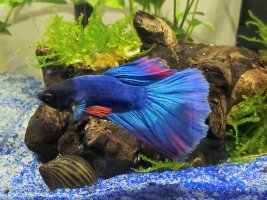
Is there any way to know if I am feeding him the "right" amount? He seems happy, healthy and active. And seems to be a good size. (I'll attach a pic.)
 

Attachments

  • original_ec64cd02-a6e1-4052-827c-1027ca2e0755_20230326_112305 (1).jpg
    original_ec64cd02-a6e1-4052-827c-1027ca2e0755_20230326_112305 (1).jpg
    488.7 KB · Views: 8

Advertisement
At least with schooling fish it’s possible to see them behave differently when over feed . A school of tetras should attack the food like piranha with all food gone before it hits the substrate. When over fed tetras hit the first chunk of food out of instinct but kind of lose interest in the second bit. That is not really of any help with a betta as they are slow eaters at the best of times.But if it’s not eating it is not hungry.

Perhaps the best approach is to continue feeding exactly the same number of pellets each day for a month and then decide if it is putting on weight or losing size.

Just a note . An adult betta can easily go a week without food.

Looking at the picture he is not going hungry. The belly is not sunken in.
 
  • Thread Starter
  • #8
Tank is cycled to me. The frog bit and moss probably took in all the ammonia given you don't have a huge bioload (just a betta and snail don't produce much ammonia). Weekly water changes is the norm for my tanks though I also do bi-weekly water changes if I'm not home (my only issue is high nitrates). I would say keep doing weekly water changes and test ammonia and nitrite only and you should be good. Add Prime and Stability when adding your new water though (Prime is a water dechlorinator so unless you're using well-water, keep dosing when you do water changes) but sounds cycled to me
Well that would be great of it is! Maybe I've been stressing out over nothing! What % do you change with your weekly changes? You mentioned bi-weekly if you aren't home...do you think I will be able to leave this tank in July for two weeks? We have someone to feed the fish during that time, but I am not confident in them doing water changes. (I have been hoping it is possible with so much lead time to ensure the tank is cycled, live plants and only 2 inhabitants.)
 
Yes, overfeeding is a really big problem because we love it when out fishes dance. I feed my fish everyday but I fast them every two days just to help nutrients.
 
Well that would be great of it is! Maybe I've been stressing out over nothing! What % do you change with your weekly changes? You mentioned bi-weekly if you aren't home...do you think I will be able to leave this tank in July for two weeks? We have someone to feed the fish during that time, but I am not confident in them doing water changes. (I have been hoping it is possible with so much lead time to ensure the tank is cycled, live plants and only 2 inhabitants.)
I change about 1/3-1/2 the water every week because I tend to have high nitrates that I'm trying to control. I would test your tank at the end of the week and see what the nitrates are at. I try to keep mine below 20ppm if I can, but postponing water changes shouldn't be an issue if everything is fine at the end of the week. I have fully cycled tanks so I almost never get ammonia or nitrite (the only time I would is if something died and I didn't notice). I only do water changes because of high nitrates (not harmful to fish until 80ppm+ but I've been told they shouldn't go past 40ppm due to issues it can cause for live plants and possibly causing algae (feel free to correct me if I'm wrong on that anyone!).

I only feed my fish every other day though, because I know I probably overfeed a bit. Doing it every other day means I'm not wasting food or causing issues in the tank by overfeeding a little. Only fish I feed every day are fry (i have a tank of guppy fry right now so they get something every day until they're bigger).

I left my tanks for a month because of a school trip in the summer. I told my family only to feed the fish every other day and top up the water (with water conditioner and beneficial bacteria liquids, which I left instructions for). Only thing I came back to was algae because I had them dosing plant fert too and without water changes it was a feast for algae. So, if your tank is fine after a week (0 ammonia, 0 nitrite, and a bit of nitrate) you should be set to leave it for two weeks. If you have them top up the tank, just give them instructions for water dechlorinator and beneficial bacteria. Shouldn't have any trouble :)
 
Advertisement


Advertisement


Back
Top Bottom