Ich Treatment Help Please

Josie12012

Active Member
Member
Messages
118
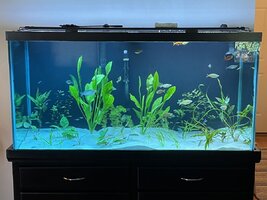
Any advice welcome, I believe I’m battling Ich in my 90 gallon planted tank. I’ve had this tank up for over two years now. I have close to 30 fish a mix of Rainbows, Tetras, and Barbs and two fiddler crabs currently in this tank.
Today I noticed one of my rainbows covered head to toe in white spots. I recently changed substrates in my tank so for a moment thought perhaps it’s just the sand but after some research realized it’s clearly ich. How should I move forward with treatment. I’ve read anywhere from use medications, to don’t use medications to try heat and salt and then to not and the apparent debate of to treat the main tank or to quarantine and treat there and vice versa. I don’t believe my fish will tolerate extreme heat that I’ve seen recommended and don’t want to put them through a painful death, so scared to proceed in any direction. Current tank temp is about 78 degrees and that’s on the high end for the fish I keep.

I currently have a cycled empty 30 gallon tank so I did decide at least for now to move the one fish pictured below to that tank due to his current extreme bout of it. But of course do not want to lose my entire 90 gallon tank of fish. Any advice to treat this situation is greatly appreciated! I’ve been lucky and never had this disease before. Feeling very sad and scared for all my beloved fish :/
Thanks.
 

Attachments

  • DB5D6A7D-1229-456C-91A3-053F8742D372.jpeg
    DB5D6A7D-1229-456C-91A3-053F8742D372.jpeg
    63.2 KB · Views: 15
  • B459AF06-9050-4166-8A65-6DEF2BAF7594.jpeg
    B459AF06-9050-4166-8A65-6DEF2BAF7594.jpeg
    181.3 KB · Views: 15

Advertisement
Hi Joise12012.

I have had fish die from these parasites. It’s definitely ich by the looks of that picture. You have it living in your substrate and living in the tank . You now have it in two tanks. And most likely in any other tank you used the same nets or hoses in ?


30 days without any fish will have all the ich die out .

The fish in the picture is probably not going to make it. You will lose lots of fish if you don’t act fast. I would strongly recommend medication with malachite green and formaldehyde as active ingredients. When treatment is started before the fish get as bad as what’s in the picture no fish will die from medication ( in my experience).

As you are hesitant to use medication I will post a link to a recent video on the subject.


Advertisement
So sad....this is heartbreaking and scary.
I was just thinking to separate the fish. As you now have already ich in both tanks, I would move the heat tolerant fish together in one tank and slowly increase the heat to 84°. Heat speeds up the lifecycle of ich, and as the ich cysts will fall off, you will need to gravel vacuum daily. You will have a re-infection, but it should be less and less. Keep up the heat treatment and cleaning regimen for a week after the last time you see spots on the fish.
The heat sensitive fish you may treat with rid-ich or ich-x in a regimen recommended on the bottle.
Also here the gravel vacuum is important.
I wish you a lot of luck, the fish will suffer and I really hope that your loss will be minimal.
 
  • Thread Starter
  • #4
Hi Joise12012.

I have had fish die from these parasites. It’s definitely ich by the looks of that picture. You have it living in your substrate and living in the tank . You now have it in two tanks. And most likely in any other tank you used the same nets or hoses in ?


30 days without any fish will have all the ich die out .

The fish in the picture is probably not going to make it. You will lose lots of fish if you don’t act fast. I would strongly recommend medication with malachite green and formaldehyde as active ingredients. When treatment is started before the fish get as bad as what’s in the picture no fish will die from medication ( in my experience).

As you are hesitant to use medication I will post a link to a recent video on the subject.

Thank you so much for the needed information! I have watched the video closely and ordered some medications but they will take two days to get here :/ It’s not that I’m hesitant to use medications more that I just wasn’t sure what would be the best route for the fish I have. I’ve read so many conflicting things online. Mostly that you should choose one or the other heat and salt or medications.
This video recommends all together, heat, salt and meds. I hope that’s a safe way to proceed. Losing any fish is so hard. Thanks again.
So sad....this is heartbreaking and scary.
I was just thinking to separate the fish. As you now have already ich in both tanks, I would move the heat tolerant fish together in one tank and slowly increase the heat to 84°. Heat speeds up the lifecycle of ich, and as the ich cysts will fall off, you will need to gravel vacuum daily. You will have a re-infection, but it should be less and less. Keep up the heat treatment and cleaning regimen for a week after the last time you see spots on the fish.
The heat sensitive fish you may treat with rid-ich or ich-x in a regimen recommended on the bottle.
Also here the gravel vacuum is important.
I wish you a lot of luck, the fish will suffer and I really hope that your loss will be minimal.
:( such heartbreak. Well sounds like this will be a difficult month. Hoping my fish are strong and can pull through the treatment. Thanks.
Does anyone know if rainbows, barbs and tetras can withstand the 85degree temps?
 
Use the heat to speed up the life cycle from eggs to adulthood and back to eggs . This just helps kill more of the ich on the day they can be killed as free swimming.
Vacuum every few days to increase the chances of removing a few eggs.

Change some water as you vacuum and redose every 3 days or whatever your bottle of medication says. .

Continue treatment for 10 - 14 days after the last spots are seen .

Use a torch for the next few weeks in case one adult ich survived long enough to drop eggs.

At least in Australia we always have the medication on hand 365 days a year. Not that old tanks get ich , it’s because any new fish may have them .

Obviously follow the instructions exactly. However my local club members don’t even measure the medication you just add it often when you have an issue is their thinking.
 
Thank you so much for the needed information! I have watched the video closely and ordered some medications but they will take two days to get here :/ It’s not that I’m hesitant to use medications more that I just wasn’t sure what would be the best route for the fish I have. I’ve read so many conflicting things online. Mostly that you should choose one or the other heat and salt or medications.
This video recommends all together, heat, salt and meds. I hope that’s a safe way to proceed. Losing any fish is so hard. Thanks again.

:( such heartbreak. Well sounds like this will be a difficult month. Hoping my fish are strong and can pull through the treatment. Thanks.
Does anyone know if rainbows, barbs and tetras can withstand the 85degree temps?
I have Neon Tetras, and they were little troopers. What kind of Barbs do you have? Rainbows I read have a temp range up to 82°, so I can imagine that 84° will be tolerated. I am sure Barb and Rainbow experienced members will chime in.
 

Advertisement
  • Thread Starter
  • #7
I’m going to go to my LFS tomorrow to see if they carry the medication on hand so I can maybe start treatment tomorrow. But went ahead and ordered it online just in case they don’t. When you say “use a torch” what are you talking about? Thanks
 
i forgot to mention an air stone is helpful at this time , because the medication and heat both consume a little more oxygen.
 
  • Thread Starter
  • #9
I have Neon Tetras, and they were little troopers. What kind of Barbs do you have? Rainbows I read have a temp range up to 82°, so I can imagine that 84° will be tolerated. I am sure Barb and Rainbow experienced members will chime in.
I have one line tiger Barb left and 6 roses barbs.
 
After the medication treatment is finished. Look at your fish daily with a flashlight. Look closely for any spots.
 
  • Thread Starter
  • #11
i forgot to mention an air stone is helpful at this time , because the medication and heat both consume a little more oxygen.
I have a Fluval FX6 do you think if I pull the output out of the water and allow it to dump into the tank that that will be enough added oxygen from the water disturbance?
After the medication treatment is finished. Look at your fish daily with a flashlight. Look closely for any spots.
It’s sucks upon initial look at the fish I thought only one other had maybe one or two spots but swear right before my eyes I’m seeing more and more in a matter of hours. This is the worst, really hoping I can get the treatment tomorrow to start.
 

Advertisement


I have one line tiger Barb left and 6 roses barbs.
From what I read the temperature should not be a problem, considering that it is temporary. You do not consider heat and meds, correct?
Best of luck with the treatment, keep us posted.
 
Yes probably a splashy return is enough?

But we struggle with a hot climate in Australia and have air stones running for that reason.If you don’t have an air pump or the money to buy one it may not be required?
 
Yes probably a splashy return is enough?

But we struggle with a hot climate in Australia and have air stones running for that reason.If you don’t have an air pump or the money to buy one it may not be required?
Would not need to be a high end one, I purchased my first airpump used in the classified ads.
 
  • Thread Starter
  • #15
From what I read the temperature should not be a problem, considering that it is temporary. You do not consider heat and meds, correct?
Best of luck with the treatment, keep us posted.
Are you asking if I will raise heat and add meds? Yes at this point I plant to do both, despite conflicting online information it appears both can and should be used together.
Also, do you think it’s ok to add the one fully covered fish back to the main tank seeing as the entire tank needs treated anyways? I may just break down the 30 gallon tank let it dry out and start it again at a later time. I can’t see how putting the lone fish back could do much harm at this time and feel he may be more comforted by his peers than alone through this process.
 
As you have ich already in both tanks now, it is most likely easier for you to fully focus on the one tank.
 
  • Thread Starter
  • #17
As you have ich already in both tanks now, it is most likely easier for you to fully focus on the one tank.
I agree. So am I understanding that you too agree I should both raise temps and medicate at the same time?
 
I agree. So am I understanding that you too agree I should both raise temps and medicate at the same time?
I don't advocate using both methods at once because it doubles the stress on the fish. Also formaldehyde can deplete oxygen, so using it in conjunction with heat is not a good idea. Use either heat treatment or medication.

If heat is chosen it needs to be a minimum of 30C (86F) to stop the Ich reproducing and break its life cycle. Most tropical fish can handle this temperature for the period it takes to treat Ich.

I think where it gets confusing is that it's often recommended to raise the temp when treating Ich with meds. However in this context what is meant is that the temp can be raised a little (to about 27C, not 30C) because that is the temp at which the Ich life cycle is at its fastest. Therefore treating at this temp minimises the treatment period. So yes if you're going to use meds you can raise the temp a little.
 
Heat can be used to shorten the life cycle of the parasites in order to limit the time medication is used. For example in extremely cold water the life cycle is up to a month meaning the minimum time fish have to be exposed is 6 weeks ( ish) .

Normal tropical temperature tank the life cycle is around 10 - 14 days.

As mentioned in the video raising the temperature just a couple of degrees means the life cycle is sped up . Even as short as 3 days from egg to adulthood back to egg.

I completely agree not to raise the temperature high enough to stop ich breeding ( 30 plus C ) and adding medication is not required.
 
My apologies, I didn't watch the video. I thought that the OP was considering using heat treatment in conjunction with meds, as opposed to just raising the temp slightly while medicating.
 
  • Thread Starter
  • #21
I don't advocate using both methods at once because it doubles the stress on the fish. Also formaldehyde can deplete oxygen, so using it in conjunction with heat is not a good idea. Use either heat treatment or medication.

If heat is chosen it needs to be a minimum of 30C (86F) to stop the Ich reproducing and break its life cycle. Most tropical fish can handle this temperature for the period it takes to treat Ich.

I think where it gets confusing is that it's often recommended to raise the temp when treating Ich with meds. However in this context what is meant is that the temp can be raised a little (to about 27C, not 30C) because that is the temp at which the Ich life cycle is at its fastest. Therefore treating at this temp minimises the treatment period. So yes if you're going to use meds you can raise the temp a little.
Make sense! Thank you for your help!! As a rainbow fish keeper do you have any advice on a preferred method!? I feel so torn about which route to go! Thanks for your time and advice.
My apologies, I didn't watch the video. I thought that the OP was considering using heat treatment in conjunction with meds, as opposed to just raising the temp slightly while medicating.
I think being caught off guard and ich and worried about my fish I also missed that the heat could be raised slightly with meds and thought the video was recommending both. But I understand now. I will not do both. Thank you thank you for likely saving me much heartache. I was trying to sort this all out at midnight and was very tired.
 

Advertisement


Start using meds a.s.a.p. and only raise the temp if the manual of the med asks you to. In this stage doing both might have a lethal outcome.
 
As a rainbow fish keeper do you have any advice on a preferred method!? I feel so torn about which route to go! Thanks for your time and advice.
I prefer to use meds, though that's partly because we have some heat resistant Ich strains here.
 
I agree. So am I understanding that you too agree I should both raise temps and medicate at the same time?
I personally am not a fan of medication, but can understand that both methods can be used in conjunction and are successful.
Watch your fish really closely, be diligent to gravel vacuum.
 
  • Thread Starter
  • #25
Thanks again to all! I was able to purchase Ich X this morning at my LFS. He also informed him his rainbow fish came to him with ich and he thought he had treated it but apparently I would assume due to adding a new rainbow fish and now suddenly having ich he was not done treating his fish. Feeling frustrated but then again I didn’t quarantine so also partially my own doing. Anyways, working on 30 percent water change and gravel clean now then will add treatment! Any suggestions on how many days after seeing no spots to continue treatment?
 
The number of days you need to continue treatment after the last spot is seen depends on water temperature. As the medication ( all medications) only kills the free swimming stage of the life cycle of the parasites you only have a window of a few hours in that life cycle to kill. As an egg or when attached to the fish the medication does nothing.

At normal tropical water temperature the complete life cycle is around 7 days.
Given that we are human and might not see one single spot inside the gills of a fish it is recommended to continue treatment for 10 to 14 days. In reality 7 days is enough. In practice as you have seen with the shop owner we make mistakes and don’t see one or two spots.

My opinion is it’s better to be certain and continue the treatment a few days longer than to stop to soon and have to start again for another 10 - 14 days.

There is no short answer or quick fix.
Continue treatment for at least 10 days. But spend time everyday for the next fortnight looking very closely with a strong light source/ flashlight/ torch etc. Looking for a single spot . Finding one spot means dozens will hatch out again.

As I wrote in post #2 prepare yourself for the loss of at least that one fish in the picture. The amount of spots is an extreme infestation in the tank.

PS . I know the eggs are not called eggs and it’s called a cyst but I continue to use the word egg regardless.
 
  • Thread Starter
  • #27
The number of days you need to continue treatment after the last spot is seen depends on water temperature. As the medication ( all medications) only kills the free swimming stage of the life cycle of the parasites you only have a window of a few hours in that life cycle to kill. As an egg or when attached to the fish the medication does nothing.

At normal tropical water temperature the complete life cycle is around 7 days.
Given that we are human and might not see one single spot inside the gills of a fish it is recommended to continue treatment for 10 to 14 days. In reality 7 days is enough. In practice as you have seen with the shop owner we make mistakes and don’t see one or two spots.

My opinion is it’s better to be certain and continue the treatment a few days longer than to stop to soon and have to start again for another 10 - 14 days.

There is no short answer or quick fix.
Continue treatment for at least 10 days. But spend time everyday for the next fortnight looking very closely with a strong light source/ flashlight/ torch etc. Looking for a single spot . Finding one spot means dozens will hatch out again.

As I wrote in post #2 prepare yourself for the loss of at least that one fish in the picture. The amount of spots is an extreme infestation in the tank.

PS . I know the eggs are not called eggs and it’s called a cyst but I continue to use the word egg regardless.
Perfect! Thank you thank you! Don’t know where I’d be without such a helpful society of fish lovers! ♥️
 
Just watch out, if fish really start to suffer under the meds, you may want to pull those guys out and treat them with just heat in the separate tank.
Treatment is hard on those little guys...
 
  • Thread Starter
  • #29
Update!!
Today is day 5 of medication and the turn around my own rainbow fish has made is truly remarkable! Nearly every spot is gone now! Picture below! I haven’t lost any fish yet either!! These daily water changes and daily gravel vacs are exhausting but my fish are worth it!! I have only one other fish with active spots still. Hoping in maybe one more day all spots will be gone and then I’ll continue treatment for 7 more days! But things are (so far) going extremely well! Thanks again, all! It’s truly a miracle!!

before on the right and current state now on the left 5 days into treatment!!
 

Attachments

  • 5BC11230-75FD-443B-A39F-E76EBF377A93.jpeg
    5BC11230-75FD-443B-A39F-E76EBF377A93.jpeg
    84.8 KB · Views: 7
  • EF2C6C72-3B21-428A-8CCF-E7DD82FCFF3A.jpeg
    EF2C6C72-3B21-428A-8CCF-E7DD82FCFF3A.jpeg
    76.2 KB · Views: 7
Congratulations....now keep up the good work, ich is not gone yet!!!
So nice to read a success story...
 
  • Thread Starter
  • #31
Update: day 9 of treatment 8 doses have been given so far still needing to do todays. I was hopeful that I was on the winning side around day 5 but unfortunately more spots have appeared on several other fish now. I would say the good news perhaps is it’s less spots collectively throughout the fish in the tank than the one very sick fish had initially.
Obviously since this is a community tank and well stocked there are many “hosts” for new Ich to find. I don’t think there is anything I can either about that, perhaps it just gets less and less as the weeks go on.
Is it typical to need to treat the active spots for weeks? I know it was discussed to go several days to a week after the last spot is seen but I keep finding new spots despite 30 percent water changed and vacuuming sand everyday. I even removed rocks and wood to ensure I could get to all the sand.
Also, the bottle of Ich X states to treat every 24 hours no more than every 8 hours. Does anyone see a benefit in treating multiple times a day? Just hoping eventually that this Ich will actually be gone. So disappointing to see new spots on different fish some days. :/
Would doing larger water changes help at all? Just wish I knew this treatment was working or going to work at some point.
 

Advertisement


Continue treatment. The medication can only kill the free swimming ich on one day of their life cycle. Some have been missed and dropped eggs leading to a new batch of parasites.

I don’t know if the concentration of active ingredients is as strong as what I use but clearly after 9 days some of the parasites have gone through the complete life cycle. Is the water so blue/green you can hardly see the back of the tank? ( 12 inches)

I draw your attention to my post #5 in which I mentioned my local club members dosing by colour not by volume. Not measuring the medication is not my preferred way to suggest another person should treat their fish. But it would agree with the instructions you have that are saying it’s possible to add more medication at ether 8 hours or 24. That’s a big difference in time don’t you think?

edit
The picture in your post #29 . The water looks clear ,if that is a picture taken 4 days ago?
 
  • Thread Starter
  • #33
Continue treatment. The medication can only kill the free swimming ich on one day of their life cycle. Some have been missed and dropped eggs leading to a new batch of parasites.

I don’t know if the concentration of active ingredients is as strong as what I use but clearly after 9 days some of the parasites have gone through the complete life cycle. Is the water so blue/green you can hardly see the back of the tank? ( 12 inches)

I draw your attention to my post #5 in which I mentioned my local club members dosing by colour not by volume. Not measuring the medication is not my preferred way to suggest another person should treat their fish. But it would agree with the instructions you have that are saying it’s possible to add more medication at ether 8 hours or 24. That’s a big difference in time don’t you think?

edit
The picture in your post #29 . The water looks clear ,if that is a picture taken 4 days ago?
That was a current picture of day 5. I’ll take a picture tonight right after I dose it and time how long the water stays blue, I know it’s not long, perhaps about 20 minutes maybe. And you can see through it pretty easily. Ich X which is what I’m using says to treat at least every 24 hours but not more frequent than every 8. I agree that is a wide variation. The dose the bottle says is 1teaspoon to every 10gallons of water. I’ve been doing 8.5 for my 90 gallon tank accounting for slightly less water due to sand, rocks, wood and tank not being filled all the way to the top.
I don’t know if I’m willing to just dose based on color… sounds like a recipe for disaster. But I could start dosing every 8 hours if anyone has done this or think it would be worth while.
 
  • Thread Starter
  • #34
Just finished todays water change, gravel vac and added the medication. The photo to the left is the tank before added medication. The photo to the left is with 8.5 teaspoons of Ich X as this this a 90 gallon tank.
(No the fish are not all hanging out at the top due to being stressed, I simply just fed them prior to dosing medication)
 

Attachments

  • C4827A31-648B-4A61-BEF2-7FCC54065553.jpeg
    C4827A31-648B-4A61-BEF2-7FCC54065553.jpeg
    199.2 KB · Views: 4
  • 7A95A385-CB0A-4442-B7E5-B03F045129EA.jpeg
    7A95A385-CB0A-4442-B7E5-B03F045129EA.jpeg
    169.1 KB · Views: 4
I have no hands on experience with Ich X .
The active ingredients are the same but the instructions are not. I can only think the amount of active ingredient in the bottle is different.

Any carbon should have been removed from the filter.

I am not suggesting YOU dose on colour.

Follow the instructions as stated by the manufacturers on the bottle you have in your hand.
 
I've never tried Ich X but I'm a bit wary of Ich meds that require daily dosing. Seachem Paraguard is one of those, I tried it once and it reduced Ich but had trouble totally eradicating it. Having said that, Ich X seems to have a very good reputation. The instructions are a bit vague though, I'd be inclined to dose every 12 hours to ensure that no Ich slip through the net.
 
  • Thread Starter
  • #37
I've never tried Ich X but I'm a bit wary of Ich meds that require daily dosing. Seachem Paraguard is one of those, I tried it once and it reduced Ich but had trouble totally eradicating it. Having said that, Ich X seems to have a very good reputation. The instructions are a bit vague though, I'd be inclined to dose every 12 hours to ensure that no Ich slip through the net.
Is there a medication you’d recommend? I may need to switch at some point if this doesn’t get the job done.
 
Is there a medication you’d recommend? I may need to switch at some point if this doesn’t get the job done.
I'm in a different country where we have mostly different brands. I think the Ich X will work for you but it might be quicker if you shorten the time a bit between doses, as long as your fish are not reacting adversely.


Advertisement


Back
Top Bottom