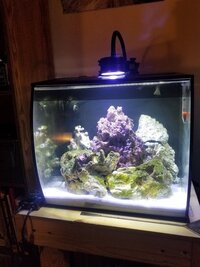
Hey there Asomeone Congrats on the salty tank!!!
Thank you for bringing this to my attention Thedudeiam94
Asomeone , I am unsure what your current burning questions are so I just have a bit to add at the moment, but please feel free to ask away.
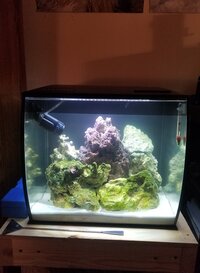
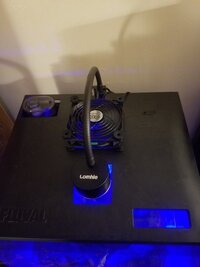
I see you got a wavemaker. That's great because you absolutely want your total flow rate to be at least 20x the tank's volume. The flow rate is sometimes hard to believe when you've come from freshwater but just think about how dangerous ocean currents can be for us! Anyway, I heartily agree that low flow will only cause problems and it's a very good idea to supplement your output's flow with a powerhead. For what it's worth, you may still want to look into Jebao powerheads someday. They are relatively cheap, come with a controller allowing the user to set a flow pattern, (which really is what makes them cheap because other controlled pumps can be quite expensive) and are quite a bit smaller than the one you've got.
Idk about too much
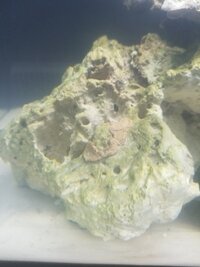
live rock crashing a tank. The issue I think is being referenced here is when the 'live' part of live rock suffers some or total death. Live rock must be kept wet or the life begins to die, and what do dead organics give us? Just like in freshwater, dead organics mean ammonia spikes. Perhaps a large, established, strongly cycled tank could handle it, but a smaller water volume, and/or a less mature tank and cycle make ammonia spikes more dangerous. In fact, the biggest reason that bigger is better with any tank is that smaller tanks are more vulnerable to instability and in much greater danger with toxins... since those big tanks have all that dilution.
However... I'm a nano reef keeper myself. So, don't let that go big or go home thing put you off of reefing someday. It's really not that hard, I swear it! As has been said, your tank will rely on regular weekly water changes of about 20% for keeping the water clean and parameters stable.
As far as a cycle goes... I do not change water during a cycle unless ammonia or
nitrites hit 4ppm or higher and/or nitrates hit 100ppm or higher. Your live rock may have given you an instant cycle... though I kind of doubt that given that you had the rock for several hours before the tank was running. Live rock really does depend on staying 100% wet as well as the oxygenation provided by flow. Soooo... take care that the semi-live rock doesn't make your nitrogen levels too high and to avoid the other bad news that comes from dead organics, you should probably get yourself a
phosphate kit. Nitrates and phosphates feed algae. So, where do you want your parameters to be in a cycled salty tank?
Ammonia - 0ppm
Nitrite - 0ppm (yes, just like with fw, ammo and nitrite are toxic to salty critters)
Nitrate - 0 -15ppm
Phosphates - below 0.5ppm
Why the range on nitrates? Well, also like fw, nitrates are less toxic than ammo or nitrites, but marine creatures are sensitive to higher levels of nitrates. 15ppm doesn't sound so bad coming from freshwater but consider the vastness of the oceans and the dilution that takes place there. Despite pollution and all the rest, the oceans still provide very good water quality for the most part.
Errmm, we didn't wash our
sand either. What's the point of buying live salty sand if you're gonna rinse it with tap water?
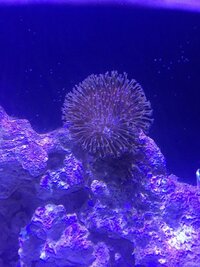
The coral pictured here...
is a leather coral called a Toadstool. Very cool! It's extended (the stringy things, called polyps) in the pic too and that's great! PE (polyp extension) is a sign of happiness in corals and happiness means they're comfortable and assumedly healthy. Leathers are considered the hardiest of hardy and most species do okay in very low light indeed, (by reef standards that is.)
Phew... that was more than a bit. Nice to meet ya, I'm Stella... the author of very looong posts all too often. Hope this helps! Lastly, stop beating yourself up. We all start somewhere and all will make their mistakes, (a couple of mine have been BAD.:eek You're doing great!