Endler Females

Jkaliszew

New Member
Member
Messages
32
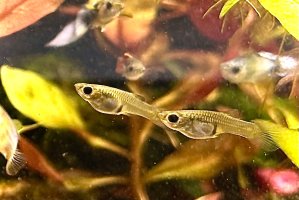
Hi, I’m new to Endler females. I purchased 4 of them and I was wondering how you can tell if they are with fry? Picture below. I need to read up on breeding. I’m so excited to see what kinds of colors the fry have.

if anyone has a tip on getting them to breed please share. Thank you
 

Attachments

  • IMG_3950.jpeg
    IMG_3950.jpeg
    240.1 KB · Views: 76

Advertisement
I have had them reproduce with hard water from the well, light tannins and 80 degrees. They take about 21 days then you will see fry. I have had a mild issue with them being eaten by the group so it may be best to have a birthing tank till they gain size.
 

Advertisement
  • Thread Starter
  • #3
orandaman Thank you, my tank is as you described above except 78f. I may turn the temp up and look into setting up a small separate tank.
 
orandaman Thank you, my tank is as you described above except 78f. I may turn the temp up and look into setting up a small separate tank.

I wouldn't turn up the heat. They bred just fine for me in unheated tanks. Also, I didn't have any trouble with them predating on the fry.
 
Yep, they also look a little bit young too. Might take some time before you see fry. The males will dance and the females will decide if they're worthy of mating.
 
  • Thread Starter
  • #6
BPSabelhaus, oh thank you, I was wondering about their size, if they were small because young or because they are Endlers.
 

Advertisement
BPSabelhaus, oh thank you, I was wondering about their size, if they were small because young or because they are Endlers.
Probably pregnant either way lol Think of them as teenagers / young adults instead of late 20's early 30's peak growth / ready to start a family.
 
Well, endlers shouldn't be eating their fry. In general, endlers will have less fry than most fancy guppies. Female endlers can reach almost the same size as female fancy guppies. When they are pregnant, they stop growing during the whole pregnancy. When they've dropped fry, they tend to be able to grow more. They stop growing temporary during pregnancy because all the nutrition they get is needed to have an energy buffer to be able to carry the load of embryos. Once theyr're dropped, the nutrition in food will be needed to grow to a bigger size until a female has reached her max size.

This means also that young females can become pregnant early.

Heating up is not needed at all. If you do heat up, those endlers will go faster through their lifespan. Best is to keep and breed them at lower or moderate temperatures (between 18°C-23°C is best). When they grow up slower, they can develop a better immune system than when kept at higher rates where they'll grow up faster. A lot of people don't think about that.

And yes, usually the gestation period in endlers will be around 3-4 weeks. Generally, a bit faster than in most guppy breeding forms.
 
Now that you mention the life span and the heat i was never told that, I learned something there. I always wondered why they never lived as long as some of my other fish. I did a bit of research and want to say thank you for the info.
Well, endlers shouldn't be eating their fry. In general, endlers will have less fry than most fancy guppies. Female endlers can reach almost the same size as female fancy guppies. When they are pregnant, they stop growing during the whole pregnancy. When they've dropped fry, they tend to be able to grow more. They stop growing temporary during pregnancy because all the nutrition they get is needed to have an energy buffer to be able to carry the load of embryos. Once theyr're dropped, the nutrition in food will be needed to grow to a bigger size until a female has reached her max size.

This means also that young females can become pregnant early.

Heating up is not needed at all. If you do heat up, those endlers will go faster through their lifespan. Best is to keep and breed them at lower or moderate temperatures (between 18°C-23°C is best). When they grow up slower, they can develop a better immune system than when kept at higher rates where they'll grow up faster. A lot of people don't think about that.

And yes, usually the gestation period in endlers will be around 3-4 weeks. Generally, a bit faster than in most guppy breeding forms.
I hope I did not mislead
 
I hope I did not mislead
No, not at all. Like I've said: Most people don't think of it. And let's be honest, there are way too much people who claim to keep them at higher rates because they thinik it's a tropical fish. The general fish stores and aquarium books will label fish coming from tropical countries as being tropical. This is the first mistake. And that statement has been copied on the internet. Which makes people believe that such fish should be kept at higher temperatures.
It's the location within such a tropical country which makes a fish tropical, subtropical or even coldwater fish. Not each body of water in a tropical country is warm water. Look at body of waters at a higher altitude or surrounded by trees where daylight hardly comes in.
And warm water in a natural body of water creates a different ambiance than warm water in a tank (unless it doesn't have a lid). In a natural body of water, heat can be passed on to the air easier than in a tank with a lid. And that 24 hours a day...
None of my tanks are heated. I've got a normal reproduction and no endler fry are eaten by adults. And they live longer.
You should also know that areas around the equator will have about 12 hours of daylight and 12 hours of nightfall. This goes also for the temperature, at day higher rates than at night. Especially shallow body of waters will have a serious difference in temperature during these two parts of the day. In shallow water, those fish can't swim to a deeper part where the temeparture is more stable. Where most aquarium books and the commercial trade would claim that all tropical and subtropical fish should be kept at a stable water temperature 24/7, serious and seasoned aquarists would claim that for a serious number of fish it's better to keep the fluctuations in temperature in. And I stand by this as well. It's good for their immune system. But the margin in fluctuation should happen gradually in a closed envionment as a tank. This is also the way how it happens in my outdoor tanks during the better months of the year. These fish are way stronger than fish kept at one and the same temeparture.
 
IIRC you've had them in low 60's water temps outside, maybe even into the high 50's before bringing them in.
 
  • Thread Starter
  • #12
Wow, thank you all for the wealth of information, I ended up leaving the temp where it was fluctuating from 76 - 78F and yesterday I spotted these in my tank, there are only 4. Made me so happy!!
 

Attachments

  • IMG_4051.jpeg
    IMG_4051.jpeg
    381.8 KB · Views: 96

Advertisement


Back
Top Bottom