

- Messages
- 173
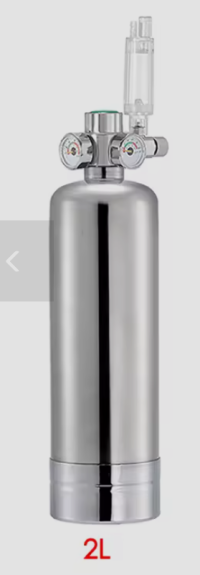
Here is the Carbon Dioxide Reactor Kit for those that not sure what it is:
Results: 1:1 ratio is fine or 1.145 Citric A:1 Baking S.(229g citric acid / 200g baking soda)
However, a 1.31 baking soda: 1 citric acid mass ratio is safer, but more on this later
For around 200g/200g powder, ~300g water is okay (it is just a medium where the reaction takes place)
Note: do not exceed the recommended amounts for your bottle, or it might explode if you put a lot more of any of them, even water (takes space). For my bottle, 200g citric acid /200g baking soda /300g water is recommended.
Reasoning (lots of chemistry):
Before I begin, please correct me if I am wrong...
After some research, I came to the conclusion that a 3:1 mol ratio is not quite right.
But this reaction looks more like this:
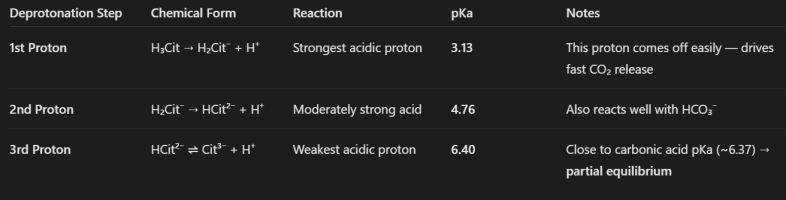
Looking at this table, GPT provided me (I am lazy), we can see the pka values for each step. The first and second protons are being donated quite easily, but the 3rd one has some struggles.
For this reaction to move forward, the pKa of the donor acid < pKa of the conjugate acid of the base (That means: the proton goes from the stronger acid (lower pKa) to the weaker acid (higher pKa). The acid is HCit²⁻, and conjugate acid is H2CO3 (carbonic acid)
The carbonic acid has a pKa of 6.37, which is lower than 6.4 for the 3rd proton and therefore not favoured to react. The values are very close to each other, which means some reaction might occur, but it will be at a very slow rate.
Considering the high pressure inside the bottle after 1st and 2nd proton donated, the reaction will shift to the reactant side (or favoured). This is another reason that the 3rd proton is not favoured.
One thing that can be done to force the 3rd proton to be donated is to have a basic solution. This will shift the reaction to the product side as it is more favoured to release a proton.
OTHER IMPORTANT FACTOR
This is to protect your steel bottle. I don't know what brand you are using, but mine is a Chinese, cheap one. Which means they probably used a low-quality stainless steel. If the solution is acidic, it will ruin the bottle over time.
It is better for the bottle to have a slightly basic solution than a slightly acidic one. One reason to use more bicarbonate.
In conclusion:
A slightly more basic solution is more efficient and better for the bottle's longevity.
Why 1:1 mass ratio?
So, if we use a 2:1 mol ratio, then the excess is baking soda (2.28:1), making the solution more basic. A more basic solution will both save the bottle and make the 3rd proton more favourable to be donated.
229g citric acid / 200g baking soda
It looks riskier to me. The 2:1 mol ratio will make the solution neutral in theory, not making it slightly basic to help the last proton be donated. And more likely slightly acidic if the last proton is donated over time.
My questions:
While I spent like +2 hours getting to the bottom of this, I am still not sure about one thing:
The nerds, please let me know if there is a mistake somewhere.
Thank you.
Results: 1:1 ratio is fine or 1.145 Citric A:1 Baking S.(229g citric acid / 200g baking soda)
However, a 1.31 baking soda: 1 citric acid mass ratio is safer, but more on this later
For around 200g/200g powder, ~300g water is okay (it is just a medium where the reaction takes place)
Note: do not exceed the recommended amounts for your bottle, or it might explode if you put a lot more of any of them, even water (takes space). For my bottle, 200g citric acid /200g baking soda /300g water is recommended.
Reasoning (lots of chemistry):
Before I begin, please correct me if I am wrong...
After some research, I came to the conclusion that a 3:1 mol ratio is not quite right.
It might look tempting to say citric acid gives 3 protons (H+) to bicarbonate:H3Cit + 3 HCO3⁻ → Cit³⁻ + 3 H2CO3 → Cit³⁻ + 3 CO2 + 3 H2O
OR
H3C6H5O7 + 3NaHCO3 → Na3C6H5O7 + 3CO2 + 3H2O
Citric acid + 2 Sodium bicarbonate → Disodium hydrogen citrate + 2 Carbon dioxide + 2 Water
OR
H3C6H5O7 + 3NaHCO3 → Na3C6H5O7 + 3CO2 + 3H2O
Citric acid + 2 Sodium bicarbonate → Disodium hydrogen citrate + 2 Carbon dioxide + 2 Water
But this reaction looks more like this:
H3Cit + HCO3⁻ → H2Cit⁻ + H2CO3
H2Cit⁻ + HCO3⁻ → HCit²⁻ + H2CO3
HCit²⁻ + HCO3⁻ ⇌ Cit³⁻ + H2CO3
So, there are 3 steps to this equation, and in each step, one proton is being donated.H2Cit⁻ + HCO3⁻ → HCit²⁻ + H2CO3
HCit²⁻ + HCO3⁻ ⇌ Cit³⁻ + H2CO3
Looking at this table, GPT provided me (I am lazy), we can see the pka values for each step. The first and second protons are being donated quite easily, but the 3rd one has some struggles.
HCit²⁻ + HCO3⁻ ⇌ Cit³⁻ + H2CO3
For this reaction to move forward, the pKa of the donor acid < pKa of the conjugate acid of the base (That means: the proton goes from the stronger acid (lower pKa) to the weaker acid (higher pKa). The acid is HCit²⁻, and conjugate acid is H2CO3 (carbonic acid)
The carbonic acid has a pKa of 6.37, which is lower than 6.4 for the 3rd proton and therefore not favoured to react. The values are very close to each other, which means some reaction might occur, but it will be at a very slow rate.
Considering the high pressure inside the bottle after 1st and 2nd proton donated, the reaction will shift to the reactant side (or favoured). This is another reason that the 3rd proton is not favoured.
One thing that can be done to force the 3rd proton to be donated is to have a basic solution. This will shift the reaction to the product side as it is more favoured to release a proton.
OTHER IMPORTANT FACTOR
This is to protect your steel bottle. I don't know what brand you are using, but mine is a Chinese, cheap one. Which means they probably used a low-quality stainless steel. If the solution is acidic, it will ruin the bottle over time.
It is better for the bottle to have a slightly basic solution than a slightly acidic one. One reason to use more bicarbonate.
In conclusion:
A slightly more basic solution is more efficient and better for the bottle's longevity.
Why 1:1 mass ratio?
Calculate moles for 100 g each:
moles_citric_acid = 100 / 192.12 ≈ 0.521 mol
moles_baking_soda = 100 / 84.01 ≈ 1.19 mol
Molar ratio (baking_soda : citric_acid):
1.19 / 0.521 ≈ 2.28:1
I talked about how the 3rd proton won't react most likely. A 3:1 mol ratio is not a very good representation of what's going onmoles_citric_acid = 100 / 192.12 ≈ 0.521 mol
moles_baking_soda = 100 / 84.01 ≈ 1.19 mol
Molar ratio (baking_soda : citric_acid):
1.19 / 0.521 ≈ 2.28:1
So, if we use a 2:1 mol ratio, then the excess is baking soda (2.28:1), making the solution more basic. A more basic solution will both save the bottle and make the 3rd proton more favourable to be donated.
229g citric acid / 200g baking soda
It looks riskier to me. The 2:1 mol ratio will make the solution neutral in theory, not making it slightly basic to help the last proton be donated. And more likely slightly acidic if the last proton is donated over time.
My questions:
While I spent like +2 hours getting to the bottom of this, I am still not sure about one thing:
- Does 3 baking soda :1 citric acid mol ratio make a more basic solution that will force the 3rd proton to be donated more? If perhaps most of the 3rd proton is going to be donated over time (since we have +a month using the bottle's solution), then do we need the 3:1 mol ratio to be able to use all of the last proton? Or is it just a waste of material and space in the bottle?
The nerds, please let me know if there is a mistake somewhere.
Thank you.


