Any not only under water frogs?
If you can find some, the species
Ocidogyza lima is a lot of fun.
Asian floating frog, green puddle frog, rough-skinned floating frog, pearly skin puddle frog, etc., are all names applied to these little guys.
They’re very quiet unless love is in the air - one of mine, I believe it was a male, made sounds just like wet sneakers on a kitchen floor - startled me the first time he did it.
Adults almost never leave the water but should have a raft or platform to crawl onto just in case they choose to. Juvies will crawl onto floating plants to hunt.
They spend most of their time floating quietly because they are ambush predators - unbelievably fast ones.
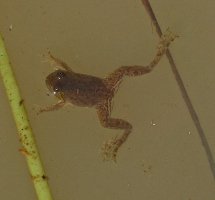
Their beady eyes are smack on top of their heads so they can lurk with only their eyes above water and allow the water’s distorting effects, reflections & the floatingplants to hide them from both their potential prey and all the larger predators seeking a froggie entre for dinner.
Image from Wikipedia, Commons licenced.
They only eat live insects so feeding them is a more challenging task than with the ADFs, and just fyi, crickets alone are
not enough.
Be sure to dust their insects at least a couple times a week with a herp’ mineral/vitamin powder with
calcium & Vit D unless there is a UV lamp over them - if there is UV light then you can use the powdered supplement version without Vit D.
When you put prey insects in their tank, the instant they notice it’s like turning on a light - they all become hyper alert at once. The difference between how they act when prey is visible compared to them just hanging’ out has to be seen to be appreciated.
They’re a little wider in body than an ADF - females are a bit more chunky triangle shape & they have a bit shorter front legs but overall they’re similar in size to an ADF & when I had some, I thoroughly enjoyed them. I would love to have them again if only I could find some.
As wee froglets they would do a mad scramble across the floating plants to take prey. They’re so fast that all you see is a blur. But if you can get video then you can see the scrambling & dive at the end with the prey in their mouth.
Once they grew a bit bigger, scrambling was too much work or maybe they were too heavy, but they went into lurking mode then.
It was quite entertaining to watch them slowly seemingly drifting into the perfect position to suddenly lunge & snatch a luckless cricket or beetle. And then watch the legs of the insect slowly disappear as the frog worked on swallowing it all.
They require a lot of floating plant cover to lurk around/under & the insects need it too, so they can move around without drowning.
Crickets are apparently not aware that they can’t swim. They drown with ridiculous ease.
If an insect drowns, the frogs ignore it - though with time & effort you may be able to teach them to take freshly drowned insects from tongs.
I had only limited success with that as the frog I was training had a very unfortunate accident, so I didn’t get to finish what we started.
These frogs are not remotely interested in fish or shrimp or anything else underwater so they pose no danger to them.
But I learned a painful lesson with my frogs
- do not keep catfish of any species with them.
My last female frog mistook a quick dash for air by a Pygmy corycat for the movement of an insect - it made the plants move when it hit the surface. Froggy grabbed it before it had a chance to dive back down - strictly a case of mistaken identity but the poor things both died.
The catfish was so tightly wedged in the frog’s mouth that it was not possible to remove it even after death - its spines were too deeply anchored in the poor frog’s mouth.
Their tank needs an insect proof cover to keep their prey in and stop frogs leaping out - though the only times mine tried to jump was when they were startled or I had to catch one.


