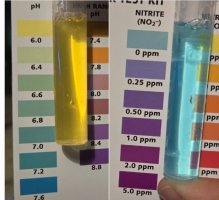
How To Fix This Mess

megant26

New Member
Member
Messages
5
Tank
What is the water volume of the tank? 120 gallon
How long has the tank been running?
over 2 years
Does it have a filter?
2 fluval ac110 filters
Does it have a heater?
 yes
What is the water temperature?
85F(recently had to change my heater and have been out of town, yes I know this is high and will be corrected shortly)
What is the entire stocking of this tank?
6 silver dollars, 1 angelfish, 3 blue gourami

Maintenance
How often do you change the water?
 monthly
How much of the water do you change?
25%
What do you use to treat your water?
tetra aquasafe plus and easy balance plus
Do you vacuum the substrate or just the water?
vacuum substrate

*Parameters - Very Important
Did you cycle your tank before adding fish?
 yes
What do you use to test the water?
API Freshwater Master Test Kit
What are your parameters?
Ammonia:see photo
Nitrite: see photo
Nitrate:see photo
pH:see photo
GH:unknown
KH: last tested with strip, showed 240

Feeding
How often do you feed your fish?
 daily
How much do you feed your fish?
approx 1/4 tsp
What brand of food do you feed your fish?
 tetra
Do you feed frozen?
occasionally blood worms
Do you feed freeze-dried foods?
 no

Illness & Symptoms
A cory cat got stuck in a rock crevice and died, setting off a chain reaction that killed 6 cory cats, 4 dojo loaches, 2 angels, a spotted Rachael catfish, and a highfin plecco. I did a 40% water change, then tested with a strip test. I found the ph very acidic, so I added API ph 7.0 and retested 48 hours later. Ph was still 6 or below and kh was now over 240. I got the Master Test Kit and have the more accurate results listed. How do I get this back to safe parameters?
 

Attachments

  • Screenshot_20260927_193027_Gallery.jpg
    Screenshot_20260927_193027_Gallery.jpg
    69.2 KB · Views: 17
  • Screenshot_20260927_193043_Gallery.jpg
    Screenshot_20260927_193043_Gallery.jpg
    63.8 KB · Views: 15

Advertisement

Advertisement
How do I bring up the ph? Or will that gradually fix with water changes?
WC will bring it back up but don’t go too fast or you’ll make it worse. You can also use baking soda to raise it. There must be a calculator out there to calculateur how much to use and how fast. The one I know is for reefs.

Once you’ve fixed this urgent issue, you need to look at why a single fish dying in your tank is causing so much problem when it should have been completely transparent. Your tank biology and natural process should have taken care of this without even you noticing.

You have a high bioload and your maintenance is minimal. I would look at increasing water changes frequency, and systematically syphoning the substrate every time you do one.
 
This is indeed perplexing.
I agree with cdr63corv that messing with pH is not ideal atm. Besides, with a KH of 240, the pH is not likely to move.

Get extra oxygen via bubblers, wave makers, or any surface agitation into that tank asap until your 85 degrees is way lower which you have to do gradually. A heavy load having a high temperature without ample oxygen is trouble in the making.

The ammonia test you showed had too high a level, but with a pH of 6, most all that ammonia (TAN total ammonia which is both NH3 free ammonia [bad] and NH4 ammonium [not lethal to fish] is, in fact ammonium because of your lower pH. In other words, that one cory death could never have created enough ammonia to harm anything in your tank…..especially one of that size volume.

Something is off. I say this only to help remedy your situation, not to be condescending. Because your results are really atypical, my first inclination would be to retest. Then, check to make sure you’re doing it right. Do test the new water going into the tank as well, for it could actually be the culprit. Finally, with such odd results, I would buy a new test kit and be sure it is not expired. I know this is a pain……sorry.

I could go on and on about how your numbers seem odd, but suffice it to say, eliminate any possible errors in testing and in the materials being used. Just one example of one peculiar issue perplexing to me would be your having a pH of 6 while also having a KH of 240. There are more, but start eliminating factors to work this out and a picture should develop of what happened….and don’t buy or replace any fish yet. Good luck and sorry you’re going through all this. Keep us apprised.
 

Advertisement
  • Thread Starter
  • #8
WC will bring it back up but don’t go too fast or you’ll make it worse. You can also use baking soda to raise it. There must be a calculator out there to calculateur how much to use and how fast. The one I know is for reefs.

Once you’ve fixed this urgent issue, you need to look at why a single fish dying in your tank is causing so much problem when it should have been completely transparent. Your tank biology and natural process should have taken care of this without even you noticing.

You have a high bioload and your maintenance is minimal. I would look at increasing water changes frequency, and systematically syphoning the substrate every time you do one.
Explain high bioload. I have 10 fish in a 120 gallon tank.

Oh…..forgot to ask, but do you use/add CO2 into your tank for plants?
I have a dual bubbler already in the tank. No added co2.

Not a fan of messing with the ph. I'd wait and see what happens after a few water changes. What is your pH out of your tap?
7
 
Oops….sorry….misread the numbers. That is not a high bioload. Mybad.
 
I have been in this mess before and it was due to very low pH crashing the cycled tank.
It goes like this:

• Bacterial slowdown: Beneficial nitrifying bacteria grow and reproduce much slower when the pH drops under 6.0. If the pH drops to around 5.0 or lower for more than a couple of days, the bacteria can become dormant or die off, stalling the cycle.
• Lack of carbonate hardness (KH): Nitrifying bacteria consume carbonate hardness (bicarbonate) as they work, which naturally depletes KH and pulls the pH down over time.
• Ammonia conversion: At a lower pH, most ammonia converts into ammonium (NH₄⁺), which is safe for fish but less available as a high-energy food source for standard ammonia-oxidizing bacteria, making the process take much longer.

How to Fix or Prevent a pH Stall:

• Perform water changes: Do partial water changes using fresh tap water with a higher pH and mineral content to replenish KH and raise the pH.
• Add buffer material: Place a small mesh bag of crushed coral, aragonite, or limestone in your filter to slowly dissolve and buffer the water against sharp pH drops.
• Avoid harsh chemicals: Avoid liquid "pH Up" additives, as they create unstable chemical rollercoasters in the aquarium.

How It Works
    • The Equilibrium Point: Crushed coral is made of calcium carbonate. It dissolves in acidic water (lower pH) and releases carbonate ions, which raises the carbonate hardness (KH) and pH.
    • When It Stops Dissolving: Once the water's pH reaches roughly 7.6 to 7.9, the water becomes saturated with calcium carbonate. The coral stops dissolving, which prevents the pH from climbing infinitely higher.
    • Amount vs. Target pH: Adding more crushed coral speeds up how fast the pH rises and increases your overall buffering capacity (KH), but it does not change the final ceiling or equilibrium point of the pH. If your tap water's pH is already above 7.8 or 8.0, crushed coral will generally have little to no effect.
 

Random Great Topic!

Advertisement


Advertisement


Advertisement


Back
Top Bottom