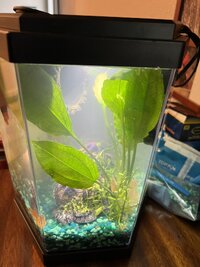
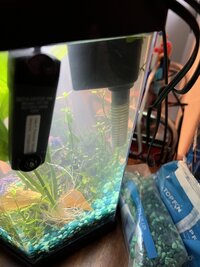
2 Gallon Tank Trying to do a fish in cycle with betta

Cubbs44

New Member
Member
Messages
1
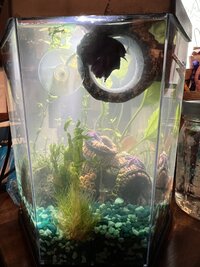
I need some help with our 2 gallon tank. We have a betta in the tank and are now trying to do a fish in cycle. We did not realize beforehand and awe are just trying to do everything we can to make this work. I’m using Prime and Stability at this point. I was told to dose with the prime to neutralize the ammo is and whenever I saw and ammonia spike to add stability. However I’m not sure on the exact dosing and some people have even suggested doing 100% water changes everyday and im
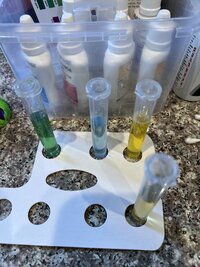
Not sure that sounds wise either. We have some plants in the tank and a small water heater. As of this morning PH 6.0 AM 3.0 NO2 0 NO3 2.5 ~ according to API test. I did a 30% water change last night and a 50% water change 2 days before. We just really need some good and solid guidance.
 

Attachments

  • IMG_0674.jpeg
    IMG_0674.jpeg
    397.7 KB · Views: 170
  • IMG_0675.jpeg
    IMG_0675.jpeg
    383.2 KB · Views: 131
  • IMG_0676.jpeg
    IMG_0676.jpeg
    336.1 KB · Views: 136
  • IMG_0677.jpeg
    IMG_0677.jpeg
    326.1 KB · Views: 76
  • IMG_0671.jpeg
    IMG_0671.jpeg
    366.8 KB · Views: 64

Advertisement
I would at some point consider upgrading to a 5gal, but for now...
When it comes to dosing, all you should need is just a drop or two of prime given the size of your tank. It's very concentrated. I use just a couple drops for my 29gal.

Your beneficial bacteria lives on surfaces, ie: Your filter cartage/media and your substrate. Not the water column, this is why you can do a massive water change and not have a cycle crash. For each large change, however, (50 percent and above) I would add stability because you already have it and large changes can mess with your pH.

Back when I had my ammonia spike as a total beginner, I DO wish I did larger water changes then the 50 percent ones every other day.
 

Advertisement
Welcome to Fishlore. I can set your mind at rest regarding ammonia because thanks to basic water chemistry and the way ammonia behaves in water, at a pH of 6, there isn’t any dangerous ammonia to worry about.

Ammonia has two forms in water, at all times, which coexist with other in a very well understood ratio controlled primarily by pH and also temperature.

The two forms are NH3 & NH4. NH4 is called ammonium and is not toxic to fish. NH3 is extremely toxic, aka free ammonia.

The lower the pH, the less NH3 and the more NH4 there will be and at any pH lower than 7 the amount of NH3 is extremely low and at pH6 the amount is so low it’s far below the threshold where it could harm fish.

With ammonia as with so many other things, it is ALL about dosage. At a level of .05ppm or less, NH3 won’t harm fish because the dose is too low.

At .6ppm or more it WILL harm the fish.

Nitrite is actually a bigger danger. Safe levels are .75ppm or less. Over that fish become stressed and the higher the level the more stress. At 5ppm it starts to affect their blood in a way that prevents oxygen from being carried to vital organs so fish begin to show signs of difficulty breathing.

The only ideal reading for either ammonia or nitrite is zero but there is no point to being worried sick so long as levels aren’t actively causing harm to the fish.

The claims that products like Prime make regarding ‘detoxing’ ammonia fly in the face of well understood chemistry so I am among the many who do not believe the claims.

But with pH as low as yours, whether or not Prime can detox ammonia is irrelevant because of the low pH. I see no point in wasting money by using Prime in any greater amount than is needed to neutralize chlorine/chloramine.
 
I would not recommend fish-in cycles. The current ammonia count in your tank can often prove fatal to certain types of fish. I would also recommend trying a more concentrated bacteria solution than Stability, such as FritzZyme7 or TurboStart. Although TurboStart is expensive, it is (in my opinion) the best chemical to cycle your tank. If you don't have access to either of these chemicals, dose Stability daily, and perform 30% water changes twice a week. You should see your ammonia levels start to drop within the next 5 days or so if you follow these instructions. As your ammonia levels drop, you should see an increase in nitrites. Make sure to keep using Prime to neutralize these nitrites. Within the next month, your tank should be fully cycled as long as you keep those ammonia and nitrite levels in check. In the end, as long as you keep dosing Stability and testing your water frequently, your betta should be okay as long as your ammonia levels drop. After all, bettas are hardy fish! In the future, I would recommend a fishless cycle, and possibly a bigger tank for your betta, (5+ gallons). Let me know if you have any more questions or concerns.

Best wishes, TheBettaKeeper
 
It is normal practice for betta breeders to do a %100 water change every day or every other day in the bare jars or bottles they grow them out in. Water changes are only a shock to fish if the temperature and parameters of the new water is close to the old water which they should be if you are doing big water changes. Your tanks is pretty small so it is not a big deal to do that.
 
It is normal practice for betta breeders to do a %100 water change every day or every other day in the bare jars or bottles they grow them out in. Water changes are only a shock to fish if the temperature and parameters of the new water is close to the old water which they should be if you are doing big water changes. Your tanks is pretty small so it is not a big deal to do that.
You should NEVER do 100% water changes. This can ruin the nitrogen cycle in your aquarium. Unless you are quarantining, your fish should never leave the tank.
 

Advertisement
If the substrate and filter stay wet it is not really %100 and the colonies will get established.
 
You should NEVER do 100% water changes. This can ruin the nitrogen cycle in your aquarium. Unless you are quarantining, your fish should never leave the tank.
Why? The beneficial bacteria almost entirely lives on surfaces. As long as these surfaces don't dry out, they'll be fine*.

*Obviously don't let your substrate and filter media go without a food source(ammonia/biowaste) for an extended period of time, but that is hair-splitting, and I would like to NOT overwhelm this newcomer to the hobby.
 
You should NEVER do 100% water changes. This can ruin the nitrogen cycle in your aquarium. Unless you are quarantining, your fish should never leave the tank.
Nothing wrong with doing a total water change, especially in a tank this small. There is almost no beneficial bacteria that is free floating in the water column. Nitrifiers form hardy biofilms on surfaces, like filter media and the substrate. The issue with doing a complete water change is when the new added water has different tds, hardness, pH, temperature, etc. But like someone mentioned, a tank this small won’t be an issue to do a complete water change
I need some help with our 2 gallon tank. We have a betta in the tank and are now trying to do a fish in cycle. We did not realize beforehand and awe are just trying to do everything we can to make this work. I’m using Prime and Stability at this point. I was told to dose with the prime to neutralize the ammo is and whenever I saw and ammonia spike to add stability. However I’m not sure on the exact dosing and some people have even suggested doing 100% water changes everyday and im
Not sure that sounds wise either. We have some plants in the tank and a small water heater. As of this morning PH 6.0 AM 3.0 NO2 0 NO3 2.5 ~ according to API test. I did a 30% water change last night and a 50% water change 2 days before. We just really need some good and solid guidance.
Welcome! You don’t need to dose these chemicals, they are not harmful but they are not miracle cures. They are marketing points to try and get new hobbyists to detoxify ammonia and nitrite. In reality, these products are likely pseudoscience, but there is some research and patents with the supposed main component of prime, rongalite, potentially detoxifying ammonia. Regardless, all you need to do are simple water changes. I recommend testing daily and doing 50% changes accordingly. No need to worry about dosing additives
 
If pH is 6 the ammonia is all ammonium and can't hurt the fish.
Test your source water let us know what that is, is it also ph6?

I'm gonna say if your water is pH 6, it's not going to cycle. Ideally for a betta you'd want closer to pH7 and really not lower than pH6.5 not sure if it will shorten the lifespan or open the fish up to illness or just stop it from ever breeding. Not sure of the results of keeping a betta fish there. But it's not going to cycle at that pH no matter what you try the nitrifying bacteria doesn't like it unless some of the ammonium is unlocked to ammonia.

It doesn't really need to be cycled though if it's pH 6 though, it's not dangerous with all of the ammonia locked up as ammonium.

Anyways. Test the water you used for filling the tank and water changes for pH KH and GH let us know the results of that, it really shouldn't be pH 6 unless it's filtered or really old water with no KH.
 
I'm not saying that 100% changes are always a no, I just wouldn't recommend them often, because if you let your substrate and media dry out, than this is when your beneficial bacteria are at risk. I'm only saying that it may not be wise to move your fish to another tank to perform these water changes, unless you are quarantining them. Although, with a tank this small, I suppose you can perform an 100% water change if absolutely necessary. I personally keep my bettas in 10 gallons, so I don't like performing changes over 50%. When I said that the nitrogen cycle could be ruined, I meant when you are still cycling your tank. When cycling, beneficial bacteria is still becoming established on surfaces inside your tank, so you would have more of it free-floating in the water column. This is because it hasn't become fully seeded in your substrate/filter media yet. I apologize for any confusion. Feel free to reach out to me with any more questions or concerns.

Happy fishkeeping, TheBettaKeeper
Why? The beneficial bacteria almost entirely lives on surfaces. As long as these surfaces don't dry out, they'll be fine*.

*Obviously don't let your substrate and filter media go without a food source(ammonia/biowaste) for an extended period of time, but that is hair-splitting, and I would like to NOT overwhelm this newcomer to the hobby.
I agree, I'm sorry for the confusion. Read my most recent post in this strain.
 
Advertisement


Advertisement


Advertisement


Back
Top Bottom