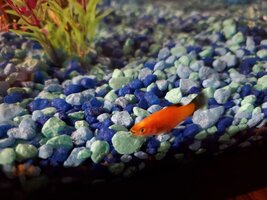
First time fish owner. We decided to get fish as a pet for our 3 year old. We have a 20 gallon tank. After a week of the tank running we got 5 red wag platys. They seemed to be just fine. A week later we got 5 panda catfish. Within a day one of the catfish was dead. I don't think it moved much in the store so I'm thinking that was the problem with that one. I also realized the catfish like cooler temps so we dropped it from 79 to 75. The catfish got a lot more active but the platys seemed to be less active. The ammonia is about 1.0, maybe 1.5. We changed out 2 gallons of water today hoping that will help. We have one platy that is very lethargic and I'm pretty sure we're going to lose it but I just noticed a white spot on its head but it doesn't look like ick, but no expert on that either. We wanted to get our final 5 fish this friday but I'm thinking we shouldn't. Any recommendations in how to make sure no more die would be great. Also does anyone have any idea what is wrong with our platy?

You are using an out of date browser. It may not display this or other websites correctly.
You should upgrade or use an alternative browser.
You should upgrade or use an alternative browser.
Sick Red Wag Platy?

Advertisement
- Messages
- 343
Your ammonia level is extremely high. It needs no be as close to 0 as possible. The water is toxic to your fish and is probably causing skin irritation and not allowing your fish to preform proper body functions. You need to do a significant water change, at least half the water as soon as possible. Are you sure those levels are correct? I would expect your fish to be showing more symptoms or dead, but then again Platys are pretty tough in my experience. The sore may heal with proper water conditions.
Before you get any more fish please research the nitrogen cycle and learn how to properly cycle an aquarium. It's easy to learn and 100% necessary to keep your fish alive for more than a couple weeks. You need more than just a filter to clean the water in the tank. You have to grow bacteria inside of it inorder for it to be effective.
It is going to be hard to keep that many fish healthy and alive until you cycle the tank. Do you know anyone with an established fish tank that has been running for a few months or years? Taking media from their filter or gravel from the tank would help you a lot. That's where the nitrifying bacteria are. There are plenty of people here willing to help you and answer any questions you have, and there is a lot of helpful info at the top of the forum. Good luck!

- Messages
- 2,046
Welcome to Fishlore
It's unusual for a thread to go unanswered for so long on this forum. I'll hazard a guess that it's because there are so many problems with your situation. It would take a while to sort through it and explain the reasons why.
Start reading here: READ FIRST: Freshwater Beginner Important Topics | Freshwater Beginners 14296
Any ammonia is potentially toxic and could kill the fish. Any nitrite is toxic too.
Municipal tap water is typically treated with chlorine or chloramine. It should be detoxified before being added to a tank as those chemicals are toxic to fish. Seachem Prime is the most popular water treatment solution with good reason.
I suggest that you pour a bottle of Tetra Safe Start Plus into your filter media. Shake it really hard first. This bacteria booster is a shortcut to establish your "cycle" - growing the beneficial bacteria colonies that will keep fish poop and waste from poisoning your fish.
Stressed fish are prone to developing ich, AKA "white spot". Their environment is probably toxic right now so they're stressed. I suggest a product like Ich-X to treat them if you confirm it's ich.
A proper test kit is essential for monitoring water parameters, especially in a new tank. The API Master Freshwater Test Kit is usually $22-$24 on Amazon. Big box pet stores should price match.

- Messages
- 1,223
Building on ammonia being toxic... keep in mind in a tank that has 20 gallons of water, if your ammonia is at 1.0 hypothetically, and you change 50% of the water (10 gallons), then your ammonia level after the water change would be at .5. If you only changed 10% of the water (2 gallons) then your ammonia level after the water change would be at .9. So if you have high levels of ammonia, only changing 2 gallons of water isn't helping. You need to do much larger water changes. The ammonia should be as close to 0 as possible as any level of ammonia can be toxic to fish. In your case, right now, you should probably be doing HUGE water changes (90% if you can), because we need to get that ammonia reading below 0.1. Once your tank is cycled and your bacteria colony is processing the ammonia properly, then you can possibly rely on 20% water changes every week. But you aren't there yet. It can take a month or longer for a tank to cycle.
The people above mentioned cycling the tank (the nitrogen cycle) and water conditioner, so I won't get into detail about those items, but it is essential that you understand those things. Those aren't optional things, they are essential to keeping your fish alive. I know at first glance it seems complicated, but once you wrap your head around it, it's not so bad. There is no magic product or chemical you can pour into your tank to make these problems go away... you need to understand what is happening in your tank so you can properly address it.
The people above mentioned cycling the tank (the nitrogen cycle) and water conditioner, so I won't get into detail about those items, but it is essential that you understand those things. Those aren't optional things, they are essential to keeping your fish alive. I know at first glance it seems complicated, but once you wrap your head around it, it's not so bad. There is no magic product or chemical you can pour into your tank to make these problems go away... you need to understand what is happening in your tank so you can properly address it.
Random Great Topic!
Today's Deals
Advertisement
Advertisement
Advertisement