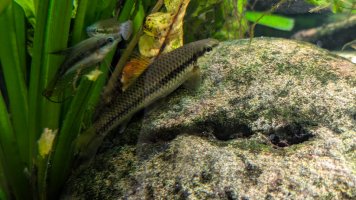
Siamese algae eater identification

naluralstyletanks

New Member
Member
Messages
39
Hello all, Ive been wondering for a while know about wether or not I have true Siamese algae eaters or not. I first bought a couple of these guys (one in picture) last spring and they've been doing well, no doubt they've been nibbling on algae, but not a lot given their size. The main thing that's confusing me is that these fish share every trait with Siamese algae eaters except for the barbells in which they lack. I bought a few more Siamese algae eaters with the barbells, and other than that I e trait( and size) they look the same, however their behavior are definitely different. The ones w/ barbells appear to eat more algae that the others ( likely size dependent) and are way more active than the others ever were. The two groups seem to interact as well, but they don't school together, they usually stick to their own groups apart from the occasional swim.
I can't figure out anything definitive with my research and it's a really interesting problem because I've noticed that when you search Siamese algae eater online they show both types I'm mentioning here, but it seems like nobody knows the difference (at least not easily findable sites)
This is the best photo I could get, there a little camera shy so apologies for the quality.
 

Attachments

  • PXL_20260311_222740444.RAW-01.COVER.jpg
    PXL_20260311_222740444.RAW-01.COVER.jpg
    319.6 KB · Views: 30
  • PXL_20260311_222758608.RAW-01.COVER.jpg
    PXL_20260311_222758608.RAW-01.COVER.jpg
    368.7 KB · Views: 78

Advertisement
I suspect your fish without barbels are Garra cambodgiensis. Often confused with Crossocheilus oblongus which is the genuine SAE.

They get to garras are not known for serious algae eating though they do eat some, especially when young.

They get to roughly the same mature size of about 6” as SAEs but unlike the social SAE, they are territorial and become more so with age. You might have to rehome one eventually, depending on how much space they have.

I hope your tank is at least four feet in length, if not more, as both species need space once they get larger.

True SAEs are quite social and do best in decent size groups - 5-6 and more if that’s possible.
 

Advertisement
  • Thread Starter
  • #3
I suspect your fish without barbels are Garra cambodgiensis. Often confused with Crossocheilus oblongus which is the genuine SAE.

They get to garras are not known for serious algae eating though they do eat some, especially when young.

They get to roughly the same mature size of about 6” as SAEs but unlike the social SAE, they are territorial and become more so with age. You might have to rehome one eventually, depending on how much space they have.

I hope your tank is at least four feet in length, if not more, as both species need space once they get larger.

True SAEs are quite social and do best in decent size groups - 5-6 and more if that’s possible.
Thanks for the advice, hopefully I won't need to re home them, but if so I do have some tanks that could take them.

On second thought, It doesn't seem that they are, the garra have sucker mouths, which these don't, and a stripe above the black lateral line. The black stripe on the tail fin also goes all the way through on mine, and doesn't in the garra.

I'll try to find something older photos and get some new clearer ones.
 
If you have black beard algae and they ate it all they are true saw. If not they are most likely flying foxes. But yours do look identical to the ones I e had in the past. Got them at about .5 inches each and one grew to close to 6” and the other was close to ‘5”… I believe the true saw also have a very faint gold line running just above their black stripe that runs from tip of nose to the very end of the center of their tail. A full body picture in a little better light may be helpful.
 
  • Thread Starter
  • #5
Here's what I could get, I was able to capture a video of one from a couple feet away, but I couldn't get any closer or it would swim away, so apologies if the quality still isn't great.
Hopefully seeing some behavior could help as well

New video · Thursday, Mar 12
 
Your fish looks like a true SAE to me. Something to consider, though, is that there are several species of "true" SAEs. For example, Crossocheilus oblongus, Crossocheilus langei, Crossocheilus nigriloba, and Crossocheilus artilimes are all true SAEs. There's probably a bunch more out there, including those that haven't been named yet. Seriously Fish puts it like this, "The distribution of laterally striped Crossocheilus spp., particularly in Thailand, requires further study as some populations may apparently represent undescribed species."

Therefore, when we buy a "true" SAE, it could be any number of species. I think this may account for the inconsistent observations of this fish such as shy/bold, aggressive/peaceful, eats BBA all it's life/stops eating algae when it gets big, etc.

I'd bet you have 2 different species of true SAEs.
 
.
Flying fox fish (Epalzeorhynchus kalopterus) have two pairs of slender, short barbels that point forward around the mouth.

Members of genus Crossocheilus all have barbels too but in some species they aren’t easy to see.

Sadly, there isn’t specific information for all the species. Here’s what I could find.

C.langei has two pairs of barbels - one pair maxillary (around the mouth), one rostral (above & slightly behind upper lip).

C.cobitis has two pairs of barbels very like those of C.langei.

C..obscurus has a single pair of rostral barbels without any visible maxillary barbels.

C.elegans

Has a different body stripe pattern & small barbels that can be hard to see without a very up close & personal physical examination.

Seriouslyfish says, Quote” easily distinguished from other members of the genus by its colour pattern which consists of a blackish midlateral stripe extending from the tip of the gill opening to the middle of the caudal-fin base, which is separated from the dark brown dorsum by a pale yellowish brown stripe.

This differs from the pattern seen in other Crossocheilus species with a black midlateral stripe in which the the dorsum is olive brown and much paler than the midlateral stripe, there is no yellow stripe between the dorsum and the black stripe, and the black stripe extends to the tip of the snout.”Unquote

C. atrilimes has one pair of small rostral barbels but no maxillaries.

Seriouslyfish says, Quote” can be diagnosed by the following combination of characters: midlateral stripe extending to posterior extremity of median caudal-fin rays; 1 or 2 rows of faint dark spots along scale rows below lateral line; 1-1½ scale rows between anus and anal-fin origin; body depth 23.8-26.4 % SL; a single pair of rostral barbels.”Unquote
 
Advertisement


Advertisement


Advertisement


Back
Top Bottom