L239 plecos - Not eating much/anything

umiz00mi

Active Member
Member
Messages
58
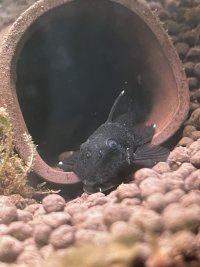
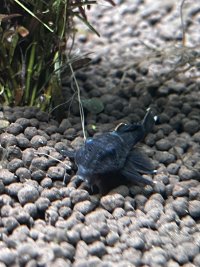
I got 2 L239 "Blue panaque" Baryancistrus Beggini plecos in about 2 weeks ago, which I believe are still juveniles. They're beautiful fish, but I cannot for the life of me figure out what to feed them. From my research I know that their diet is omnivorous, consisting mainly of algae wafers and whatnot with supplemental protein like shrimp pellets, brine shrimp, etc. as well as driftwood for rasping. I've provided them with all of these things, but no matter what I feed them the food is untouched in the morning (they are nocturnal, so I drop food in before I head to bed so they can eat in peace).

I started off with some old algae wafers I had from petco which they showed no interest in, then transitioned to Hikari algae wafers which they also showed no interest in. I have fed them frozen brine shrimp, freshly hatched bbs, nothing. They are very shy and dart into hiding most times when I come up to the tank to observe them, but from the rare glances I do get they don't seem to have sunken bellies or sunken eyes. I have seen what looks like pleco poop a few times, and have seen them surfing along the glass eating the algae there but I can't imagine that being enough to really fill their stomachs long term. Does anyone have any experience with these plecos and know what in the world I can do to get them to eat?
 

Attachments

  • IMG_5597.JPG
    IMG_5597.JPG
    378.2 KB · Views: 115
  • IMG_5820.JPG
    IMG_5820.JPG
    334.8 KB · Views: 101

Advertisement
Were they wild caught? If they were, they are unlikely to recognize any manmade foods as being edible, though they may learn to with time.

This species is an aufwuchs grazer - its wild diet consists mostly of periphyton.

Aufwuchs is a German word that describes all the surfaces underwater that have some algae growing on them. These layers are also home to a wide assortment of wee beasties, bacteria, oomycetes, etc., which all get consumed along with the algae, rather than as separate items in the diet.

I would cultivate algae on rocks to feed them and for the time being, you might want to blast the aquarium with light to encourage algae, painful as that might be to contemplate.
 

Advertisement
  • Thread Starter
  • #3
Were they wild caught? If they were, they are unlikely to recognize any manmade foods as being edible, though they may learn to with time.

This species is an aufwuchs grazer - its wild diet consists mostly of periphyton.

Aufwuchs is a German word that describes all the surfaces underwater that have some algae growing on them. These layers are also home to a wide assortment of wee beasties, bacteria, oomycetes, etc., which all get consumed along with the algae, rather than as separate items in the diet.

I would cultivate algae on rocks to feed them and for the time being, you might want to blast the aquarium with light to encourage algae, painful as that might be to contemplate.
I didn't ask the LFS when I got them but it is a notoriously difficult species to breed in captivity, so likely wild caught.

I've ordered some fluval bug bites bottom feeder formula, hopefully that will get them a little more interested. I've purposefully blasted my lights for 12+ hours a day and even put up dead leaf cuttings in an attempt create some detritus that may entice them, nothing really seems to have worked but they have definitely done a good job of keeping the glass clean.

I'm thinking, would it be worth it to try the old dip it in garlic juice trick?
If wild caught, were they treated for parasites, either by the store or by you? Prazipro works well for this with plecos if not, but it's a really good idea to do it if they haven't or you don't know, wild plecos about always come with them.

The problem with them and too much light is they won't enjoy it, being nocturnal and throws them off of normal behaviors. they want to creep about in the shadows and do their work thing in the dark. It's not really a species that does well in an aquarium, maybe in a pond with trees overhanging and full sun in some areas and shade and darkness in others at various times through the day. A blue light that can be turned up and down would be useful rather than a white light. It allows you to view the plecos and not spook them so they can be comfortable, it simulates moonlight but it's not good for growing algae.

I would agree to put out smooth rocks in water to grow algae outside and let them get all nice and alive then put them in the tank as a means around the whole too much light for the fish/ but needs intense light for algae. At least for a constant food source that you can rotate rocks as they deplete them. In the interim, go dig up some worms wash them off, chop into small chunks and and toss them in there, see if any interest, you can try live bloodworms or blackworms also. Dont leave it in though it will foul the water. If wild caught I'm sure they've encountered worms and know exactly what they are. Not ideal or well rounded, but its protein that will keep them alive.

If that doesn't work out still and you're getting really worried about them eating you can take a flake food and grind it up really fine, separate an egg white from the yolk. Then just use the egg white and mix it with the ground up fish food then paint it on a large rock and let it dry on there. Takes a few hours with a fan or overnight without one to dry, then put it in the tank at lights out. They should get about sucking on it shortly. It's not a permanent fix but may get you over the hump and get them to recognize the flake or pellet as food by taste plus the white will give them some extra protein outside of the fishfood.

They are also faster flow fish from the Orinoco River and tributaries, they aren't found in slack water or pools.
It's a difficult fish to find the right methods for. But thinking river or tributary and not pond or lake helps for ideas. Plenty of room to forage, smoother rocks, they likely cover a lot of water to forage, and they likely have a faster metabolism than other plecos do so probably eat very frequently, and like hiding spots, and shadows and darkness best.
 
If wild caught, were they

If that doesn't work out still and you're getting really worried about them eating you can take a flake food and grind it up really fine, separate an egg white from the yolk. Then just use the egg white and mix it with the ground up fish food then paint it on a large rock and let it dry on there. Takes a few hours with a fan or overnight without one to dry, then put it in the tank at lights out. They should get about sucking on it
There are a few quicker ways to dry food - though a directed flow from a fan will work.

If no fan is available, set the oven to the lowest temperature it will allow and when it reaches temperature, turn it off & put the rocks in. Let them sit for an hour or two, should dry them nicely.

Using a microwave is by far the fastest way I know but this must be done carefully to avoid damaging the microwave or burning the coating on the rocks.

There isn’t much moisture in a wet rock and you don’t want to damage the magnetron by letting the oven stay on too long at a time with next to no water in there.

Place the newly painted rocks on a plate that’s microwave safe and if there is more than one, spread them out as evenly as you can.

Then turn the microwave on for 5 or possibly 10 seconds at the very most. Check to see if the rock is dry after each burst of microwaves. It won’t take long.

Incidentally, this method is outstanding for drying fresh herbs to preserve their flavour & colour much better than conventional drying does.

If you wanted to try it, maybe try it to dry some leafy greens. Once they are crispy-crunchy dry, they’re easily crumbled to fine powder and could be mixed with egg white like the fish food.

Edit:

Come to think of it, you could use gelatine to stick ground fish food to a rock too. Dissolve unflavoured gelatin in only half as much boiling water as is called for.

Mix fish food into it once the mixture has cooled a bit and then paint that mix thinly on rocks & let it set - you could put the rocks in the fridge to hasten the setting.
 
There are a few quicker ways to dry food - though a directed flow from a fan will work.

If no fan is available, set the oven to the lowest temperature it will allow and when it reaches temperature, turn it off & put the rocks in. Let them sit for an hour or two, should dry them nicely.

Using a microwave is by far the fastest way I know but this must be done carefully to avoid damaging the microwave or burning the coating on the rocks.

There isn’t much moisture in a wet rock and you don’t want to damage the magnetron by letting the oven stay on too long at a time with next to no water in there.

Place the newly painted rocks on a plate that’s microwave safe and if there is more than one, spread them out as evenly as you can.

Then turn the microwave on for 5 or possibly 10 seconds at the very most. Check to see if the rock is dry after each burst of microwaves. It won’t take long.

Incidentally, this method is outstanding for drying fresh herbs to preserve their flavour & colour much better than conventional drying does.

If you wanted to try it, maybe try it to dry some leafy greens. Once they are crispy-crunchy dry, they’re easily crumbled to fine powder and could be mixed with egg white like the fish food.
Along with the egg white and fish flakes you could try adding spirulina powder to that mixture for extra protein along with mustard greens or collard greens and/or spinach. They likely just have to get used to eating certain foods because they have not encountered them in the wild. I have heard many omnivorous plecos like brine shrimp as well as regular shrimp and prawns. So keep offering them the brine shrimp. Another food you could try is ebo fish foods and extreme sinking pellets, or dr bassleers. My l183s like pleco ceramics pleco wafers and paste. You could also try canned green beans. I have heard people have success with sera viformo and you could try different shrimp pellets like sera or others. Also pleco ceramics spirulina pellets and sera spirulina pellets. Spirulina is a blue green algae so im not sure if that has a bearing on why plecos like it so much. You could try dr bassleers food that has chlorella in it too. Chlorella is a microalgae. Hope all goes well for you.
 

Advertisement
  • Thread Starter
  • #7
Little bit of an update, my l239s are both still alive and seem to be doing sort of okay. They have both gained much more confidence and I see one of them all the time (the other, though improved, is still on the less active side). I have given them a very wide assortment of foods to try and am still trying in the hopes that they'll eat one day, but they haven't so much as even touched any of the foods. I wasn't all too concerned since I see them grazing on the tank glass every day, but took an up close photo of one today (the same one in the photo from my original post) and his eyes look to have sunken a bit? They should still be getting a little more protein than just plain algae I feel. Am I just overthinking it? They both seem to be healthier and have filled in more around the head, odontodes have started growing in...

I just don't know what to think anymore.

A list of what I've tried:
-Random algae wafers
-Hikari algae wafers
-Frozen brine shrimp
-Freshly hatched BBS
-Cucumber
-Potato
-Repashy soilent green (both cubed and dried on a flat stone)
-Fluval bug bites bottom feeder
-Mysis shrimp
-Hikari carnivore pellets (these are mostly for my l046, but thought I would toss in a few extra in case they'd be interested)

All of these foods are starting to get real expensive.
 

Attachments

  • IMG_6190.JPG
    IMG_6190.JPG
    276.6 KB · Views: 72
  • IMG_6188.JPG
    IMG_6188.JPG
    295.6 KB · Views: 95
I would assume these were wild caught - so it may well be that they don’t recognize manmade food as being edible, though they can learn to eat manmade given enough time.

Once they start checking it out, gelled foods made at home can be excellent.

But until then, what I think you need is actual periphyton (or aufwuchs, as they call it in Germany). And you need lots of it, asap.

Aufwuchs is composed of growing live algae plus all the tiny creatures that live n such surface layers of algae. It’s a complex biofilm that covers most surfaces where these fish are native.

Most importantly, it is alive and fresh as fresh can be. It isn’t cooked or dried & extruded.

To grow live algae, you’ll need to grow green rocks. If you can seed green rock bins with live infusoria, copepods, rotifers & such like, they’ll inhabit the algae layers and add their nutritional value - detritus worms would be good too.

This means setting up some containers with tank water & a lot of rocks - ideally, they’d be spread on the bottom in a single layer - bus bins or dish pans work nicely for this.

Blast the rock bins with very intense light - ideally more than 6500K, for about 18 hours a day. Or 24/7 for awhile if you can. Heating the water isn’t necessary but warmer temperatures encourage algae. Fertilize the bins with an all in one type plant fertilizer.

A fixture I bought last fall that says it’s 8000K (which I failed to notice at the time) has proven to be an outstanding algae grower. Aim for light like that if at all possible.

As rocks turn green, rotate them in & out of the tank. New ones get clesned off by the fish and then returned to the bin to grow green again.

Add leaf litter to the rock bins to encourage colonies of bacteria that break them down & detritus worms.

Also start to strongly encourage algae to grow in their tank and I’d add lots of leaf litter to it too.

Use a very intense light for longer hours per day. You can keep the front pane clear for viewing but let algae grow everywhere else and let’s hope that a reasonably friendly algae shows up - one that’s green & filamentous rather than something like Black beard or Cyanobacteria.

All the foods you’ve spent money on so far could be packed with as little air as possible (ideally vacuum packed) and frozen until the fish can be persuaded to eat manmade food.
if nothing else, they can be ground or wetted and mashed to become part of homemade grilled food along with veggies & some frozen fish or shrimp or worms.
 
  • Thread Starter
  • #9
I would assume these were wild caught - so it may well be that they don’t recognize manmade food as being edible, though they can learn to eat manmade.

But until then, what I think you really need is actual periphyton or aufwuchs as they call it in Germany.

Aufwuchs is composed of growing live algae plus all the tiny creatures that live n such surface layers of algae. It’s a complex biofilm that covers most surfaces where these fish are native.

Most importantly, it is alive, not cooked, not dried & extruded.

To grow live algae, you’ll need to set up some containers with tank water & a lot of rocks in it - ideally, they’d be spread on the bottom in a single layer - bus bins or dish pans work nicely for this.

Blast the rock bins with very intense light - ideally more than 6500K, for about 18 hours a day. Or 24/7 for awhile if you can. Heating the water isn’t necessary but warmer temperatures encourage algae. Fertilize the bins with an all in one type plant fertilizer.

As rocks turn green, rotate them in & out of the tank to be cleaned off by the fish and returned to the bin to green again.

Also encourage algae to grow in their tank. More intense light for longer hours is helpful for this. You can keep the front pane clear for viewing but let algae grow everywhere else and hope that a reasonably friendly algae shows up - one that’s green & filamentous.
Hi,
Yes. I was recommended this earlier in this thread and have been switching rocks in and out from one of my other algae infested tanks. They will graze on them occasionally, but really much prefer to glide on the glass surfaces. I haven't touched the side glass whatsoever, so they have a healthy amount of algae available to them. That isn't really the issue - I'm more concerned about the fact that after a month and a half they still eat nothing else! While they are primarily aufwuchs grazers, meaty foods high in protein are still an important part of their diet. Regardless, I would be content to give them even another month to be picky little babies if that's what they needed, but I'm noticing what seems like, to my eyes at least, the start of sunken eyes - a telltale sign of malnourishment and if I am correct (fingers crossed I'm not), they may not even have that extra month left in them at their current rate.

I'm just confused and haven't seen any posts online like this, where a pleco improves leaps and bounds from their previous condition and clearly has some semblance of an appetite, but pays no mind to the plentiful buffet they're being provided to the point of malnourishment. Gives me a headache.

A side note - I'm not sure if you're aware of what repashy soilent green is but it's a gelatinized formula made exactly for aufwuchs feeders which I've dried on flat stones to mimick real aufwuchs. From what I have read its highly recommended for picky fish and I've never even heard of any pleco, no matter how picky, being uninterested in it.
 
According to Seriouslyfish, it isn’t uncommon for them to be in an underfed and generally poor condition by the time they get to a hobbyist’s tank.

Once an animal is in poor condition, it can be quite challenging to turn that around. I’m aware they need prey but at this point, eating anything beats not eating, even what you think they need most.

Have you tried any live prey? Most fish have a hard time resisting the lure of the erratic movement of live prey.

Maybe live daphnia or scuds or blackworms would tempt them to eat more and hopefully turn this unfortunate trend around before it’s too late. Scuds are benthic & the worms are too so they’d be your best bet, I think.

Might not be a bad idea to let algae grow on the front glass as well, at least for now.

I can easily relate to the frustration - the apparent willingness of some animals to starve themselves is a miserable thing to have to deal with no matter what animal it may be. Been there & it is not fun.
 
  • Thread Starter
  • #11
According to Seriouslyfish, it isn’t uncommon for them to be in an underfed and generally poor condition by the time they get to a hobbyist’s tank.

Once an animal is in poor condition, it can be quite challenging to turn that around. I’m aware they need prey but at this point, eating anything beats not eating.

Have you tried any live prey? Most fish have a hard time resisting the lure of the erratic movement of live prey.

Maybe live daphnia or scuds or blackworms would tempt them to eat more and hopefully turn this unfortunate trend around before it’s too late.

Might not be a bad idea to let algae grow on the front glass as well, at least for now.
I did try live baby brine shrimp early on into ownership of them, but they paid no mind to it. I could try again in the hopes that with more confidence they might give it a shot, but I have a strong feeling it won't be that simple.

I am also culturing infusoria for some tetra fry at the moment - was considering giving that a try but thought they might be too small an organism for them to even notice...
 

Advertisement


I did try live baby brine shrimp early on into ownership of them, but they paid no mind to it. I could try again in the hopes that with more confidence they might give it a shot, but I have a strong feeling it won't be that simple.

I am also culturing infusoria for some tetra fry at the moment - was considering giving that a try but thought they might be too small an organism for them to even notice...
When nothing else has worked, anything is worth a try. Scuds would be much more noticeable than BBS and blackworms are something I’ve never seen ignored - but then, I’ve never tried to keep Blue panaque plecos.
 
  • Thread Starter
  • #13
I'll try and catch a few from my other tank. Who would've thought those d*mn pests might come in handy one day :p. Bad idea to crush their head before feeding? Those little buggers are surely too fast at digging beneath the substrate for the plecos to catch otherwise.
 
I'll try and catch a few from my other tank. Who would've thought those d*mn pests might come in handy one day :p. Bad idea to crush their head before feeding? Those little buggers are surely too fast at digging beneath the substrate for the plecos to catch otherwise.
The idea is that the movement of scuds will entice them to go after them & generally stimulate them.

If you have crushed a scud’s head then it won’t be moving, so it would defeat the purpose.

Incidentally, bettas can catch scuds, with no problems. With their huge tails & analfins they are anything but agile or fast but they pick off scuds quite successfully.

I like scuds - they’re in most of my tanks & I consider them both cleanup crew & handy self sustaining live food.

I have never thought of them as pests - and they only eat live plants if they’re really hungry. I make sure they never get that hungry. :-)
 
  • Thread Starter
  • #15
The idea is that the movement of scuds will entice them to go after them. If you have crushed the scuds head they won’t be moving so it would defeat the purpose.

I like scuds - they’re in most of my tanks & I consider them both cleanup crew & self sustaining live food. I never think of them as pests - and they only eat valuable plants if they’re really hungry. I make sure they don’t get that hungry.
One word - shrimp. They are also so d*mn gross to me, and can grow in numbers exponentially. A few months back I tore down my 10 gallon completely - boiled every single piece of aquasoil, rock, wood, what have you, trying to finally eradicate them. Of course, a month later and I find them crawling around under some rocks again.
 
One word - shrimp. They are also so d*mn gross to me, and can grow in numbers exponentially. A few months back I tore down my 10 gallon completely - boiled every single piece of aquasoil, rock, wood, what have you, trying to finally eradicate them. Of course, a month later and I find them crawling around under some rocks again.
Even with shrimp - they aren’t a death knell for shrimp if the scuds are well fed. But we all have our own opinions, likes & dislikes, right?
 
  • Thread Starter
  • #17
Anybody else have any suggestions/experience with something like this? I got some live blackworms today that I'm going to try.
 
Anybody else have any suggestions/experience with something like this? I got some live blackworms today that I'm going to try.
Let us know how that goes. Fingers crossed for a good outcome.
 
Well, I wasn't able to catch my L239s but their bellies look significantly fuller right now! I was also able to get my L046 pleco, which I haven't been able to get eating anything since I got him, to finally have a little bit of an appetite.

This is good news, but I hope this doesn't stay the norm - live food is too expensive to feed constantly :confused:
That’s encouraging! Good news.

Live food can be dirt cheap if you culture your own though it does take some time to go from starting a culture to being able to harvest it regularly to feed out.

Though they are not aquatic (and will soon drown if they aren’t eaten) white worms & grindal worms are both quite easy to culture.

Odourless ( at worst they smell only of damp soil) and they can be fed with an assortment of things, all of them pretty cheap & easily obtained.

Blackworms can be cultured too but it will take longer and of course they need water. I used to culture them in a dishpan I kept on a shelf. The worms like it dark but room temperature is fine for them & they’re cheap & pretty easy to feed.

They reproduce by fragmentation almost exclusively so it’s necessary to give them a good stirring up every one & then to break some them so the fragments will grow into new worms.
 
Advertisement


Advertisement


Advertisement


Back
Top Bottom