How hardy are Laetacura species?

Gudgie

Well Known
Member
Messages
626
In researching various species to decide what I'm going to add to my 20 gallon long, I came across Laetacara. They seem like the perfect size for adding a pair to my 20 gallon long; the only other fish are some green neons and ember tetras as dither fish.

In your experience, how hardy have you found Laetacara to be? And if you've kept them, which species was it? I'm hoping that they're a bit hardier than your average blue ram.

Also if I were to get a pair, is the sex ratio particularly important? Is a trio better than a pair?

Edit: I realized I misspelled the title (should be Laetacara), but sadly cannot edit that. :/
 

Advertisement
In my experience they are very hardy and breed easily, though not necessarily the best cichlid parents they do improve with age. They definitely breed in pairs and pairs stay together, even though they might fall out temporarily. Not aggressive with other fish except when breeding and do not hurt plants. I have only had L. araguaiae.
 

Advertisement
  • Thread Starter
  • #3
I found someone selling 5 packs of juvenile L. curviceps (only ~0.5" right now), so I might go that route. Hopefully I'd eventually get a pair out of them once they mature a bit. Long-term I'd keep the pair in the 20 gallon and either move the others to my 75 or rehome them (probably the latter..not sure my 75 would have enough space).
 
Bear in mind that "Curviceps" is the most used name commercially for all the species of Laetacara. When they get some maturity you'll want to check back to find out if that is the actual species that you have. Not sure I'd trust them with Embers or Green Neons, as both of those are pretty small. If you are getting tank bred young you may be OK, but if those are too close to wild stock, expect aggression toward everything.

They do tend to be quite hardy, especially compared to Rams.
 
  • Thread Starter
  • #5
Bear in mind that "Curviceps" is the most used name commercially for all the species of Laetacara. When they get some maturity you'll want to check back to find out if that is the actual species that you have. Not sure I'd trust them with Embers or Green Neons, as both of those are pretty small. If you are getting tank bred young you may be OK, but if those are too close to wild stock, expect aggression toward everything.

They do tend to be quite hardy, especially compared to Rams.
Thanks! Glad to know they tend to be hardy.

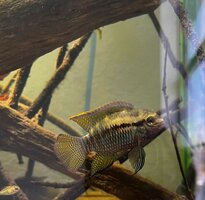
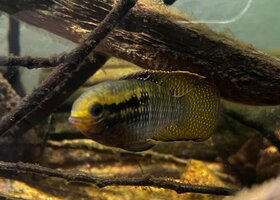
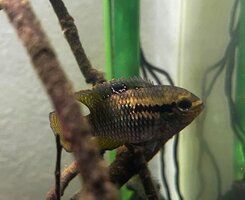
These ones are tank bred, though I don't know how many generations. They sent me some pics of the parents in addition to the juveniles - see below. Do they look like curviceps or another species to you? I'm admittedly okay if they're another species too, unless they'd be expected to get too big for the 20 long.
 

Attachments

  • IMG_3703.JPG
    IMG_3703.JPG
    188.5 KB · Views: 62
  • IMG_3704.JPG
    IMG_3704.JPG
    189.9 KB · Views: 82
  • IMG_3705.JPG
    IMG_3705.JPG
    165 KB · Views: 95
The pics are of Laetacara dorsigera, the red breasted acara. They’re frequently confused with L. curviceps.

C1A92D2F-9896-4D94-BAFD-53ABB56CD23B.jpeg
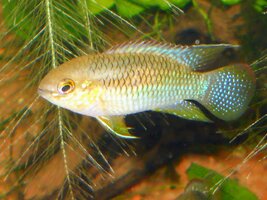
The fish in my photo is a young male L. curviceps. Note the white edging on the rear of the dorsal fin. This is probably the best way to distinguish curviceps from dorsigera, especially with young specimens.
 
  • Thread Starter
  • #7
The pics are of Laetacara dorsigera, the red breasted acara. They’re frequently confused with L. curviceps.

View attachment 893567
The fish in my photo is a young male L. curviceps. Note the white edging on the rear of the dorsal fin. This is probably the best way to distinguish curviceps from dorsigera, especially with young specimens.
Thanks for that - I'm glad to have the correct ID for them so that I don't perpetuate misinformation! From what I can find online, it does sound like they're fairly similar to curviceps with regards to their size and recommended tank parameters, so hopefully they'll still work in my setup.
 
I would take hobbist bred tank raised fishes over asian farmed fishes any day of the week. The reason most tank bred sold by shops come from farms is pure ##. Hobbist can raised a nice size group every 4 to 6 months (it takes a while for them to grow out to sellable size); where farms produce 1000's of fishes to be distributed but their technique sometime lead to less healthy fishes. Just something to keep in mind. Also with the hobbist (seller) you are looking at you can ask him the parameters of the water he is breeding them in and see how close that is to your water.
 
Advertisement


Advertisement


Advertisement


Back
Top Bottom