20 Gallon Tank Help with Interpretation of Test Results

dpetersen954

New Member
Member
Messages
1
Hey Guys new to the forums and I’m sure you get a lot of these but hopefully I can make it a quick question.

New to the hobby with a 20 gallon tank. It’s been going about 2 weeks. Fish in cycling (2 Mollys and 1 Hifin Tetra). I have around 10 plants in the tank as well. Made the classic mistake of not understanding cycling before getting the fish.

I have been monitoring levels and doing a 25% water change almost daily to keep the Ammonia and Nitrite levels down.

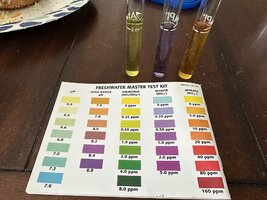
Based on the test results from this morning how close do you think I am to being fully cycled? It seems I have all three currently (Ammonia, Nitrite, and Nitrate) which is strange to me because almost everything I have read says that once you start getting Nitrates you shouldn’t really have Ammonia anymore.

edit: Forgot to mention that I tested my tap water yesterday to confirm there were no nitrates and the test came back as 0 nitrates in pure tap water.
 

Attachments

  • 25439CF2-1A66-4DAD-B6A7-146007782F99.jpeg
    25439CF2-1A66-4DAD-B6A7-146007782F99.jpeg
    339.2 KB · Views: 86

Advertisement
Yeah the stuff you read where you basically have one spike transitioning to another is super old, and in fact misleading, given there is no requirement for a cycle to have to go through those phases - not to mention that only indicates the establishment of nitrification, but not that it is robust enough. So forget those guides lol.

When fish-in cycling, all you care about is that eventually your ammonia and nitrite reads zero (or 0.25ppm for ammonia, will explain soon) without being dependent on water changes. Then that means your tank is cycled for your current bioload.

Your ammonia looks like 0 by the way, but could just be the color in the picture not reflecting real life. With that said, it is very common for the API test kit to register 0.25ppm ammonia, when effectively it can be considered zero. Plenty of potential reasons as to why, but it's less important versus that it does. If ammonia does not read higher than 0.25ppm no matter what, consider it zero.

So anyways yeah, your nitrite is still relatively lower now. Shouldn't be too long before the cycle is done. For the current bioload.
 
looks good to me. just want to keep the combined ammonia and nitrite below 1ppm and doing what you are doing seems to be doing that.

Fish in cycling does everything at once. the webistes are geared towards people doing fishless. and for fishless, you need to start with ammonia, and then build a colony to break that before the nitrate breakers get established.

With fish in, and plant, these guys are coming with bacteria to start a colony, decomposer bacteria live in the gut and on the fish along withall sorts of stuff that help them break food down.
So, decay cycle as well as nitrification cycle starts at the same time from the day the fish and plant is introduced and all builds up simultaneously. You will have Ammonia, Nitrites and Nitrates all at once because all those colonies are actiuvce and getting up to speed at the same time, as opposed to fishless cycling which moves in steps with decay cycle beginning after fish get added at the end of nitrification.

More plants might use up some more nitrate, nt necessary since you are doing water changes, but only thing you might want to do. Don't add more fish yet until it's just nitrates showing up for at least a week.
You got maybe 1 more week to go I think. almost there.

When you go to add fish, be mindful the bacteria colony you have was built for the fish you currently have, not for what you want to keep, so don't overdo adding fish.
It will get there in time to the stocking you want, just leave time between adding fish and not too many at once right off the bat.You got 3 fish, you can add one or two more when it's just nitrates. 3 additional at once, doubling the load might give you a spike in ammonia or nitrite for a day or so until the colony multiplies again and doubles in size and knocks it out and catches up to the new load.

Nitrifiers need about 15 hours to reproduce. if all is well for a couple days after the first add f new fish, then you can add again some more up to half the current stocking level of similar sized fish. This just keeps you out of trouble. and if something spikes it's going to be short until the bacteria colony reproduces to knock it out.
 
Advertisement


Advertisement


Advertisement


Back
Top Bottom