Filter Safety

DaisyP

New Member
Member
Messages
7
Hello all, new to the forum and the hobby. Did a lot of research here before registering and setting up my tank so thank you!

I’m currently cycling a small 60litre tank in anticipation for my first goldie. I’ve had the filter running for a good few days now to keep the cycle going.

Long story short, as a child we had a fire in our home (not caused by a tank, caused by a lamp) and since then I’ve had an unhealthy obsession with unplugging almost all non-essential electronics when I leave the house.

Obviously a filter is essential so I can’t switch it off! But unhelpfully a friend spooked me the other day by saying her grandparents had a small house fire as a result of their tank filter. This is probably a very silly question but I’m sure this can and does happen, so I wondered if anybody has any safety tips or experience with this?

I’ve set up a drip loop and I live in Japan so the voltage is much lower than the UK or US (it’s just 100V here). So I’m sure I’m just being totally paranoid but any advice given would be much appreciated. ^^
 

Advertisement
A properly wired electrical device is no more likely to start a fire than a bulb in a socket.
 

Advertisement
You can plug everything for your tank into a power bar with a circuit breaker built in that will trip if it shorts. That's what I have everything on my tank plugged into.
 
  • Thread Starter
  • #5
Thanks so much for your encouragement, everyone! David, I’m sure they must have something similar here. I’ll head to some electronic shops this weekend and see what’s available.
 
I guess haven't seen nor heard of any fire caused by tank filters for the past few years but nevertheless the following are the safety precautions that you can take.

1) Firstly, before you perform your weekly maintenance/ change of water for your fish tank, always ensure that your filter is turned off first.
This is to prevent being electrocuted in the event if there is an insulation breakdown in the filter.
[ I suspect most filters used double or reinforced insulations as they only have two pins plug(without the earth connection). ]


2) Secondly, look for a reputable brand like Aquaclear, Eheim, Fluval, Aquael, GEX (Japanese brand), etc when buying a filter.


3) Thirdly, if you want to be even safer, look for filter that have the safety marks.

For example, JBL brand has a German safety mark, "TUV-GS" which means it has been tested and approved/certified for safety.

Here is a link for JBL filter:


Aquaclear brand seems to have a Canadian safety mark "CSA".

Some brands may have CE (European safety mark). But CE mark is a "self-declare" safety marks by the manufacturer, unlike TUV-GS or CSA which are certified by a third party agency.
So, a CE mark alone without a third party certification mark may not necessarily guarantee the safety of the products and the users.
I've seen some very cheap products that have CE marks and I doubted their safety.
From my many years of working in design and product safety, we know that it's costly to produce a product that complied with safety/regulatory requirements and it may not be cheap when you send your product for safety certifications.

Risks of fire
In Japan, the 100Vac supply may not necessarily be safer as the risks of fire depend on the power available to the filter(or any product) and not just the voltage.
I supposed that in Japan, the circuit breaker rating is 20A or 30A for the house.
So, if the circuit breaker is rated 20A, the total power available is 100V x 20A = 2000W which can easily burn anything.
But if you used an extension cable which usually has a 13A fuse, your available power is 100V x 13A = 1300W which is still very high and can easily cause fire if there is any short circuit.

Risks of electric shocks.
But on the other hand, 100Vac has slightly lower risks of electric shocks as compare to other countries that have supply voltage of 230/240Vac.
[ The risk of electric shocks is dependant upon the supply voltage. ]
Nevertheless, any voltage above 30Vac is consider dangerous and can cause electric shock. So, it may make not much difference between 100Vac and 230/240Vac since both are consider hazardous voltage.

Solution: Anyway, usually you don't have to worry about the risks of fire or electric shocks caused by "bad designs or bad material used" if your filter has a safety mark(third party certification).


Other suggestions:
4) If you are considering installing a separate circuit breaker or fuse
, you have to ensure that the current rating of the circuit breaker is low enough to prevent a fire.
According to some safety standards, your power limit should be less than 100W to prevent fire.
It means for 100Vac supply, you need a circuit breaker rated at about 1A. If your current rating is more than 1A, then there are risks of fire.

But if you are sharing the circuit breaker for a few equipment, then you have to use higher current rating of circuit breakers.
But then, your circuit breaker may not achieved it's purpose. In this case, you may have to dedicate a single circuit breaker for each equipment in order to be effective.
Solution: This may not be necessary if your filter has a safety mark unless you want to have double precautions.

5)Provide a cover for your power socket to prevent water from getting in.(very serious as it can cause fire).
This is required only if your power socket is directly below your fish tank.
If your power socket is at the side and some distance away, or above your fish tank where the water from the tank can't get into it, then you don't really need this.
 

Advertisement
Hang on back filters use between 4-15watts of power.

Canister filters use between 12-45watts of power.

Relatively, this is a minute amount of current draw compared to most home electronic devices.


Most electrical fires are caused by overloaded wall outlets from too great of power draw (such as multiple space heaters and extension cords running tons of stuff) or improper wiring when the home was constructed.

Chargers for a laptop computers, ceiling fans and LED TV's draws more power than most aquarium filters for example.

I won't say an aquarium filter has never started a fire in the history of fish keeping, but an aquarium filter made by a reputable brand and that is plugged into an electrical wall outlet (that's not over loaded) and installed correctly would be near the very bottom of my list of safety concerns.

I have a background in occupational safety and emergency response, so that is where my comments are based from, but I can not guarantee any particular situation as being "safe", since I'm not an electrician. Any of my statements are of "general practices" and not specific, especially dealing with another continent's power grid.

Make sure you use a drip loop on your filter's cord and use a name brand filter that is common where you live. Lajos have very good info about product ratings. In the US, electronic devices usually have "UL" (Underwriters Laboratories) markings.

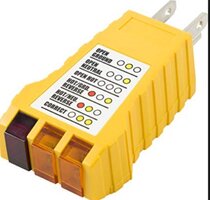
I'm not sure the style of electrical outlets you have, but 3-prong American 110volt outlets can be tested with simply fault detectors, that show things like improper ground, open fault, etc etc.

Screenshot_20190507-081301_Chrome.jpg

Here is an example of a generic outlet tester for 3-prong US style 110v power grid outlets.

I'm sure the equivalent can be found for your region.
 
Most electrical fires are caused by overloaded wall outlets from too great of power draw (such as multiple space heaters and extension cords running tons of stuff) or improper wiring when the home was constructed.

I fully agree. Most fire are caused by overloading.
If you connect many appliances especially high power appliances (eg. heating and cooling equipment) to an extension cord, it may easily cause fire.
 
  • Thread Starter
  • #9
Thank you so much everyone, you’ve reassured me no end!

The plugs for the light and filter are safely in different sockets so no worries on that front. Happy that I asked, I was sure it was very unlikely but sometimes childhood fears prey on your mind.

(Incidentally the filter is a Tetra Auto Filter, which I went with based on the aquarium shop’s recommendation. It’s the No.1 seller for new fish owners here in Japan (for good reason, the tank is cycling very nicely) and gets very positive reviews from aquarium bloggers and forums over here too.)
 
I’ve set up a drip loop

you should be good. a surge protector with a breaker will add more protection.

FYI, goldfish, especially the feeder common/comet goldfish will get big, about 10-12" long. And they are social and should have atleast 2 together.
 
  • Thread Starter
  • #11
Thank you Skavatar! ^^

Yes, I had read that they like to have friends. My worry is over-stocking though, the tank isn’t that big.
 
For an added measure of protection, consider changing the outlet to a GFCI (ground fault circuit interrupt) or Japanese equivalent.

Since water and electricity don’t mix, if one of your devices got wet (say by an air pump check valve failing and drawing water out of your tank) the GFCI would trip instantly and cut off power to everything and prevent a short. It will probably prevent any major damage to your equipment as well.

I changed my outlet to a GFCI before I set up my tank. It was pretty simple, but for most I would recommend having a licensed electrician do the work or purchase a standalone GFCI adapter like this:
 
Advertisement


Advertisement


Advertisement


Back
Top Bottom