1 Gallon Tank Cryptocoryne balansae

ruud

Fishlore VIP
Member
Messages
4,102
Question: can a species associated with hard(er) water (and also regarded as a "root-feeder"), survive and grow in very soft water (in a sand substrate)?

Species: Cryptocoryne crispatula var. balansae.

I receive the plant tomorrow and hope it'll initially fit in this small vase. I'll add RO water with plant fertilizer, mostly nitrates and potassium. KH and GH are both < 1. Only ambient light.

IMG_20260603_170434955.jpg
 

Attachments

  • IMG_20260603_170434955.jpg
    IMG_20260603_170434955.jpg
    79.9 KB · Views: 15

Advertisement
Have you considered also setting up a second glass with hard water as a control?

You could also set up a 3rd glass with soil instead of sand, could be interesting to compare.
 

Advertisement
  • Thread Starter
  • #3
Tempting... currently I don't have the means to do this very controlled; for KH I'll have to use tapwater and add some additional calcium. I need to create equal light settings. Same vase. I'll do my best.
 
  • Thread Starter
  • #4
The plant arrived and is currently floating in a vase with tap water. I found 2 identical vases which I'll use.

My tapwater

GH 40 ppm calcium, 4 ppm magnesium ≈ 6.5 dGH
KH 115 ppm bicarbonates ≈ 5.5 dKH

Sulphate 19
Chloride 16
Sodium 9
Nitrate 7
Silicate 6
Zinc 5
Barium 4
All else, very small quantities

In sum: mildly mineralized calcium-bicarbonate water, typical of limestone, chalk, or other carbonate aquifers.

Water chemistry, Cryptocoryne balansae

The best quantitative proxy I found is a hydrochemical study from the same broader Saraburi limestone–volcanic province, based on 35 quality-controlled groundwater samples; mean Calcium runs about 34–54 ppm, mean bicarbonate about 249–347 ppm. Because these are groundwater proxies, not in-stream measurements from the plant beds, they should be read as the upper-end.

So calcium levels are fairly equal, KH is higher.

I could purchase some eg. potassium-bicarbonate, but I won't.

Very soft water

Substrate
A super tiny layer of aquasoil + trace elements
A thick layer of sand

Water
RO water + 3 ppm calcium + 3 ppm magnesium (which both come with sulphates) + 0 bicarbonates

+ NPK mix
Moderately hard, mildly alkaline water

Substrate
A super tiny layer of aquasoil + trace elements
A thick layer of sand

Water
Tap water


+ NPK mix

My hypothesis: no real difference in growth or appearance between the two.
 
I will watch to see what results you get. Should be interesting.
 
  • Thread Starter
  • #6
Change of plans, mostly because I don’t have any clean, unused “dead sand”, only sand that’s already in use.

I added a thin layer of aquasoil with chelated trace elements, topped by a thick sand + clay layer from another tank. So both vases now have a rich substrate.

Vase 1 has tap water, which equals ~6 dGH/dKH and about 200 TDS.

Vase 2 is very soft water, targeting a TDS of 20 and keeping it below 30.

I’ll post pictures tomorrow.
 

Advertisement
  • Thread Starter
  • #7
I made the immediate environment as dark as possible and added a light on top of it. It is at max 5% of its normal output.

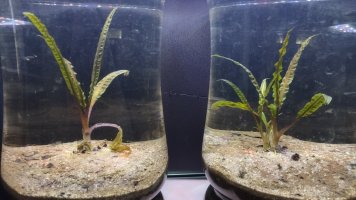
The specimen in the near-pure RO water vase (right) looks a little more full than the specimen in the GH/KH water vase. It doesn't matter much. Let's look how left develops from where it is today and let's look how right develops. If left shows growth and right diminishes, I need to consider my thoughts on plant ecology.

IMG_20260607_112302528.jpg
 
  • Thread Starter
  • #8
Leaves repositioned I guess.
TDS left 168, right 28

IMG_20260612_134640946.jpg
 
  • Thread Starter
  • #9
Both plants continue to look fine. A leaf has melted in the left, hard water vase, but it could just as well have melted in the right, soft water vase. And perhaps this will happen sooner or later.

In both vases, the tips of every leaf touching the glass is rotting.

In any case, the plant in the right vase hasn't died yet.

I'll continue with the experiment for a month, then I'm off for a two week holiday. When i return, and both plants are still alive and looking in shape; I'll move on to a new experiment: keeping both in high concentrations of nitrates and phosphates; the "agricultural combo" responsible for massive algae blooms in lakes.

The hypothesis is that visible algae will not occur due to the subdued light (it is hard to tell from a photograph, but not seeing shades from the leaves should tell you something) and cool water temperature.

IMG_20260621_170925362.jpg
 
  • Thread Starter
  • #10
A week later. Breaking news! A plant leaf is melting in the right, RO water vase.

IMG_20260628_143804094.jpg
 
I'm surprised how quickly your Cryptocornye balansae seem to have adjusted and grown. And, their growth forms look like plants that are getting plenty of light...even with just ambient light. Interesting.

The one of the left seems like it might be growing a little faster? Then again, the plant(s) on the right might have more mass. I'm wondering if weighing the plants before and after such an experiment might be needed to determine any difference when the growth seems so similar.
 
  • Thread Starter
  • #12
Perhaps the strong upward orientation, especially in the left, mineral rich water vase, is related to the subdued light. I have no history with balansae. I have a few other crypt species and I can't recall they have shown a similar response.

I went downstairs to take a picture at 80% light intensity - see below. My previous remark about shadows doesn't hold. The camera of my phone compensates greatly....perhaps there is a setting to turn this off...

I'm not sure if the leaves / all leaves in the left are growing faster than in the right. Perhaps some or all do. What is the cause? Mineral richer? Individual variation?

Obviously for sake of science, I should've conducted the experiment with e.g. three mineral-rich water vases vs. three mineral-poor water vases to rule out other factors.

And yes, dry weight measurements.

But my point is merely to show that some plant species can tolerate but not necessarily require hard water for survival and growth. So far, the plant on the right is doing fine. If it is a little lagging because of the RO water, I'll be the first to accept it.

IMG_20260628_194021538.jpg
 
  • Thread Starter
  • #13
One month has passed. Plants in both vases do great. Time to add fish!

Just kidding. Time to terminate this experiment. My basement is becoming a mushroom cave; the vases are small but add up to the total area of water surface. I'll leave the EI / algae experiment in low light tanks for some other time.

IMG_20260705_121404249.jpg
 
Advertisement


Advertisement


Advertisement


Back
Top Bottom