Any clay-rich soils that are aquarium safe?

propel

Active Member
Member
Messages
473
Finishing up my plans for my 10 gallon betta biotope and I'm wondering if there are any clay soils that are safe for aquarium use. The mud and substrate that is found in Thailand's marshes is very clay heavy so that's why I'm asking.

I've googled it and the results show stuff that doesn't look "muddy" so I won't be going for those.
 

Advertisement
There are many clay based aquarium substrates on the market. Here's a list of a few companies that make clay based substrates (from another members post). There are more: CaribSea, Seachem, Fluval, JBA, Dennerle, Landen, ADA, Marfied/UNS, Mars, UP, Brightwell, SL, Sera

If you want it to look like mud, you could make your own.
 

Advertisement
  • Thread Starter
  • #4
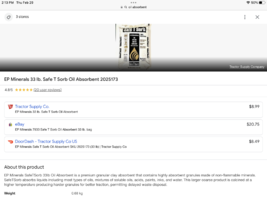
Not showing for me anymore either. This is a pic it’s called safe-t sorb 1DF3CB36-87DE-4AA7-A24A-579CA7CD87E3.png
People use to use this for growing plants. But not so much anymore. All the aquasoils have put an end to it. Looks like cat litter. Think you may be overdoing it with the betta. Yes they originated out of mud puddles. But todays bettas are far removed from mud puddles. The mud effect may kill them.
 
  • Thread Starter
  • #6
Not showing for me anymore either. This is a pic it’s called safe-t sorbView attachment 899089
People use to use this for growing plants. But not so much anymore. All the aquasoils have put an end to it. Looks like cat litter. Think you may be overdoing it with the betta. Yes they originated out of mud puddles. But todays bettas are far removed from mud puddles. The mud effect may kill them.
It's going to be a wild one ordered online, not one of those store-bought ones (via BWAquatics).

I've found someone on ebay selling red clay soil from Georgia and I've thought about getting that instead. Is it safe?
 

Advertisement
  • Thread Starter
  • #9
I don't want a clean look, I want it to be messy and natural looking. The biotope is meant to represent the marshes and swamps of eastern Thailand.

Here is a link to the soil.
 
I don't want a clean look, I want it to be messy and natural looking. The biotope is meant to represent the marshes and swamps of eastern Thailand.

Here is a link to the soil.
I see. Well, that ought to work, if anything will.
 
I'd use pond potting soil.

I've worked with clay powders, but not usable for an aquarium unless you cover it with sand.
 

Advertisement


  • Thread Starter
  • #12
I'd use pond potting soil.

I've worked with clay powders, but not usable for an aquarium unless you cover it with sand.
I might do that. I've also thought about humus, would that work?
 
Yes, humus works fine. Easily disturbed and in the water column, similar to clay, but unlike clay, humus returns very quickly to the bottom. My blackwater tank has nothing but dead leaves and humus.

If you want to resemble something from Thailand, I assume you would need to work with lateritic soil. And I assume it will affect water clarity also. Laterite is also used as first layer substrate for planted tanks due to the iron it contains.
 
  • Thread Starter
  • #14
Yes, humus works fine. Easily disturbed and in the water column, similar to clay, but unlike clay, humus returns very quickly to the bottom. My blackwater tank has nothing but dead leaves and humus.

If you want to resemble something from Thailand, I assume you would need to work with lateritic soil. And I assume it will affect water clarity also. Laterite is also used as first layer substrate for planted tanks due to the iron it contains.
How much will it affect water quality? Would it just be kind of red for a little while before the rest settled? Or would it be permanent? If it adds tannins or resembles tannins it'd be perfect.

How would I make sure I'm getting the right type of humus or laterite, so I know it's safe? Some might have additives so that's why I'm asking.
 
In planted tanks, laterite can be used at the bottom. I've never seen tanks with laterite only or on top. I assume it will be messy..... like nature.

Pond potting soil can be pretty messy also, hence in ponds they add stones on top, and in aquaria they add sand or gravel on top. I've briefly kept a pond potting soil only tank and it was not that bad. I assume mixing it with aquasoil, it becomes more fixated, but....very dark. The soil of tropical Thailand is more iron-red, but not that different from soils in other tropical parts.

I think you should find individuals online in the USA who sell "red colored sand".

Tannins....are actually humic substances and not so much tannins. Humic Substances are organics that develop when dead stuff decomposes. Like minerals (inorganics). This is not so easy to orchestrate. The easiest way is adding dead stuff that comes with humic substances; wood, dead leaves, botanicals. Rooibos tea is extremely effective with water changes.


Lake Bung Khong Long, Bueng Kan province, Thailand, 54 L – Biotope Aquarium

Not really that red either. On a smaller scale, you'll find plenty of variation in any region.

I'm sure the creator added plain sand, or different sands, and lots of leaf litter, both crumbled and in original shape, added lots of grasses and called it a day.

I'd buy different substrates in small volumes and experiment in different small tanks or occasions. You could test the water.
 
  • Thread Starter
  • #16
In planted tanks, laterite can be used at the bottom. I've never seen tanks with laterite only or on top. I assume it will be messy..... like nature.

Pond potting soil can be pretty messy also, hence in ponds they add stones on top, and in aquaria they add sand or gravel on top. I've briefly kept a pond potting soil only tank and it was not that bad. I assume mixing it with aquasoil, it becomes more fixated, but....very dark. The soil of tropical Thailand is more iron-red, but not that different from soils in other tropical parts.

I think you should find individuals online in the USA who sell "red colored sand".

Tannins....are actually humic substances and not so much tannins. Humic Substances are organics that develop when dead stuff decomposes. Like minerals (inorganics). This is not so easy to orchestrate. The easiest way is adding dead stuff that comes with humic substances; wood, dead leaves, botanicals. Rooibos tea is extremely effective with water changes.


Lake Bung Khong Long, Bueng Kan province, Thailand, 54 L – Biotope Aquarium

Not really that red either. On a smaller scale, you'll find plenty of variation in any region.

I'm sure the creator added plain sand, or different sands, and lots of leaf litter, both crumbled and in original shape, added lots of grasses and called it a day.

I'd buy different substrates in small volumes and experiment in different small tanks or occasions. You could test the water.
Okay.

I'm also wondering if rocks that look like they have some rust in/on them are safe to use in an aquarium. Sometimes I'll find a good rock but there'll be a spot of what looks like rust and I don't know if that's aquarium safe.
 
Can always just buy a bag of clay and mix it with your sand, youll get a muddy texture when it becomes wet. Add in some peat moss and youll have a very rich fertilized substrate.

Clay is just sand particles smaller than a certain size. When people rinse their substrate.... They are washing away this clay dust

For me I just buy bags of sand and keep this dust. Doesnt make much sense to wash it away and then buy it back
 
Okay.

I'm also wondering if rocks that look like they have some rust in/on them are safe to use in an aquarium. Sometimes I'll find a good rock but there'll be a spot of what looks like rust and I don't know if that's aquarium safe.

In the older days of planted tanks, people kept iron nails in their tanks to add iron.

Anyways, you want to create a certain tropical biotope. Is there an example you are trying to achieve? Or do you just fancy the rocks? :)
 
  • Thread Starter
  • #19
In the older days of planted tanks, people kept iron nails in their tanks to add iron.

Anyways, you want to create a certain tropical biotope. Is there an example you are trying to achieve? Or do you just fancy the rocks? :)
Nothing specifically. Just a general recreation of marshes/swamps in Thailand. I'd do a floodland biotope but that would need more grassy/reedy plants that are too big for the tank.
 

Advertisement


Back
Top Bottom