
You are using an out of date browser. It may not display this or other websites correctly.
You should upgrade or use an alternative browser.
You should upgrade or use an alternative browser.
Amano Shrimp Larvae Growth Progress - Updated
Advertisement

- Messages
- 11,424
Advertisement
Not long, just recently had my first successful batch of 20 that are growing out and still smaller than Cherry shrimp.
My last batch of 100+ all died due to my mistake of cleaning up the algae, I guess it suffocated them the next morning. I was doing this for the last 5 years on and off, mainly off but going to continue now that I have a better understanding even with some set backs.
The current batch is even larger since it's about 5-6 females that gave birth. I've been collecting a lot of larvae every day that I thought about stopping since I never ever raised this amount. Definitely a challenge for me when it comes to the final morph phase in catching them all.
- Messages
- 11,424

- Messages
- 7,080
Advertisement
Thanks, I'm really a novice with this and have no repeatable results yet to be comfortable for someone to follow and plus i'm experimenting with additional feed that the guide doesn't do. Not to re-invent the process, this guy's guide is what I followed. My only advice to set up the grow out tank following his direction to grow algae and when you see a decent amount of algae on the glass then it's ready. Most fail because they starve I believe.
Here's a video I took today, I stacked both extension tubes and got an even closer magnification. You can see them eating the crushed flakes.
Here's a video I took today, I stacked both extension tubes and got an even closer magnification. You can see them eating the crushed flakes.
- Messages
- 11,424
Well mach6 that is unbelievable and the second video is awesome, ive read on forums over the years of people claiming to have bred Ammano but none of them showed videos or pics for that matter when I've asked, you are the first who as done so, I am totally speechless, there is another on Fishlore who is trying and failed the first attempt but have heard nothing of his latest attempt,
I'll follow your progress with interest
Well done
I'll follow your progress with interest
Well done
I was surprised by this I captured yesterday, they hatch slowly too... I guess he's not an earlier riser.
It stretches at 1:30 and starts to come out at the 2:18 mark but it's interesting to see what happens inside the egg before that.
If you're wondering what's all the green and brown stuff, that's Amano shrimp poop up close. Also the bugs swimming around was from a local pond I was raising for fish fry in their tanks.
I think some morphed or became more red from the algae.
The light is from below this time, you can see more details to their shape.
At 1:45, I slowed it down so you can see them a bit better from their twitchy movements.
- Messages
- 11,424
Advertisement
They are coming on great. How long dose it take from born to morphed?
It's hard to say, I'd think it's more dependent on each on how much they eat more so than a time thing. I just noticed some coloration and their bodies are a bit elongated.
Because my batch here has some larvae collected more than 7 days ago, it's almost impossible to figure out when they will morph. I believe they have at least 3 stages of larvae growth. Next time I'll try to do a controlled group to grow out.

- Messages
- 7,236
I cleaned out the tank entirely to scrape some algae and remove any dead larvae. I found some that was still alive and not moving until I had a closer look. This is just laid there and ate for the 20 minutes I recorded it. Found another bit of an extension tube to give me just a bit more magnification.
- Messages
- 11,424
- Messages
- 11,424
Advertisement
That's brilliant like a how many have made it to that stage
Can't really tell, at this stage they don't really move around and just stay still and eat. I would think the survival rate might be another 20~30 like last batch. I think next batch I will clean out this tank and re-grow the algae. Too much of the green algae grew which isn't what I wanted. You want the brown diatom algae which is only growing on the top half of tank. I will reposition the lights so they are not so close and intense.
In some disappointing news, I'm down to like 3 of them with a darker red color, hopefully they will survive. I put in 20 newly hatched ones. Not sure how or where they are disappearing too since I don't see too many dead. Oh well, there's always the next batch. I definitely needs to scrub the entire tank clean and re-grow the algae.

- Messages
- 5,436
Really fantastic quality videos, I've never seen someone post anything close to this before. Are you using a microscope?
One thing I've always been curious about is the possibility of selective breeding amanos to be certain colors, like cherry shrimp have been, but of course their difficulty in breeding hasn't made it feasible for the hobby yet
One thing I've always been curious about is the possibility of selective breeding amanos to be certain colors, like cherry shrimp have been, but of course their difficulty in breeding hasn't made it feasible for the hobby yet
- Messages
- 11,424
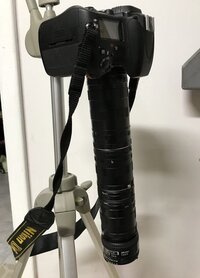
I use a Nikon D610 DSLR, I stacked on extension tubes and reverse mount a 24mm wide angle lens. I used this for my bug photography but didn't think it would work but I guess it was bright enough. I just got some more extension tubes so I wonder how much more closer, if any I can get. The extension tube set up with lens is over 1' long right now.
Unfortunately, these shrimps don't vary color much unless you probably inbreed but I don't want to do that. About the only thing I'll try to selective breed for is the size.
I've been wanting to try other low order shrimps like bamboo and green lace shrimp but I'll hold off for now.
Unfortunately, these shrimps don't vary color much unless you probably inbreed but I don't want to do that. About the only thing I'll try to selective breed for is the size.
I've been wanting to try other low order shrimps like bamboo and green lace shrimp but I'll hold off for now.
- Messages
- 11,424
This is the camera set up. I put the subjects into a small container on top of one of the low powered LED lights from one of the small 1~ G tank kit for the back lighting.
Since I already had extensions tube about 3/4 of the total length, I figured I'd just invest in another set instead of buying a microscope for my phone or PC.
Since I already had extensions tube about 3/4 of the total length, I figured I'd just invest in another set instead of buying a microscope for my phone or PC.
Attachments
- Messages
- 11,424
This is the one I wanted to record last time but lost track of it in the water. It looks like this is should be on the last morph before I start the transition. You can tell because the swimmerettes are almost developed and has even more arms. The green inside is likely the algae they eat.
Let's hope this little guy makes it, the other one is behind in development by a one or 2 phases.
Let's hope this little guy makes it, the other one is behind in development by a one or 2 phases.
Advertisement
- Messages
- 11,424
I usually vacation somewhere where I can snorkel and some areas are very rough, it makes you wonder how these little guys can survive an unforgiving ocean and make it back upstream into freshwater. What we set up to grow them out is like vacation for them. The only thing they have to watch out for some times is bubbles.
It's hard to say since I wasn't able to keep them under a control environment from the beginning to only observe a select few. I think most literature say it takes about 30~60 days to morph. I'd say this has to be just about 20~25 days?
It's hard to say since I wasn't able to keep them under a control environment from the beginning to only observe a select few. I think most literature say it takes about 30~60 days to morph. I'd say this has to be just about 20~25 days?

- Messages
- 1,281
I'm actually really glad I came across this, It gives me confidence to try this myself. I have had the 2 female Amano shrimp in my 10 gallon berry at least twice in a year but never took it beyond that. You make it seem so much less daunting. Thanks for the post and the information, keep up the great work!
That's great, give it a try. It's minimal investment. You can buy the cheapest salt but don't get Red SEa, it leaves a residue and takes a while to clear up. I may have to hold off since it's been getting too cold in my basement w/o using a heater. I'm trying to do it low tech w/o using a heater but I may get another betta heater from Petsmart since it seems to have passed the reliability test of keeping it at 78 in my 1.5G S/W nano. That's probably why it grew much faster during the summer.
- Messages
- 1,281
I think I'll wait until the next time I see fresh eggs so I have a better idea of the age and where she's at in the process. I'm sure they'll berry again no doubt but I'm also trying to get at least 2 more females to make 4 total in hopes of bettering my odds. I'm also setting up a new 3 gallon shrimp tank fro some RCS to try my hand at them too. The shrimp hobby really hooked me hard like I never imagined.
- Messages
- 11,424
I had lost a lot of eggs from putting the females separately in containers, I am not sure how others keep them in there w/o filtration with the shrimp or the eggs not developing fungus. I had changed the water frequently but still lost many eggs from fungus developing on the eggs or on the shrimp itself. Once I used a filter, it helped maintained water quality to be able to hatch and collect.
I never got into the RCS, I had some chocolate or blueberry for a short while until they were eaten by my Amanos. Plus I consider them too small for me. I was looking to pick more shrimps like bamboo or if I can get the green lace shrimps.
I never got into the RCS, I had some chocolate or blueberry for a short while until they were eaten by my Amanos. Plus I consider them too small for me. I was looking to pick more shrimps like bamboo or if I can get the green lace shrimps.
- Messages
- 1,281
Ahh I bought the Amanos to help with algae and just fell in love with them. Knowing the difficulty in breeding them is what sparked my interest in RCS. I had a Betta in a 1.6g that died and decided it would be a nice possibility but ended up feeling like it would be too small and cramped for what I'd like to see happen. Honestly I've grown to like shrimp just ever so slightly more than fish being that my main interest was initially Bettas which I would ultimately like to breed as well. Between the Shrimp and Bettas the hobby is quite consuming as it is.I had lost a lot of eggs from putting the females separately in containers, I am not sure how others keep them in there w/o filtration with the shrimp or the eggs not developing fungus. I had changed the water frequently but still lost many eggs from fungus developing on the eggs or on the shrimp itself. Once I used a filter, it helped maintained water quality to be able to hatch and collect.
I never got into the RCS, I had some chocolate or blueberry for a short while until they were eaten by my Amanos. Plus I consider them too small for me. I was looking to pick more shrimps like bamboo or if I can get the green lace shrimps.
Yeah, these guys grown on me also because they live long and active. Ghost shrimps are alright but they don't live long, Whisker are fun to watch and active but they didn't last long either.
Unfortunately I don't think this larvae may make it. It has got to be the laziest larvae I've ever seen that just lays there and barely moving. I'm not sure if it's the water temp being colder or the water itself. I better start prepping a new tank to grow out the algae.
Unfortunately I don't think this larvae may make it. It has got to be the laziest larvae I've ever seen that just lays there and barely moving. I'm not sure if it's the water temp being colder or the water itself. I better start prepping a new tank to grow out the algae.
I was able to collect some recently hatched larvae that were bigger than previous ones I've collected. I was able to actually see their tiny legs flail w/ my naked eye! Not sure if I can raise these since the tank is still barely growing algae.
Since people seem to lose their batch early on, I decided to experiment by observing if amano shrimp larvae are capable or if they eat right after hatching.
Unfortunately, they don't seem to be interested in the liquid zooplankton or crushed flakes.
Since people seem to lose their batch early on, I decided to experiment by observing if amano shrimp larvae are capable or if they eat right after hatching.
Unfortunately, they don't seem to be interested in the liquid zooplankton or crushed flakes.
Advertisement
They didn't survive, I made a rookie mistake and didn't check the salinity which I thought was within but turns out it hit the max of what my hydrometer could read. I corrected that and collected whatever small amount of larvae I saw today.
Anyway, this is from the successful batch I had in August earlier this year. I used my iPhone with a macro lens clip on so excuse the quality and shakiness. From more successful batches, I'll be able to get a better idea to compare their growth stages, it seems the ones I took more recently had develop growth that wasn't seen in my successful batch. So maybe they were not growing properly.
This vid below is what a settled larvae looks like, it's a miniature version of the adult but you can see it still has the tiny legs when they were larvae, they will eventually lose that with their next molt.
This is the last stage before they settled into miniature adult versions. They are mobile and not fast or as dependent on light as they were in earlier stages. They can swim forward by now and easy to catch. Around the 1:30 mark you can see from a wider shot of them in the tank, they're just hanging out on the bottom.
- Messages
- 11,424
- Messages
- 1,281
Gotta get use out of all the technology I bought and glad, you're enjoying them.
The reason behind it is also to show how even the tiniest of creatures is a complex marvel like us and our bodies that we should be in awe of instead of taking things for granted and oversimplifying how things in nature work because you don't see it.
The reason behind it is also to show how even the tiniest of creatures is a complex marvel like us and our bodies that we should be in awe of instead of taking things for granted and oversimplifying how things in nature work because you don't see it.
- Messages
- 1,723
Great thread, and thanks for all the pics and info!!
I'm in the early stages of this adventure, first time around and I'm just trying to anticipate problems at this point.
mach6 Can you please tell a bit more about a few things (other readers please chime in if you have knowledge/suggestions!!):
I'm in the early stages of this adventure, first time around and I'm just trying to anticipate problems at this point.
mach6 Can you please tell a bit more about a few things (other readers please chime in if you have knowledge/suggestions!!):
- It looks like container sizes are quite small. Airstone and light, but no heater, right? Same size for 1 'pregnant' mama, as for all the babies after hatching?
- My basement probably stays at 65-70F, will that be okay for mama and babes?
- Do you remove the mama as soon as eggs are released, then salt the water? Or do you siphon out the babies from the container they're born in, and place in waiting salt water?
- How often do you change the salt water? How much at a time? Your linked vid looks like it uses a mini-siphon or syringe the water out, while 'luring' the larvae to a safe area, away from the tube. Is that about right?
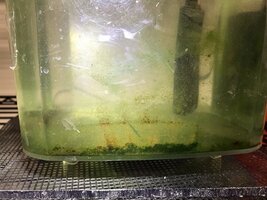
First and foremost, if your grow out tank is sterile and devoid of algae, the larvae will starve. I've re-did my grow out tank with another one and found that none was surviving until a significant amount was present on the sides and possibly water column, that took more than 2 weeks surprisingly of 24 hour lighting. A video on YT by Chappy says they can survive with algae being grown when you put it in a sterile container. That doesn't seem to be my experience so best to ensure you got a food supply for them. The attached pic is what a ready looking tank should be like. Right now that tank has about 30~ larvae I've collected over the last week and still survived a few days.
The water isn't cloudy so one can assume they're feeding on the algae on the sides, I did brush the algae off to get more free floating. It doesn't hurt they can feed in the water column too. You can try to grow out algae by taking S/W from an establish tank and adding some microalgae fertilizer or something to spur the growth quicker. I did add some DT's phytoplankton from the successful batch but I've lost that culture by not refrigerating the bottle I kept and it went foul. I didn't want to buy another bottle for this batch to see if I really need to spend $13+ on it. However if I do, I will pick up Phycopure because it contains larger microalgae like diatoms that the DT one didn't have.
The grow out tank now is an Aqueon 1.6 but I've used a Tetra half moon too, both are about 1.5~ gallons. I mix the salinity to 1.024 or as close as you can keep in that range on your hydrometer. Salt doesn't seem to matter, just get the cheapest that can be used for marine fish tanks. I've used IO and Red Sea regular, the Red Sea seems to leave a residue so I'll be going to back to Instant Ocean when that's done. I'm going to pick up Dr Foster's salt since I read it dissolves clear. You should also have some aged saltwater always ready in a 5 gallon bucket and make more when you use it all. Typically, I don't change the water unless it becomes too cloudy with algae where I can't see them. I will try to grow them w/o feeding since I was able to do it w/o supplemental feeding which just adds more things that can go wrong and i'm not experienced enough with successfully raising them to try supplemental yet.
MiniCube LED Kit - Aquarium Starter Kits | Aqueon Aquarium Products
I heat my tank for the pregnant Amanos and grow out tanks since a higher temp means higher metabolism to grow faster than a non-heated tank. I use a betta heater that keeps it around 70~F. I just started with using a heater since it's winter here and the water drops to 60s which they will survive in but grow slower. The main tank where the males and females are put back into is not heated. The successful batch was during the summer and no heater was necessary. It looks like the larvae I'm collecting is much larger in a heated tank vs unheated. It definitely helps they have a good head start.
I isolate my pregnant Amanos in a filtered 5 gallon tank, I have tried many times w/o success to put them into containers with no filtration with frequent w/c. The eggs would always turn orange or the shrimp expel it too early and even shrimp themselves get it. Putting them back into the main tank that was filtered cured the shrimp with the fungus so I added small intank filter. The main tank is a 10 gallon filtered and unheated.
I use a 5 ml to suck out the larvae if they are free floating to transfer them to the grow out tank. The eggs are put into a container because the mother expelled the eggs and I try save them from the tank and get some to hatch. You can drop them into S/W right away there is no acclimation needed for the larvae stage only after they settled. I return the pregnant to the main tank once I noticed all the eggs or most of the eggs are gone. They are attracted to light so use a strong light source and they will swim to it then you can easily suck them out with a siphon from airline tubing or a pipette.
One thing I will experiment with is to see if 24hr lighting is necessary because nature has a light cycle and to save some cost on energy. I've lost some when I accidentally shut off switch to the light and forgot to turn it back on. I'm thinking that was due to a sterile tank more than anything, later on when they're bigger and capable of swimming a bit they don't really swim to the light like the early stages.
Attachments

I noticed from my last success that there was an abundant of these tiny creatures moving on the algae. I didn't pay much attention to but I did save the old tank water for the new grow out tank to speed up the algae growth. In the beginning, I noticed these things weren't as plentiful and now they're literally everywhere where there is a thick patch of algae growing. It looks like they are a few larger varieties that I don't see in my older videos. I have used water from established saltwater tanks so they could be from there.
Since they are very tiny, it's hard to see if you have any without some magnification.
You can see a comparison in size to the larvae that shows up and at the 12 second mark the larvae is giving a dazzling performance, funny how nature has way to surprise you... At the 50 mark its magnified more and I sped up the video and you can see them move.
Assuming nothing goes wrong, we'll see if the current larvae survives all the way through.
Random Great Topic!

Today's Deals
Advertisement
Advertisement
Advertisement