Ever tried a co2 generator?


Advertisement

Advertisement
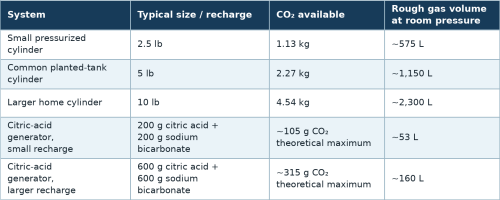
Baking soda and citric acid give you about half a gram of CO2 per gram of baking soda. Matching one 5 lb cylinder refill is over four kilos of it, a bottle at a time.

Which is MasterPython's point with a number on it.
 
I use a FZONE CO2 Generator and have been very happy with it. I buy food grade Baking Soda and Citric acid in bulk. So far I've been very happy with the results. My system lasts about 2-3 months between recharges at the rate I'm using CO2. I use 600 grams of each in the system I linked. Below is a table with an approximate comparison between 2.5 - 10lb CO2 cylinders and 200g/600g CO2 generators.

1787849371922.png

Using the chart a 5lb CO2 cylinder comes out to about 22 charges of a 200g generator and 7-8 charges of a 600g generator. It would cost me about $25 to refill a 5lb CO2 cylinder in my area, not counting travel expenses. I costs me about $82 for 11lbs of Citric Acid and 11lbs of Baking soda.

So, not counting travel expenses, refillable CO2 cylinders are about 1/2 the cost of mats for a generator.

Cost and travel aside, a CO2 gas cylinder is more convenient for most folk to use. Kind of like your gas for your barbecue. Just disconnect, take it in for exchange/refill, reconnect. I don't mind refilling my generator every 2-3 months. With the amount I use, material cost really isn't an issue.

I may try CO2 cylinders at some point, just for the convenience. I'm not sure, for most folk, that the price difference is all that much in reality. The CGA-320 regulators (that I believe you need for CO2 cylinders) that I've looked at cost as much or more than the entire system I linked earlier.
 
I think there is a useful distinction to be made.
While a CO² generator, as posted above, may be useful, they are most likely to be effective on smaller tanks. Maybe 30 gals. and below. If you're dreaming about that lush, planted 90 gal or 110 gal, go get a regulator and a 20lb tank.
 
I think there is a useful distinction to be made.
While a CO² generator, as posted above, may be useful, they are most likely to be effective on smaller tanks. Maybe 30 gals. and below. If you're dreaming about that lush, planted 90 gal or 110 gal, go get a regulator and a 20lb tank.
I respectfully disagree. I'm using a generator on a 90-gallon tank (110-gallon total volume) aquarium. Effectiveness isn't an issue with either, since both can provide all the CO2 you need for a planted tank. Convenience, at least to me, is the major difference between the two.

For example, even with a 5lb CO2 tank, I could probably go for a year without changing/recharging the tank rather than having to recharge my generator every 2-3 months.

One additional note: CO2 tanks operate at much higher pressures than generators, usually >800 psi when just filled versus about 50 psi for a generator.

I should also mention, for the OP, that in case they are new to CO2, you normally run CO2 only during daylight hours, since plants use Oxygen at night and consume CO2 only during lighted periods. I run an airstone from lights out to about an hour before lights on, and start running CO2 when the lights come on.
 

Advertisement
I respectfully disagree. I'm using a generator on a 90-gallon tank (110-gallon total volume) aquarium. Effectiveness isn't an issue with either, since both can provide all the CO2 you need for a planted tank.
Are you using a larger CO2 generator?

For example, even with a 5lb CO2 tank, I could probably go for a year without changing/recharging the tank rather than having to recharge my generator every 2-3 months.
Really? Wow. The last time I ran CO² my 5lb tank lasted 2-3 months on a 36 gallon aquarium.
You're able to get 30 ppm of CO² out of a generator?
 
Are you using a larger CO2 generator?


Really? Wow. The last time I ran CO² my 5lb tank lasted 2-3 months on a 36 gallon aquarium.
You're able to get 30 ppm of CO² out of a generator?
I use a CO2 checker and keep it in the green, so approximately 25 - 35 ppm CO2. I haven't actually used a 5lb CO2 tank, so I was approximating based on the chart. I know a single charge on my 600g generator lasts 2-3 months. It is pretty well dialed in now. A lot can depend on how heavily stocked your tank is as well, since the animals will contribute to the CO2, probably only 2-5 ppm. Also, how dense your plantings are since more plants equals more CO2 uptake during the day.

Another contributing factor is surface exchange and the amount of CO2 in the air in your fish room. I'd strongly encourage folks to get a CO2 monitor, and not just for the fish room. Especially if you have a relatively modern, energy-efficient home.

I posted this somewhere, but I'll repeat the short version here. I was having issues keeping my pH up in my saltwater aquarium, so I was considering buying a CO2 scrubber. Before purchasing one (I did BTW), I bought a CO2 monitor and put it in my reef room. Much to my surprise, the CO2 ppm averaged 1000-1200 and was as high as 1900+. As a reference, the outside CO2 is about 425 PPM where I live.

Anything over 1000 ppm is considered unhealthy. Since it isn't feasible to keep my windows open all the time, I installed a whole-home ERV (Energy Recovery Ventilator) to constantly bring in fresh air. This lowered my CO2 ppm in-home to around 600-800, with some occasional spikes to around 1000 ppm.

The downside, if you want to call it that, is I'm now using more CO2 on my freshwater tanks. The upside is we feel better, and I'm not having issues keeping the pH up in my Reef Tank :)

I don't have enough data yet to know how much more CO2 I'll be using, but regardless, I think it was worth reducing the in-home CO2 ;)
I had heard that in a tightly sealed home, with people breathing that CO² could reach 1000 ppm, and you did it.
I wonder how much of that actually entered an aquarium via gas exchange.
Maybe you didn't need to buy a CO2 generator at all, just exhale more. :eek:
 
Advertisement


Advertisement


Advertisement


Back
Top Bottom