
As with some well known terrestrial plants like African violets and gesneriads, certain aquatic plants will grow from some kind of leaf cutting. For these types of plants it won’t matter whether the leaf is in submersed or emersed form.
There are three basic types of leaf cuttings but so far as I know, the third type isn’t applicable to aquatic plants. I believe it only applies to Sanseverias & Gesneriads. (Leaf vein cuttings)
Of the remaining two types, one behaves like African violet & other gesneriads or Peperomias do, by producing new plantlets from the cut tissues of the leaf petiole.
Just snip the petiole of a healthy middle aged leaf (oldest & youngest leaves may succeed but have a much lower success rate).
One plant you might know already that works like this is Nymphaea zenkeri, aka Tiger lotus. It will produce one to several plantlets from the cut end of a leaf petiole and it doesn’t matter where you cut the petiole - short or long works the same way.
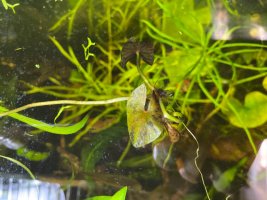
I have several lily leaves sprouting plantlets at the moment & more that should soon start - see the pic below.
I intend to try this with similar species of water lily to see if they also sprout this way - like my banana lily, N.aquatica, once it has a couple more leaves - only has two at the moment.
Given how expensive these lilies can be, the more I can produce, the better. Maybe sell a few to offset expenses if all goes well.
Update 2/3/2025
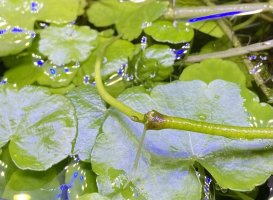
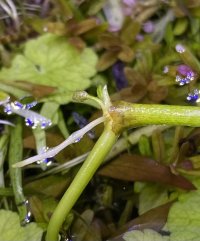
Images showing Nymphoiodes aquatica leaf cutting. It was roughly a month from cutting the leaf off to the second new plant shoot
The callused over cut leaf petiole with a root shoot, then a new plantlet shoot, a second new plantlet shoot & the same a couple of days later.


The other type of leaf cutting is a bit more delicate to prepare. The new plantlet & roots come from an invisibly tiny dormant bud which is part of the petiole at its attachment point to the stem.
Hygrophilas are like this. Pogostemons seem to be but their leaves are a lot harder to work with either because of their fragility or size/shape.
I’m fairly sure Pearlweed works this way but its leaves are so tiny - talk about hard to work with, yeesh!
But a stem’s worth of the leaves could produce as many new stems of Pearlweed as there are leaves, assuming they all sprouted successfully, for nothing except the time spent peeling leaves off stems. (But truth be told, be much easier just to snip a stem of this plant below every node).
I don’t have an exhaustive list of plants that will grow from a leaf. I only know the ones I’ve had some success with. If you know of any I don’t mention, please include the name in a comment if you can.
For plants that work this way it’s a dead simple method to get more plants than you ever could from the more usual stem cuttings.
Most of the successful leaf cuttings I’ve had were from various species of Hygrophila. Another potential success appears to be Pogostemon Octopus - take a little more time to be sure it will give plantlets as well as roots, which are all I’ve seen as yet. P.Octopus has four leaves per node - could add up to an impressive number of new plants.
I have some images of some leaves in progress & some that show how to tell if you likely succeeded in removing the dormant bud successfully or not.
Those dormant buds are what become new branches of the plant when a stem’s growing point is snipped off or the stem is placed underwater.
Think about the fact that all the emersed leaves on a new plant are doomed to die once the plant goes in a tank. Seems like such a waste.
Why would you not want to make them work a little harder for you before they die, if they can?
To have success with this kind of leaf cutting, it is critically important to avoid damaging the bud or leaving it on the stem.
So each leaf you hope to propagate must be very gently & slowly peeled away from the stem in a downward direction only. Never peel to either side or pull upward.
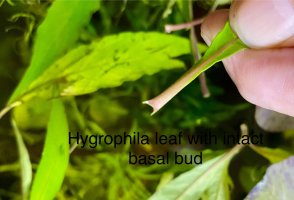
You can easily see the difference between a leaf taken off intact and one that left a vital part behind on most of the larger Hygrophila leaves, such as the H.angustifolia leaves in the following images. (On the Pogostemon leaves it’s not as easy to tell).
The leaf below was removed with the bud intact and no part of the petiole left on the stem.
Not every leaf you peel off with apparent success will sprout a plantlet - some just rot as they would anyway. The odd one will produce roots but no plantlet.
Anytime I buy a Hygrophila, I try to peel off as many of the doomed but healthy emersed leaves as possible with the bud intact but I fail with as many as are successful. The image below is one of the failures - parts of the petiole remained attached to the stem.
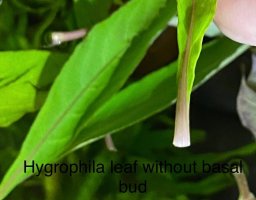
I usually let these leaves float but the longer ones, like the ones in the pictures, can be planted. They’ll eventually rot but with just a little luck, you may get a nice collection of new plants coming up before they do.
Once a leaf grows roots, probably best to plant it as when they are left to float the new little sprout will curve, bend & twist trying to grow above water.
I suspect this technique likely works for all species of Hygrophila but I can’t say for sure. I certainly haven’t grown every species!
I intend to try it with H.pinnatifida because they tend to be expensive and in my experience, are miserably picky about transitioning to submersed form. Once transformed they are not difficult to grow but they are very difficult to transition successfully.
The successful Hygrophila leaf now has a two inch root and a tiny plantlet just starting - as can be seen below in the pic.

Hygrophila cuttings (aka bunch plants) are rather prone to stem rot. I’ve learned to just assume a rootless cutting is likely to rot so I try to salvage the leaves from the stem bottoms I cut off in hope of thwarting the stem rot.
Sometimes all that’s left of a six or eight inch cutting is the top pair or two pairs of leaves! Any plantlets I get from a leaf I can salvage off stems like that are worth taking the bit of time necessary to peel off healthy leaves & float them awhile.
It would be a lovely bonus if I got so much as one extra pinnatifida from a leaf, or pretty much anything else for that matter.
Prices for plants have risen so much, it makes no sense to me to waste potential freebies!
There are three basic types of leaf cuttings but so far as I know, the third type isn’t applicable to aquatic plants. I believe it only applies to Sanseverias & Gesneriads. (Leaf vein cuttings)
Of the remaining two types, one behaves like African violet & other gesneriads or Peperomias do, by producing new plantlets from the cut tissues of the leaf petiole.
Just snip the petiole of a healthy middle aged leaf (oldest & youngest leaves may succeed but have a much lower success rate).
One plant you might know already that works like this is Nymphaea zenkeri, aka Tiger lotus. It will produce one to several plantlets from the cut end of a leaf petiole and it doesn’t matter where you cut the petiole - short or long works the same way.
I have several lily leaves sprouting plantlets at the moment & more that should soon start - see the pic below.
I intend to try this with similar species of water lily to see if they also sprout this way - like my banana lily, N.aquatica, once it has a couple more leaves - only has two at the moment.
Given how expensive these lilies can be, the more I can produce, the better. Maybe sell a few to offset expenses if all goes well.
Update 2/3/2025
Images showing Nymphoiodes aquatica leaf cutting. It was roughly a month from cutting the leaf off to the second new plant shoot
The callused over cut leaf petiole with a root shoot, then a new plantlet shoot, a second new plantlet shoot & the same a couple of days later.
The other type of leaf cutting is a bit more delicate to prepare. The new plantlet & roots come from an invisibly tiny dormant bud which is part of the petiole at its attachment point to the stem.
Hygrophilas are like this. Pogostemons seem to be but their leaves are a lot harder to work with either because of their fragility or size/shape.
I’m fairly sure Pearlweed works this way but its leaves are so tiny - talk about hard to work with, yeesh!
But a stem’s worth of the leaves could produce as many new stems of Pearlweed as there are leaves, assuming they all sprouted successfully, for nothing except the time spent peeling leaves off stems. (But truth be told, be much easier just to snip a stem of this plant below every node).
I don’t have an exhaustive list of plants that will grow from a leaf. I only know the ones I’ve had some success with. If you know of any I don’t mention, please include the name in a comment if you can.
For plants that work this way it’s a dead simple method to get more plants than you ever could from the more usual stem cuttings.
Most of the successful leaf cuttings I’ve had were from various species of Hygrophila. Another potential success appears to be Pogostemon Octopus - take a little more time to be sure it will give plantlets as well as roots, which are all I’ve seen as yet. P.Octopus has four leaves per node - could add up to an impressive number of new plants.
I have some images of some leaves in progress & some that show how to tell if you likely succeeded in removing the dormant bud successfully or not.
Those dormant buds are what become new branches of the plant when a stem’s growing point is snipped off or the stem is placed underwater.
Think about the fact that all the emersed leaves on a new plant are doomed to die once the plant goes in a tank. Seems like such a waste.
Why would you not want to make them work a little harder for you before they die, if they can?
To have success with this kind of leaf cutting, it is critically important to avoid damaging the bud or leaving it on the stem.
So each leaf you hope to propagate must be very gently & slowly peeled away from the stem in a downward direction only. Never peel to either side or pull upward.
You can easily see the difference between a leaf taken off intact and one that left a vital part behind on most of the larger Hygrophila leaves, such as the H.angustifolia leaves in the following images. (On the Pogostemon leaves it’s not as easy to tell).
The leaf below was removed with the bud intact and no part of the petiole left on the stem.
Not every leaf you peel off with apparent success will sprout a plantlet - some just rot as they would anyway. The odd one will produce roots but no plantlet.
Anytime I buy a Hygrophila, I try to peel off as many of the doomed but healthy emersed leaves as possible with the bud intact but I fail with as many as are successful. The image below is one of the failures - parts of the petiole remained attached to the stem.
I usually let these leaves float but the longer ones, like the ones in the pictures, can be planted. They’ll eventually rot but with just a little luck, you may get a nice collection of new plants coming up before they do.
Once a leaf grows roots, probably best to plant it as when they are left to float the new little sprout will curve, bend & twist trying to grow above water.
I suspect this technique likely works for all species of Hygrophila but I can’t say for sure. I certainly haven’t grown every species!
I intend to try it with H.pinnatifida because they tend to be expensive and in my experience, are miserably picky about transitioning to submersed form. Once transformed they are not difficult to grow but they are very difficult to transition successfully.
The successful Hygrophila leaf now has a two inch root and a tiny plantlet just starting - as can be seen below in the pic.
Hygrophila cuttings (aka bunch plants) are rather prone to stem rot. I’ve learned to just assume a rootless cutting is likely to rot so I try to salvage the leaves from the stem bottoms I cut off in hope of thwarting the stem rot.
Sometimes all that’s left of a six or eight inch cutting is the top pair or two pairs of leaves! Any plantlets I get from a leaf I can salvage off stems like that are worth taking the bit of time necessary to peel off healthy leaves & float them awhile.
It would be a lovely bonus if I got so much as one extra pinnatifida from a leaf, or pretty much anything else for that matter.
Prices for plants have risen so much, it makes no sense to me to waste potential freebies!
Advertisement
